
Should PR Families Choose a Popular School or a Nearby School for P1 Registration?
A practical Singapore guide for PR parents weighing school reputation against admission realism, commute, and daily family routine.
For most PR families, a nearby school is the more practical default for P1 registration. Try for a popular school only if the admission picture still looks realistic for a PR child, the commute will not create daily strain, and your backup plan is one you can truly live with.
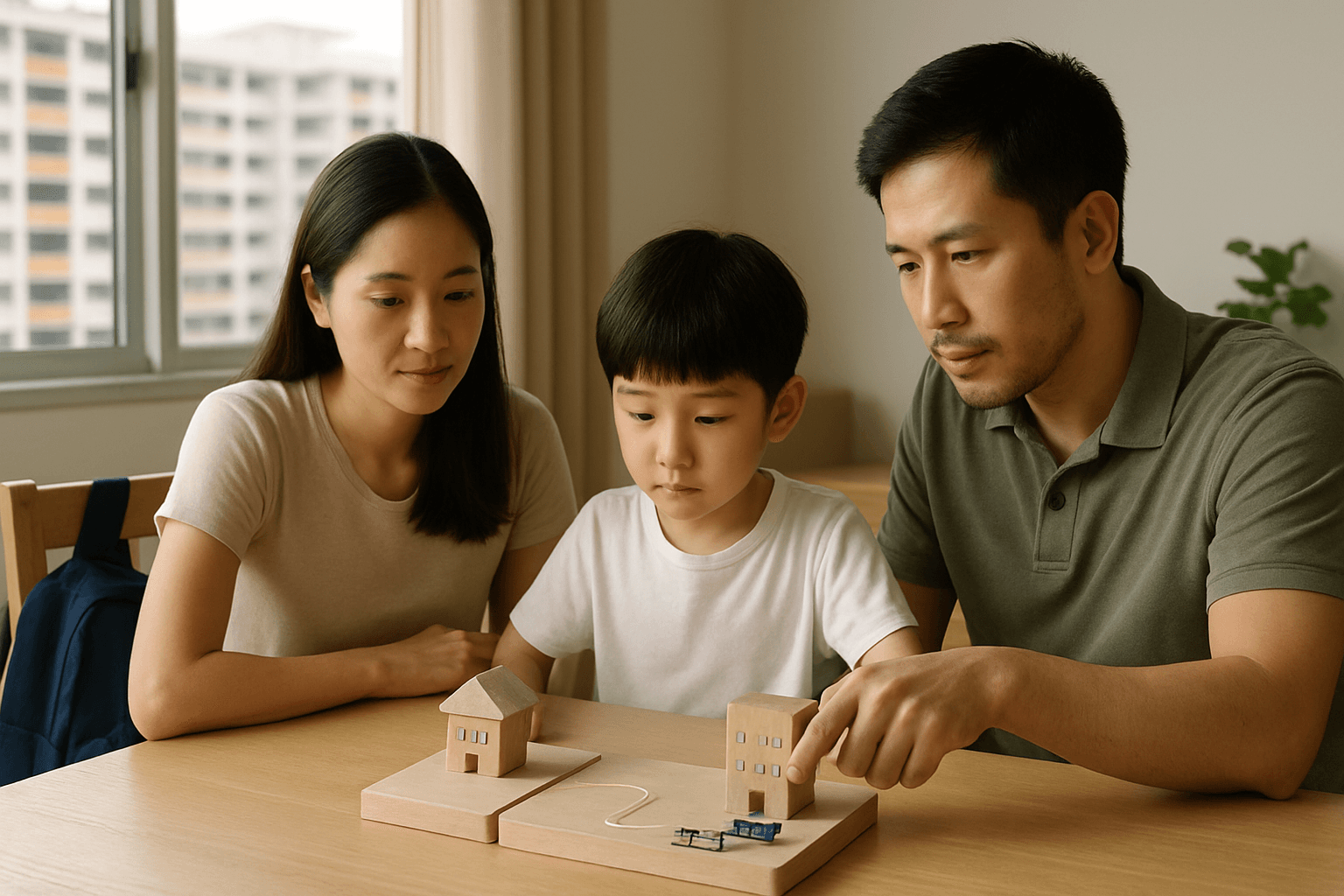
PR parents often face the same P1 question: should you aim for a well-known school, or choose a nearby school that is easier to reach and easier to live with day to day? The best choice is usually not the most famous one. It is the one your family can realistically get into, travel to without strain, and accept calmly if you do not get your first choice.
Short answer: should PR families choose a popular school or a nearby school for P1?
For most PR families doing P1 registration, a nearby school is the better default. Choose a popular school only if admission still looks plausible and the commute is manageable every day.
For most PR families, the nearby school is the better default. A popular school can still be worth trying, but only if the admission picture is realistic for your child and the daily journey will be comfortable enough to sustain for years, not just on registration day.
Think of this as a two-part decision: can you get in, and can your family live with the commute if you do? MOE says it sets aside 40 places in each primary school for Phase 2C at the start of registration to widen access to schools near where families live, and it also notes that a nearby school reduces travelling time and gives families more meaningful time together, as explained in this MOE FAQ.
For PR families, the margin for error is usually smaller because vacancies can be tighter by the time PR-relevant places are considered. That is why the stronger choice is usually the school that is both plausible to secure and easy to attend every day. If you want the full registration context, start with our Primary 1 Registration in Singapore guide.
How your kid's performance in P1 if attended gd Pre-sch?
Dear Members Can anyone of you feedback how your kid/kids doing in P1 if they attended pre-school as follows: 1)\tPat school 2)\tMontessori 3)\tMy First School or Normal child care centre 4)\tHalf day in CC or in Kindergartens I have heard so much about how good /strong or poor academically the pre -school can be. But ultimately are kids really perform better when go to Pri i.e. (e.g. with Montessori they do have their special techniqe in their learning path, half day CC or Kindergarten as they
How your kid's performance in P1 if attended gd Pre-sch?
preschool does not matters if you can supplement it with enrichment or coach your child by yourself with regards to preparing for P1. if you have no time for external enrichment (ie weekends reserved for families), a preschool with good curriculum matters a lot.
Why do popular schools appeal so strongly to PR parents?
Popular schools appeal because they feel proven, familiar, and reassuring, especially for PR parents who want a school name they can trust.
Popular schools feel reassuring because they come with a known name, a visible track record, and a sense that other parents have already done the homework for you. For PR families who are still learning the Singapore system, that familiarity can feel like lower risk.
Many parents also associate popular schools with stronger academic culture, more established programmes, and a peer environment that seems more stable. For example, a school that is often talked about among relatives or friends may feel like a safer choice simply because it is easier to picture what life there might look like.
That instinct is understandable. But reputation is only one part of the decision. The real question is whether the school’s perceived advantages are strong enough to justify the admission uncertainty and the daily commute. If you want the broader prestige-versus-fit discussion, our guide on popular primary school vs neighbourhood school in Singapore goes into that trade-off in more detail. For a broader overview, see Primary 1 Registration Distance Priority: How Home-School Distance Works.
Have More Questions?
Get personalized guidance on schools, tuition, enrichment and education pathways with AskVaiser.
Try AskVaiser for Free →What do PR families need to understand about admission reality?
For PR families, a popular school is often much less realistic than it first appears, so treat it as an aspiration unless the current vacancy and demand picture is genuinely encouraging.
The biggest mistake is treating a popular school as a normal preference instead of a higher-risk choice. A school can look ideal on paper and still be very hard for a PR child to secure if demand is high and PR places are limited. MOE publishes PR vacancy information for affected phases, which is a clear reminder that availability is not unlimited.
A practical way to think about this is to separate schools into two groups. The first group is schools you like and can realistically see yourself entering. The second group is schools you would love, but which are clearly long shots once demand is taken into account. If a school regularly attracts heavy interest, do not build your family plan around the hope that this year will somehow be easier.
Past outcome roundups such as 2024 P1 Registration Phase 2C results can help you spot where demand tends to cluster, but they are better for pattern recognition than prediction. For a more structured way to assess risk, read How to Read Past Balloting Data Before Chasing a Popular Primary School.
When is a nearby school the smarter choice for a PR family?
A nearby school is usually the better choice when the popular school is hard to enter, the commute is long, or your family needs a low-friction daily routine.
A nearby school is usually the smarter choice when your family needs a routine that is stable, predictable, and easy to repeat five days a week. That becomes especially important if both parents work, a grandparent or helper handles pickup, or your child will need student care close to home.
It is also the stronger choice when the popular school is clearly more competitive than you are comfortable with. If the likely outcome is weeks of stress followed by a long commute even if you succeed, the trade-off is often weak. By contrast, a nearby school usually means easier drop-off, less pressure on rainy days, simpler after-school planning, and fewer transport surprises.
Many parents hear “nearby school” and assume it means “backup school.” That is often the wrong way to look at it. A nearby school can be both the safer admission choice and the better daily-life choice. If distance is likely to shape your planning, our guide on how home-school distance works is a useful next read. For a broader overview, see Primary 1 Registration Unsuccessful: What Happens If You Do Not Get Your Preferred School.
Top sch vs Good neighbourhood sch
My child went to one of the IP schools in Singapore following his PSLE. I think access to resources (e.g. facilities, materials, quality teachers, etc.) is one factor, but more importantly is the type of learning environment that he/she will be subject to. In such schools that may be deemed “better”, students are generally motivated to study harder and are more focused on their academics. This will play a huge part in what your child prioritises during these early / impressionable years. Even if
Top sch vs Good neighbourhood sch
@jkids There are many dimensions to look at the situation. Firstly let me share with you my situation. All my children did well enough in PSLE to qualified for any secondary schools. We did not go for any IPs schools, nor any neighbourhood schools. They went into Chung Cheng High Main, not a neighbourhood school, and can be considered an above average school. Reason for not selecting any IP schools because we wanted for them a more relax environment, and to avoid the perceived “elitist” (btw we
How does commute affect primary school life more than parents expect?
Long commutes create hidden strain through earlier mornings, transport delays, tired children, and harder after-school coordination.
Commute issues usually do not feel serious when parents are comparing schools on paper. They show up on ordinary weekdays: the child is tired, it is raining, one adult has an early meeting, or pickup suddenly takes longer than planned. A 10-minute walk and a 45-minute door-to-door trip may both sound manageable at first, but they create very different family routines over six years.
A longer commute usually means earlier wake-up times, more dependence on traffic or public transport, and less room for small disruptions. If the route involves bus transfers, a crowded MRT ride, or one caregiver who must always be available, the whole household becomes less flexible. Children can cope for a while, but fatigue often becomes more obvious once full school days, student care, enrichment classes, or CCA are added later.
A simple parent check helps here: do not test the route only once on a calm day. Try it during peak hour, think about the return trip, and picture it on a wet weekday with a sleepy six- or seven-year-old. In P1 planning, think in school weeks, not registration day. For a broader overview, see Popular Primary School vs Neighbourhood School in Singapore: Which Is Better for Your Child?.
Competition among primary schools
Hi Parents, I'm just another worried mum who is now worrying about P1 registration for my girl next year. As quoted by ChiefKiasu, \"Students and outsiders love to lambast parents for being kiasu and creating the competitive culture in Primary school....... So who's fault is it that the Primary schools are so competitive?\" How do we as parents, label a school being \"good\", \"average\" or \"not so good\" ? From a parent perspectives, why do (must) we, by all means try to get our children into
Competition among primary schools
Haha ... my initial reason for wanting my kids to be in the school of my choice is really quite silly - I like the primary school uniform alot :oops: And then I realised that it is actually quite a good school, and all my nephews and nieces are either already in the school, or will be registering at this school. So after checking around, I made up my mind to register my girl at this school too. The main reason being the family network that's available to me and my cousins in that if one of us ca
How can parents compare a popular school and a nearby school using a simple checklist?
Compare both schools on admission realism, commute, after-school support, and whether the fallback still feels genuinely acceptable.
- ✓Ask whether the popular school is realistically reachable for a PR child this year, not just attractive in theory.
- ✓Compare actual door-to-door travel time, not map distance alone.
- ✓Think about who will handle drop-off and pickup on normal workdays, rainy days, and days when one adult is unavailable.
- ✓Check whether student care, enrichment, or caregiver support is easier around one school than the other.
- ✓Ask whether your child is likely to cope well with the earlier wake-up time required by the farther school.
- ✓Decide in advance whether the nearby school is a school you would genuinely accept, not just a reluctant last resort.
- ✓If the popular school does not work out, ask whether your backup still works emotionally, logistically, and financially.
- ✓Choose the school that gives you both a plausible entry path and a sustainable daily routine.
What does a sensible first-choice and backup plan look like for PR families?
A strong PR-family plan usually pairs one school worth trying with one school that is realistic, workable, and acceptable for daily life.
A sensible plan usually has one aspirational option and one realistic option that you can accept comfortably. The mistake is not hoping for a strong school. The mistake is having no emotionally acceptable fallback if the hoped-for school does not materialise.
For example, one family may try a well-known school that is still reasonably close, while keeping a nearby neighbourhood school as the practical backup. Another family may like a more famous school across town but realise their true fallback is stronger because it matches a grandparent’s home, nearby student care, and a simpler afternoon routine. In both cases, the better plan is the one the family can execute without panic.
A useful mindset is this: your backup should not feel like an emergency. It should feel like a plan you already understand and can accept. If you want to pressure-test your options, our guides on what happens if you do not get your preferred school and the broader P1 registration process can help.
What many parents overlook: the best school choice is the one your child can actually attend comfortably every day
The right school needs to work for the child’s daily life, not just the parent’s preference list.
A school is only a better choice if your child can get there, learn there, and come home without constant strain on the family. A manageable school often beats a prestigious school that depends on rushing, fragile transport plans, or an exhausted child.
Pls advise: Choose River Valley Primary School or Pei Chun Public School
Hello, My younger son was born in 2020 and will be registering for primary school in 2026. We also have an older daughter who is currently in Primary 3. We would like to seek everyone’s advice on whether River Valley Primary School or Pei Chun Public School would be a better choice for our son. We are a Chinese family and hope that our children can develop a good foundation in the Chinese language. We also place great importance on character education in school. In addition, we have been trying
Which preschool would you choose?
I would choose School 2. My reasons: 1. School 1 seems to be lacked of enough facilities to provide sufficient stimulation (unless teacher is sooooo creaitve???). They don’t have outdoors, just w classrooms?? Being in an enclosed room for 3hrs everyday without being able to go outdoors or change environment, I myself hate that! And I dun like children to be in such environment too. 2 hours is the max maximum I would go for such enclosed environment. 2. What level is your child in? For Nursery/pl
How do you decide if the popular school is still worth trying?
Try for the popular school only if it offers a real fit beyond reputation, the commute is sustainable if you get in, and your backup is already acceptable if you do not.
A popular school is worth trying when the choice is based on more than prestige. That could mean the school is still reasonably close, the culture or programmes genuinely match your family’s priorities, or the route works well because of sibling logistics or caregiver support.
A practical test is whether you can answer yes to three things at once. First, does the school still look plausible enough to justify the attempt? Second, will the commute remain manageable if you actually get in? Third, have you already accepted your backup before the result is known? If one of those answers is no, the attempt may bring more stress than it is worth.
What usually does not justify the attempt is prestige alone. If the only reason is that the school is famous, the travel is long, and the backup still feels like a disappointment you have not accepted, that is a weak plan. If you want more context on how demand behaves at sought-after schools, past pattern roundups such as 2023 P1 Registration Phase 2C can help set expectations, but your final decision should still be based on daily fit, not just school name.
Have More Questions?
Get personalized guidance on schools, tuition, enrichment and education pathways with AskVaiser.
Try AskVaiser for Free →