
Can You Use a Caregiver's Address for MOE P1 Registration?
What Singapore parents should know if grandparents or relatives care for your child day to day.
Yes, but only through MOE's alternative child-care arrangement process. A grandparent's or caregiver's address is not an automatic substitute, and only the parent who made the declaration can use the approved address for registration.
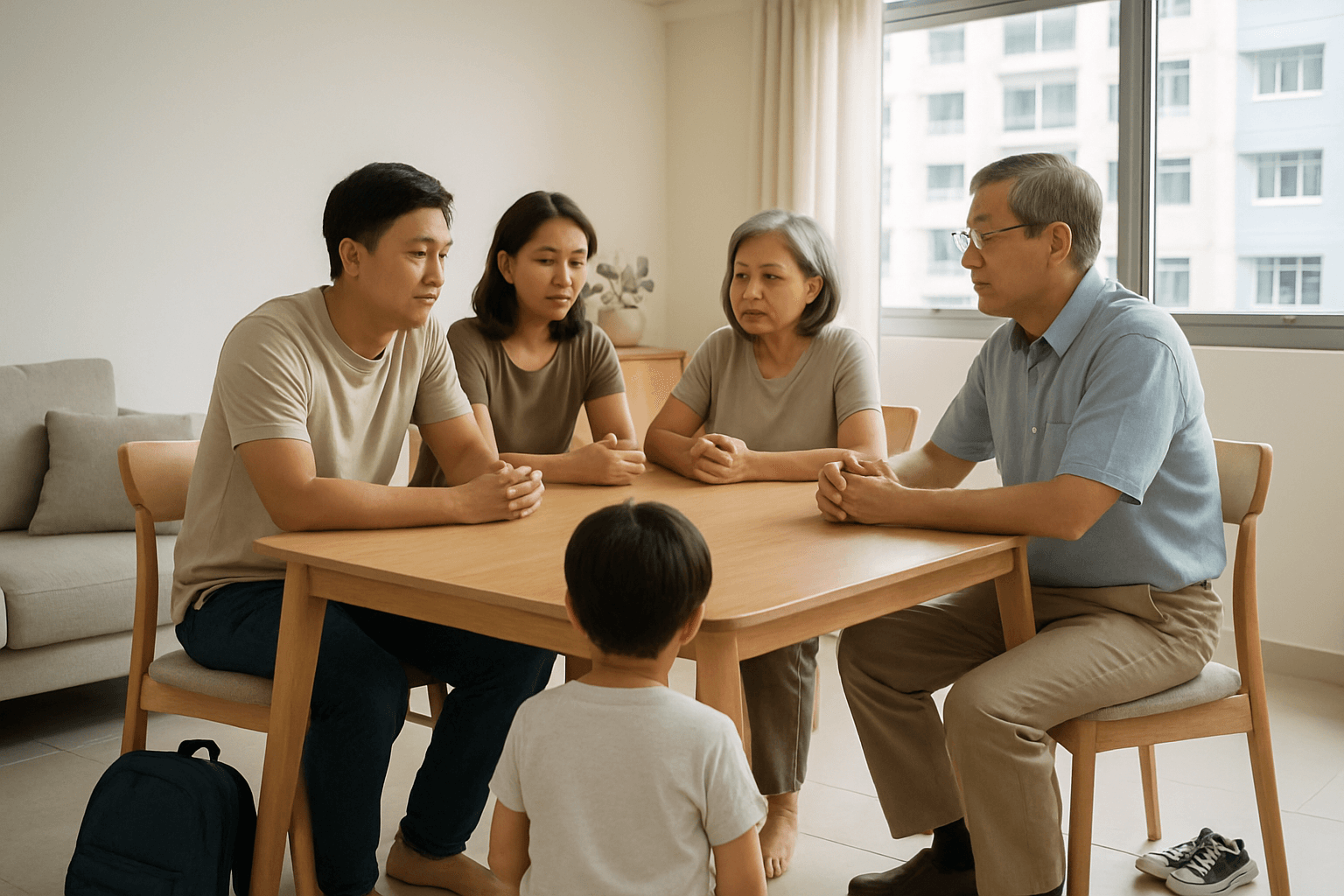
Yes, a caregiver's address can sometimes be used for Primary 1 registration, but not simply because grandparents or another relative help with daily care. MOE requires an alternative child-care arrangement to be declared first, and only the parent who made that declaration can use the approved caregiver address in the P1 Registration Portal.
For most families, the key question is not "Who helps the most?" It is "Where does the child actually live, and is that arrangement properly declared?" That distinction matters more than many parents realise.
Can you use a caregiver's address for MOE P1 registration?
Yes, but only after MOE approves an alternative child-care arrangement. A caregiver's address is not a convenience choice.
Yes, but only if the caregiver address has been approved through MOE's alternative child-care arrangement process. MOE states in its FAQ that a declaration must be made before a caregiver's address can be used for Primary 1 registration.
That means a grandparent's or relative's home is not a free address choice. Parents should think of it this way: MOE is not asking which home is most convenient for school transport. It is asking whether the caregiver address reflects the child's real and properly declared living arrangement. If you are still deciding how your family should approach registration overall, start with our main Primary 1 Registration in Singapore guide, then check whether your home setup genuinely fits the caregiver-address route.
*** READ ME FIRST !!! - P1 Registration FAQ ***
Can someone tell me if this rule is new starting from this year or was it around before? Extracted from MOE FAQ under Proximity to School FAQ 4. How long do we need to stay in the address used to register our child during the P1 Registration Exercise? In a small number of cases, there may be situations where the families are unable to remain at the address for the entire duration of the primary school studies. Even so, a child who gains priority admission into a school through his/her distance c
For Reference for P1 registration: MOE Official Letters
From: xxx Sent: Thursday, 11 July, 2013 9:36 AM To: Contact Us (MOE) Subject: P1 Registration Hi, I am writing in to enquire the following for the purpose of Primary 1 registration. \"From MOE website: Proof of Purchase of Yet-to-be Completed Property An original Sales and Purchase document is required if the address of a yet-to-be completed private property is used for registration. The date of commitment by the developer in the Temporary Occupation Permit (T.O.P.) has to be within two years of
What MOE requires before you can use the caregiver's address
The declaration must be made first, and only the parent who made it can use the approved caregiver address in the portal.
There are two practical gates. First, the alternative child-care arrangement must be declared before the caregiver address can be used. MOE's FAQ is clear that parents cannot simply type in a caregiver's address in the portal and treat it as valid.
Second, only the parent who made the declaration can use the approved caregiver address in the P1 Registration Portal during the child's eligible phase. The other parent cannot use that address. This is an easy detail to miss, especially when one parent usually handles admin but the declaration was made under the other parent's name. Before registration opens, confirm two things: which address is approved and which parent is allowed to submit it. For a broader overview, see Which Home Address Counts for Primary 1 Registration in Singapore?.
*** READ ME FIRST !!! - P1 Registration FAQ ***
Your child will receive a brochure containing information like the schools available in Singapore and their niche areas, etc. Within the brochure, there will be registration dates. No other letters from MOE.
*** READ ME FIRST !!! - P1 Registration FAQ ***
All P1 registration phases are held consecutively, ie. one after the other. So Phase 2A(2) is held after Phase 2A(1), and not simultaneously. You are allowed to participate in any Phase, and apply for any school in any Phase, subject only to citizenship, distance, and other Phase-specific criteria (eg. PV, alumni, etc). You can always apply to the same school in later Phases even if you failed in earlier Phases. As for your address, there is no requirement on the length of time you stay at the a
Have More Questions?
Get personalized guidance on schools, tuition, enrichment and education pathways with AskVaiser.
Try AskVaiser for Free →If your child is raised by grandparents, when does the caregiver address make sense?
A grandparent's address only makes sense if that home is the child's actual day-to-day base, not just where care happens sometimes.
It makes sense when the grandparent's home is genuinely the child's day-to-day base and the family is using the proper declaration route. That is the situation many parents mean when they ask whether they can use a grandparent's address for P1 registration.
A stronger example is a child who lives with grandparents full time or most of the time in a stable long-term arrangement. Another possible example is a child who sleeps there on most school nights and keeps the normal weekday routine there. A weaker example is when grandparents mainly help with morning drop-off, after-school care, or holiday supervision while the child still clearly lives at the parents' home.
A simple rule helps: care support is not the same as residence. The question is not whether grandparents are involved. The question is whether their home is the child's real approved caregiving base for registration purposes. For a broader overview, see Primary 1 Registration Documents Checklist: What Singapore Parents Commonly Prepare.
*** READ ME FIRST !!! - P1 Registration FAQ ***
Hi all, Anyone knows how does registration work for unmarried parents? Checked on MOE Website and it mentioned that one parent may register if child’s birth cert only had the name of one parent. My child’s birth cert has both my and his father’s name. We were unmarried and not on good terms now.
MOE Kindergarten
Morning mummies and daddies. Would like to ask if any of you have considered sending your children to MOE Kindergartens or whose children are in MOE Kindergartens. Am recruiting parents to do a 1-hour interview. I am especially interested to talk to parents who registered under phase 1 or 2. Please contact me at 90493798 if you’re interested. There will be compensation. Thanks! Priority Order (PO)\tEligibility 1\t MOE will reserve one-third of places for Singapore Citizen (SC) children from hous
What proof families commonly prepare for a caregiver-address arrangement
There is no official checklist in the source, so prepare common supporting documents that tell a clear, consistent story about the child's living arrangement.
The source provided does not include an official document checklist, so parents should treat any paperwork as common examples rather than guaranteed requirements. In practice, families usually prepare documents that show one consistent story about where the child lives and who handles daily care.
Common examples include the caregiver's NRIC address details, a utility bill or similar record that shows the address, and simple supporting documents that help explain the living arrangement. Some families also prepare a short written explanation when the setup is longstanding but not obvious from a single document. These are examples only, not an official or complete MOE list.
The key is consistency. One isolated document usually does not clarify an unclear arrangement. If you want to get organised earlier, our guide to Primary 1 registration documents parents commonly prepare can help you build a sensible file before registration season. For a broader overview, see Primary 1 Registration Distance Priority: How Home-School Distance Works.
*** READ ME FIRST !!! - P1 Registration FAQ ***
From MOE website: Proof of Purchase of Yet-to-be Completed Property An original Sales and Purchase document is required if the address of a yet-to-be completed private property is used for registration. The date of commitment by the developer in the Temporary Occupation Permit (T.O.P.) has to be within two years of the child’s entry into Primary One. In the case of a yet-to-be completed HDB flat, the Agreement for Lease is required. Parents must move into the new property within two years of the
*** READ ME FIRST !!! - P1 Registration FAQ ***
For Singaporean - The child’s Singapore Birth Certificate - The child’s Singapore Citizenship Certificate for those who are not Singapore Citizens at the time of birth - Singapore NRIC of both parents or Entry / Re-entry Permits of parents if they do not possess Singapore NRIC - The child’s Immunisation Certificates For PR - The child’s Birth Certificate - The child’s Entry/Re-entry Permit - Singapore NRIC of both parents or Entry/Re-entry Permits of parents if they do not possess Singapore NRIC
The main mistake parents make: using a convenient address instead of the child's real home
Do not use a caregiver's address just because it is closer to the school you want.
A caregiver's address is not a shortcut for Primary 1 registration. The biggest mistake is assuming that because grandparents help with transport, meals, or after-school care, their address should automatically count.
If the real reason for using the address is to improve distance priority for a preferred school, stop and reassess. Address decisions should follow the child's approved living arrangement first, not the school strategy. If distance is part of your plan, read our guide to Primary 1 registration distance priority only after you are sure you are using the correct address. For a broader overview, see Primary 1 Registration After Moving House: Should You Use Your Old or New Address?.
MOE Kindergarten
In terms of priority, the MOE K has been tweaked to 500m to 1km, 500m to 1km, >1km. lyra: you should consider attending their open house this Saturday (14 April). Most of your queries could be answered by their representatives and you can also check out the environment of the kindergarten.
*** READ ME FIRST !!! - P1 Registration FAQ ***
2A need to apply at school , so withdrawal also need to be at school. Then go over to school B for registration. Consider time for travel, withdrawal take 5-10min. Buffer 1.5 hours would be safe if driving. If you can let us know your 2C choice , we can tell you the risk. It might be worth just to go 2C
What to do if the parent address and caregiver address are different
If the addresses differ, confirm the approved address and the submitting parent before registration starts.
Settle the address question before registration opens. Do not leave it until you are in the portal and trying to submit under time pressure.
Start with a simple sequence. First, confirm whether the caregiver address has gone through the alternative child-care arrangement route. Second, confirm which parent made that declaration. MOE's FAQ says only that parent can use the approved caregiver address in the P1 Registration Portal during the child's eligible phase. This matters in real households more often than parents expect, including separated families, parents living at different addresses, and families where one parent usually handles admin while the other parent is the declared parent.
The safest approach is simple: decide early who is submitting the registration, which address that parent is allowed to use, and whether everyone in the family would describe the child's living arrangement the same way. If those answers are still unclear, do not guess.
Address for P1 Registration (Phase 2B)
Hi Parents, May I check if anyone has encountered this situation and managed to register successfully under Phase 2B? I am currently an active GRL (Grassroots Leader) in the Punggol area, but I intend to shift to another area in June 2026. My questions are: Do I need to update my address before receiving the Phase 2B verification letter, or can I update it after receiving the letter? For Phase 2B registration, will MOE base eligibility on the residential address shown on my NRIC? is it ok if the
*** READ ME FIRST !!! - P1 Registration FAQ ***
Yes. You and your spouse need to be stationed in the two schools - one in the P2A1 school and the other at the P2C school. Once you have decided to register with the P2C school, the one who is at the P2A1 school needs to withdraw your child's application before the one at the P2C school is able to proceed with the registration. Depends. If the school traditionally has balloting in the distance category you are in, you will only know the result of your application on the day of balloting. Please
Quick checks before you rely on a caregiver address
Use these checks before you build any school plan around a caregiver address.
- ✓Is the caregiver's home truly where your child lives day to day, rather than just where care happens before or after school?
- ✓Has the alternative child-care arrangement been declared before registration?
- ✓Is the parent who will submit the registration the same parent who made that declaration?
- ✓Can the parent and caregiver describe the living arrangement clearly and consistently if asked?
- ✓Is the arrangement stable enough to last through registration and school start, instead of being a short-term workaround?
How to decide whether to ask MOE before registration
Ask MOE early if the arrangement is mixed, recent, or unclear, especially before you shortlist schools based on that address.
Ask MOE early if the arrangement is mixed, recent, temporary, or hard to explain in one sentence. Typical examples include a child who stays with grandparents only on weekdays, a family that recently changed living arrangements, separated parents using different homes, or a child who moves between two households.
A useful test is this: if two adults in the family would give different answers to the question "Where does the child mainly live?" you should clarify before relying on a caregiver address. MOE publishes yearly registration updates such as its 2024 Primary 1 registration announcement and 2025 Primary 1 registration announcement, but the yearly exercise dates do not remove the need to check an unusual family setup.
This is one of those cases where early clarification saves more stress than last-minute paperwork. It is better to adjust your school shortlist around a confirmed address than to plan around an address you are only hoping will count.
*** READ ME FIRST !!! - P1 Registration FAQ ***
Should be able to register under 2A2, bring all your documents for proof of staff member of school. But if contract is it for a few years in the school? Hard to say if get a higher chance, like my friend who's kid is in MOE kindy (under 2A2)- if slots allocated for that phase is less than registrants,then need to ballot also. So depends on slots available and popularity of the school. Most likely will get in since it's an earlier phase.
*** READ ME FIRST !!! - P1 Registration FAQ ***
I don't recall this rule, so I think it should be fairly recent. I'm happy that MOE is actually tightening the rules, although the means of enforcement remains unclear.
If my child stays with grandparents on weekdays, can I use that address for P1 registration?
Not automatically. Weekday stays can be part of a valid arrangement, but you should not assume they make the grandparent's home the usable registration address.
Not automatically. Weekday stays may be part of a genuine caregiving arrangement, but the source provided does not say that weekday care alone is enough to use the grandparent's address for registration.
The practical question is whether the grandparent's home is really the child's main living base, rather than just the place that solves weekday logistics. For example, a child who sleeps there most school nights, keeps most daily essentials there, and follows a long-term routine there may look more like a genuine caregiving residence. A child who stays there for convenience and returns to the parents' home as the clear main home is a weaker case. If your situation sits somewhere in between, treat that as a signal to clarify first instead of assuming the weekday arrangement will be accepted.
If you are still deciding which address should count, our guide to which home address counts for Primary 1 registration can help you compare the two more carefully.
*** READ ME FIRST !!! - P1 Registration FAQ ***
P1-IS is now offered for ALL participating Primary schools (see the http://www.moe.gov.sg/education/admissions/primary-one-registration/phases/ under \"Registration Procedures\" and \"Phase 2C/Phase 2C Supplementary\"). However, please note that 8 out of the past 9 years, Kong Hwa school required balloting for Singaporean Citizens under 1km in Phase 2C. I suggest that you work on an alternative school for Phase 2C instead, given that you are between 1km and 2km.
*** READ ME FIRST !!! - P1 Registration FAQ ***
It is from 2 July 2015. So you cannot leave until your child is just starting P3.
Have More Questions?
Get personalized guidance on schools, tuition, enrichment and education pathways with AskVaiser.
Try AskVaiser for Free →