
How to Choose a Backup Primary School in Singapore if Your Child Has Additional Support Needs
Choose for daily support, access, communication, and routine sustainability, not reputation alone.
To choose a backup primary school in Singapore for a child with additional support needs, start with daily practicality, not prestige. Compare whether the school seems able to support your child in routines, transitions, distress, access, communication, and commute. A strong special needs backup school P1 registration plan is usually the school your child can manage calmly and consistently, not the one that sounds most impressive.
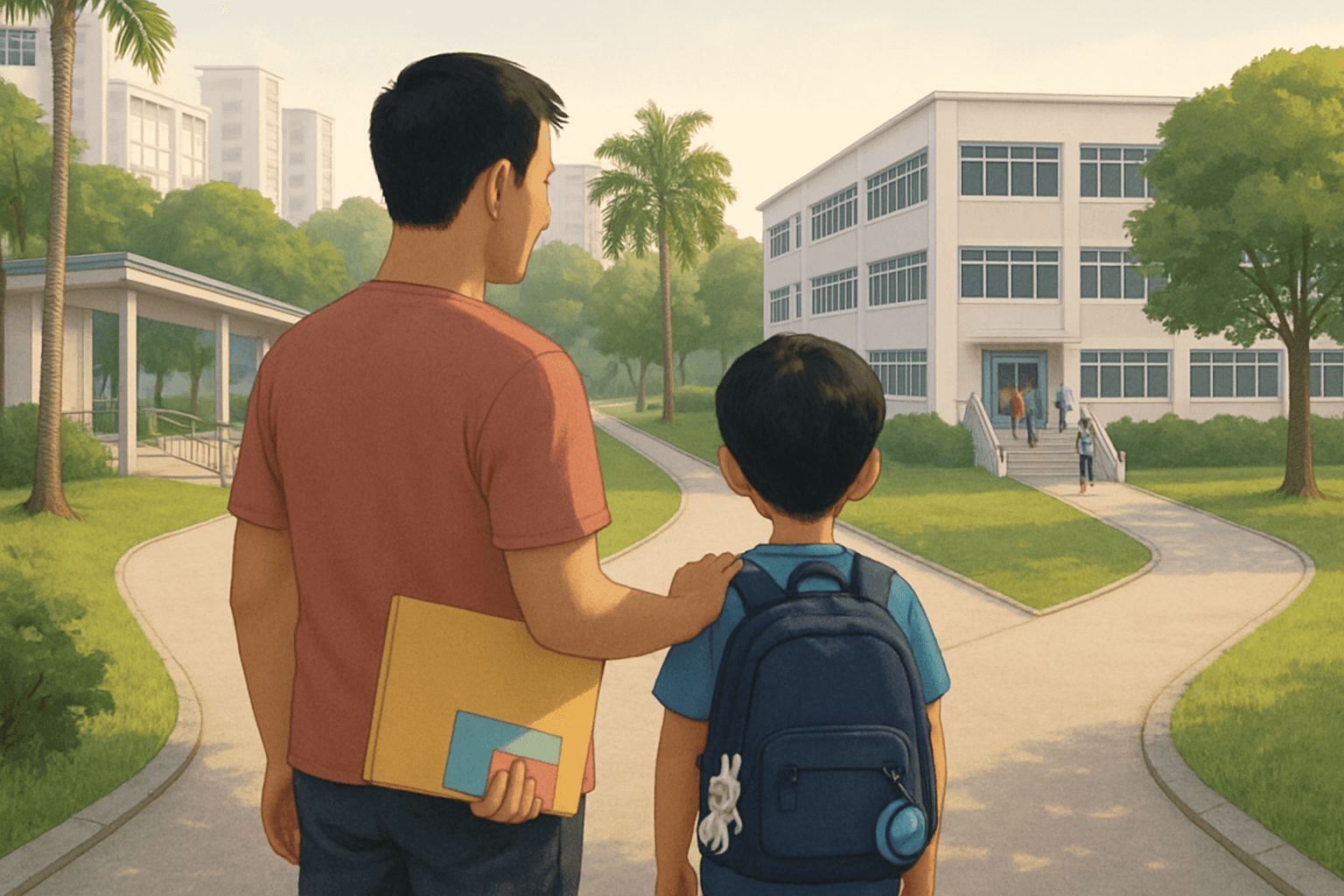
If your child needs extra learning, behavioural, sensory, mobility, communication, or medical support, your backup primary school should be chosen for day-to-day fit first.
That usually means looking past school reputation and asking a simpler question: can this school support my child safely and consistently in ordinary daily routines? A practical backup plan should cover support fit, campus access, parent-school communication, and whether the journey and home routine are sustainable for your family.
What should a backup primary school do for a child with additional support needs?
The right backup school is one your child can manage safely and consistently in daily life. It does not need to be perfect, but it should be sustainable.
A good backup primary school should be workable in real life. Your child should be able to get through the school day safely, join in reasonably well, and learn without the family feeling like every week is a damage-control exercise.
That standard looks different for different children. One child may need clear reminders before transitions and extra help settling after assembly. Another may need a campus that is easier to move around because stairs, long distances, or crowded walkways are tiring or unsafe. Another may cope academically but still need calm adult check-ins during recess or dismissal because unstructured times are the hardest part of the day.
The useful distinction is this: possible is not the same as sustainable. A school may be technically manageable for a few days, yet still be a poor backup if the commute, routines, sensory load, or communication gaps keep pushing your child into distress. Backup school means workable every day, not impressive on paper.
If a school can support your child through ordinary mornings, difficult transitions, and occasional bad days, it is already a stronger backup option than a more famous school that creates constant strain. For a broader overview, see Primary 1 Registration in Singapore: How It Works, Balloting Risk, and How to Choose a Realistic School Plan.
[Punggol] Primary Schools
Published on Jun 19, 2015 Oasis of learning in Punggol, to fill young minds source http://mypaper.sg/top-stories/oasis-lea ... s-20150619 THREE new primary schools will open in Punggol next year to help meet the growing demand in the area. The schools - Oasis Primary in Edgefield Plains, Punggol Cove Primary in Sumang Walk and Waterway Primary in Punggol Drive - will be able to take in 210 pupils each . They are located near a number of housing projects. Waterway Primary, for instance, is locate
[Punggol] Primary Schools
hmm… the most impt thing is your child must be happy. This must come from supportive parents in their learning. My boy enjoys his class and gamely contribute and am glad teachers (Chinese and form teacher) have been responsive in his learning. As he was a transferred student, I was also concern of him blending to his school but such were unfound. Phew! All in all, in a primary school, be it a popular, a top or mediocre school (in others’ opinion) you can still “control” a child’s learning habits
What types of support needs should you consider before shortlisting a school?
Consider learning, attention, communication, sensory, mobility, behavioural, emotional, and medical needs together. The hardest part of school may not be the lesson itself.
Look at the whole school day, not just academics. Many parents start with reading, writing, attention, or pace of learning, but daily fit is often shaped just as much by noise, movement, transitions, communication, physical access, behaviour regulation, and medical routines.
For example, a child may read well but struggle badly with crowded spaces, sudden timetable changes, or long verbal instructions. Another may do fine in class but become overwhelmed during assembly, recess, or dismissal. A child who uses mobility aids may manage the classroom itself but find toilet access or moving between blocks much harder. A child with a medical condition may need dependable routines around medication, meals, fatigue, or emergency response.
A simple way to think about this is to map the day from door to door: arrival, assembly, class time, recess, toilets, movement between spaces, after-school care, and the trip home. The points where your child usually struggles now are often the exact points to test when comparing schools.
That broader idea of readiness beyond pure academics also shows up in this parent-focused article on school readiness. If you are still trying to understand your child's learning profile, this overview on signs of learning difficulties and getting help early may also be useful.
These are practical examples, not an official checklist. The key question is: what parts of the school day are most likely to go wrong for my child, and which school environment is more likely to make those moments easier? For a broader overview, see Primary 1 Registration Unsuccessful: What Happens If You Do Not Get Your Preferred School.
What goes into choosing a suitable Secondary School
Saw this being shared in the parents groupchats. https://www.thewackyduo.com/2022/11/how-to-choose-secondary-school-guide.html https://i.imgur.com/fDkJSy6.png\"> https://www.thewackyduo.com/2022/11/how-to-choose-secondary-school-guide.html It's time to choose a secondary school. Choosing a secondary school is a completely different process than primary school. One tends to choose a primary school based on distance or affiliation. Picking a secondary school is a different ball game. Grades play a
Sengkang/punggol primary school - input from parents of kids in schools in these area?
~ starting to think about primary school registration (applying this year, 2025) and it’s giving me a headache. The schools my kid has a good chance of getting in (2B - 1km) are: 1)Nativity primary 2)Mee Toh 3) Rivervale primary My kid is really quite nerdy and has a hard time finding friends because of her subject-specific interests (usually science-related). Has expressed a preference for co-ed, but I don’t know how seriously to consider her input. Nan Chiau (phase 2b) seems impossible because
Have More Questions?
Get personalized guidance on schools, tuition, enrichment and education pathways with AskVaiser.
Try AskVaiser for Free →How do you judge whether a school's support setup is a real fit, not just a nice brochure description?
Judge support by how it works during lessons, transitions, distress, and communication with home. Practical answers matter more than general claims about care.
Look for evidence of what happens on an ordinary day. A school website may say it is caring or inclusive, but parents need to know what staff actually do when a child misses instructions, becomes anxious after a routine change, shuts down in class, or gets overwhelmed after a noisy event.
A useful conversation with a school usually reveals three things. First, whether staff can speak concretely about routines and support instead of staying at the level of general reassurance. Second, whether there is a clear point of contact when concerns come up. Third, whether the school sounds willing to problem-solve with families instead of only reacting after something has already gone wrong.
Try to listen for specifics. Do they explain how transitions are handled? Can they describe what happens if a child is distressed at recess or dismissal? Do they ask sensible follow-up questions about your child's triggers, strengths, and routines? Those details matter more than polished language.
School visits and conversations often reveal things that a brochure cannot. Schoolbag's advice on school choice and this parent account of how school visits helped are written for later stages, but the principle is the same: visits help you judge culture, responsiveness, and practical fit.
Support is real only when it works on an ordinary Wednesday. If answers stay vague, or no one seems able to explain day-to-day processes, treat that as useful information. It does not mean the school is bad. It may simply mean it is not the right backup for your child.
If you are also weighing whether a safer option may be better than a high-demand one, our guides on choosing a popular dream school or a safer nearby school and popular primary school versus neighbourhood school can help frame that tradeoff.
Preschools prepared your kids well for Singapore primary?
For parents who have already been through the pre-school days and with kids now in primary schools (Singapore schools), can you share your comments on your kid's previous preschool and their curriculum - specifically if they have prepared your child properly for the Singapore education system ? (not discussing the international or foreign schools system here) Nowadays, there are so many pre-schools and childcare centres with many learning methods. Parents currently at the pre-school stage will b
Which are the Primary Schools that comes with Student Care ?
My DD goes to Lianhua Pri (LPS) which is also in Bt. Batok, near Little Guilin. DH (sashimi) and I chose this school partly due to proximity to our home and her old childcare centre. This is because her childcare centre provides After School Care (BASC) for LPS students. (LPS is a single session sch.) Since the centre is within walking distance (you only need to the cross zebra crossing in front of the school and the carpark), and you can walk under the connecting HDB blocks during heavy downpou
What should parents ask during a school visit or conversation with the school?
Ask questions that reveal how the school handles ordinary routines, difficult moments, and parent communication. You are testing real-life readiness, not collecting vague reassurance.
- ✓Who should I speak to about my child's support needs before school starts and once school is in session?
- ✓How do teachers usually support children who need more reminders, structure, or help with transitions?
- ✓What happens if a child becomes overwhelmed by noise, crowds, or unexpected changes?
- ✓How does the school respond if a child is distressed, shuts down, or has behavioural escalation?
- ✓How are parents updated when there is a recurring concern rather than a one-off incident?
- ✓Are there parts of the campus or school routine that may be harder for a child with mobility, sensory, or communication needs?
- ✓What should families know about arrival, dismissal, recess, toilet access, and movement between blocks?
- ✓If my child has medication, fatigue issues, or a medical condition, how are practical routines usually handled?
- ✓Is the school open to hearing from external therapists, psychologists, counsellors, or doctors when relevant?
- ✓If a support strategy is not working, how does the school review and adjust it with parents?
- ✓Is there anything about the school's usual routines that you think my child may find especially challenging?
- ✓What information would be most useful for the school to know before the school year begins?
How important is location, commute, and daily routine when choosing a backup school?
Very important. A shorter, more predictable commute can reduce fatigue, sensory overload, lateness, and caregiver stress.
For many children with additional support needs, commute is part of the support plan. A school can look suitable on paper but still be the wrong backup if getting there is tiring, crowded, unpredictable, or too dependent on fragile caregiver arrangements.
A child who is already working hard to regulate attention or emotions may arrive unsettled after a long bus ride or congested MRT journey. A child with sensory sensitivities may cope in class but struggle with a noisy drop-off area every morning. A child who tires easily may manage the academic part of the day, then fall apart during the trip home. Families also need to think about who can do pickup if the child has a bad day, becomes unwell, or cannot stay in after-school care as planned.
If possible, test the actual route at the actual time. Notice walking distance, shelter, traffic, stairs, waiting time, crowding at the gate, and how realistic the handover is to a grandparent, helper, student care, or other caregiver. A route that looks acceptable on a map can feel very different during the morning rush.
If the commute breaks the routine, the school choice is already harder to sustain. For many families, a shorter and more predictable journey is not a small convenience. It is one of the reasons the school remains workable after the first month.
If distance is shaping your options, our guide on how home-school distance works can help. For the wider registration picture, start with our main Primary 1 registration guide.
School Placement Exercise for returning S'porean children
Yes, doing Sec 1 topics is right if the student is planning to join Sec 2, and P6 topics for joining Sec 1. I don't know of any group - hope someone can help if there is one. What about relatives and family friends? If you can arrange some \"play dates\" (they are old enough not to want to use that term, I guess!) for them in the weekends, that might help. If you go to church or other regular activity, ask for them to join in some activities with similar-aged kids? Do they have old school friend
Info on what your child learns in P1 and how you can help
Dear parents, in case you're wondering what your child will be learning when he goes into P1, here's an article which you may find useful. http://sg.theasianparent.com/what-your-child-is-learning-in-primary-1/ The article covers tips which you can do to help your child with literacy and numeracy skills. Hope it helps! Sincerely Junior Wonders Tuition Centre
What role should specialist support, external therapists, or allied health professionals play in the decision?
Use existing professional input to understand fit and improve communication with the school. A good backup school can work alongside your child's support network, even if it does not provide the same services itself.
If your child already has outside support, the main question is not whether the school can replace it. The more useful question is whether the school can work alongside it in a practical way.
Many children enter primary school with input from therapists, psychologists, counsellors, doctors, or early-intervention teams. A workable backup school is usually one that is open to understanding what helps, willing to share observations when needed, and able to respond sensibly to recommendations that fit the school setting. That does not mean every outside suggestion will be adopted exactly as given. It means the school is prepared to collaborate rather than treating existing support as irrelevant.
In real life, many parents keep a small set of reference materials ready for school conversations. Common examples include a recent professional report, a short therapy summary, a brief note on triggers and calming strategies, or a one-page routine guide covering transitions, eating, toileting, or dismissal. These are examples only, not official requirements and not guaranteed to be requested by every school.
The practical aim is simple: help the school understand your child quickly and accurately. One useful parent mindset is that external support should sharpen the conversation, not make it more complicated.
A parent story like this ADHD journey in primary school is a reminder that support often depends on ongoing communication, not one conversation at the start of the year. If you want a broader sense of what families often prepare during P1 season, our documents checklist guide may help, even though not every item will apply to support-related discussions.
School Placement Exercise for returning S'porean children
I think it may be best to ask MOE directly about what happens if your child doesn't get into Sec school. From what I gather, those who don't clear SPERS and get held back are those who either are really weak in English, or can't cope with the Maths. Since your child has been in an English stream, it shouldn't be too hard to familiarise him (not sure whether yours is a boy or girl from your post) with the style of the English paper. And you have time to work on the 2 subjects. You will find that
Support for Children with Special Needs
hi parents I have been searching to know parents whose children which special needs (gdd/asd or others ) are in mainstream currently. with special needs kids going to primary sch , there a lot of challenges n stress parents /child facing . My child is with gdd , attending P1 this year. I would like to know parents who willingly to share exp / info or giving each other support. It been really tough to find info or parent support group for this group of kids. Do PM me or reply to this thread.. eve
How should parents weigh academic reputation against support fit?
Treat support fit as the priority and reputation as secondary. The better backup is usually the school your child can manage more calmly and consistently.
If your child has meaningful support needs, support fit should usually come first. Reputation may tell you that a school is popular or well regarded, but it does not tell you whether your child can cope there day after day.
A well-known school may be farther from home, more crowded, less predictable, or simply harder for your child to navigate. A quieter nearby school may not carry the same prestige, yet it may offer a calmer start, easier communication, and a school day your child can actually sustain. For a child who is easily overwhelmed, physically tired, dependent on routines, or sensitive to transitions, those differences shape attendance, regulation, confidence, and family stress.
Sustainable matters more than impressive. That fits the broader school-choice thinking in Schoolbag's discussion of school fit and practical considerations. It is also closely related to our own guides on dream school versus safer nearby school and popular versus neighbourhood school.
A useful test is this: if two schools sounded equally respectable to other parents, which one would make your child's mornings, transitions, and recovery after school easier? That answer is often the better backup choice.
Choosing Secondary school
I think you have to watch out for point 3 in the chart - 3. Pupils from primary schools which has an affiliation will take priority in posting to its affiliated secondary school if they have opted for that school as the first choice. If you have the \"privilege\", take advantage of it. Otherwise, consider its impact on the number of available vacanies left for \"non-affiliated\" students.
How your kid's performance in P1 if attended gd Pre-sch?
Dear Members Can anyone of you feedback how your kid/kids doing in P1 if they attended pre-school as follows: 1)\tPat school 2)\tMontessori 3)\tMy First School or Normal child care centre 4)\tHalf day in CC or in Kindergartens I have heard so much about how good /strong or poor academically the pre -school can be. But ultimately are kids really perform better when go to Pri i.e. (e.g. with Montessori they do have their special techniqe in their learning path, half day CC or Kindergarten as they
What are realistic signs that a school may be a poor backup choice?
Watch for vague answers, weak communication, difficult access, and routines that already look too demanding for your child. Poor fit usually shows up in practical details first.
The clearest warning sign is not that a school admits it cannot do everything. The more important red flag is when staff cannot discuss your child's needs in practical terms at all.
Be cautious if answers stay vague when you ask about routines, distress, communication, or physical access. Notice whether staff seem uncomfortable talking about support needs, whether nobody can tell you who the right contact person is, or whether the overall message is simply that the child must adapt without much adjustment from the school side.
Other warning signs are often very ordinary. The route may be too tiring. The campus may look hard for your child to move around safely. Dismissal arrangements may depend on timing that your family cannot reliably maintain. Different staff may give inconsistent answers. Replies may be slow enough that you already sense communication will be difficult once school starts.
Parents sometimes miss the softer signals because they are focused on reputation. But if a school feels rigid in all the places where your child needs flexibility, structure, or reassurance, that is useful information. It does not automatically mean the school is poor overall. It means the fit may be poor for your child, which is exactly what backup planning is supposed to uncover.
How your kid's performance in P1 if attended gd Pre-sch?
My son is in P5 next year too. He didn't attend Pat School House, Montessori, CC or PAP. Hubby & I didn't really know how to prepare him for P1. However, we did get those EPH K2 assessment books to coach him for English & Maths. He attended group tuition conducted by his K2 Chinese teacher. Daughter just finished K2 this year...going to P1 next. She attended the same kindy as son. 听写 and Spelling words were very much tougher in Term 3 and daughter struggled. :siao:...compared to the time son was
Beyond AL/PSLE scores - Choosing Secondary School
Hi everyone, I’ve noticed a lot of discussions here about PSLE posting and how tough it can be to shortlist secondary schools — especially when trying to consider more than just the cut-off points. I recently built a free website called School Advisor SG that might be useful for parents going through this process. It helps you explore schools holistically, by combining publicly available data on: PSLE cut-off points (2024) Sports & CCA performance (from national competitions) Primary–secondary a
How can parents build a practical Plan B after P1 registration?
Shortlist realistic schools early, compare them using your child's key needs, test the routine, and prepare simple background notes. Plan B should reduce panic, not add complexity.
Start by narrowing your backup list to two or three schools that are realistic on support fit and daily routine, not just popularity. Then write down the few factors that matter most for your child. That may be predictable transitions, lower sensory load, wheelchair-friendly access, shorter travel time, medication routines, or faster parent-school communication. Once those priorities are clear, comparing schools becomes much easier.
Next, speak to the schools or visit if possible. Test the route at school-run times. Decide who will handle drop-off, pickup, and emergency pickup. Keep a simple folder of helpful background materials such as reports, therapy notes, current routines, or a short parent summary of what works well for your child. These are common examples parents prepare for smoother conversations, not official requirements.
This step matters because families often make worse decisions when they are under balloting pressure or reacting to disappointment. A good Plan B should already feel thought through before you need it.
For the bigger registration picture, see our main Primary 1 registration guide. If you are worried about not getting your preferred school, this guide on what happens next can help you plan calmly instead of scrambling at the last minute.
All About Preparing For Primary One
Starting primary school? This is a big milestone. Do enjoy the journey with your child! :rahrah: https://www.straitstimes.com/singapore/education/the-st-guide-to-preparing-your-child-for-primary-1 Parents often confuse being ready for school with being academically capable in skills like reading and counting. Instead of focusing solely on academic progress, it is more important to make learning an enjoyable process, and help your child have a swift and happier adjustment to primary school. Here
All About Preparing For Primary One
Dear parents, I hope parents could share your experience regarding the preparation for primary school and time schedule spend with your kids everyday. I have a son of 6 this year going to P1 next year. I would like to find out with parents things that you are doing with your child prior going P1, cos I do not want to react too kan-jiong or too relax in front of my child. I am particularly concerned about the 3 main subjects being taught in P1 and wonder should I expect him to be able to do the a
Have More Questions?
Get personalized guidance on schools, tuition, enrichment and education pathways with AskVaiser.
Try AskVaiser for Free →