
GEP vs HAP in Singapore: Common Myths Parents Should Know
A practical guide to what the labels mean, how selection works, and what they do and do not say about your child.
The biggest myth in the GEP vs HAP conversation is that the label ranks children. It does not. GEP is the established national programme for intellectually gifted pupils, while newer support for higher-ability learners is more school-based and flexible. The real decision is about fit, stretch, and stress, not status.
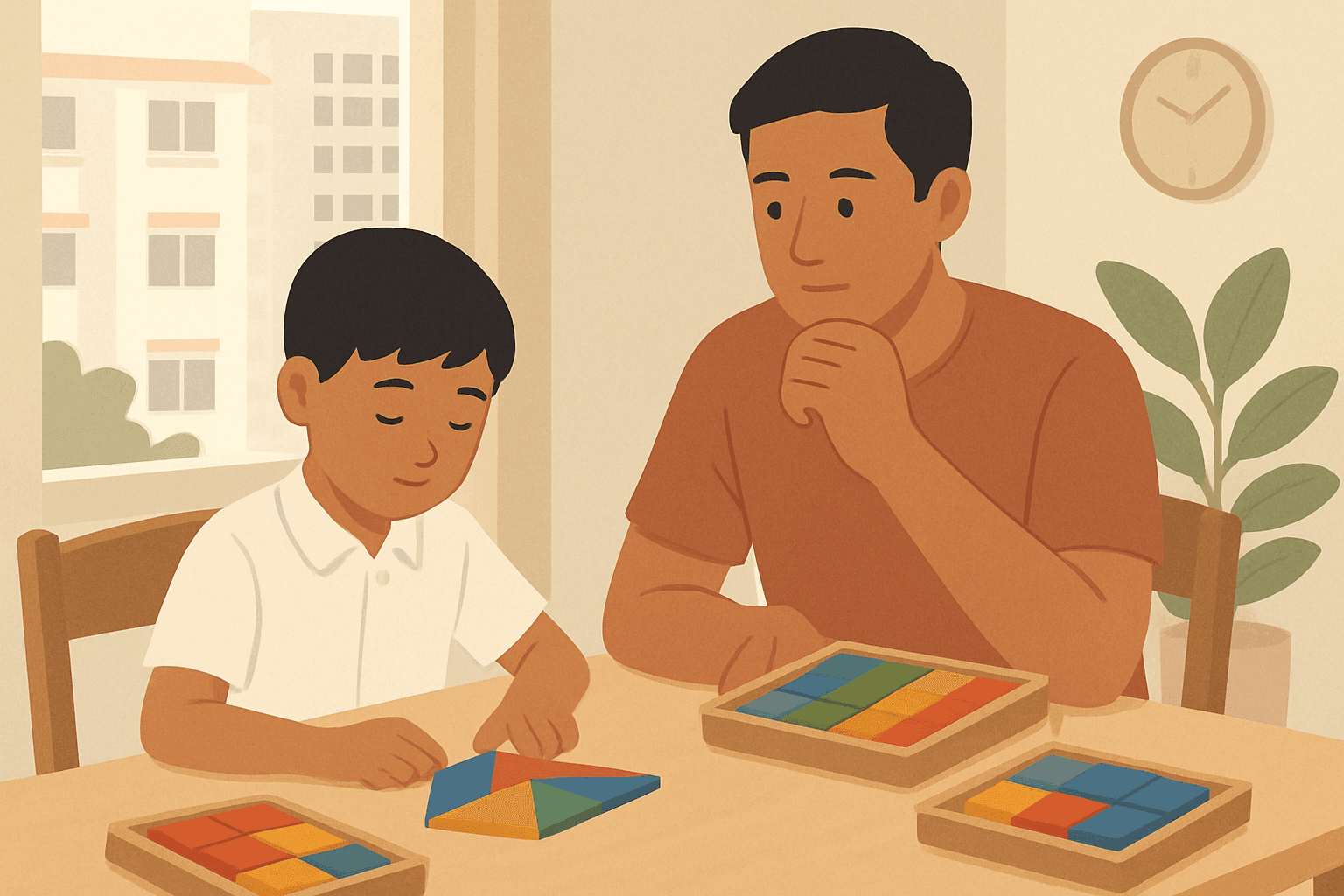
GEP and HAP are not the same thing, and neither label says which child is “better.” GEP is MOE’s long-running programme for intellectually gifted pupils, while the newer higher-ability approach is broader and more flexible. For most parents, the better question is not prestige. It is whether the pace, teaching style, and school setting fit your child well.
What are GEP and HAP, in plain terms?
GEP is MOE’s established gifted education programme. What parents call HAP usually refers to newer support for higher-ability learners, often delivered through school-based programmes and after-school modules.
In plain terms, GEP is MOE’s established programme for intellectually gifted primary school pupils. Under the current model, selected pupils are identified in Primary 3 and join the programme in Primary 4, as explained on MOE’s Gifted Education overview. It is a named, selective programme with its own enriched curriculum.
What many parents mean by “HAP” is the newer support approach for higher-ability learners. In current public MOE materials, this is described more often as school-based support and after-school modules for higher-ability learners, as set out in MOE’s press release on strengthening support for higher-ability learners.
The simplest way to think about it is this: GEP is one specific national programme, while the newer model is a broader way of giving stretch opportunities to more children. One child may move into a separate gifted setting. Another may stay in the home school and still receive deeper learning opportunities. If you want the side-by-side comparison first, see our guides on what GEP is and GEP vs High Ability Programme. For a broader overview, see Gifted Education Programme (GEP) in Singapore: A Parent's Guide.
GEP Preparatory Program
Good morning Angelight, Gifted Education Programme (GEP) is not a PSLE preparatory program. As stated in MOE’s website that Ministry has recognized that children have varying abilities, it’s not a sound practice to give every child the same education and to expect him/her to move at the same pace as his/her peers. Those intellectually gifted children need high degree of mental stimulation. Normally, intellectually gifted children are very inquisitive, fast learners and with very high level of re
GEP Preparatory Program
Having checked with parent chatgroups, here is my humble assessment of the TOP 3 GEP Preparatory Program specialists . EduCHAMPS academy https://www.theeduchamps.com/gep-preparation-class-2/ • 2 branches – Novena and Katong. • 6 to 10 students per class • Known for following a patented Advanced Brain Training and 5 ‘A’s Method to bring out the full intellectual potential in students • 100% passed the GEP Screening test (1st round). 68% passed the GEP Selection test (2nd round) and got into the P
A quick note on the term “HAP”
“HAP” is often used informally, but current public descriptions are usually broader than that single acronym.
Treat “HAP” as a shorthand, not a fixed official label. In current public MOE wording, the newer approach is usually described as support for higher-ability learners, not as one single acronym used everywhere. The practical question is not what the label is called. It is how the support is delivered, whether your child stays in the home school, and what kind of stretch the programme actually provides. For a broader overview, see GEP vs High Ability Programme in Singapore: What’s the Difference?.
All About GEP
https://singaporemotherhood.com/articles/2020/10/gep-gifted-education-programme-singapore/
GEP Preparatory Program
Sorry have not heard of Joyous but it has sent more than 300 students into GEP within 8yrs of operation? Why not claim 1,000 or 10,000? Since MOE does not step forward to refute such claims anyway. GEB has the brains to administer the GEP, but no idea how to stop fake advertising.
Have More Questions?
Get personalized guidance on schools, tuition, enrichment and education pathways with AskVaiser.
Try AskVaiser for Free →What is the biggest myth about GEP vs HAP?
The biggest myth is that GEP or HAP tells you which child is superior. These labels describe the kind of learning support a child may need, not a permanent ranking.
The biggest myth is that the label tells you which child is better. It does not. A programme label is about educational support, not a child’s value, future success, or family background.
This is where many parents get pulled into the wrong question. A child in GEP may need faster, deeper, more inquiry-based work. A child in a school-based higher-ability programme may also need stretch, but in a different structure. A child in mainstream may still be very capable and may simply learn better with steadier pacing, clearer routines, or less disruption. None of that is a ranking of worth.
Programme labels describe support, not a child’s worth.
Another common misunderstanding is that GEP is only for a tiny privileged group from a few schools. MOE has said selected pupils came from a broad spread of primary schools, not just a narrow cluster, as noted in this parliamentary reply. For parents, the better question is: “Which setting helps my child learn well without unnecessary stress?”. For a broader overview, see GEP Selection Process in Singapore: Stage 1 and Stage 2 Explained.
GEP and IQ
To me GEP is about if you have it, you nurture it. There is a certain advantage in putting a child in GEP, if she has what it takes. First, you have more resources in the education system dedicated to educating the child. Second, the academic road is somehow smoother. The GEP label helps somehow. I once asked one of my GEP students to ask her teacher how GEPPers do traditionally in PSLE. She came back with the report that they have had people who got B in PSLE math so far. While most do get A*,
All About GEP
Parents that pay thousands of dollars to try to get their children into GEP: Yes, GEP is a coveted programme. Yes, GEP allows your dd/ds to be able to have a higher chance of getting into an IP school. But bear in mind that the programme is immensely challenging. Your child will have to juggle tonnes of projects and lots of HW and at the same time prepare for the all-important PSLE. And if you PUSH for your child to get into GEP by loads of tuition classes, ask yourself: Will he/she be cope? Wil
Is HAP a lesser version of GEP?
No. It is more accurate to see it as a different support model, not a downgraded one.
No. “Lesser” is the wrong lens. GEP and newer higher-ability support are better understood as different ways of meeting advanced learning needs.
GEP has traditionally been a separate, selective structure. The newer higher-ability approach is meant to spread stretch opportunities more widely and, in many cases, allow children to remain in their own schools. MOE has said this can reduce disruption to a child’s learning environment and social bonds, which is a real advantage for some families, as described in the MOE press release.
That matters in everyday life. One child may thrive in a concentrated gifted setting with similarly advanced peers and more specialised teaching. Another child may be just as capable but do better staying with familiar classmates, avoiding a long commute, and receiving stretch work without changing schools. A separate programme is not automatically a better fit just because it sounds more selective.
Think in trade-offs, not status. Continuity, travel time, school culture, and your child’s comfort with change all matter. If you want the policy context, our guide on why Singapore is moving from GEP to HAP explains the shift in plain English. For a broader overview, see How Do I Know If GEP Is a Good Fit for My Child?.
Is GEP really necessary?
Is GEP really necessary? If it’s designed to cater to kids with special needs, yes. If the intention is to groom leaders or specialists in a developing country to raise the quality of the human resource, yes. But Singapore has progressed beyond this need. Unfortunately, the GEP is used as a guaranteed passport to an elite education. This is the grand prize that pushes all parents to overdrive. So much is invested in so few, and these few are given the best tools and resources. And at the end of
All About GEP
Based on the following criteria: 1. Are you already in that GEP school; 2. Do you already have a sibling in that GEP school; 3. Distance from the GEP school; 4. The type of school the child was from (SAP, mission, or single-gender school) which is similar to the GEP school; The large majority gets their first choice. You yourself have to decide whether HCL is for your child. I think there are some schools that cannot drop HCL. Not sure whether this is still true. All the GEP schools now practice
How does selection into GEP work, and what do parents often misunderstand?
Under the current model, GEP selection happens through a two-stage exercise in Primary 3. Parents often mistake it for a final ranking of intelligence, when it is really about identifying readiness for a different learning environment.
Under the current model, GEP students are identified through a two-stage exercise in Primary 3, and selected pupils join the programme in Primary 4, according to MOE’s overview page. Public reporting has described the exercise as starting with an English and Maths screening, followed by a second round that includes English, Maths, and General Ability for shortlisted pupils. Because the system is being updated, treat those details as the existing model rather than a promise that every step will stay the same, as summarised in CNA’s coverage.
Only a small share of the cohort is usually admitted each year, which is why some parents see the process as a prestige race. But the more accurate way to read it is as a needs-based selection exercise for a different learning environment.
The key misunderstanding is this: selection is not trying to crown the “smartest” child in an absolute sense. It is trying to identify pupils whose learning profile may suit a different type of teaching and challenge. A result is better read as a snapshot of current readiness, not a lifelong verdict on intelligence.
That is why some children with excellent school grades do not enter GEP, while another child with uneven classroom results may still show strong reasoning, unusual curiosity, or high potential for deeper work. If your child is selected, ask whether the environment suits them. If your child is not selected, do not assume future growth is capped. For a fuller breakdown, see our guide to the GEP selection process.
All About GEP
Hi NJmom, Congratulations to your child being selected for the selection test! Which means your dd is among the top 4000 P3 student in Singapore. That's some recognition! So far from what I have found out, the GEP programme are a course designed to cater for a different group of students, for those intellectually gifted kids. Thus, the learning concepts and assumptions are completely different from our main stream. There will be alot of research work and like what fairy has mentioned in her post
All About GEP
Hi folks, I was browsing reddit, and came across this today: https://www.reddit.com/r/singapore/comments/qlplx5/getting_into_a_primary_school/?sort=confidence On reddit, several students who went through GEP said that they were \"trained\" by enrichment for GEP, and they got in. However, once they were in the GEP programme, they struggled to stay on par with their really gifted peers, who just breezed through difficult tests. Can any parent who went through this with their children or similar, h
What kind of child may be better suited to GEP or higher-ability support?
The strongest signs are usually pace, curiosity, independence, and readiness for depth, not just top marks.
Look beyond marks. Strong scores can be one sign, but they are not the whole story. Children who enjoy depth, ask unusual questions, finish work quickly and want extension, or get energised by open-ended tasks often respond well to stretch programmes.
Parents usually get better clues from what the child does without being prompted. For example, one child may read far beyond the syllabus and keep asking “why” or “what if” questions that are hard to satisfy in a standard lesson. Another may solve Maths problems quickly and then invent harder versions for fun. A third may not always score perfectly but becomes deeply absorbed when given a puzzle, project, or independent task. Those patterns often tell you more than one neat report card.
The opposite pattern matters too. A bright child can still be a poor fit for a more intense or more open-ended environment. If your child is easily anxious, dislikes ambiguity, needs constant reassurance, or shuts down when work becomes less structured, a steadier mainstream setting with targeted enrichment may be healthier. That does not mean the child lacks ability. It means the learning environment has to match how the child works day to day.
Fit matters more than label. If you are unsure, watch how your child handles challenge at home and in school, not just how fast they finish worksheets. Our guides on how to know if GEP is a good fit and whether your child is gifted or simply advanced can help you think about this more realistically.
GEP and IQ
For gifted children - they don't necessary make it into GEP because of the test and if children perform well for test... As such, gifted child don't just grow overnight... I suggest you contact the GEP department and ask them to support your child... so technically you need some suitable document from a psychologist doing an IQ test and recommendation on how the school can support the child. my younger child is in p2 this year and GEP is working closely with the school at times (LOL) to support
All About GEP
I read many interesting concerns on the GEP ... Let me share some of my thoughts on these ... Why force your kids to a GEP if she /he is meant for it. Don't believe those crap training centre ..Let nature take it course My daughter is in P6 GEP at RGPS and had just completed her PSLE like all other 50K kids in her cohort. She is now enjoying herself with her fellow P6 GEP at the Sentosa UnderWater World. She was posted to RGPS from CHIJ Pri (Toa Payoh) in 2008. As a child , she was always more s
How do workload and curriculum differ from mainstream Primary school?
GEP usually means deeper, broader, and more independent learning rather than simply moving faster. Newer higher-ability support also stretches students, but not mainly for exam prep.
The key difference is not simply “more work.” MOE describes the GEP curriculum as enriched rather than accelerated. Students cover the same broad content areas as mainstream, but with more depth, breadth, inquiry, and independent exploration, as explained in MOE’s GEP enrichment model.
In practice, that can still feel heavier. A child may be expected to discuss ideas in more depth, handle open-ended tasks, do project-style work, or think across subjects instead of aiming for one standard answer. For a child who enjoys this, the workload feels stimulating. For a child who prefers clear steps and predictable tasks, the same experience can feel tiring even if the homework count is not dramatically different.
For the newer higher-ability support in schools, MOE has said the after-school modules are not mainly meant to improve examination scores. The stated aim is to build curiosity and a love of learning, as noted in the 2024 press release. That gives parents a better question to ask: not “Will this get my child more marks?” but “Will this stretch help my child grow without burning out?”
If you want a fuller picture of day-to-day experience, our articles on GEP vs mainstream primary school and what the GEP workload is like go deeper.
All About GEP
GEP curriculum covers the same content areas as those in mainstream but is extended in breath and depth. And GEP students will sit for the same PSLE and proceed to IP or O level, just like mainstream students. Sounds quite like IP, where students are exposed to an enriched curriculum but also learn the same syllabus and sit for the same A level exam as mainstream students. Or A level students taking H3 subject with extended contents but only the standard syllabus H2 content results will count to
GEP Preparatory Program
GEP curriculum covers the same content areas as those in mainstream but is extended in breath and depth. And GEP students will sit for the same PSLE and proceed to IP or O level, just like mainstream students. Sounds quite like IP, where students are exposed to an enriched curriculum but also learn the same syllabus and sit for the same A level exam as mainstream students. Or A level students taking H3 subject with extended contents but only the standard syllabus H2 content results will count to
What advantages does GEP actually offer, and what does it not guarantee?
GEP can offer a better learning match for some children, but it does not guarantee future success, happiness, or elite outcomes.
The real advantage of GEP is a better educational match for some children. A child who is consistently under-stretched in mainstream may benefit from deeper discussion, more complex tasks, greater independence, and peers who also enjoy abstract or open-ended thinking. For the right learner, that can improve engagement and reduce boredom.
What GEP does not guarantee is just as important. It does not automatically lead to top PSLE results, guaranteed admission to a particular secondary school, or an easier long-term path. A bright child can still struggle with stress, perfectionism, motivation, or the social side of a more demanding environment. Another child outside GEP can flourish later and do very well through mainstream pathways.
Parents also tend to over-focus on the programme label and under-focus on school fit. If a GEP option involves a transfer, day-to-day experience may depend more on commute, school culture, friendships, and family routines than on the fact that the school hosts the programme. Prestige feels loud, but fit affects your child every day.
A useful rule is simple: separate learning match from status. If you want a grounded comparison, read our guides on whether GEP is better than mainstream and the real advantage of GEP vs mainstream.
Is GEP really necessary?
GEP is not a guaranteed passport to an elite education. There have been cases of students ending up in neighbourhood secondary schools. Also those who have not had their GEP status renewed and hence are not awarded EESIS. It is true though that there’s an unhealthy frenzy by parents to get into GEP thinking that it’s a guaranteed pathway to success in life. There was even a post by a forummer who thought being a GEPper guaranteed the student Officer status in the Army and a good career. It is th
All About GEP
If you look at the stuff the GEP kids are learning compared to the mainstream kids, a lot of things may not come out in PSLE at all. Similarly they don't learn quite a lot of stuff learnt by their peers. I'm comparing what my son who is in P5 now to the mainstream P5. Certainly they don't learn follow the same lesson progress in math and Science. A lot of time is spend on social studies/project work/investigative work etc as well. For Chinese basically there is no difference between GEP and non
What happens after Primary school for students in GEP or HAP?
GEP or higher-ability support in Primary school does not permanently decide a child’s future. Pathways remain open, and support is becoming more flexible.
Primary school labels do not lock in a child’s future. This is one of the most important points for anxious parents. A child who is not in GEP has not missed the only chance to develop strongly. A child who was in GEP has not been guaranteed a smooth path forever either.
Singapore’s policy direction matters here. Public reporting on the revamp has described a more flexible model in which higher-ability learners may be identified at multiple points from Primary 4 to Primary 6, rather than being treated as if one screening point defines everything, as reported by TODAY. Even if school-level implementation continues to evolve, the practical message is clear: support for advanced learners is becoming broader and less tied to one rigid moment.
After Primary school, what still matters most is the child’s continued development, interests, resilience, and school fit. Secondary pathways remain open through multiple routes, and growth does not stop because of one Primary school outcome. If you want context on the broader shift, our article on why Singapore is moving from GEP to HAP is a useful next read.
All About GEP
GEP Status in Secondary Levels 1.What happens after the primary GEP? After Primary 6, retention of the GEP status and promotion to the next level of gifted education is based on: ■performance in the GEP from Primary 4 to 6, including a pass in Social Studies ■attitude towards work and the enrichment programme ■performance at the PSLE 2.What percentage of the Primary 6 GEP pupils meets the criteria for retaining the GEP status? Each year approximately 99% of the pupils meet the criteria. For more
All About GEP
https://www.straitstimes.com/singapore/politics/45-of-pupils-in-gifted-programme-in-the-last-five-years-live-in-hdb-flats-chan-chun-sing Ng Wei Kai PUBLISHED MAR 9, 2022, 10:37 PM SGT SINGAPORE - About 45 per cent of pupils who joined the Gifted Education Programme (GEP) over the last five years live in Housing Board flats, said Education Minister Chan Chun Sing on Wednesday (March 9). The pupils selected for the GEP came from 60 per cent of Singapore's primary schools, he added in response to a
How can parents support a child without creating pressure?
Support readiness without turning the process into a prestige contest.
- ✓Watch how your child responds to challenge in daily life, not just test scores.
- ✓Talk about learning style instead of building family identity around a label like “gifted.”
- ✓Keep any preparation light and skills-based, such as reading widely, doing puzzles, and discussing ideas.
- ✓Look out for hidden strain, including irritability, stomach aches, perfectionism, or fear of mistakes.
- ✓Compare programmes by fit, travel time, routine, and emotional readiness, not just reputation.
- ✓If your child is selected, ask whether the environment suits them before assuming you must say yes.
- ✓If your child is not selected, focus on what enrichment, support, or challenge still makes sense now.
- ✓Keep the family message simple: the goal is the right learning environment, not a status race.
Have More Questions?
Get personalized guidance on schools, tuition, enrichment and education pathways with AskVaiser.
Try AskVaiser for Free →