
Do Parent Volunteer Schemes Guarantee a Place in Primary 1?
A practical Singapore guide to what parent volunteering can help with, what it cannot promise, and when it is worth the effort.
No. Parent volunteer schemes do not guarantee a Primary 1 place in Singapore. They may help at some schools, but they do not bypass the P1 registration process or remove competition for limited places.
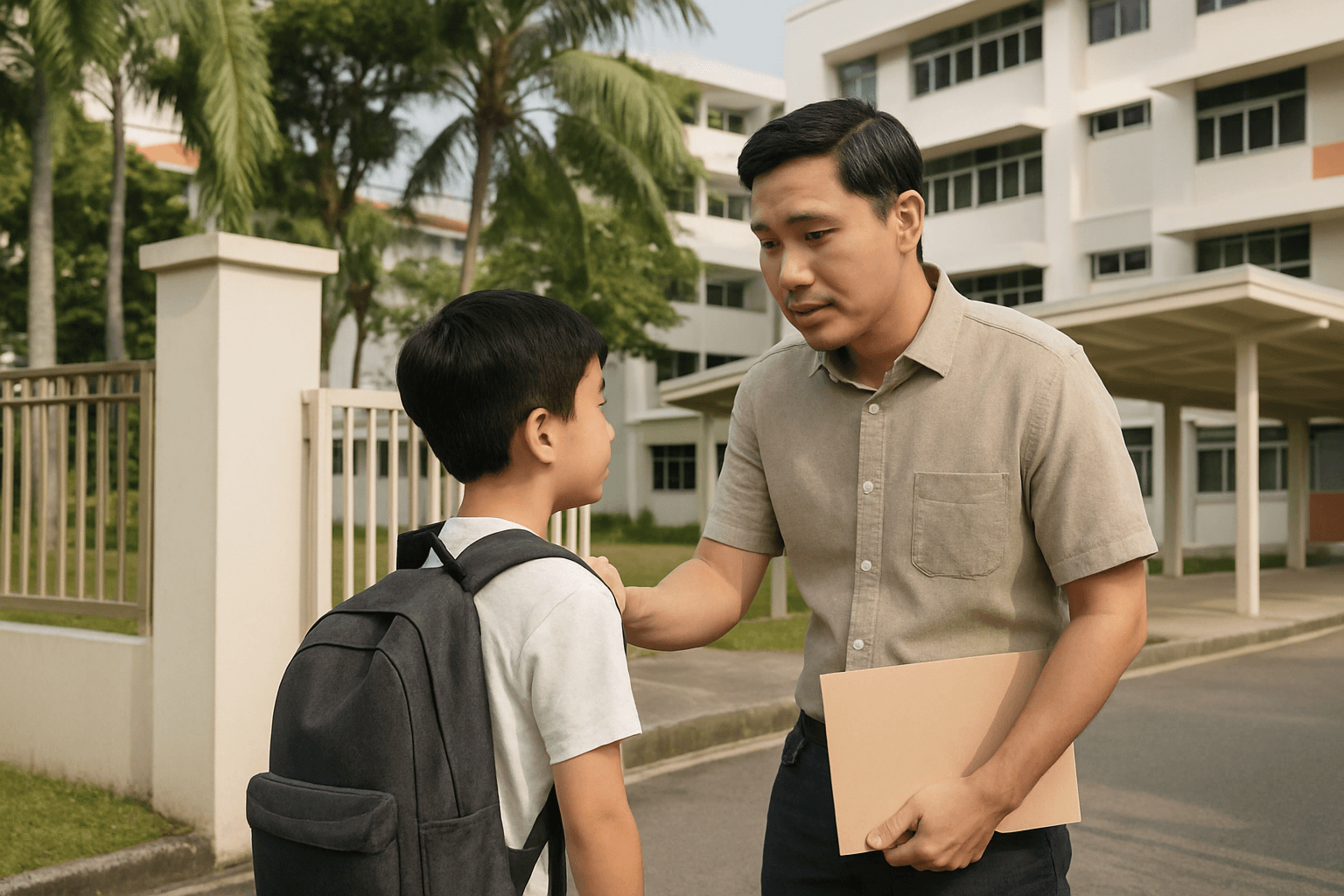
If you are planning ahead for P1 registration, the key point is simple: parent volunteering is not a reserved seat. In Singapore, volunteer arrangements are school-specific. Even if a school accepts your help, your child still goes through the wider Primary 1 registration process and may still face competition if that school is oversubscribed.
Short answer: Do parent volunteer schemes guarantee a place in Primary 1?
No. Volunteering may help at some schools, but it does not reserve a Primary 1 place or bypass registration.
No. Parent volunteer schemes do not guarantee admission. At most, they can improve your child's chances at some schools, but they do not reserve a seat or override the wider P1 registration exercise.
That is the safest way to read MOE's guidance. MOE explains the overall Primary 1 registration process, but parent volunteer arrangements are not presented as a nationwide guaranteed route. MOE also states that schools have different needs and requirements for volunteers, and a school can reject a parent's offer to volunteer. That matters because many families assume that offering help automatically creates an admissions advantage.
Practical takeaway: treat volunteering as a possible boost only after you confirm three things with the school. First, the school is actually taking parent volunteers. Second, the arrangement is relevant to your child's intake year. Third, there are still enough places available when that cohort applies. If any one of those is missing, volunteering is not a dependable route on its own. For a broader overview, see Primary 1 Registration in Singapore: How It Works, Balloting Risk, and How to Choose a Realistic School Plan.
Does school conduct test before allow the kid to reg Pri 1?
I have not heard of Primary schools giving entrance exams as part of the initial Primary One Registration process. I don't think that will come down well at all, as it implies that parents will be FORCING their pre-schoolers to take up all sorts of academic courses just to ace the entrance tests. However, if you want to transfer your child to another school after Primary One, the new school may require your child's exam results and even conduct assessment tests.
Share with us your kid's P1 registration experience
First thing to do after being balloted out, is to put your child's name under the school's wait list. After then, I've wrote in to MOE, called/met the school's Principal for discussion. Telling them all my problems and how the registration system had affected us (because I have only 1 school within 2km and NO school within 1km). With this factual, MOE has verified and consulted the school. My son was then placed on the highest priority in the waiting list .. and fortunately by early Nov, we were
What is a parent volunteer scheme in the MOE Singapore context?
It is a school-based arrangement where parents help the school in ways it needs, not a standard MOE admissions scheme.
In practice, a parent volunteer scheme is a school-based arrangement where parents help the school in ways it needs. It is not a standard MOE-wide admissions scheme with one common set of hours, duties, or guaranteed outcomes.
MOE's guidance is clear that schools decide their own volunteer needs and requirements, and parents should contact the school directly for details. MOE also says a school can reject an offer to be a parent volunteer, which is an important reality check for families who assume every school offers this route. You can see that in MOE's FAQ on whether a school can reject a parent volunteer offer.
On the ground, this means one school may welcome volunteers for reading support or events, another may not need volunteers for that cohort, and another may not treat volunteering as something that materially affects admissions. The useful parent mindset is simple: do not rely on what friends heard from another school. Ask the school you actually want, for your child's intake year. For a broader overview, see Primary 1 Registration Phases in Singapore: What Each Phase Means for Your Chances.
All About Parent Volunteers (PV)
Straits Times, 21 May 2012 Schools \" free to decide how parents volunteer \" Primary schools will be left to decide how they want parents to volunteer, said Education Minister Heng Swee Keat . But the parent volunteer scheme should not be just about getting priority for their children in the Primary 1 registration, he pointed out. Parents should use the opportunity to get to know the programmes offered by different schools in their neighbourhood, he said. His comments followed a report in The S
All About Parent Volunteers (PV)
Some parents volunteer to get priority registration to Primary 1 in Phase 2B. I hope this answers your question.
Have More Questions?
Get personalized guidance on schools, tuition, enrichment and education pathways with AskVaiser.
Try AskVaiser for Free →How does volunteering affect P1 registration chances in practice?
It may improve your position only if the school recognises volunteering, but you still compete for limited places.
Volunteering may help only if the school actually recognises it in its own admissions arrangement. Even then, it is still not the same as confirming a place. Your child remains part of a broader admissions process where places are limited and demand can change from year to year.
This is where many parents oversimplify the strategy. They think, "If I volunteer, I get a better queue." Sometimes that may be partly true. But the more important question is whether that queue is still larger than the number of places. At a school with manageable demand, volunteering may make a real difference. At a heavily subscribed school, the same effort may still leave your family facing competition.
A better way to think about it is this: volunteering can improve your position, but it does not remove vacancy pressure. If you are building a full school plan, start with the bigger picture in our guide to Primary 1 Registration in Singapore: How It Works, Balloting Risk, and How to Choose a Realistic School Plan. Parents who understand the full process usually make calmer decisions about whether volunteering is a bonus or a distraction. For a broader overview, see Primary 1 Registration Distance Priority: How Home-School Distance Works.
Seeking advice for P1 registration for daughter and son
Hi, just checking 2027 to enter P1, hence P1 registration for my girl is 2026, is it 2025 I should register for Parent Volunteer?
Share with us your kid's P1 registration experience
P1 registration experience… On the 1st day, went to the 1st choice school in the morning of 2/Aug to register… Actually I wanted to go on the last day to better gauge the chances as I was staying between 1-2km but the other half keep pestering me to go early… many parent still don’t understand the concept of balloting and priority and 3 days registration period… no sure why they always have the belief of 1st-come-1st-serve go later no place misconception even after much much explanation… No choi
Why popular schools still do not offer a guaranteed route through volunteering
Popular schools can still be oversubscribed, so volunteering does not turn a high-demand school into a guaranteed route.
Because demand can still exceed vacancies, even when parents volunteer. A school can accept parent volunteers and still have more eligible applicants than available places for that intake.
This is the part families often underestimate. "Helpful" and "guaranteed" are not the same thing. At a well-known school with strong demand, volunteering may slightly improve your chances, but it does not erase the queue. If many families are trying for the same school, a volunteer route can still end in disappointment.
A practical comparison makes this clearer. Imagine one family volunteers at a famous school with a long history of strong demand, while another family volunteers at a solid but less pressured nearby school. The volunteer effort may be similar, but the admissions outcome can be very different because the vacancy pressure is different. That is why parents should look at school demand patterns, not just whether a volunteer scheme exists. Our article on how to read past balloting data before chasing a popular primary school can help you assess that risk more realistically.
Insight line: volunteering may improve your odds, not erase the competition.
Share with us your kid's P1 registration experience
Funtastic4, RGPS finally had 117 applicants >2km fighting for 51 places under phase 2C (after 26 applicants <2km admitted). For my case, I had a daughter borned in year 2002. From 2005 onwards, we were closely monitoring the P1 registration stats, keeping all the records ourselvs as MOE dont retain them. Since my mil stayed near HPPS, we decided to enrol our child there. We were prepared to move <1km of the school. However after studying the stats, we discovered that HPPS needs balloting under p
Share with us your kid's P1 registration experience
Hi parents, I've gone through 2 rounds of registration for my kids - Phase 2B 5 years ago (2006) and Phase 2A2 (2010). For son's P1 registration at Pei Hwa then, there was just 1 stop - ie to submit documents for verification. No guarantee at Phase 2B, just a high chance of getting in. Today's registration for daughter is slightly longer - 3 'stops'. Station 1 is at ground floor where a lady will make sure we are eligible for Phase 2A2. If so, then we proceed to the hall on 2nd floor. Station 2
What parent volunteers are usually expected to do
Expect school-specific duties that may require regular time, reliable attendance, and a longer commitment than parents first assume.
There is no official universal checklist, so parents should expect school-specific work rather than a standard MOE template. In real life, common examples may include helping at school events, supporting reading programmes, assisting with simple administrative or logistics tasks, or helping with outreach. These are examples only, not guaranteed duties.
What matters more than the task label is the commitment behind it. A role that sounds simple may still require regular attendance, weekday availability, or a longer period of involvement than parents first expect. For a full-time working parent, even a modest school role can become hard if sessions are mainly during school hours. For a parent with younger children, the hidden issue may be childcare rather than the volunteer work itself.
Before agreeing, ask practical questions about timing, frequency, expected duration, and whether consistency matters more than total hours. A useful test is this: if admission did not work out, would the commitment still feel manageable and worthwhile for your family? If not, you may be leaning too heavily on volunteering as a transactional shortcut instead of a realistic contribution. For a broader overview, see Primary 1 Registration Unsuccessful: What Happens If You Do Not Get Your Preferred School.
All About Parent Volunteers (PV)
kidznme, lene and others, I have been-there-done-that and also saw friends/relatives who went through P1 registrations the last few years. You have to ask yourself what is your take towards primary school for your children. If you belong to the school that every school is the same and okay, then you can sit back and relax. However, if you have some criterias, consider your resources(time,$$$) and do some planning in advance. I see many frustrated parents left with no options but to send their ki
All About Parent Volunteers (PV)
Anyway the school that I volunteered already told us that there is no guarantee we can get a place even if we fullfill our hours but most of time those completed n met their requirements will probably be accepted. True enough my son able to get a place in p1 next year. In fact all the PV parents got a place…so key thing is get a PV job from one of the school u want first…shit this year the p1 registration is so so competitive…
What most parents overlook before signing up
The real cost is ongoing commitment with no guaranteed admissions result.
The hidden cost is not just time. It is time plus consistency plus uncertainty. Parents often overestimate the admissions payoff and underestimate how early they may need to ask, how regular the commitment may be, and how stressful it becomes if work or caregiving duties keep clashing with school expectations. Before you commit, ask the school whether it is currently taking volunteers, what the expected pattern of involvement is, and whether the arrangement is even relevant to your child's intake year.
How your kid's performance in P1 if attended gd Pre-sch?
All experience moms, thanks for your valuable advice. Aug Mom: Pat’s consider all in ONE? - If all in ONE, great idea that we need not rush here or there for enrichment classes during weekend but can simply laze at home if parents are too tire. We can reserve wkend for play only. But Pat’s school v exp. $1471.25 7am to 7pm. can i ask worth going for it??? yes, they have i-maths, speech drama, story telling. Is their Chinese strong? do they teach kid school skill entering P1 i.e “spelling” & "tin
IS IT COMPULSORY TO ATTEND KINDERGARTENS BEFORE P1 ADMISSION
Hi, Anyone can advise me on the above issues ? Is it compulsory to attend K2 before admission to Primary one ?
When parent volunteering may be worth it
It is worth considering when the school is a real preference and your family can contribute consistently without undue strain.
Parent volunteering may be worth considering when the school is already a genuine fit for your family and you can commit without stretching your household too far. That usually means the school is not just a prestige choice, the travel is manageable, and you would still feel the effort was reasonable even if admission is not assured.
For example, volunteering often makes more sense when the school is near enough for daily life to remain practical, your work schedule has some flexibility, and the school is one you would honestly choose over other options. It can also make sense if you value being involved in the school community for its own sake, not only as an admissions tactic.
A useful rule of thumb is this: volunteering is strongest when it supports a school you already have good reasons to choose. If you are still torn between a high-demand name school and a more realistic option, our guide on whether to pick a popular dream school or a safer nearby school can help you think through that tradeoff more calmly.
All About Parent Volunteers (PV)
This article is about parents who volunteer after their children are accepted and not to gain priority during P1 registration.
All About Parent Volunteers (PV)
Hi Munnoos, PV is not compulsory. If you become a PV at a school, it gives you an edge when registering your child in primary one. As your older child will enter at P4 when you come to Singapore, your second child will be a shoo-in (in the same school that his/her elder sibling is in) when it is his/her turn to register for primary school. If your older child does not get into Shuqun Primary as you hope, you might want to consider being a PV there to give your younger child the edge. Some parent
When parent volunteering is probably not worth the effort
It is usually a weak strategy if it causes family strain or if you are using it as the main plan for a highly competitive school.
It is usually not worth it when the only goal is to chase a very oversubscribed school or when your family cannot comfortably sustain the commitment. An uncertain strategy becomes even weaker when it creates repeated stress at home or work.
Common examples are easy to recognise. A parent with a rigid job may need to keep taking leave for sessions. A family with younger children may face repeated childcare problems. A school that is far from home may turn every volunteer session into a tiring commute. In each case, the admissions benefit may be modest while the practical cost is very real.
Another warning sign is when volunteering becomes your only serious plan. If you would feel completely stuck without that one route, step back and broaden your options. A realistic school list is usually better than an all-or-nothing strategy. It also helps to think through the fallback scenario early, using our guide on what happens if you do not get your preferred school.
All About Parent Volunteers (PV)
Even as a Volunteer, you will not be garuntee a place in the school. Thats what happen in my son's school.
All About Parent Volunteers (PV)
The PV will not be strike off as the school need extra helps from Parents and their in house Parent support group. Especially the school is having events, concerts,festival,sport day etc.. It is an earlier phrase for parents to register in 2B and secure a place for your child, or extra chance to ballot again in 2C (2nd choice school) if you're balloted out from 2B phrase. :rahrah:
What else affects Primary 1 registration outcomes besides volunteering?
The bigger picture is the registration phase, school demand, home-school distance, and any other priorities your child may qualify for.
Volunteering is only one part of the P1 registration picture. MOE's process runs through phases, and your outcome depends on the wider admissions framework, the number of places available, and how many other children apply in that intake. The official starting points are MOE's Primary 1 registration overview and how to register.
In practical terms, parents should pay attention to the bigger levers as well. These may include the registration phase your child falls under, sibling-related arrangements where applicable, home-school distance, and the school's overall demand level. Parents often spend too much energy on one possible advantage and too little time building a realistic school shortlist.
If you are not relying on parent volunteering, the best alternative is usually not a special trick. It is good planning. Understand the phases, shortlist more than one school, compare travel time honestly, and look at demand patterns before locking in a single dream option. For follow-up reading, our guides on Primary 1 registration phases and home-school distance priority are useful next steps.
Insight line: volunteering is one lever, not the whole machine.
Give citizens priority in Primary 1 registration
Ha.ha. maybe next time the P1 registration phase can propose like that, just a suggestion: Phase 1 – Existing siblings in the Primary school except PR siblings. Phase 2A(1) – No Change Phase 2A (2) – No Change Phase 2B – No change Phase 2C – Singapore Citizenship Only. Phase 2C Supplementary - Singapore Citizenship Only Phase 3A – Permanent Residents Phase 3A Supplementary - Permanent Residents Phase 4 – Non Citizen.
Info on what your child learns in P1 and how you can help
Dear parents, in case you're wondering what your child will be learning when he goes into P1, here's an article which you may find useful. http://sg.theasianparent.com/what-your-child-is-learning-in-primary-1/ The article covers tips which you can do to help your child with literacy and numeracy skills. Hope it helps! Sincerely Junior Wonders Tuition Centre
Questions to ask the school before you commit to parent volunteering
Use these questions to find out what the school expects before you commit your time.
- ✓Does the school currently accept parent volunteers for my child's intake year?
- ✓What type of help does the school actually need from parents?
- ✓Is the commitment recurring, seasonal, or one-off?
- ✓What timing is expected, and are sessions mostly during weekday school hours?
- ✓How long is the expected volunteer period before P1 registration?
- ✓Does the school treat volunteering as relevant to admissions in any way, or is it purely for school support?
- ✓What happens if work or caregiving duties cause me to miss sessions?
- ✓Should I treat this as a genuine contribution even if it does not lead to admission?
Have More Questions?
Get personalized guidance on schools, tuition, enrichment and education pathways with AskVaiser.
Try AskVaiser for Free →