
Does Distance Still Matter With Alumni, Volunteer or Affiliation Priority for P1 Registration?
How home-school distance affects your child’s chances in Singapore Primary 1 registration when you already have a school connection.
Yes. Alumni, volunteer, and affiliation priority can help, but distance can still matter if the school is oversubscribed. Priority improves your route; it does not make admission certain.
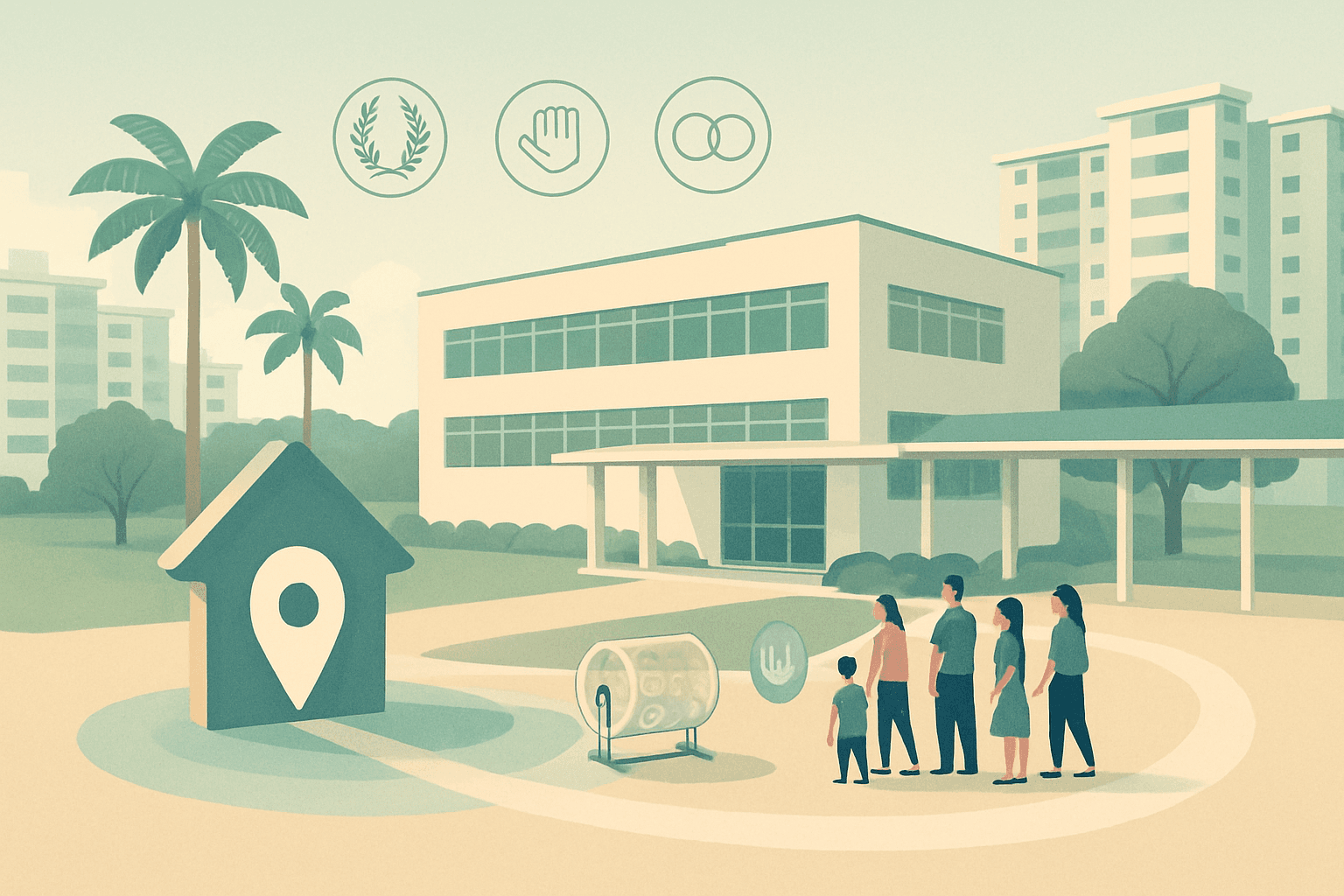
Yes, distance can still matter even if your child has alumni, volunteer, or affiliation priority. The practical rule is simple: priority can improve your position, but it does not remove the vacancy limit. If the school has enough places for that route, distance may not matter much. If the route is crowded, MOE may still need to sort applicants further and, in some cases, conduct balloting. This guide explains when distance matters, when it matters less, and how parents who live farther away should plan realistically.
Short answer: does distance still matter if you have alumni, volunteer, or affiliation priority?
Yes. Priority can improve your child’s position, but distance can still matter when the school is oversubscribed.
Yes. A school connection can put your child in a stronger route than families applying without that connection, but it does not remove the school’s vacancy limit. If the school has enough places for that route, home-school distance may never become decisive. If too many eligible families apply, MOE may still need to separate applicants further and some families may face balloting.
The simplest way to think about it is this: priority gives you a better queue, not a reserved seat. MOE’s home-school distance guide explains how proximity fits into the wider framework, and our full [/primary-1-registration-singapore-guide] shows where this sits in the overall P1 process. For a broader overview, see Primary 1 Registration in Singapore: How It Works, Balloting Risk, and How to Choose a Realistic School Plan.
All About Getting Priority Registration
You are talking abt whether a pv cum registered alumni have priority over a regiatered alumni if both stay outside 2km in phase 2a1, answer is no.
Questions on new rules of P1 registration
With the announcement of the new rules of P1 registration - that citizens now have advantage over PRs, I have 2 questions: 1. Does the living distance to the school matter (ie 1 km away)? 2. If the PR has an older child in the school already, is priority given to the child’s younger sibling? Thanks!
How Primary 1 priority pathways work in plain English
Priority moves your child into a more favourable route, but it does not automatically secure a place.
Parents often over-read the word “priority.” In P1 registration, it usually means your child can apply through a more favourable route, not that the school must take every eligible child.
In broad terms, alumni usually means a former-school connection, volunteer priority comes from recognised service to the school community, and affiliation comes from a linked-school relationship. These routes are not identical, so parents should not assume they work the same way in every phase. What matters is that each route sits inside a fixed-vacancy system. MOE also reserves places for later phases, so connected families are still applying within limited capacity, not an unlimited pool.
A useful mindset is this: priority affects where you enter the process, not whether the process still applies to you. If you want to understand the timing as well, our [/blog/primary-1-registration-phases-singapore] guide is the best next read. For a broader overview, see Primary 1 Registration Phases in Singapore: What Each Phase Means for Your Chances.
All About Getting Priority Registration
Even though you're an alumni, if you don't join the membership, you are only eligible for Phase 2A(2). If Phase 2A(1) is oversubscribed, you can't even register in Phase 2A(2).
All About Getting Priority Registration
Does anyone know if there's any priority for grassroots over PV parents in P2B? Or both have same priority? (assuming both are citizens and stay with 1km of the school) Thanks! :please:
Have More Questions?
Get personalized guidance on schools, tuition, enrichment and education pathways with AskVaiser.
Try AskVaiser for Free →When home-school distance matters less — and when it becomes decisive
Distance matters most when the school needs to separate similar applicants. It matters much less when your route already has enough places.
Distance matters less when there is no shortage to solve. If your child applies through a priority route and the school still has enough places for that group, living 600 metres away instead of 3 kilometres away may make no practical difference because the school does not need to separate applicants any further.
Distance becomes important when the school needs a way to separate otherwise similar applicants. MOE uses the address registered for P1, and its distance guide explains the official framework. In practical terms, distance works best as a sorting tool. It can help move a family into a stronger proximity band, but it cannot create vacancies where none exist. If families are already competing within the same band and there are still too many applicants, they may still face a ballot.
Example: a family with affiliation at a school that is not crowded may get in smoothly even if they do not live nearby. The same affiliation at a much more competitive school can still lead to uncertainty because the real issue is demand, not the label itself. If you want the distance piece explained separately, see [/blog/primary-1-registration-distance-priority-how-home-school-distance-works]. For a broader overview, see Primary 1 Registration Distance Priority: How Home-School Distance Works.
All About Getting Priority Registration
Dear experienced parents, may I check, if I am an alumni of a school but I am staying more than 2km from the school. Does it mean that my chances will be lower or as long as you are the alumni, it doesn’t matter where you stay?
All About Getting Priority Registration
Distance priority applies to all phases, but usually the number of vacancies is enough to cater for all applicants in Phase 2A. For your case, you don't need to volunteer as PV because if you can't get in under Phase 2A(1), your chance to get in under Phase 2B will be lower. It will be better to volunteer as PV in a different school, if you anticipate that Phase 2A will require balloting.
What happens when a school is oversubscribed
If there are more applicants than places, the school may need to ballot. Priority helps, but it does not make admission certain.
An oversubscribed school simply has more applicants than vacancies. This is where many parents become too confident. Qualifying for alumni, volunteer, or affiliation priority does not make the shortage disappear.
MOE states that balloting can take place from Phase 2A to Phase 2C Supplementary when there are more applicants than vacancies. MOE’s FAQ on former-primary-school admission also says clearly that even if a child can register through that route, a place is not guaranteed.
The parent takeaway is simple: once a route is crowded, the main question is no longer “Do we have priority?” but “How many other families have the same or stronger claim to this school this year?”. For a broader overview, see How to Read Past Balloting Data Before Chasing a Popular Primary School.
All About Getting Priority Registration
As for PV vs Grassroots, both equal opportunity at Phase 2B BUT if both fail at the ballots, PVs stand a higher chance in the the waiting list (appeal) than grassroots or clan members coz they directly served the school.
All About Getting Priority Registration
Actually, it depends on schools. Some schools will allow that if you pay to join their alumni. You need to contact the school to find out. I know an ex-classmate (who joined the school in Secondary only) and she managed to get into alumni and managed to get her gal a priority registration for the same affiliated primary school. Better to enquire from the school.
How balloting affects families who live nearer or farther away
Being near the school can help, but it does not make balloting disappear. Being farther away does not automatically cancel a priority route.
Living near the school helps only when the sorting stage still uses distance. It is not a universal shield once competition becomes tight. A nearby family can still miss out if the school has already narrowed applicants into a ballot pool and demand is still too high. A family living farther away is not automatically out if their child qualifies through a stronger route and there are enough places in that route.
This is why parents often compare the wrong things. A far-away family with a school connection may be better placed than a nearby family applying later without that connection. But if many families with that same connection apply, the far-away family can still face risk. In other words, proximity does not automatically beat priority, and priority does not automatically cancel balloting risk.
If you are trying to judge your odds, look at the school’s competition in your likely phase, not just the map. Community summaries such as this balloting risk overview can help you spot patterns, but treat them as context rather than a promise about your own year.
All About Getting Priority Registration
so far no difference, as balloting has only occurred for phase 2B and after. All applicants in earlier phases were 100% successful. The only school that had came very close to ballot in phase 2A2 was CHS, during registration exercise last year. CHS has increased the number of vacancies this year by 1 class.
All About Getting Priority Registration
Karl If u failing ballot in dream sch u will be in later phase later on but in your backup sch as dream sch no more vacancy for later phase aka p2cs. U will have priority over PR in registration in backup sch in p2cs but bear in mind that u may need to ballot it out with other citizens if your back up sch vacancy is limited in p2cs as a result of their popularity increase in the PR community as PR turn to these sch to secure a place at p2c to avoid balloting . Do note that there may only be a ha
Practical examples of alumni, volunteer, and affiliation cases
Outcomes depend less on the label alone and more on how crowded that route is at that school in that year.
Here are common scenarios that make the trade-off clearer. These are examples, not official MOE case studies.
An alumni family applies to a very popular former school and lives beyond 2 kilometres away. Their school connection gives them a stronger route than families without that connection, but many other alumni families also apply. The risk comes from crowding within that route. This pattern has been seen at popular schools; CNA has reported alumni parents still having to ballot.
A volunteer family applies to a school that is less crowded that year. They do not live especially near the school, but the volunteer route has enough space. In that case, distance never becomes the deciding issue because there is no oversubscription problem to solve.
A family with affiliation lives within 1 kilometre of the school and assumes the place is safe. But if many other affiliated families make the same choice, being nearby may improve their position without turning the school into a certainty. The mistake was treating proximity as a guarantee instead of asking how crowded the affiliation route is.
Another affiliated family lives farther away but targets a school that is well regarded without being heavily oversubscribed in that route. They get in smoothly. The lesson is that demand matters as much as labels.
All About Getting Priority Registration
No need... Alumni will register under P2A1. If not alumni, also can register under P2A2
All About Getting Priority Registration
I have friend who is alumni and did not serve the school actively. Worst, just joined alumni because the boy is due for p1 registration. NowI have a clearer picture of some alumni does contribute to the school actively.thus, they deserved to go to phase 2a. But for those inactive alumni, they should serve the school within a certain period of time in order to entitle phase 2a. No system is perfect but improvement is needed.
What parents commonly misunderstand about priority and distance
The biggest mistake is assuming priority means guaranteed admission or that distance always overrides everything else.
The biggest mistake is treating priority as automatic admission. Parents hear “alumni” or “affiliation” and mentally turn that into “safe school.” That is usually where disappointment starts.
The second mistake is assuming distance always wins. In reality, the process is layered. Your child may first be helped by the route they qualify for, and only then does distance become relevant if the school still needs to sort among too many applicants. If you assume living nearby cancels every other factor, you may misread your actual risk.
Parents also often lump alumni, volunteer, and affiliation together as if they behave exactly the same way. They do not. The useful question is not “Do we have some kind of priority?” but “Which route applies to us, how competitive is that route at this school, and what happens if too many families apply?”
One more blind spot is looking only at a school’s reputation instead of phase-specific demand. A famous school may be manageable in one route but highly risky in another. Our [/blog/how-to-read-past-balloting-data-before-chasing-a-popular-primary-school] guide can help you read those patterns more realistically, and [/blog/primary-1-registration-should-you-pick-a-popular-dream-school-or-a-safer-nearby-school] covers the bigger trade-off.
*** READ ME FIRST !!! - P1 Registration FAQ ***
If I’m a school alumni member, will I get priority when it comes to Phase 2C? I stay >2km away from the school. Thanks!
*** READ ME FIRST !!! - P1 Registration FAQ ***
If a vacancy arises soon after P1 registration ended, The parent (can be a PV, or can be from Phase 2A1 or 2A2 : who is seen by the school Principal to be active, serving and helping out at school activities) & whom the Principal know very well : the child will get the place. Not a stranger, whom the Principal doesnt even know or never met before. In life, sometimes is \"Who you know ...\" and also \"What exactly did you help out directly, in the school activities\", that count. (not Chief)
Important caution: priority is helpful, but it is not the same as certainty
Treat priority as helpful, not guaranteed, and use only a genuine address for registration.
Treat priority as an advantage, not a promise. If a school is popular, plan as though balloting is still possible. Also be careful with address assumptions. MOE says the registered home address must be true and accurate, and its home address guidance warns that if an address is used only to gain a registration advantage, the child may be transferred and parents may have no say in the new school placement.
*** READ ME FIRST !!! - P1 Registration FAQ ***
Can someone tell me if this rule is new starting from this year or was it around before? Extracted from MOE FAQ under Proximity to School FAQ 4. How long do we need to stay in the address used to register our child during the P1 Registration Exercise? In a small number of cases, there may be situations where the families are unable to remain at the address for the entire duration of the primary school studies. Even so, a child who gains priority admission into a school through his/her distance c
*** READ ME FIRST !!! - P1 Registration FAQ ***
Thanks for the info!!! So in the scenario if I fail in P2A1 (old boy with alumni), I can re-apply for P2A2 (old boy). Correct? I will be buying a property within 1km to the school to boost my chances in case of balloting. So just wanted to know how soon/late I need to buy and stay prior to registration.
What should parents do if they have priority but live far from the school?
Confirm your route, assess the school’s competition level, verify your address, and keep backup schools ready.
- ✓Confirm which priority route your child actually qualifies for and which phase that is likely to place you in. If you are unsure, start with [/blog/primary-1-registration-phases-singapore].
- ✓Check whether the school has been oversubscribed in your likely phase, not just whether it is generally considered popular. [/blog/how-to-read-past-balloting-data-before-chasing-a-popular-primary-school] is the useful next step.
- ✓Treat distance as a risk factor, not a guarantee booster. If you live farther away, plan on the assumption that you may still need a backup even with priority.
- ✓Make sure the address used for registration is genuine and supportable, and compare your situation with MOE’s home address rules and our [/blog/which-home-address-counts-for-primary-1-registration-in-singapore] guide.
- ✓Shortlist at least one or two backup schools you would realistically accept, then read [/blog/primary-1-registration-unsuccessful-what-happens-if-you-do-not-get-your-preferred-school] so you know what happens if your first choice does not work out.
- ✓Before the exercise opens, review the full [/primary-1-registration-singapore-guide] so your plan is based on current rules rather than old hearsay.
Have More Questions?
Get personalized guidance on schools, tuition, enrichment and education pathways with AskVaiser.
Try AskVaiser for Free →