
Primary School Commute Time in Singapore: How Far Is Too Far?
How to judge whether a school run is practical for your child, your schedule, and the full six-year primary school journey.
For primary school commute time in Singapore, there is no fixed distance or time that automatically makes a school too far. A school is usually too far when the route is hard to repeat every day because it is long, broken up, stressful, or difficult to support with your family's schedule. A farther school can still work if the journey is direct, predictable, and backed by reliable transport or care arrangements.
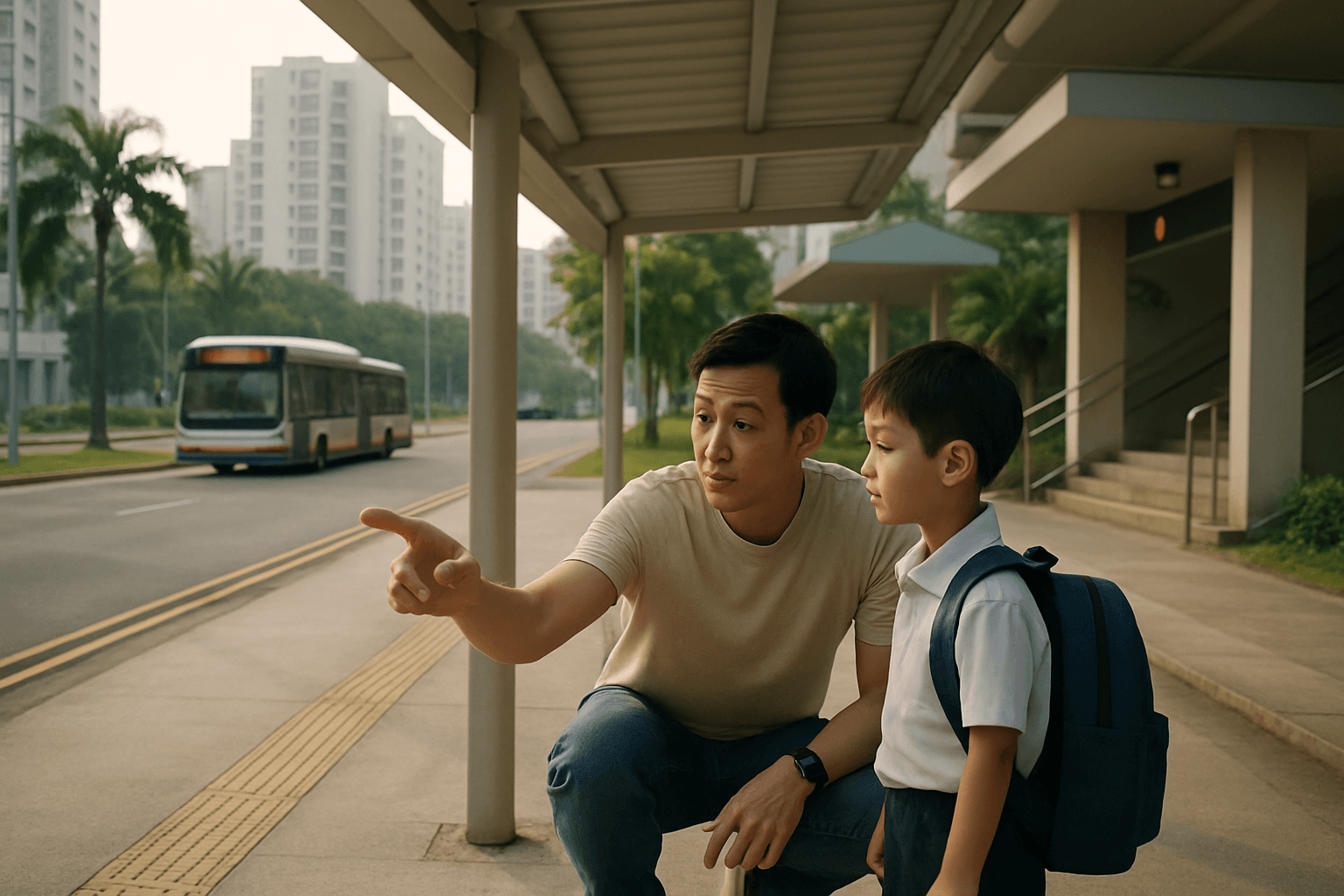
There is no official rule that says a primary school is "too far" after a certain number of kilometres or minutes. In real life, a school is too far when the daily journey is too long, too fragmented, or too tiring for your child and family to sustain comfortably. The best way to judge it is not by map distance alone, but by the full door-to-door trip: the walk, waiting time, transfers, pickup plans, rainy-day reality, and how the routine feels on an ordinary weekday morning.
What does "too far" really mean for a primary school in Singapore?
There is no official cutoff. A primary school is usually "too far" when the daily journey is too tiring, too complicated, or too disruptive for the child and family to sustain comfortably.
In Singapore, "too far" does not have an official universal definition for daily school travel. In practice, it means the route creates more strain than your child and family can comfortably repeat across the school week. That strain may come from a long ride, early wake-up times, multiple transfers, crowded transport, a difficult final walk, or the fact that an adult has to keep rearranging work and family routines around the trip.
A useful way to think about it is this: too far is a daily strain test, not a map test. A school can look close on paper but still feel far when your child has to wake very early, walk in bad weather, wait for transport, and arrive already tired. The reverse can also be true. A school farther away on the map may still be manageable if there is a direct school bus, a simple parent drop-off routine, or one easy public-transport leg.
The better parent question is not just "Can we get there?" It is "Can we do this calmly for six years?" If the answer already feels shaky during planning, that is usually more important than the distance shown on a map. For a broader overview, see Primary 1 Registration in Singapore: How It Works, Balloting Risk, and How to Choose a Realistic School Plan.
How far is too far?
I think distance is pretty important especially for a primary one student. He or she will be too tired from the travelling. So is the parent who has to do the ferrying. THe time could be spent on other more meaningful activities. Best balance is try to get into the best school within 5km of your house. Of course, there is no such thing as best, i should say the most optimal and balanced one in terms of academic performance, environment etc. Balloting may be required but you at least stand a chan
How far is too far?
My boy will only enter P1 in 2013. We're putting him in my hb's alma mater, which is NYPS. We stay in Punggol. I was also searching madly for more info on school bus. NYPS has a bus to pick up the kids in SK/PG area. Usually the kids board the bus at around 6.20am. Should be no problem for my boy as he is already used to travelling on daily basis. It's good for kids to have some 'daydream' time during the day. Usually, they'll end up playing on the bus. To save time, I intend to change to a scho
Should parents use distance, travel time, or door-to-door commute as the main measure?
Use the actual door-to-door journey as your main measure. Map distance is useful for registration planning, but it is only a starting point.
Use the real door-to-door commute as your main measure. Map distance is still relevant because parents often start with MOE's guidance on finding nearby schools and the home-school distance categories used in Primary 1 registration. But that registration distance is not the same thing as the commute your child actually experiences. News coverage on how distance is calculated for P1 registration also shows why parents often fixate on categories first, even though those categories do not tell you how the morning trip feels in practice, as The Straits Times reported.
What matters day to day is the full trip from leaving home to reaching the school gate. That includes the first walk, waiting time, the bus or MRT ride, transfers, traffic unpredictability, and the last stretch to school. A school that is 2 km away but needs a walk, a bus ride, an MRT transfer, and another walk may feel harder than a school that is farther away but has a direct school bus.
If you are weighing both admissions and daily life, separate the two decisions clearly. Distance can affect admission priority in some situations, while commute affects your child's routine every day. If you want the admissions side explained properly, see our guide on Primary 1 Registration Distance Priority: How Home-School Distance Works.
[Geylang] Primary Schools
For primary schools, I recommend going for convenience than popularity. Reason is the kids are still young, and travelling time should not be long enough to tire them out, even for those driving. Have you seen children dozing off in the parents car (some in an awkward position, especially straining their necks) because they have to wait up earlier than their peers to reach these “better” schools to feed their parents “ego”. Please note that the above is just my PERSONAL view as I have gone throu
[Bukit Timah] Primary Schools
if i have the powder, i may even ask MOE to have one more criteria on 500m - vertical distance first, then followed by horizontal distance by gazzetted road distance, not straight line distance in the form of radius from the school compound 1. these days there are so many high apartments, surely the one staying on ground floor is nearer than the one staying on the 50th floor 2. some houses on straight line is within 1 km from school, but on driving distance, due to road conditions and traffic ro
Have More Questions?
Get personalized guidance on schools, tuition, enrichment and education pathways with AskVaiser.
Try AskVaiser for Free →Do not judge a primary school commute by kilometres alone
Kilometres do not show how stressful the school run feels. The route itself matters more than the headline distance.
The shortest-looking school on a map is not always the easiest one to live with. The real burden often comes from waiting, transfers, crowding, wet-weather walking, heavy bags, and whether the journey depends on adults being available at exactly the right time. For a broader overview, see Primary 1 Registration: Should You Pick a Popular Dream School or a Safer Nearby School?.
Is Singapore’s education system too stressful?
Singapore is far from being too stressful compare to many other countries in Asia. Top schools in India are also very stressful and competitive.
[Bukit Timah] Primary Schools
Since all parents from all over SGP are willing to send their kids to the school, MOE should move the school to a more centrally location and build a SUPER CAMPUS, likes ITE Simei and ITE Choa Chu Kang, to accomodate the kids, so everybody will be happy......Just look at our Raffles family in Bishan.....
What commute patterns are usually manageable for primary school children?
Short, direct, and predictable routes are usually easier than journeys with multiple changes, long waits, or complicated final stretches.
The most manageable patterns are usually short, direct, and predictable. A direct school bus often works well because the child follows the same routine every day without handling transfers. A single public bus ride with a short walk can also be workable, especially when an adult accompanies a younger child or the route is simple enough for an older primary school child to learn over time. MRT can be fine too if it is straightforward and the final walk is easy.
What usually makes a route feel heavy is fragmentation. A child who has to switch from bus to MRT, deal with a crowded interchange, and then walk again is using more energy than a child on one uninterrupted journey, even if the total time looks similar. In many cases, a slightly longer single-seat ride is easier than a shorter trip broken into several parts.
Age matters, but not in a rigid way. A confident Primary 5 child may cope well with a simple public-transport routine. A Primary 1 child may find even a moderate journey draining if every step needs supervision. The best rule is simple: routine beats ambition. A modest route your child can handle calmly is usually better than a school choice that creates stress before lessons even begin. For a broader overview, see Popular Primary School vs Neighbourhood School in Singapore: Which Is Better for Your Child?.
Malaysian coming S'pore for Secondary School Education
My daughter is from JB and started her education in singapore since Primary 1. I suggest that u first go to the ICA building to apply for a student pass in order to study in singapore. Are u considering to live in singapore or let her cross the causeway everyday? it would be very tiring to choose the latter. the cca's will be very long and by the time ur child reach home, ur child won't even have the energy to complete ur homework. futhermore, sec schs in woodlands area is not very good. My P6 d
[Geylang] Primary Schools
for Kong Hwa Phase 2C - you need to be within 1 km, to ballot for chance. Haig Girls is \"All Girls\" school - your son can't go. go back to Yu Neng - your alma mater (Phase 2A) ring up Yu Neng school bus driver - find out how long travelling time to pick up your son from your home in Geylang Serai.
When does a bus or MRT commute become a problem for a young child?
Bus or MRT becomes a problem when the route is stressful, unsafe, or too broken up for a child to handle comfortably every school day.
A bus or MRT commute becomes a problem when the route is stressful, fragmented, or hard to repeat safely every day. Public transport itself is not the issue. Many Singapore families use it successfully. The difficulty starts when the child has to cross busy roads, stand through crowded segments, cope with uncertain waiting times, manage several transfers, or rely on an adult being available every morning and afternoon with no buffer.
This helps explain why some parents choose to drive even when the school is not extremely far away. In TODAY's reporting, parents cited practical reasons such as safety concerns, heavy bags, bus fees, and wanting their children to sleep longer. Those are not prestige issues. They are signs that the route itself feels too costly in daily life.
School bus arrangements can help, but they are not automatically simple. Pickup timing, route length, and drop-off setup vary by operator. Concerns about drop-off points and road safety have also surfaced in The Straits Times. If you are considering a farther school, one practical next step is to ask the school whether it can refer you to the bus operator. MOE notes that schools can do this in its FAQ guidance.
[Ang Mo Kio] Primary Schools
My girl will be enrolling in a primary school next year too. I feel where you stay will play a big part in deciding on which pri school your child will study at eventually. Why do we need to compare which primary schools your child will study in ? I think this create an unhealthy system in which most parents will strive to get their child into these perceived good schools. ( If they score well in those schools, it is expected of them but if they do not, these children will enter different second
[Bukit Timah] Primary Schools
Personally, I find the journey challenging on rainy days. Stress on both exam + rainy days. Are you sending your child to school next year? Some parents find it ok to sleep on school buses but i prefer to sleep in my own bed.
What signs show that a school is too far for your child even if the route looks okay?
Watch for fatigue, repeated complaints, rushed mornings, lateness, and lost sleep or rest. Those are often stronger signals than map distance.
The clearest signs usually show up in daily life, not on the map. If your child is regularly exhausted after school, starts dreading the trip, becomes unusually irritable on school days, or keeps arriving just on time because the route leaves no margin for delay, the commute may be too demanding. Another sign is hidden time loss. When the journey starts eating into sleep, breakfast, after-school rest, homework time, or general family calm, the school may be workable in theory but not in practice.
Many parents miss this at the start because the first few weeks can feel manageable while everyone is motivated. The better test is whether the routine still works on ordinary hard days: rain, heavier bags, a tired child, a delayed parent, or an afternoon when everyone is running late. If the plan keeps breaking on normal weekdays, it is not a strong plan.
A simple insight line helps here: if the commute keeps costing you bedtime, calm mornings, or your child's mood, it is probably too far in practice.
[Bukit Timah] Primary Schools
Sometimes this school thing is a big joke! I have Fairfield 1-2km from my house. No chance. Henry Park 1-2km from my house too. No chance! New Town will be backup for me if my gal really so suay at 2A2 and 2B. But 2B school very far away and student care is a problem cos no school-based one, must find outside the school. Sian. You are 1km from NYPS applying for 2C? For other schools, do you need student care after school? School bus? You will need to consider these as well.
[Serangoon] Primary Schools
ChiefKiasu Wrote [quote]4. And finally, there's the question of practicability. It wouldn't make sense for a child who stay at one end of the country spend hours travelling to a school on the other end of the country. Singapore may be small, but not that small. [/quote]With the sentence above, I believe the system still needs additional tweaking. 2A/2B in my opinion should not be abolished. However, there should be a limit set for 2A. Places after Phase 1 should be apportioned too, accordingly w
How do before-school care, after-school care, and fetch arrangements change the decision?
Strong care and fetch arrangements can make a farther school workable, while weak support can make even a shorter commute stressful.
These arrangements can change the answer completely. A farther school may still be realistic if your child has reliable before-school care, after-school care, or a stable bus-and-fetch routine that removes daily friction. In some families, the hardest part is not the morning journey but the handoff at the end of the day. A school can be geographically close yet still be stressful if a parent must rush from work for pickup with no backup plan.
The opposite can also be true. A longer commute may work well if the child takes a direct school bus, goes to student care near the school, and returns home in a predictable routine. Parents often focus on getting to school and underestimate the return leg, but afternoons are usually less forgiving because children are more tired and adults are more likely to be delayed.
Think of the school run as a full-day chain, not a one-way trip. The right school for your family is not just the one you can reach in the morning. It is the one that still works with your job schedule, backup caregivers, enrichment timing, and the occasional bad day.
Preschools prepared your kids well for Singapore primary?
For parents who have already been through the pre-school days and with kids now in primary schools (Singapore schools), can you share your comments on your kid's previous preschool and their curriculum - specifically if they have prepared your child properly for the Singapore education system ? (not discussing the international or foreign schools system here) Nowadays, there are so many pre-schools and childcare centres with many learning methods. Parents currently at the pre-school stage will b
[Toa Payoh] Primary Schools
Schools generally don’t prioritize distance in their selection of PV; it’s mostly what you can offer vs what they need. HOWEVER, if there’s a long record of balloting in Phase 2B for SC < 1km, it makes sense to factor in the distance. Otherwise, the school is just wasting the parent’s time and more importantly, depriving another PV of a chance (if the school has also limit the number of PV).
When is a far-away school worth the commute?
A farther school may be worth it if there is a strong reason for choosing it and your family has a realistic plan to sustain the routine for years, not just the first term.
A farther school can be worth it when there is a clear reason for choosing it and your family can support the routine for the long term. That reason might be a school culture that suits your child, a programme fit, sibling alignment, or a broader Primary 1 strategy. The mistake is not choosing a farther school. The mistake is choosing one without testing whether the daily logistics match real life.
If the school mainly appeals because of reputation, weigh that appeal against the transport burden honestly. Our guides on Primary 1 Registration: Should You Pick a Popular Dream School or a Safer Nearby School? and Popular Primary School vs Neighbourhood School in Singapore can help with that tradeoff.
A useful rule of thumb is this: the stronger the reason for choosing a far-away school, the stronger your daily plan needs to be. Before you commit, do a realistic route trial at school-run timing rather than relying only on a map app at a quiet hour. If the educational upside is meaningful and the route is calm, direct, and sustainable, the extra travel may be acceptable. If the reason is vague but the logistics already look hard, the commute cost may outweigh the benefit.
[Jurong East] Primary Schools
there are 4 primary schools within 1 Km from my place: Yuhua, Fuhua, Jurong East and Princess Elizabeth. for 2C, we’d like to try Princess Elizabeth, but I’m afraid if we are not lucky enough, we may not have the chance to go into any of the 4 schools. How can we stratigise so that we can try our preferred school? many thanks for the advices from experienced parents.
[Jurong East] Primary Schools
[Moderator's Note: For Balloting History of Jurong East schools, click http://www.kiasuparents.com/kiasu/content/jurong-east .] Im too having problems with my boy for next year P1 intake. I live in the west area. The schools which I aiming for is Princess Elizabeth but is too far from my place at Jurong East. Thought of putting him in Jurong Primary.. but not to sure if its a good school... Nevertherless... even Jurong Primary is more than 1km from my place.. you see... please help.. any suggest
Can I choose a primary school that is far from home in Singapore?
Yes, if the commute is safe, direct, and sustainable. No, if it creates daily strain that is likely to wear everyone down over time.
Yes, you can, if the commute is safe, predictable, and sustainable for your child and family. Many families do choose schools that are not the nearest option, and some do so for sensible reasons such as school fit, sibling plans, or a transport arrangement that works well.
What matters is whether the full routine works in ordinary life. Your child should be able to manage the travel without daily stress, and the adults should be able to support the timing without constant rushing or last-minute rescue plans. A farther school can work if the route is direct and stable. If getting there keeps draining sleep, mood, or family logistics, it is probably too far for your family.
If you are still deciding between school options, start with our broader Primary 1 Registration in Singapore guide so you can weigh commute together with admission chances and overall school-choice strategy.
[Serangoon] Primary Schools
Hi Parents, My elder son going to register for P1 this year. Currently, we are staying in sengkang. We are planning to try phase2B for nan chiau primary school (ncps) Chances of getting in is slim as we are staying between 1-2km. We are planning for the worst. We have shortlisted Northvista Primary for phase 2C. But my son needs to take school bus back to my mother-in-law place everyday bcos both my wife and myself are full time working parents. My mil leave in hougang which is considered 1-2km
[Bukit Timah] Primary Schools
Your choices are all over Singapore! Where do you stay? Isn't there a good school nearer your home? It's tiring for the child to travel so far everyday.
Have More Questions?
Get personalized guidance on schools, tuition, enrichment and education pathways with AskVaiser.
Try AskVaiser for Free →