
How Sibling Priority Works in Primary 1 Registration in Singapore
A practical guide to where sibling-linked priority fits in MOE’s Primary 1 process, and where it does not.
In Singapore Primary 1 registration, sibling priority usually means a younger child may be able to register at the same school through Phase 1 if an older sibling is already enrolled there. That is helpful because Phase 1 comes before the later phases where vacancies, distance and balloting matter more. But parents still need to register properly, watch the timeline, and check whether their family situation fits the current MOE rules.
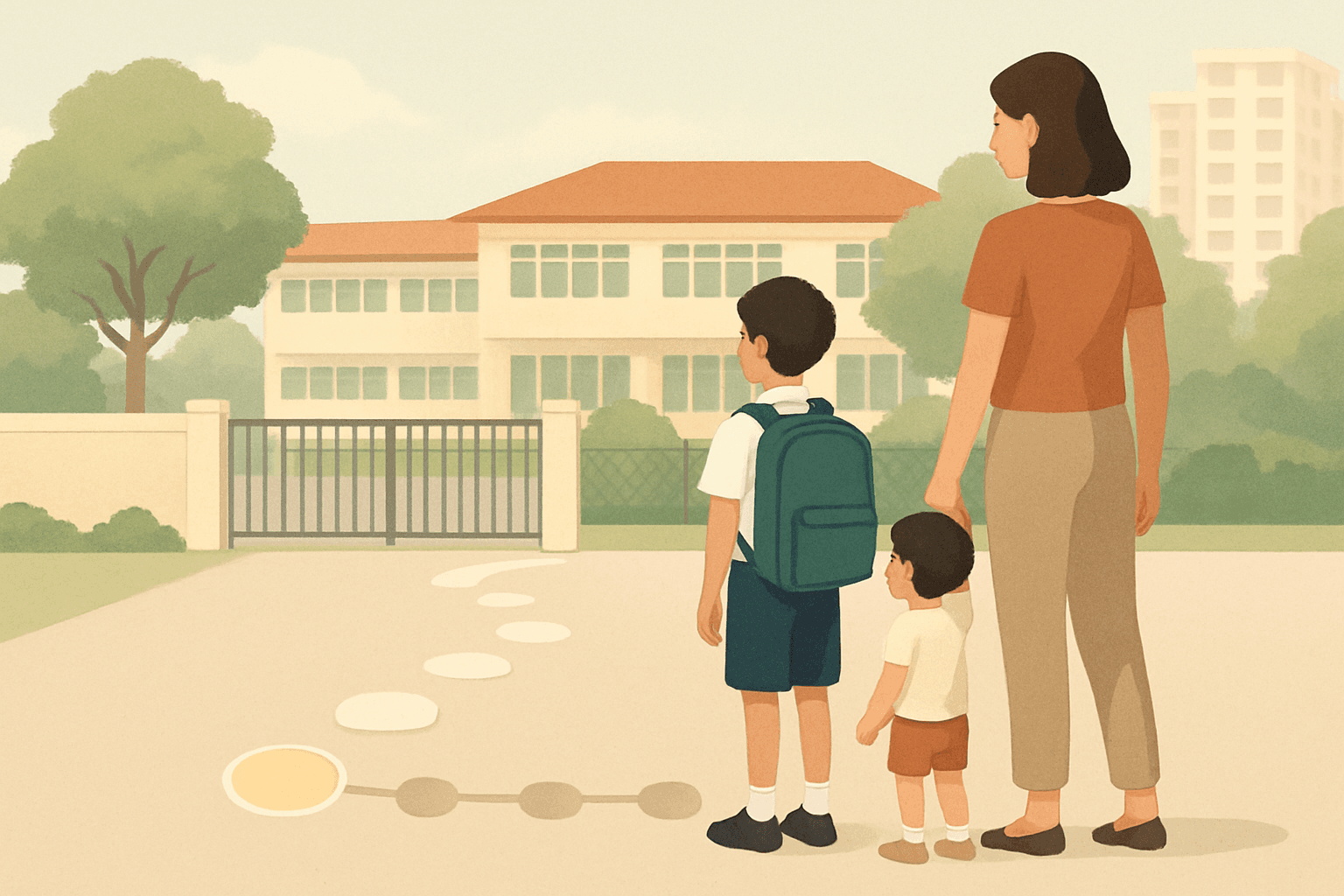
Sibling priority can make Primary 1 registration much less stressful, but it is not a separate admissions system. In most cases, it means a younger child may be able to register at the same school through Phase 1 if an older sibling is already enrolled there. That earlier route matters because it reduces exposure to later vacancy-driven competition. This guide explains where sibling priority fits, what it helps with, and what parents still need to plan for. If you want the full phase-by-phase picture, start with our Primary 1 registration guide.
What is sibling priority in Primary 1 registration?
It is the advantage that may let a younger child register earlier at a school where an older sibling is already enrolled.
Sibling priority is the advantage that may let a younger child register at a school where an older sibling is already enrolled. In practical terms, it usually means the younger child can use the sibling-linked Phase 1 route for that school.
A simple example: if your older child is already in School A and your younger child is starting Primary 1, sibling priority may let you apply to School A earlier than families who must wait for later phases. For many parents, the benefit is not only admissions-related. It also means one school run, one set of notices, and fewer transport arrangements.
The easiest way to think about it is this: sibling priority gives you an early-process advantage inside MOE’s system. It does not mean the school is automatically reserved for your family in every situation. For a broader overview, see Primary 1 Registration in Singapore: How It Works, Balloting Risk, and How to Choose a Realistic School Plan.
Give citizens priority in Primary 1 registration
Ha.ha. maybe next time the P1 registration phase can propose like that, just a suggestion: Phase 1 – Existing siblings in the Primary school except PR siblings. Phase 2A(1) – No Change Phase 2A (2) – No Change Phase 2B – No change Phase 2C – Singapore Citizenship Only. Phase 2C Supplementary - Singapore Citizenship Only Phase 3A – Permanent Residents Phase 3A Supplementary - Permanent Residents Phase 4 – Non Citizen.
All About Getting Priority Registration
the changes made relates only to SCs over PRs. in each of the particular phase. see below: http://www.moe.gov.sg/media/press/2012/03/seven-new-primary-schools-for-2013-and-further-differentiation-and-outreach-at-p1-registration.php all the best to all for coming year registration.
Which MOE registration phase does sibling priority apply to?
It usually applies to Phase 1, the earliest stage of the MOE Primary 1 registration exercise.
It usually applies to Phase 1, the first stage of MOE’s Primary 1 registration process. MOE’s process runs through five phases: Phase 1, 2A, 2B, 2C and 2C Supplementary, and the sibling-linked route sits right at the start.
That timing is what makes it valuable. If your child qualifies for the sibling-linked route, you are not waiting to compete in later phases where vacancies are tighter and balloting becomes more relevant. MOE’s registration page sets out the overall structure, and The Straits Times has reported Phase 1 as the stage for children whose siblings are already enrolled in the school.
If you want the broader system in one place, our guide to Primary 1 registration phases in Singapore explains what each phase means for your chances. For a broader overview, see If Your Older Child Is Already in the School, Does Your Younger Child Automatically Get In?.
All About Getting Priority Registration
Yes, all phases remain the same. And PRs in earlier phases still get in before SC in subsequent phases. The SC priority over PR only applies within the same phase.
All About Getting Priority Registration
u might want to check out this website, http://www.moe.gov.sg/education/admissions/primary-one-registration/
Have More Questions?
Get personalized guidance on schools, tuition, enrichment and education pathways with AskVaiser.
Try AskVaiser for Free →How much does sibling priority actually help?
It helps most by moving your child into the earliest route and reducing the uncertainty that comes with later phases.
It helps mainly by moving your child into the earliest route. That reduces uncertainty because you are not depending on the later phases, where places can tighten and parents start worrying more about oversubscription and balloting.
The other big benefit is practical. For many families, having siblings in the same school means one morning routine instead of two, fewer pickup arrangements, and less confusion around calendars, dismissal times and school updates.
A realistic comparison helps. If the older child’s school is close to home and already works for the family, sibling priority can make the decision straightforward. If the school is far away and the daily commute is tiring, the sibling link is still useful, but it may not be worth years of difficult travel. If the younger child would otherwise enter a popular school only in a later phase, the sibling-linked route can remove a lot of stress.
A good rule of thumb is this: sibling priority helps most when it improves both your registration position and your daily routine. For a broader overview, see Primary 1 Registration Phases in Singapore: What Each Phase Means for Your Chances.
All About Getting Priority Registration
http://www.straitstimes.com/BreakingNews/Singapore/Story/STIStory_579675.html \"THE current Primary 1 registration process will not be changed to give higher priority to children living very near to their school of choice - even if they live right across the street from it.\" :stupid: :stupid: :stupid: :stupid: Sad lah....
Give citizens priority in Primary 1 registration
How about a scheme where advantage points will be given. Such that if both parent are citizen, then awards like 20 points, then if completed NS, some more points, and etc. Scheme can be defined to include like sibling same school, PV, community work, stay near home, and etc and etc. . The more points you get put you higher for prioirty for the school of your choice. . .anymore new ideas, we have to help those civil servants to think I guess. .
What counts as a sibling for P1 registration?
The usual case is an older sibling already enrolled in the school, but the sources here do not define every family arrangement.
The sources here clearly support the core case: an older sibling already enrolled in the school. They do not provide a full official definition covering every family arrangement, so parents should not assume that every sibling-like relationship will be treated the same way.
That matters most in non-standard situations such as blended families, guardianship arrangements, or other family setups where the relationship is clear at home but may need to be checked against the registration rule. The practical step is simple: verify the current year’s wording on the MOE Primary 1 registration page before you rely on sibling priority in your school plan.
If the wording is still unclear, ask the school early enough to adjust your plan. The key questions are straightforward: does the older child count as enrolled for this exercise, and does your family’s arrangement fit the live rule for the year? For a broader overview, see Primary 1 Registration Unsuccessful: What Happens If You Do Not Get Your Preferred School.
All About Getting Priority Registration
When the actual P1 registration starts, you will receive, via your elder child, the formal registration form (the one with carbon copies) from the school. Fill in the form and ask your elder child to submit to the school. The form that you mentioned is something like an \"expression of interest\". The form that you will receive is the formal application. However, as you have already submitted the necessary documents to the school, you need not submit these documents again. Phase 1 will start on
All About Getting Priority Registration
As long as can prove that you had ever studied in that ex primary school before previously, can enrol your child into that school, under Phase 2A2. Reason : There is no rule stating minimum must stay there how many years. Thus even if you had studied only one year there, got report card to prove this, can proceed to enrol your child under 2A2.
What sibling priority does not do
It does not let you skip the process, miss the timeline, or assume a place outside the relevant MOE route.
Sibling priority is not a free pass. It does not let you skip registration, register late, or assume that any sibling connection anywhere in the school system will count.
Think of it as a strong advantage inside MOE’s process, not a shortcut around it. If you want the automatic-admission question answered directly, see If Your Older Child Is Already in the School, Does Your Younger Child Automatically Get In?.
All About Preparing For Primary One
according to MOE, no need for P1 preparatory class, they stress many times, and they said all kindergarten should be able to prepare the child to primary 1… but parents are too kiasu they prepare them for P1… by the time these kids go to P1, they know most things so those din go to such classes, felt left out and their parents also will send them to classes… never ending… sigh…
All About Getting Priority Registration
If your child qualifies under P2B, he or she will still have to wait till all Singaporeans who qualify under P2B get their places in the school.
What happens if the school is oversubscribed?
Later phases can go to balloting if demand exceeds places, which is why the earlier sibling-linked route is such a meaningful advantage.
Oversubscription matters mainly in the later phases. MOE explains that balloting can happen in Phases 2A to 2C Supplementary when applications exceed vacancies, as set out in its guide to understanding balloting. When that happens, citizenship and home-school distance become important, as explained on MOE’s distance page.
That is why sibling-linked Phase 1 matters so much. It places your child earlier in the process, before those later vacancy pressures become the main issue. A family using the sibling-linked route is approaching the same school from a stronger starting point than a family waiting for 2C or 2C Supplementary at a popular school.
A realistic example helps. Imagine a heavily sought-after school. A family without sibling priority may only get a chance after many places have been taken, and then distance and balloting risk start to matter much more. A family using sibling priority is less exposed to that pressure because the application happens earlier.
MOE also says that if a child is unsuccessful in a phase, the child can register in the next eligible phase. After Phase 2C Supplementary, children who still do not have a place are posted to a school with vacancy. That is set out in MOE’s FAQ.
All About Getting Priority Registration
Hi, I am referring to the Singaporean priority system now. If I am balloted out from phrase 2C and I ended up in 2C supp for another school, will I still have priority over PR for the alternative school? Or that alternative school will admit the PR first in phrase2C and the remaining places in 2C supp will be whatever is left after PR got in in phrase 2C? Am trying to have back up plans in case I am balloted out of my preferred school. If 2C supp is the remaining places after PR got their places
All About Getting Priority Registration
I am a former pupil of a primary school that I am trying to get my son into. However I only studied in that primary school from Primary 1 to 3. Am I still considered a former student of the primary school and qualify for Phase 2A? Also about giving Singapore Citizens priority. If my son is PR, and qualify for Phase 2A. Will he get priority of entry over SC in Phase 2B?
Should parents choose a school mainly because of sibling priority?
Treat sibling priority as a practical advantage and risk-reduction factor, not the only reason to choose a school.
Use sibling priority as a strong tie-breaker, not the only reason to choose a school. It is most useful when the older child’s school already works for the family in terms of commute, routines and overall fit.
MOE’s guidance on how to choose a school encourages parents to balance the child’s interests with travel time and distance. That advice matters here. If the school is far from home, if the younger child has different needs, or if transport is already a daily strain, sibling priority may still be helpful without being decisive.
Three common parent situations make the trade-off clearer. If the older child’s school is nearby and the family is happy there, sibling priority can be a sensible reason to keep both children together. If the school is popular but far, parents should ask whether the appeal of that school is worth years of tiring travel. If the older sibling will leave soon after the younger child starts Primary 1, the practical benefit of shared routines may last for a shorter time than expected.
The simplest insight is this: sibling priority reduces friction, but it should not replace school fit. If you are deciding between continuity and a more realistic nearby option, our article on popular dream schools versus safer nearby schools can help you think it through.
All About Getting Priority Registration
If I studied at the secondary school, can my child have priority during the registration for the primary school? For example, if I studied at ACS Secondary but didn’t study at the primary school, would I be considered under the phrase 2A2? Thanks.
All About Getting Priority Registration
Y dun u move nearer to NYPS? Btw lets wait for the MOE to announce if there are any changes for the Phase. If not, normally under P2A2 can hv 99% get a place. No need to pay $1000 to join alumni for P2A1
Common mistakes parents make about sibling priority
Parents often overestimate it by treating it as automatic, universal, or enough on its own.
The biggest mistake is treating sibling priority as automatic. Parents also often assume it works in every phase, overrides other rules, or removes the need to think about commute, popularity, vacancies and backup options.
Another easy mistake is focusing only on admissions and ignoring family life. The point of having siblings in one school is not just that the route may be stronger. It is that the arrangement should actually make daily life easier for the child and the adults handling the routine.
Remember this line: sibling priority helps, but it does not remove the need for a plan.
All About Getting Priority Registration
With increased population now, there is reason to ask for priority for Singaporean kids rather than priority for those with 3 children.
Coping with Primary 1
Dear parents, I hope parents could share your experience regarding the preparation for primary school and time schedule spend with your kids. I have a son of 6 this year going to P1 next year. I would like to find out with parents things that you are doing with your child prior going P1, cos I do not want to react too kan-jiong or too relax in front of my child. I am particularly concerned about the 3 main subjects being taught in P1 and wonder should I expect him to be able to do the assessment
What should parents prepare if they plan to use sibling-linked priority?
Confirm the school, confirm the phase, and get your registration details ready before MOE opens the exercise.
- ✓Confirm that your older child is already enrolled in the school you want to use for sibling-linked priority.
- ✓Read the current year’s MOE Primary 1 registration page early so you know when the online exercise opens and which phase applies.
- ✓Keep your younger child’s basic particulars and your family’s address details ready before registration starts.
- ✓If your family situation is not straightforward, clarify the sibling relationship point with the school early instead of assuming it will be accepted.
- ✓Keep common records ready, such as identity details and address-related documents, because the exact records needed can differ by case.
- ✓Review MOE’s distance guidance so you have a backup plan if you need one.
- ✓Decide in advance which alternative school you would use if the sibling-linked route does not apply or if you miss the relevant registration window.
- ✓If you want a broader prep list, see our [Primary 1 registration documents checklist](/blog/primary-1-registration-documents-checklist-what-singapore-parents-commonly-prepare) and [which home address counts for Primary 1 registration](/blog/which-home-address-counts-for-primary-1-registration-in-singapore).
Have More Questions?
Get personalized guidance on schools, tuition, enrichment and education pathways with AskVaiser.
Try AskVaiser for Free →