
How to Choose an FSBB Subject Mix for Your Child
Practical examples for Singapore parents deciding how to balance strengths, weaker subjects, and future pathways under Full Subject-Based Banding.
A good FSBB subject mix matches your child’s real strengths, keeps the workload sustainable, and does not let one weak subject drag down the whole package. In practice, that often means taking stronger subjects at a higher level only where there is clear evidence of readiness, while keeping shakier subjects at a safer level. The aim is not an impressive-looking combination. It is a combination your child can carry through Sec 3 and Sec 4 while keeping realistic options for JC, polytechnic, or ITE open.
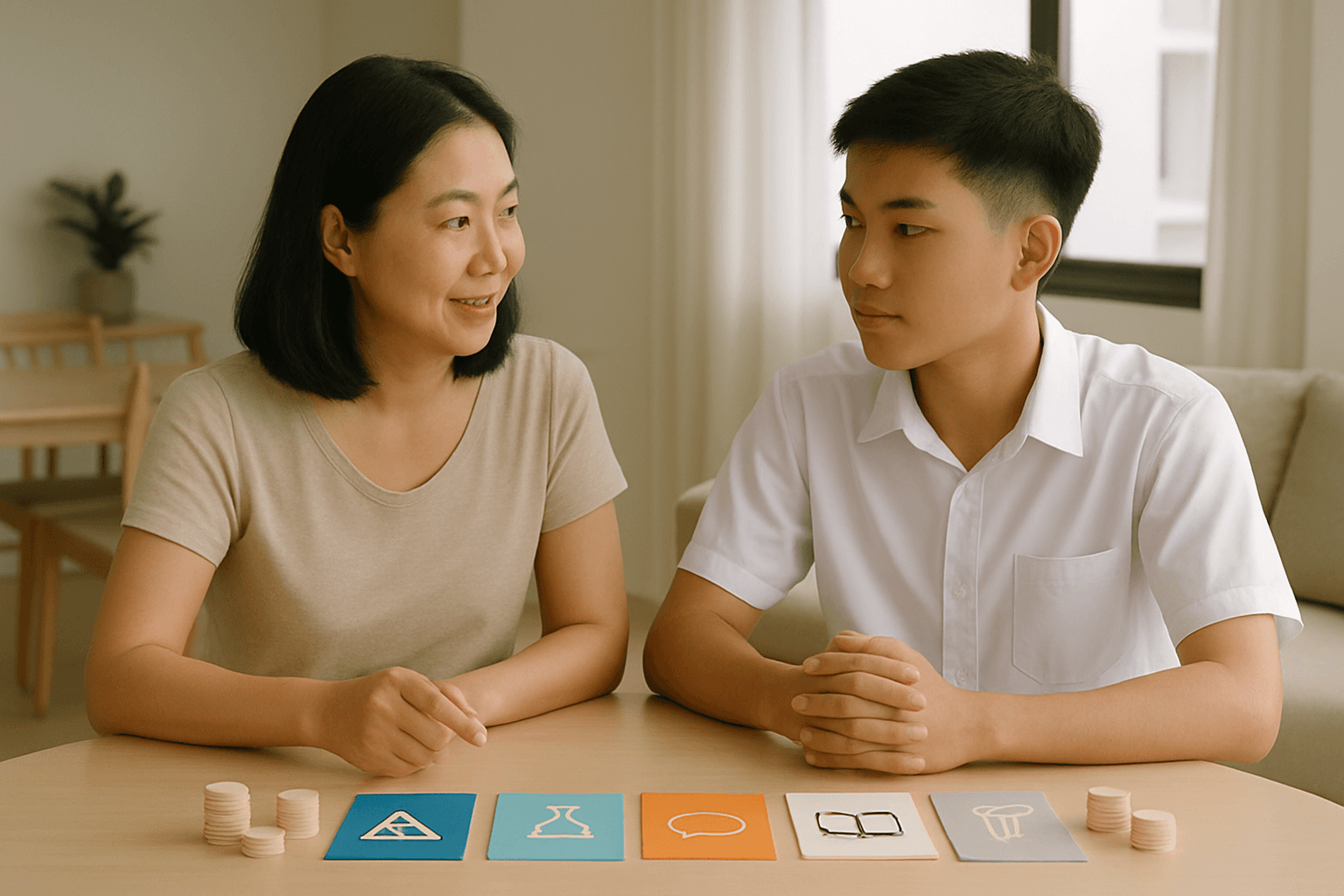
Choose the mix your child can manage well across all subjects, not the mix that looks strongest on paper. Under Full Subject-Based Banding, that often means stretching clear strengths such as Math, Science, English, or Humanities, while keeping weaker subjects at a safer level so workload, confidence, and exam performance do not suffer. This guide shows what that can look like for STEM-leaning and humanities-leaning students, and how to think about O-Levels and later pathways.
What is a good FSBB subject mix for a secondary school student?
A good FSBB subject mix matches your child’s real strengths, keeps the workload manageable, and still preserves future options. It is not the most ambitious-looking combination on paper.
A good FSBB subject mix is one that fits your child’s real profile, not one that simply looks more advanced. Under Full Subject-Based Banding, students can take subjects at different levels so learning better matches their strengths, interests, and needs, as explained by MOE and Schoolbag. In plain terms, your child does not need to be equally strong in every subject to have a sensible combination.
The key is to treat this as a full-package decision. If your child is clearly strong in Math and Science but only steady in English or Humanities, a sensible mix may stretch the STEM subjects while keeping the weaker areas at a level the child can manage. That is often better than pushing everything up and spending the next two years trying to rescue one struggling subject.
A simple way to think about it is this: the best mix is the one your child can sustain. A sustainable mix usually leads to steadier revision, less panic around weak subjects, and a healthier final exam profile.
If you are still getting familiar with the system, start with What Is Full Subject-Based Banding in Singapore? and What Do G1, G2 and G3 Mean in Secondary School?.
Time to ponder -- Subject-Based Banding (SBB)
Time to ponder -- Subject-Based Banding (SBB) Subject-Based Banding (SBB) will be implemented from the 2008 P5 cohort. It will replace the merged and EM3 stream. Depending on their performance in P4, students will be streamed into classes taking 4 standard classes with Higher Mother Tongue(HMT) , 4 standard subjects or a combination of standard and foundation subjects. Are these equivalents to the earlier EM1, EM2 and EM3? 4S + HMT --> EM1 4S --> EM2 Combination of standard and foundation subjec
SUBJECT OPTIONS IN SECONDARY SCHOOL
My dd also just had to select her subject combi. Our discussion on it was based on what subjects she liked and had an inclination towards and her career aspirations (or rather what she thought she didn’t think she aspired to be). She said she didn’t enjoy Physics and History, altho she has done well in them so far. She enjoyed Biology, Chemistry, Geog and Literature, and wanted to continue pursuing those subjects. We finally settled on going with the subjects that she enjoyed. So I wld say in dd
How do I decide whether to stretch a strong subject or protect a weak one?
Use current performance, workload capacity, and teacher feedback to decide. If a subject is only borderline strong, staying at the safer level is often the better long-term move.
Start with evidence, not hope. The first question is not whether your child seems generally bright. It is whether your child is already consistently coping well in that specific subject. A student can be ready for harder Math and still be shaky in English comprehension, essay writing, or source-based Humanities work. Subject-by-subject readiness matters more than overall impression.
A stretch usually makes sense when three things line up. Your child has shown a steady pattern of doing well in that subject, can handle harder work without other subjects slipping, and the school agrees the move is realistic. If one of those pieces is weak, the safer level is often the smarter choice.
For example, a student who regularly finishes Math papers confidently, enjoys problem-solving, and is coping well in Science may be a good candidate for a higher level in those areas. By contrast, a child who is only just managing in English with a lot of coaching may not benefit from a harder language workload just because the rest of the report book looks strong.
What parents often overlook is the spillover effect. One over-levelled subject can take revision time away from everything else. If your child spends most of the term trying not to fall behind in one subject, the whole package can weaken. Stretch where there is clear headroom. Protect where the child is already working hard just to stay afloat.
If you want a more detailed subject-by-subject framework, How to Choose Between G1, G2 and G3 for Each Subject goes deeper.
Factors to consider when choosing sec school
For me, when I picked my sec school about 3 years ago, the biggest concern was location. Try not to pick a school that requires more than 45mins of travel, since that will roughly amount to 1.5hrs of travel a day, and ur child will probably be really tired after school, CCA and what-not. You should also consider whether to choose a co-ed or boy/girl school, depending on how your child reacts in different environments. If he/she was in a co-ed Pri school and was comfortable w the opposite gender,
Which subject combination?
I would say discuss with your child on his inclinations and interest but let him have the final decision. I've gone through this process the hard way where my parents decided that I take the 3 pure sciences and double maths combi based on my lower sec scores and it nearly killed me as I hated maths and physics.
Have More Questions?
Get personalized guidance on schools, tuition, enrichment and education pathways with AskVaiser.
Try AskVaiser for Free →What FSBB subject mix usually suits a STEM-strong child?
For a STEM-strong child, it often makes sense to stretch Math and Science first while keeping a weaker language or humanities subject at a safer level.
For a STEM-leaning student, the usual pattern is to stretch Math and Science first, then be more careful with English or Humanities if those are weaker. That does not mean every STEM-strong child should take every possible STEM subject at the highest available level. It means the stronger side of the profile should do more of the lifting.
A realistic example is a child who is consistently strong in Math and Science, understands abstract concepts, and is not struggling with pace. In that case, it may make sense for Math and Science to be taken at a higher level while English or Humanities stays at a safer level. Another common example is a child who is excellent in Math, solid but not outstanding in Science, and clearly weaker in essay-based subjects. Here, the balanced move is often to stretch Math first, possibly Science too, but not to force English and Humanities up just for symmetry.
There is also the student who looks STEM-strong but has one hidden pressure point, often English. That matters because weak language skills can affect more than one paper. If a child can think well in Science but struggles to read questions accurately or explain answers clearly, the wiser FSBB subject mix may still keep English at a more secure level while STEM strengths are stretched.
Insight line: being strong in STEM does not mean being equally strong in everything academic. The goal is not to prove all-round strength. The goal is to build a package that produces good results across the board.
MOE has described mixed combinations under subject banding, including examples such as five G3 and two G2 subjects, rather than one fixed menu for all students. Schools may still structure offerings differently, so treat examples like these as planning models, not guaranteed combinations in every school. For more on mixed levels, see Can Students Take Mixed Subject Levels Under FSBB?.
FSBB (Full Subject-Based Banding)
During lower sec. my children school offers quite a wide spread of subjects at basic level. I suppose that is when students get to have a taste of different domains, and then decide their preferences at the end of Sec 2, before stream selection in Sec. 3? The subjects includes the basics like math, Chem, physics and bio; literature Eng and Chinese , Geo, history, basic music, art, Malay language, design technology. Not sure about other schools, but this is an existing model to expose students at
Combination of subjects for secondary three
Actually, the best choice would be 2 humanities and 2 science subjects. This offers the best chance of securing a good L1R5 score because it gives a backup should one subject screw up.
What FSBB subject mix usually suits a humanities-strong child?
For a humanities-strong child, stretch English, Literature, or Humanities where the evidence is there, and keep Math or Science realistic if those subjects are shakier.
For a humanities-leaning student, let strengths in English, Literature, or Humanities carry more weight, while keeping Math or Science realistic if those are weaker. A child who reads widely, writes clearly, handles source-based questions well, and participates confidently in discussion may benefit from stretching those language-heavy areas.
One typical example is a student who is strong in English and Humanities but becomes uncertain once Math questions get more abstract. In that case, a sensible mix may keep English and Humanities at a higher level while Math stays at a safer level. Another example is a child who writes well and understands content deeply but is slow and error-prone in Science calculations. Protecting Science may support a stronger overall result than insisting on a more even-looking profile.
Parents sometimes worry that this looks unbalanced. Under FSBB, that is the wrong way to think about it. The system is meant to reflect different subject strengths. A child does not need the same level in every subject to have a strong academic pathway.
A common mistake is trying to make a humanities-strong child look more STEM-balanced by over-pushing Math. If the child has never shown secure mastery there, the harder level can become the subject that drains time and confidence. In many cases, it is better for the child to be excellent in strong areas and stable in weaker ones than overstretched everywhere. For a broader overview, see How G1, G2 and G3 Subjects Work for O-Levels.
Poor Humanities Subjects. How to Improve?
My DS just got back his final SEC1 Result. The humanities subject such as Literature, History and Geography are poor. Any advise how to improve these humanities subject? And understand that it is not easy to get good humanities tutor to advise him on these subject. Not too sure whether there is any special study method for these humanities subject. Appreciate if anyone can advise.
Humanities subjects for Science course
Some links on why choose a particular humanities subject: History https://www.schoolbag.sg/story/why-study-history-as-a-humanities-subject Literature https://www.schoolbag.sg/story/why-study-literature-as-a-humanities-subject Geography https://www.schoolbag.sg/story/why-study-geography-as-a-humanities-subject?utm_source=facebook&utm_medium=cpc&utm_campaign=2018-september
Which subject should parents usually avoid over-levelling?
Usually the weakest subject, because it carries the highest stress and grade risk.
Usually the weakest subject. That is often the subject most likely to become a long-term stress point, consume too much revision time, and pull down the full result.
For example, if a child is cheerful and capable overall but becomes error-prone and discouraged once Math papers get harder, pushing Math up may create more harm than benefit. In that situation, stretching a stronger subject instead is often the better move.
Insight line: do not use your child’s weakest subject to prove their potential. Use their strongest subjects to build momentum. For a broader overview, see Can FSBB Students Go to Junior College? Entry Requirements Explained.
How does an FSBB subject mix affect O-Level performance?
Mixed subject levels change the workload and revision strategy, so parents should judge the whole package, not one subject in isolation.
An FSBB subject mix affects more than labels. It changes workload, revision time, and how much energy your child has for each paper. A package with too many harder subjects may look strong at the start but become difficult to sustain when several content-heavy subjects peak at the same time.
The practical question is not just whether your child can pass a harder subject. It is whether your child can do well enough across the whole combination. A student who takes stronger subjects at higher levels and keeps weaker ones at safer levels may finish with a better overall exam profile than a student who over-stretches and spreads revision too thin.
MOE has signalled that mixed G1, G2, and G3 combinations should be considered fairly as students move towards post-secondary pathways, as noted in its Committee of Supply response. For parents, the immediate takeaway is simpler: choose a package your child can prepare for steadily over time.
A realistic comparison helps. One child takes a slightly less aggressive mix and stays steady in every subject, leaving room for revision and recovery. Another child takes too many harder subjects and spends Sec 3 and Sec 4 firefighting one or two problem areas. In real life, the first child often reaches the exam with a calmer and more usable result profile.
If you want the exam side explained more directly, How G1, G2 and G3 Subjects Work for O-Levels is the next useful read.
Perfect Formula for Choosing H1/H2 Subjects
We have run a massive computer simulation taking data from every student that has graduated JC over the last ten years, plugging in which subjects they chose, taking into account H1, H2 or H3 selection and cross referencing their admission to a top University. We have included the trend of difficulty and percentage of A-Level A1 scores for each subject. The result of this simulation has produced a formula which will give you a 91.6% chance of University admission if you follow the following form
Secondary 3 Subjects
Only your school principal and teachers can advise you on this. as different schools have different practices. Have you checked with them? I know some schools allow their students to appeal after the initial posting is out. Do your school has such appeal process and have you try appealing?
How should parents think about JC, polytechnic, or ITE when choosing a mix?
Keep likely pathways in mind, but prioritise a sustainable mix that does not close doors unnecessarily.
Choose the mix with the likely next pathway in mind, but do not assume you need a fixed life plan in Secondary 1 or 2. The practical goal is not early specialisation. It is avoiding a subject mix that unnecessarily narrows options later.
If JC is a serious possibility, be careful about allowing key academic subjects to become long-term weak points. If polytechnic is the more likely route, subject strengths and the overall exam profile still matter, and some courses may later care about certain foundations. If ITE is part of the realistic discussion, the focus should still be on choosing a combination your child can complete confidently rather than chasing levels that do not improve readiness.
The source material here does not give a fixed official checklist covering how every post-secondary route evaluates every mixed-level combination. So the useful parent move is to work backwards from likely scenarios. Ask whether this mix keeps your child broadly credible for the routes you are considering. If the answer is yes, and the workload is sustainable, that is usually better than an impressive-looking mix that leaves your child underperforming.
A good question for school consultations is this: if my child keeps this mix and performs reasonably well, what pathways are still realistically open? That often gives you more useful guidance than asking for a perfect prediction.
For broader pathway context, see Can G1 or G2 Students Still Go to JC, Poly or ITE?, Does Taking G1 or G2 Limit Future Options Later?, and Can FSBB Students Go to Junior College? Entry Requirements Explained.
What mistakes do parents make when choosing an FSBB subject mix?
The biggest mistakes are choosing for status, copying peers, and pushing too many subjects up without checking readiness.
The most common mistake is choosing for status instead of fit. Some parents still think in old stream terms and feel pressure to make the child’s mix look as high as possible. Under FSBB, that can backfire because subject levels are supposed to reflect real differences in strength.
Another mistake is copying another child’s combination. A friend’s child may thrive with a more demanding Math and Science profile because that child has both aptitude and stamina there. Your child may be just as hardworking but much stronger in English and Humanities. The same-looking mix can produce very different outcomes.
A third mistake is over-focusing on one strong subject while ignoring the rest of the package. For example, a parent may be excited that the child can handle higher-level Science and then push several other subjects up as well, even though English is already fragile. That usually creates a lopsided workload, not a stronger outcome.
There is also a softer mistake that matters: assuming effort alone can solve poor subject fit. Hard work matters, but FSBB choices should still be based on demonstrated readiness. When a child has never been secure in a subject, asking them to simply work harder at a tougher level is often unrealistic.
If you are still comparing FSBB with the older system, FSBB vs Express, Normal (Academic) and Normal (Technical): What Changed? and Is Full Subject-Based Banding the Same as Streaming? can help reset the mindset.
What should I check before confirming my child’s FSBB subject mix?
Check performance, workload, school advice, and post-secondary fit before deciding.
- ✓Is my child consistently strong in this subject based on recent tests, class work, and teacher feedback?
- ✓Are we looking at a clear pattern over time, or just one recent good result?
- ✓Has my child shown they can cope with harder work in this subject without other subjects slipping?
- ✓If this subject is moved up, is it likely to become a major stress point?
- ✓Is there one clearly weaker subject that should stay at a safer level to protect the overall result?
- ✓Does the school support this subject level as a realistic fit for my child?
- ✓Does the full mix still keep my child broadly open to the next pathway we are considering, whether JC, polytechnic, or ITE?
- ✓Can my child realistically revise this whole package over Sec 3 and Sec 4 without burning out?
- ✓Are we choosing this mix because it fits my child, or because it simply looks better to other people?
Have More Questions?
Get personalized guidance on schools, tuition, enrichment and education pathways with AskVaiser.
Try AskVaiser for Free →