
How to Judge Primary School Fit in Singapore Beyond Ranking and Reputation
A practical way to compare school environment, routines, communication, support, and commute for Primary 1.
The best-fit primary school is not automatically the most popular or prestigious one. It is the school your child can settle into, understand, travel to, and learn in consistently. A practical way to compare schools is to check five things: your child’s temperament, the school’s routines and environment, teacher-parent communication, settling-in support, and the commute.
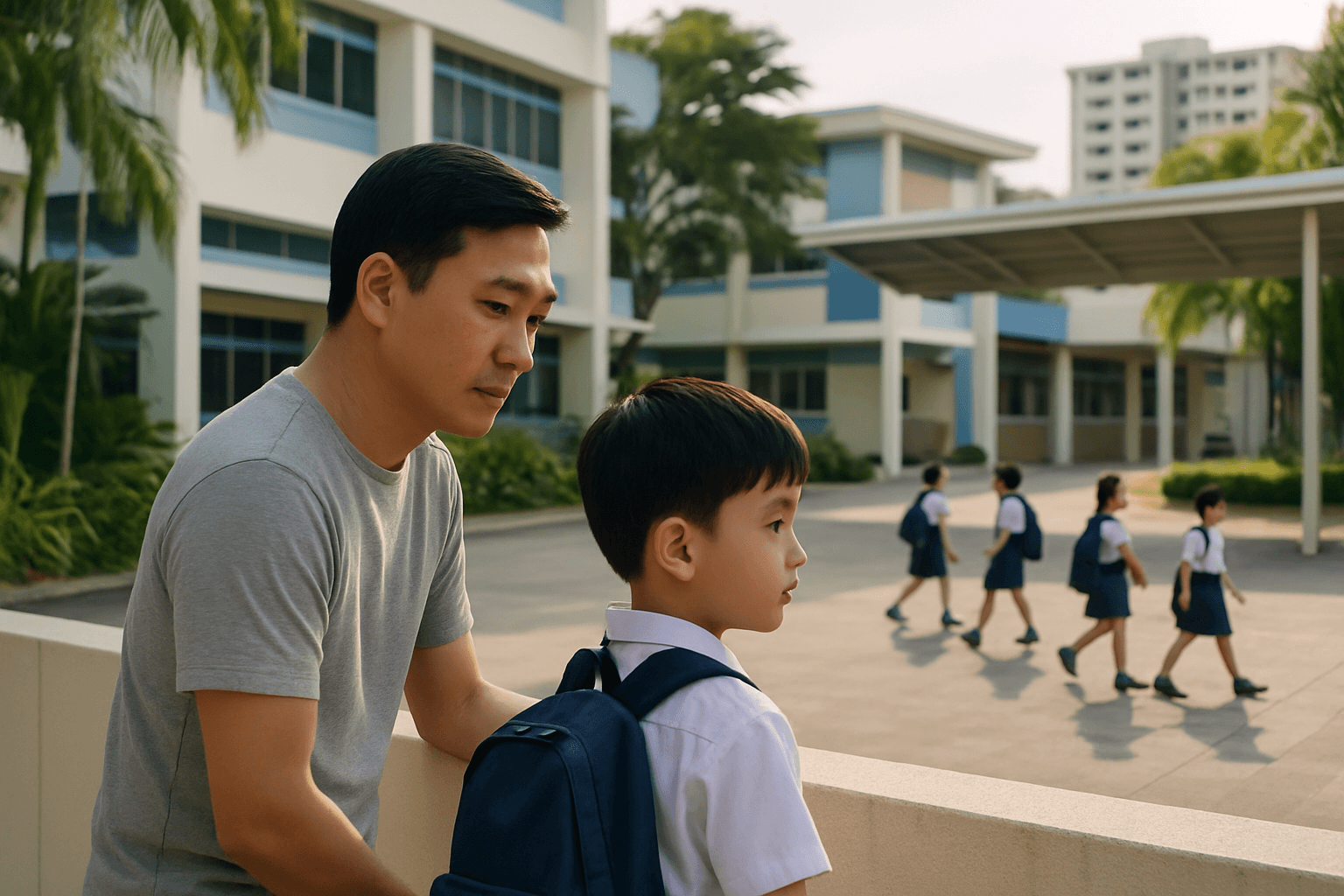
To judge primary school fit in Singapore, start with daily life, not brand name. The real question is whether your child can settle into the school’s pace, routines, communication style, support level, and commute with manageable stress. Many parents approach Primary 1 like a popularity contest, but the more useful lens is sustainability: can your child cope with this school five days a week, not just admire it from the outside? A school can be well regarded and still be a poor fit if your child will struggle every morning.
What does school fit actually mean in Primary 1?
School fit is the match between your child’s needs, the school’s daily environment, and your family’s real-life logistics.
School fit means how well your child, the school’s daily environment, and your family’s practical realities match each other. It is not mainly about name value or whether the school is famous. The better question is whether your child can handle the school’s pace, routines, expectations, and support style without constant stress.
A simple way to think about fit is this: can my child live this school day well, five days a week? That includes getting there on time, understanding assembly and recess routines, following teacher instructions, managing dismissal, and coming home with enough energy to do it again the next day.
This is where open houses are useful if you use them for the right purpose. Schoolbag’s guidance on primary school open houses explains that open houses help families get a feel for the school, meet teachers, and understand its culture. That matters because atmosphere is part of fit. The best school is not the most famous one; it is the one your child can manage every day. For a broader overview, see Primary 1 Registration in Singapore: How It Works, Balloting Risk, and How to Choose a Realistic School Plan.
All About Preparing For Primary One
Starting primary school? This is a big milestone. Do enjoy the journey with your child! :rahrah: https://www.straitstimes.com/singapore/education/the-st-guide-to-preparing-your-child-for-primary-1 Parents often confuse being ready for school with being academically capable in skills like reading and counting. Instead of focusing solely on academic progress, it is more important to make learning an enjoyable process, and help your child have a swift and happier adjustment to primary school. Here
Top Primary school?
Honestly I am not sure if there is such a thing as a top primary school based on the efforts of the school. All schools have the same mission set by MOE to deliver the same thing. If you hear from them, even teachers they have no control, it's all from MOE. So what then would you consider as top primary school? It definitely cannot be results alone because results are typically parents-driven in today's context in some schools. Every school has the best cream of the crop and the worst performers
Why ranking and reputation do not tell the full story
Reputation may reflect demand, but it does not show whether your child will cope well with the school’s actual pace, routines, and daily stress.
Reputation can tell you that a school is popular or well known. It cannot tell you how your child will actually experience the school from arrival to dismissal. It does not show whether the setting feels manageable for a six- or seven-year-old, whether routines are clear, or whether your child is likely to feel secure in the first term.
Many parents lean on shortcuts such as popularity, alumni talk, or later PSLE results when choosing a school. Those signals may reflect demand, but they do not measure daily fit. A confident, independent child may cope comfortably in a larger, faster-moving setting. A child who is shy, easily overwhelmed, or slow to warm up may do better in a calmer school closer to home.
A useful way to frame it is this: reputation tells you what other families value, not what your child needs. If you are still weighing popularity against practicality, it may help to compare this article with Primary 1 Registration: Should You Pick a Popular Dream School or a Safer Nearby School?, Popular Primary School vs Neighbourhood School in Singapore: Which Is Better for Your Child?, and How to Read Past Balloting Data Before Chasing a Popular Primary School.
It also helps not to over-read school numbers. MOE notes in its SchoolFinder FAQ that cut-off references are based on previous cohorts rather than guaranteed outcomes. The same mindset applies here: data can guide you, but it cannot replace fit.
[Pasir Ris] Primary Schools
http://sg.theasianparent.com/primary-schools-rankings-%E2%80%93-top-21/2/ Base on award.....only Pasir Ris Primary make it to top 20 in Singapore
What goes into choosing a suitable Secondary School
Saw this being shared in the parents groupchats. https://www.thewackyduo.com/2022/11/how-to-choose-secondary-school-guide.html https://i.imgur.com/fDkJSy6.png\"> https://www.thewackyduo.com/2022/11/how-to-choose-secondary-school-guide.html It's time to choose a secondary school. Choosing a secondary school is a completely different process than primary school. One tends to choose a primary school based on distance or affiliation. Picking a secondary school is a different ball game. Grades play a
Have More Questions?
Get personalized guidance on schools, tuition, enrichment and education pathways with AskVaiser.
Try AskVaiser for Free →How should your child’s temperament shape the choice?
Match the school to how your child handles noise, structure, pace, independence, and change.
Your child’s temperament should be one of your main filters. Ask how your child usually responds to noise, crowds, structure, change, and independence. That often tells you more than general school chatter.
For example, a shy child does not necessarily need a sheltered school, but often benefits from a place that feels warm, predictable, and easy to read. An energetic child does not necessarily need a relaxed school, but usually does better when routines are clear and transitions are well managed. A child who dislikes change may need a school where the first-term adjustment feels guided. A highly independent child may cope well even if the school feels bigger and busier.
A practical parent question is this: does my child need calm, structure, stretch, or reassurance right now? If your child still needs frequent reminders to keep belongings, follow multi-step instructions, or separate confidently from caregivers, pay closer attention to how structured and supportive the school seems. If your child adjusts quickly and likes new environments, a more fast-moving setting may be fine. For a broader overview, see Popular Primary School vs Neighbourhood School in Singapore: Which Is Better for Your Child?.
Preparing Your Child for Primary School:Parent Seminar - MOE
Preparing Your Child for Primary School: A Parent Seminar by MOE Starting primary school is a big step in your child's life. To help you better understand primary school programmes and enable you to make key education decisions, the Ministry of Education will be conducting a seminar on Primary School Education. At the seminar, parents can look forward to sharing sessions by the school principal and a parent volunteer, as well as view the various programmes our primary schools provide. The Primar
All About Preparing For Primary One
Was surfing around on understanding if I am well prepared on behalf of my DD1 for Primary 1 Chanced upon a few websites, thought to share though it could have been mentioned before Tips For Parents ◦Work on independent reading skills. ◦Set up a study area and regular study times that are not interrupted. ◦Learn to follow a routine with a lot of sleep and early mornings. ◦Practice organisation and planning by packing a daily bag with essentials for the day. ◦Talk about social skills and communica
What should you observe about the school environment and routine?
Observe how the school feels in motion, especially crowd flow, tone, transitions, and whether routines look manageable for a young child.
Look beyond facilities. Nice buildings and special programmes do not tell you much about how a Primary 1 child will actually move through the day. What helps more is watching how the school functions when people are moving through it.
If you visit during an open house, notice whether the entry area feels intuitive or confusing, whether crowd flow seems orderly, and whether adults give directions calmly. Watch how older pupils move around the campus. Do they seem settled and purposeful, or rushed and noisy? Is the signage clear enough that a young child could learn the routes over time? A school’s atmosphere is often easier to feel than to describe, and that feeling matters.
It also helps to imagine ordinary days instead of showcase days. Picture arrival in heavy rain, packing up after recess, finding the correct place at dismissal, or moving between activities when your child is tired. If your child already looks uneasy in a very large or loud setting, do not reject the school immediately, but treat that as a prompt to ask more about routines and adjustment support. For a broader overview, see Primary 1 Registration Distance Priority: How Home-School Distance Works.
Preschools prepared your kids well for Singapore primary?
For parents who have already been through the pre-school days and with kids now in primary schools (Singapore schools), can you share your comments on your kid's previous preschool and their curriculum - specifically if they have prepared your child properly for the Singapore education system ? (not discussing the international or foreign schools system here) Nowadays, there are so many pre-schools and childcare centres with many learning methods. Parents currently at the pre-school stage will b
All About Preparing For Primary One
You should have seen the way the mum drilled the poor child, depriving him of food till he completed his revision. Obviously, an uninterested child will only retain the information into his short term memory. Preparing a child for primary 1 is more than just the academics. There are several areas that parents have to take note of. Does your child know how to clean up after himself if he does a big business in the toilet? Does your child know how to wash his hands correctly and rinsed his hands p
How do you judge teacher support and parent communication style?
Look for communication that is clear, timely, and easy for your family to act on.
Many parents underestimate this part. In Primary 1, school fit is not only about lessons. It is also about whether your family can understand expectations quickly and respond early when something is not going well.
Good communication usually feels simple, not fancy. You should be able to tell how announcements are shared, how homework expectations are explained, and what parents should do if a child is struggling with routines, behaviour, or adjustment. Common real-world examples include communication through notes, handbooks, apps, portals, or email, but the tool matters less than the clarity. The important question is whether caregivers can easily act on the information.
This matters even more if both parents work long hours or if after-school arrangements involve grandparents or student care. A school that expects children to become independent quickly may suit some families well. Another school may seem more explicit and structured, which can be a better fit if instructions need to travel across several caregivers. Do not just ask whether communication is good. Ask how it actually works in the first term. For a broader overview, see How to Read Past Balloting Data Before Chasing a Popular Primary School.
[Geylang] Primary Schools
School vacancies out ! http://www.moe.gov.sg/education/admissions/primary-one-registration/vacancies/#geylang How to pick the right school ? http://www.straitstimes.com/the-big-story/ask-sandra-p1-registration/story/how-pick-the-right-school-20130620
[Kallang] Primary Schools
Hi parents, If you are worried about the balloting and still are not sure where to place your kid, you may want to consider attending the open house of this school. Farrer Park Primary School is having an Open House on 23 July, Saturday, 9 a.m. to 1 p.m. Sign up via the following link http://tinyurl.com/fppsopenhouse2016 Farrer Park Primary is one of the few primary schools awarded both the Applied Learning Programme (iDREAM) and Learning for Life Programme (iCARE). :rahrah: Watch this video to
What support does your child need to settle well in Primary 1?
Choose a school whose support style matches whether your child needs reassurance, structure, independence-building, or more challenge.
Different children need different kinds of support in the first year. Some mainly need reassurance. Some need firmer routines. Some need help becoming more independent. Others need enough challenge so they do not switch off.
Parents often look for a perfect school when the more useful question is whether the school’s likely style matches the child’s current readiness. A child who worries about separation may benefit from a school culture that feels warm, structured, and calm. A child who often forgets water bottles, worksheets, or simple instructions may need an environment where routines are reinforced clearly. A child who gets bored easily may need teachers and programmes that keep curiosity alive, even if the school is not seen as especially prestigious.
This is not about labelling your child. It is about being realistic about the P1 transition. Most children are still learning how to manage belongings, follow multi-step instructions, move between adults, and handle a longer school day. If your child needs more runway, choose a school where that seems workable rather than assuming they will simply toughen up in the first month.
Top Primary school?
in my opinion, I do not believe in ranking primary schools as these are totally nonsense… Primary school is an early stage of education for young kids especially from P1-P3. We should not emphasis too much on academic results. By ranking schools, it put pressure to the principals to emphasis on results & thus favours better students than the average students. This will have negative effect on the average students… Education have to be fair to ALL students… this is just my opinion and i hope pare
Top Primary school?
To be fair, I think people should not tag “good” or “bad” to a school. I don’t think there is really a “bad” school in Singapore. To me, the most important thing is the teacher your child gets. You can have very lousy teachers in the popular “good” schools as well. Or you can have very good teachers in the normal neighbourhood schools. Academic excellence is not the only thing to look for in primary school education, what about character building ? team work ? All these should be equally importa
What is a practical primary school fit checklist for Singapore parents?
Use a comparison checklist that covers child fit, school environment, communication, support, and logistics.
- ✓Can my child manage the commute without starting the day tired, rushed, or irritable?
- ✓Does the school atmosphere feel calm enough, clear enough, and structured enough for my child’s temperament?
- ✓Do arrival, assembly, recess, and dismissal look manageable for a young child?
- ✓Does the school seem to communicate expectations in a way my family can follow easily?
- ✓If my child struggles in the first term, is there a clear way for parents to raise concerns?
- ✓Does this school seem better for a child who needs reassurance, stronger routines, or faster independence?
- ✓Would my child likely feel secure in a bigger and busier setting, or do they need a more predictable environment?
- ✓Does the school’s rhythm fit our family’s morning schedule, pick-up plan, and caregiver arrangements?
- ✓After the visit, did my child seem comfortable, curious, tense, or overwhelmed?
- ✓If I remove the brand name from the decision, would I still choose this school for my child’s daily life?
What questions should you ask at open house or through conversations with parents?
Ask questions that reveal routines, settling-in support, communication, and what parents actually found difficult in P1.
Ask questions that reveal daily life, not just outcomes or prestige. For school staff, useful questions include: what do the first few weeks of Primary 1 usually look like, how are children helped to settle into routines, how are homework expectations communicated, and what should parents do if a child is struggling to adjust? These questions usually reveal more than asking whether the school is strong academically.
When speaking to other parents, avoid broad questions like “Is the school good?” Ask for concrete experience instead. Good prompts include: “What surprised you most when your child started P1?”, “What kind of child seems to do well here?”, and “What would you prepare differently if you were doing this again?” Those answers are usually more honest and more useful than general praise.
Open houses are worth using this way because they are meant to help families experience the school’s culture, not just tour facilities, as noted in Schoolbag’s open house guidance. Just remember that parent feedback is still anecdotal. Treat it as context, not proof. If several families describe the same daily pattern, that is often more useful than one strong opinion.
[Punggol] Primary Schools
hmm… the most impt thing is your child must be happy. This must come from supportive parents in their learning. My boy enjoys his class and gamely contribute and am glad teachers (Chinese and form teacher) have been responsive in his learning. As he was a transferred student, I was also concern of him blending to his school but such were unfound. Phew! All in all, in a primary school, be it a popular, a top or mediocre school (in others’ opinion) you can still “control” a child’s learning habits
All About Preparing For Primary One
Dear parents, I hope parents could share your experience regarding the preparation for primary school and time schedule spend with your kids everyday. I have a son of 6 this year going to P1 next year. I would like to find out with parents things that you are doing with your child prior going P1, cos I do not want to react too kan-jiong or too relax in front of my child. I am particularly concerned about the 3 main subjects being taught in P1 and wonder should I expect him to be able to do the a
When should you choose the more convenient school over the more prestigious one?
If the commute is likely to affect your child’s energy, punctuality, or emotional stability, the more convenient school may be the better long-term choice.
Take convenience very seriously if the longer commute is likely to drain your child before school even begins. For some children, a shorter journey means calmer mornings, fewer late arrivals, easier pick-up arrangements, and more emotional bandwidth to cope with P1.
Convenience is not a weak reason. It is part of fit. If you are weighing prestige against daily sustainability, compare that choice with Primary 1 Registration Distance Priority: How Home-School Distance Works and the broader Primary 1 Registration in Singapore guide. MOE also notes for Returning Singaporeans seeking primary school placement that placement is considered near home where possible, alongside practical constraints such as vacancies and mother tongue availability. The broader lesson is simple: logistics matter because children live the routine, not the school’s reputation.
What goes into choosing a suitable Secondary School
Hi there, Recently a relative asked me how I choosed my kid’s Secondary School and I kind of got a shock, I had no answer. It was simply just based on the results. My relative came then with a list of important factors that he thought would be helpful to help his kid cope with the stresses of school. I thought that I would help him make this post to help him make a better decision (the kid will be going into the Secondary School in next year). So here goes, considering grades what else should he
[Jurong East] Primary Schools
there are 4 primary schools within 1 Km from my place: Yuhua, Fuhua, Jurong East and Princess Elizabeth. for 2C, we’d like to try Princess Elizabeth, but I’m afraid if we are not lucky enough, we may not have the chance to go into any of the 4 schools. How can we stratigise so that we can try our preferred school? many thanks for the advices from experienced parents.
If a school is considered good, should I still choose it if my child may struggle there?
No. A generally good school is not always the right school for your child. Fit matters more than reputation if daily life there is likely to be hard for your child.
Not necessarily. A school can be good in general and still be a poor fit for your child. The better question is whether your child can settle into that school’s routines, expectations, support style, and commute without constant strain.
For example, a highly sought-after school may still be the wrong choice if your child is very anxious about change, needs more guidance with routines, or will face a tiring journey every morning. On the other hand, a less talked-about school may be the better option if it feels calmer, communicates clearly, and fits your family’s daily rhythm better.
Parents often regret choices made mainly for status when the harder issue turns out to be ordinary daily life. If you are trying to work out how to know if a primary school suits your child in Singapore, compare each option using the same five filters every time: temperament match, school environment, communication, support, and logistics. School choice usually becomes clearer when you stop asking which school sounds best and start asking which school your child can realistically thrive in.
Top Primary school?
Actually, based on your arguments, it could be more important to have the primary school ranking so that you can AVOID the \"good\" schools, in case you accidentally choose one that is so pressurizing Or you can choose one that is good in sports or character development. Without such ranking, how do we know which school is good for what other than by hearsay?
[Geylang] Primary Schools
For primary schools, I recommend going for convenience than popularity. Reason is the kids are still young, and travelling time should not be long enough to tire them out, even for those driving. Have you seen children dozing off in the parents car (some in an awkward position, especially straining their necks) because they have to wait up earlier than their peers to reach these “better” schools to feed their parents “ego”. Please note that the above is just my PERSONAL view as I have gone throu
Have More Questions?
Get personalized guidance on schools, tuition, enrichment and education pathways with AskVaiser.
Try AskVaiser for Free →