
How to Use Primary 1 Vacancy Numbers to Choose Backup Schools Wisely
Read MOE vacancy, applicant, and balloting data in context so you can shortlist backup schools that are realistic, not just easy on paper.
Use Primary 1 vacancy numbers as a planning tool, not a prediction. Compare vacancies with applicant and balloting data in the phase your child can actually use, look for patterns across more than one year using MOE’s past data, and keep a balanced shortlist with one aspirational option, one or two realistic options, and at least one safer school you would genuinely accept.
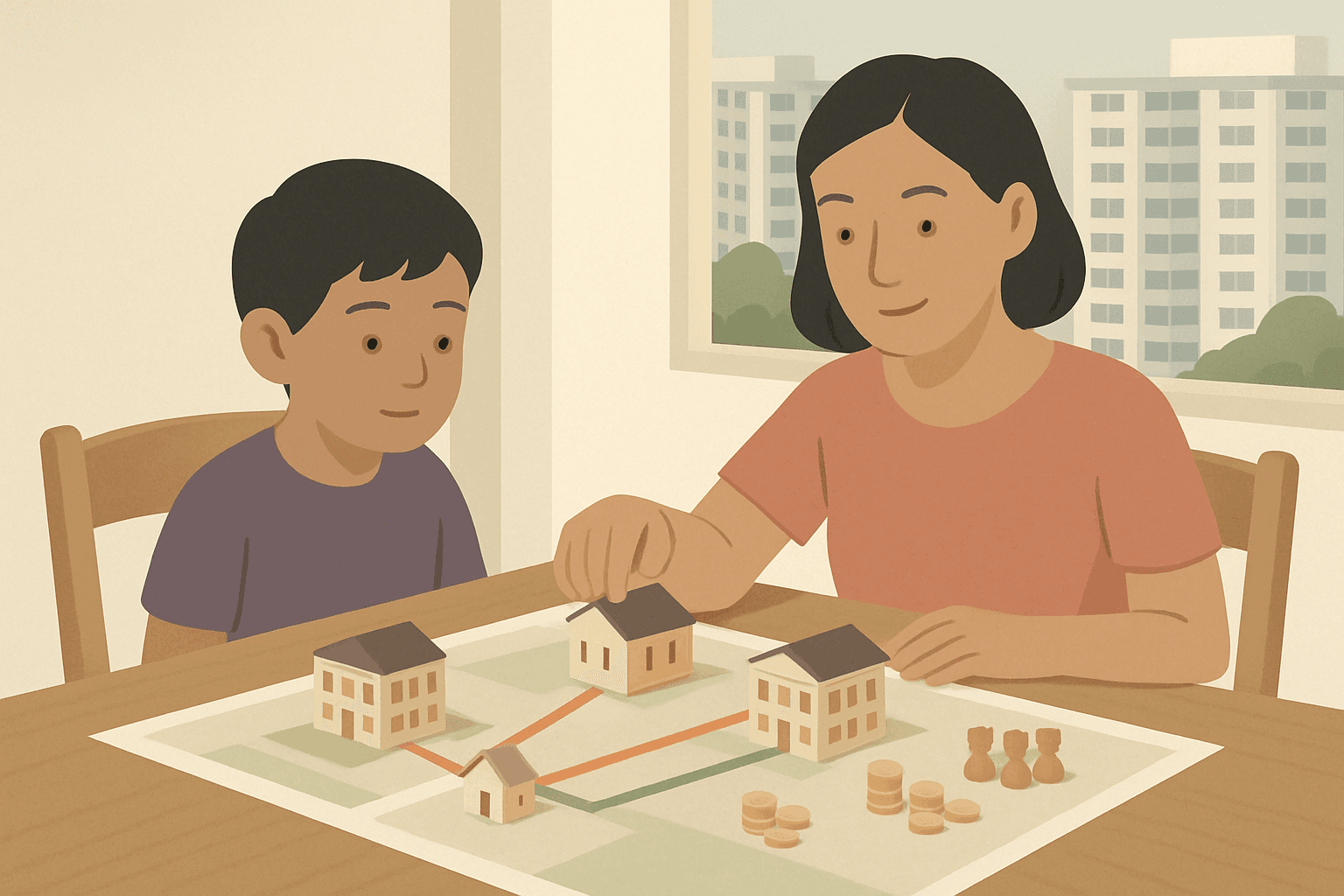
Vacancy numbers help with Primary 1 planning, but they do not tell the full story. The practical question is not just “Which school has the most places?” It is “Which schools are still realistic for my child’s phase, with demand I can live with and a daily routine our family can sustain?”
What do Primary 1 vacancy numbers actually tell parents, and what do they not mean?
Vacancy numbers show available places at a specific stage of registration. They do not equal your child’s admission odds.
Primary 1 vacancy numbers show how many places are available at that point in the registration exercise. They do not tell you your child’s exact chance of getting in. The simplest way to read them is this: vacancies show supply, while applicants show pressure. A school with 20 vacancies and 18 applicants is in a very different position from a school with 20 vacancies and 60 applicants, even though the vacancy number is the same. That is why the MOE vacancy and balloting updates only become useful when you read them together with applicant numbers and the phase involved.
What many parents overlook is that a school can still be competitive even when vacancies remain. If demand is concentrated among families with stronger priority in that phase, such as citizenship or home-school distance when a school is oversubscribed, the headline vacancy figure can look more comfortable than the real situation. If you want the wider P1 context before comparing schools, start with our Primary 1 Registration in Singapore guide.
[Central] Primary Schools
http://www.moe.gov.sg/education/admissions/primary-one-registration/vacancies/#header
[Central] Primary Schools
http://www.moe.gov.sg/education/admissions/primary-one-registration/vacancies/#central
How should parents read vacancy numbers with applicant numbers and phase data?
Read vacancy numbers only in the phase your child can use, and always compare them with applicant volume in that same phase.
Always compare schools within the same phase your child can actually use. A school that still has places earlier in the exercise is not automatically a safer choice if those places are unlikely to matter by the time your phase arrives. MOE updates vacancy and applicant counts as the exercise progresses, so the figures are a live snapshot, not a final verdict.
Phase timing matters more than many parents expect. MOE states that 60 places are reserved at the start for Phases 2B and 2C, which is one reason the competition picture can change as the exercise moves along. A school may look open when you first scan the table, but the more useful question is whether it has tended to stay open by the time your phase comes up. If you need a refresher on the sequence, read our guide to Primary 1 registration phases in Singapore alongside MOE’s main Primary 1 registration overview.
[Central] Primary Schools
Hi Msrajey, Hmm I think it is at the sole discretion of the principal to sieve out the applicants. Basically, we were given a form during registration as PV on the areas that we would like to contribute.. The numbers of PV that the school opens for registration has been dropping... Was 60 during my time then dropped to 30 last year. Seems like the number further dwindled into half this year, judging by Phase 2B's actual no. of applicants? Less PV = more vacancies for Phase 2C... When is your chi
[Central] Primary Schools
The update only available at the school compound or premises itself For some schools, what they do is place a white board for all parents, to see the numbers updated at regular time interval Every half hour (particularly on the last day of Phase 2C after 3 pm) : the P1 registration officer will appear, erase the old figures on white board first, then write down the latest registered number breakdown by the 3 distance group (less than 1 km, between 1 to 2 km, exceed 2 km) This way, parents at one
Have More Questions?
Get personalized guidance on schools, tuition, enrichment and education pathways with AskVaiser.
Try AskVaiser for Free →Why is one year's vacancy data not enough to choose a backup school?
No. One year's vacancy figure is only a snapshot, so parents should look for multi-year patterns before treating a school as a reliable backup.
Use one year as a clue, not a verdict. A single year can look unusually easy or unusually crowded because a cohort is larger, a school becomes more talked about, or parent preferences shift. That is why one calm year does not make a school “safe,” and one crowded year does not make it permanently unrealistic.
A better habit is to look for repeated patterns. One year shows the snapshot; two to three years show the direction. If a school repeatedly stays open longer or avoids balloting in the phase relevant to you, that is much more useful than one unusually easy year. MOE points parents to its past vacancies and balloting data, and our guide on how to read past balloting data before chasing a popular primary school can help you spot steady patterns without treating them as a guarantee. For a broader overview, see Primary 1 Registration Distance Priority: How Home-School Distance Works.
All About Primary Schools' Balloting History
Vacancies and balloting data: 2023 P1 Registration Exercise is out. https://www.moe.gov.sg/primary/p1-registration/past-vacancies-and-balloting-data
All About Primary Schools' Balloting History
Oh no... i wasn't talking about \"during\" the registration. I was talking about them releasing the total number of vacancies assigned to all primary schools, which is usually revealed BEFORE phase 1 even starts. Like last year, there was 41,888 vacancies in total. Oh well.
How do you build a backup list using vacancy numbers without picking random 'easy' schools?
Shortlist schools that are workable for your family first, then use vacancy data to sort them into stronger and weaker backup options.
Start with schools your child could realistically attend every day. That means checking the likely registration phase, whether the commute is practical, and whether the school is one you would genuinely consider. Only then should you use recent vacancy and balloting data to sort those schools into higher-risk and lower-risk options.
This matters because a paper-safe school is not always a real backup. For example, a school with lighter demand may still be a poor choice if it adds a long bus ride, clashes with sibling logistics, or creates a morning routine your family already knows will be hard to sustain. A slightly more competitive school that is close by and workable every day can be the stronger backup. The goal is not to find the least competitive school in Singapore. The goal is to build the least risky school plan that still makes sense for your child and household. For a broader overview, see How to Read Past Balloting Data Before Chasing a Popular Primary School.
[Central] Primary Schools
normally after all dust had settled after P1 registration Phases had ended, if vacancie(s) arise in the event a child withdraw from school before P1 Term 1 commence, transfer may take place. After 2B end, you may fill up the Transfer form, state down your reason(s) for Transfer that you were a PV before - so that P is aware, take notice of your unique application. However, it's up to individual school Principal (P) decision - who she want to take in. It is up to P whether or not she prefer to gi
[Central] Primary Schools
School / Total Vacancy / Vacancy for Phase 1 / Number of Children Registered Anglo-Chinese School (Junior) 270 270 77 River Valley Primary School 240 240 85 St. Margaret’s Primary School 210 210 52 Stamford Primary School 180 180 41
What is a sensible mix of first choice, realistic choice, and safer backup?
Aim for a three-tier shortlist so you are not forced into either a dream-school gamble or a rushed last-minute fallback.
For many families, a sensible shortlist has three layers: one aspirational school, one or two realistic schools, and one safer option. The aspirational school is the one you still want to try even if demand looks tight. The realistic schools are the ones whose recent patterns look more manageable in your likely phase. The safer option is the school you may not have started with, but would still be comfortable accepting.
The value of this approach is that it stops you from making an all-or-nothing gamble. A common example is a parent keeping one popular school as the stretch option, while also holding a nearby school with steadier demand and much better morning logistics. Another is a family that first dismisses a quieter school, then realises it is actually the more sustainable backup because the child can get there easily and the routine will be calmer. If you are weighing ambition against practicality, our guide on whether to pick a popular dream school or a safer nearby school can help.
[Central] Primary Schools
As at yesterday for P2CS Girls' School Name Vacancies Registered Marymount Convent 24 36 CHIJ OQLOP 20 18 Canossa Convent 39 27 Total 83 81 Boys' School Name Vacancies Registered Montford Junior 99 12 St Gabriel 18 10 Total 117 22 Co-ed Name Vacancies Registered Bukit Timah 75 30 Stamford 72 12 Balestier Hill 131 12 Total 278 52 Location of Marymount Convent http://www.marymountconvent.moe.edu.sg/ ... id=1080763 CHIJ OQLOP http://www.chijourladyqueenofpeace.moe . ... on-and-map Canossa Convent h
How Do Secondary Schools Choose Their Students
Hi angel2005, Have you read the MOE booklet on choosing your secondary school that’s distributed to all P6 students? The booklet describes very clearly the process the S1 Central Posting Exercise. In brief, all P6 students will be ranked according to their PSLE scores. Each student has 6 choices. The MOE computer will consider the student ranked #1 first. They will give Student #1 the school of his choice. Next they will consider the student who’s ranked #2. And so on and so forth all the way to
What should matter besides vacancy numbers when choosing backup schools?
Look beyond the vacancy count. A workable commute and a school your child can cope with usually matter more than a small gap in available places.
Once a school becomes a real option, distance, travel time, and school fit usually matter more than a small difference in vacancy numbers. MOE advises parents to consider the child’s interests and the travel time or distance to school when choosing, as explained in its page on how to choose a school. A school with more vacancies is not automatically the better backup if it creates a tiring commute, higher transport costs, or a daily schedule your child may struggle with.
This becomes practical very quickly. A school that is 15 minutes away may be the better backup than another that looked more open but takes much longer to reach. Families with siblings often discover that one extra transfer or one awkward reporting-time mismatch changes the whole plan. If distance is likely to affect your shortlist, our guide on how home-school distance works is a useful companion read.
All about Transferring to Other Primary Schools
Note that primary schools normally have a class size of maximum 30 for P1 and P2 (I think it’s MOE policy) so for most schools, unless there are parents who give up their confirmed places, it is unlikely there will be any vacancy until P3, where schools are allowed to have 30++ for each class. Or you can approach the schools that still have vacancies after P1 registration (all phases) for P1 and P2 transfers.
All about Transferring to Other Primary Schools
There is, frankly, no strategy in getting a successful transfer for lower primary. You just have to apply and hope for the best. The number one consideration for a successful transfer is vacancy which is out of your control. If no one leaves, then there’s no space available and for popular schools, there could be up to 20 or 30 parents eyeing one vacancy. Schools may also give priority to applicants based on whether they have been balloted out from earlier phases and distance to home.
How can parents tell if a school is a true backup or just looks easy on paper?
A real backup is one you can genuinely live with if needed, not just one that looks easier to enter on a vacancy table.
A true backup is a school that is manageable in daily life, acceptable in fit, and reasonably open when you study recent demand patterns. A paper-easy school is one that only looks attractive because the headline vacancy number is higher. If the commute is punishing, the routine is hard to sustain, or the school’s opening pattern does not really match your child’s phase or priority position, it is not a dependable backup.
A simple test helps: if this becomes your child’s final school, would you still feel you made a workable choice? If the honest answer is no, take it off the list. The reverse is also important. A school does not need to look completely open to be a good backup. A school with modest vacancies but stable past demand, a reasonable commute, and acceptable fit may be much stronger than a school with a bigger vacancy number but weak real-world fit. For Permanent Resident families, this deserves even closer attention because some schools are subject to a cap on PR intake in later phases.
[Central] Primary Schools
@qms : thanks for the advice didn't knew that Primary School registration will be such a stressful and competitive \"game\" for the parents I have heard from other parents in my son's kindergarten with elder siblings that the parents will each station at different Sch to do registration together on P2C and live update each other on the latest \"battle\" status. Then they will choose and withdraw application of their plan B sch should they get into their first choice sch... Something like that ri
[Central] Primary Schools
July 2012 Registration (for 2013 Primary 1 intake: born 2006) Phase 1 Central schools end of day 2 (4 July 2012, Wednesday) vacancies, applicants, Percentage of seats Been Taken up (%) 1 River Valley \t240\t102\t42.5 % 2 Anglo-Chinese School (Junior)\t270\t74\t27.4 % 3 Stamford \t180\t45\t25 % 4 St. Margaret \t210\t48\t22.8 %
What mistakes do parents make when they use vacancy numbers too aggressively?
Do not use vacancy numbers as a guarantee. They are a planning tool, not a shortcut around phase, distance, and school fit.
The biggest mistake is treating vacancy data like a prediction engine. Parents often assume high vacancies mean easy admission, low vacancies mean impossible admission, or last year’s calm pattern will repeat. They also compare schools across the wrong phases, ignore how distance priority can matter when a school is oversubscribed, or keep “backups” they would never truly accept. The better rule is simple: use the numbers to narrow blind spots, not to create false certainty. If you are planning for a fallback scenario, our guide on what happens if you do not get your preferred school can help you think one step ahead.
[Central] Primary Schools
After Day 1 of Phase 1 Registration (29/6/11) Central School Total Vacancy Vacancy for Phase 1 Number of Children Registered Anglo-Chinese School (Junior) 270 270 68 River Valley Primary School 240 240 31 St. Margaret’s Primary School 210 210 43 Stamford Primary School 210 210 40
[Central] Primary Schools
http://www.moe.gov.sg/education/admissions/primary-one-registration/vacancies/#central ACS Junior 76 registered, 54 vacancies exceeded by 22. So what happen to these 22 who'd registered into MOE system? :? Why does the school still allow them to register, if they've no chance to participate at all in 2B ? ballot or overflow into Phase 2C ? are you very sure that none of the 54 less than 2 km is a .... PR ? :? we're not talking about exceed by 1 or 2. But exceed by 22 ... is a lot. if indeed all
What is a simple way to compare schools before registration day?
Use a short comparison checklist that combines phase, demand, distance, and fit so your backup list is deliberate rather than reactive.
- ✓Confirm which registration phase your child can actually use before comparing any school.
- ✓Check more than one year of vacancy, applicant, and balloting patterns for each school on your shortlist.
- ✓Compare schools within the same phase and similar priority conditions so you are not mixing unlike situations.
- ✓Treat distance and daily travel time as early filters, not last-minute details.
- ✓Group each school into aspirational, realistic, or safer so your shortlist reflects both preference and risk.
- ✓Remove any school that looks open on paper but would be hard to manage every day.
- ✓Keep at least one backup you would genuinely accept if your first choice does not work out.
- ✓Before registration opens, review your plan against MOE’s Primary 1 registration guidance and our [full P1 registration guide](/primary-1-registration-singapore-guide).
Have More Questions?
Get personalized guidance on schools, tuition, enrichment and education pathways with AskVaiser.
Try AskVaiser for Free →