
Is Giftedness the Same as Being a Genius or Doing Well in School?
A practical Singapore parent guide to giftedness, high achievement, and what the GEP is really for
Giftedness is not a genius badge and not the same as strong report book results. In practice, it is more about how a child learns: unusually fast reasoning, strong pattern recognition, deep curiosity, and a need for more depth or challenge. A child can be gifted without always topping the class, and a child can do very well in school without being the kind of learner Singapore’s gifted education pathway is designed to identify.
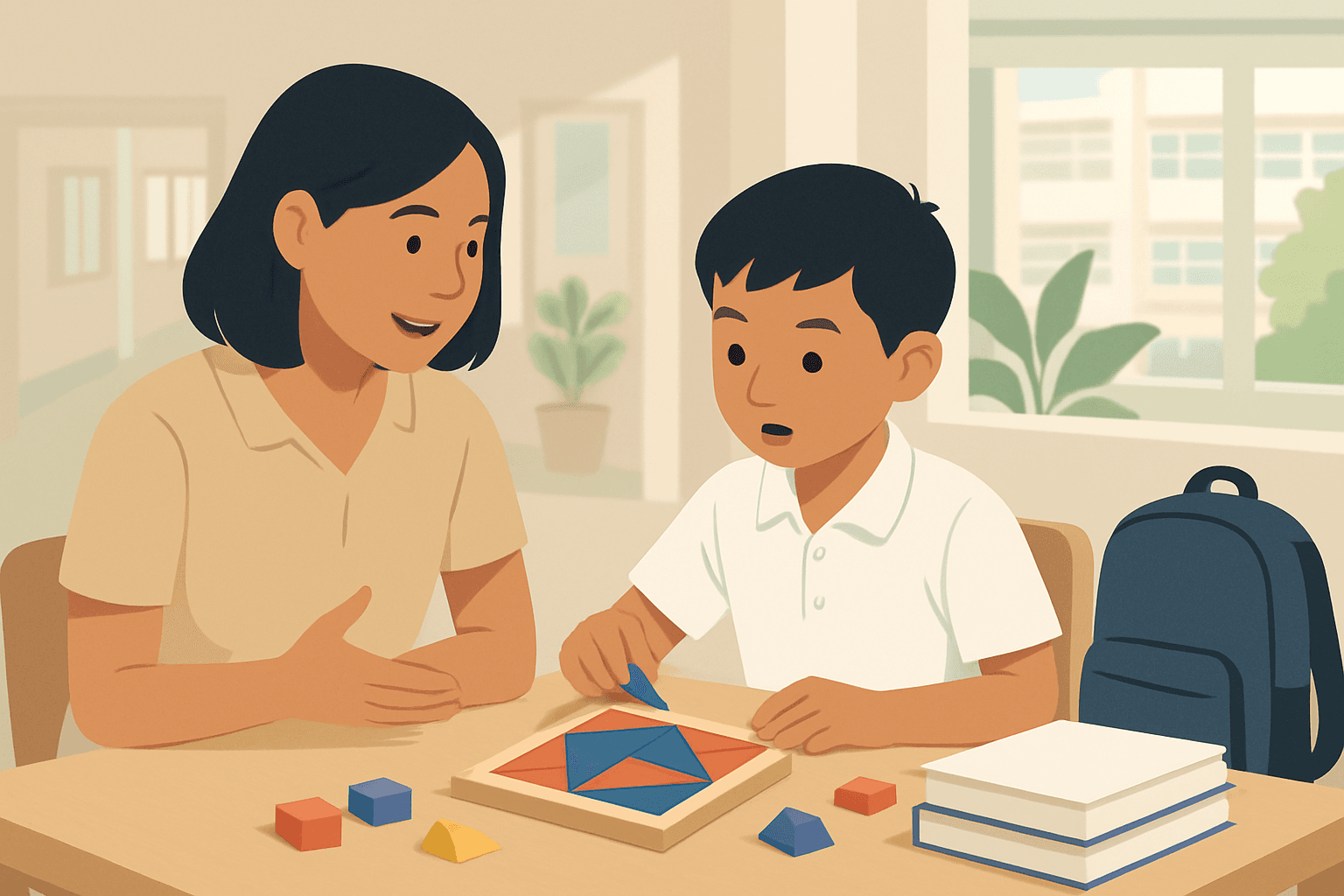
No, giftedness is not the same as being a genius or doing very well in school. A child can score highly because of effort, maturity, strong habits, or support. Another child may reason unusually quickly, ask deeper questions, and feel under-stretched, yet not always produce perfect marks. That is why Singapore’s gifted education pathway is best understood as a learning-fit decision, not a label to chase.
What does giftedness actually mean, and is it the same as being a genius?
No. Giftedness is better understood as unusually strong learning ability and a need for more depth, pace, or complexity, not a "genius" badge.
Giftedness is not the same as being a genius. "Genius" is a loose everyday label. In school, giftedness is more usefully understood as a pattern of learning ability and learning need. A gifted child may grasp ideas quickly, spot patterns early, ask unusually deep questions, or need more complexity than the usual classroom pace provides.
A simple way to think about it is this: giftedness is about how a child learns, not how impressive the child sounds. For example, one Primary school child may understand a Maths rule after one example and immediately ask why it works. Another may notice contradictions in a story that others miss. Those are learning clues, not proof of a grand identity.
This distinction matters because the word "genius" often pushes parents toward status thinking. That leads to the wrong question: "Is my child special enough?" The more useful question is: "Does my child need more depth, a faster pace, or a different kind of challenge?" When parents focus on fit instead of labels, school decisions usually become clearer and calmer. For a broader overview, see Gifted Education Programme (GEP) in Singapore: A Parent's Guide.
Opinions on Gifted Education Programme (GEP)
Isn't that consistent with what I had said, ie, it is not a genius scouting event but one that is of a rather different agenda. If it is a genius programme, then why do all these kids merge back with the rest of the cohort after three years?[/quote]So why the word term \"Gifted Education Programme\"?
Secondary School Gifted Education Programme
It is the same issue. Because intelligence works in roughly parallel ways across a wide range of activities and capacities, the general underpinnings of the GEP will work for all students. That is the idea behind the IPs in schools which used to be GE centres — the mainstream classes were able to improve by teachers adopting GE practices. The initial offering was small because our 1980s paradigms of intelligence were narrower in focus. Because they were narrower, intellectual giftedness was more
Is giftedness the same as doing very well in school?
No. High marks can come from many strengths, while giftedness is more about reasoning, learning speed, curiosity, and the need for greater challenge.
No. Good grades and giftedness can overlap, but they are not the same thing. Strong school performance can come from discipline, careful revision, good memory, tuition support, or simply being organised and developmentally ready. Those are real strengths, but they do not automatically mean a child has the kind of learning profile gifted education is designed for.
A useful comparison helps. One child may consistently score well because the child listens carefully, practises thoroughly, and avoids careless mistakes. Another child may understand new ideas faster than classmates but rush through routine work, resist repetition, or lose interest when tasks feel too easy. On paper, the first child may look more successful. In terms of learning fit, the second child may be the one who is more under-stretched.
This is what many parents miss: marks show performance, not the whole learning picture. Good results do not prove giftedness, and mixed results do not rule it out. Some gifted children are polished high-achievers. Others are uneven. They may be excellent in discussion, weak in handwriting, deeply curious in one area, or careless when bored. If you want a sharper comparison between ability and achievement, our guide on whether a child is gifted or just advanced is a useful next read.
Opinions on Gifted Education Programme (GEP)
agreed with your philosophy in life. However for the discussion the selection for the GEP concerned would be at least 8 to 10 years ago. I am of the opinion that the gifted programme can only be as good as its identification method for talent. I am not convinced that MOE is infallible given the number of policy errors and missteps and other evidence.
Does one have to be a genius to do maths?
One needs to be a genius to score full marks at A level or equivalent, but needs not to be one to score an A.
Have More Questions?
Get personalized guidance on schools, tuition, enrichment and education pathways with AskVaiser.
Try AskVaiser for Free →What is the Gifted Education Programme (GEP) in Singapore?
The GEP is MOE's programme for intellectually gifted students. It is designed around learning needs and enrichment, not prestige.
Singapore's MOE overview of the Gifted Education Programme describes it as a programme for intellectually gifted students. That wording matters. The programme is meant to meet the learning needs of children who may require more breadth, depth, and challenge than the usual mainstream pace provides. It is not meant to be a prize for children with strong report books.
MOE also explains that GEP is built on enrichment, not simple acceleration. In other words, the goal is not just to finish the syllabus earlier. The curriculum goes wider and deeper, with more emphasis on inquiry, connections across ideas, and independent thinking, which MOE explains further in its enrichment model.
Under MOE's current public description, students are identified through a Primary 3 exercise and selected students join the programme in Primary 4. At the same time, parents should know that Singapore's broader support for higher-ability learners is being reshaped. The safest way to think about GEP is not as a fixed prestige track, but as one possible way to match a child's learning needs. For a fuller overview, you can also read our main Gifted Education Programme Singapore guide and our explainer on what the GEP is in Singapore. For a broader overview, see How Do I Know If GEP Is a Good Fit for My Child?.
GEP and IQ
For gifted children - they don't necessary make it into GEP because of the test and if children perform well for test... As such, gifted child don't just grow overnight... I suggest you contact the GEP department and ask them to support your child... so technically you need some suitable document from a psychologist doing an IQ test and recommendation on how the school can support the child. my younger child is in p2 this year and GEP is working closely with the school at times (LOL) to support
Opinions on Gifted Education Programme (GEP)
Singapore need to scrap Gifted Education Programme - NCMP by NCMP Yee Jenn Jong -------------------------------------------------------------------------------- Gifted education programme was implemented in 1984. Primary school GEP starts a child at primary 4 in one of 9 designated schools. Students are identified after nation-wide tests at primary 3. Centralised secondary school GEP was scrapped in 2008 following low take-up, after the introduction of secondary schools’ IP. I like MOE to consid
How is GEP different from mainstream primary school or a High Ability Programme?
GEP is the more specialised gifted pathway, but mainstream schools and school-based high-ability support can also stretch bright children well.
The simplest way to think about it is that GEP has traditionally been the more specialised pathway, while mainstream schools and school-based higher-ability support can also be good fits for bright children. A child does not need GEP by default just because the child is strong academically.
In day-to-day terms, GEP has usually meant more depth, more open-ended work, and classmates who may learn at a similar pace. Mainstream primary school can still suit a bright child very well, especially if the child is already challenged enough, likes the school environment, and does not need a full-time specialised setting. A High Ability Programme is better understood as school-based stretch without requiring every high-potential child to move into a separate full programme.
Recent reporting by CNA says MOE is moving toward broader high-ability support across primary schools. That matters because many parents still assume the only meaningful stretch option is a GEP school. Increasingly, that is too narrow a view. For a closer comparison, our guides on GEP vs High Ability Programme, GEP vs mainstream primary school, and why Singapore is moving from GEP to HAP can help you compare fit more practically. For a broader overview, see GEP Selection Process in Singapore: Stage 1 and Stage 2 Explained.
GEP and IQ
Academic giftedness is only that. Nothing more. It does not guarantee success in other areas or in life. Many parents share stories of how some kids are gifted but bored in school. Some of them may eventually go to GEP. But the point is how these kids deal with boredom. Kids who cannot deal with boredom constructively will grow up to become adults who cannot deal with boredom, gifted or no gifted. Everything boils down to attitudes and parents play a huge part in shaping them. I have taught many
All About GEP Schools
I feel that the GEP system does not necessarily benefit children with a higher IQ. The most successful people career wise don't seem to be GEPers. This holds true whether you consider successful in terms of who earns the most money, are at the top of their field, or have achieved the most scientific breakthroughs etc. I have lived overseas for some time and in some countries, the \"gifted\" are simply allowed to skip levels and attend higher levels. Sometimes if they are good in a certain field,
How does selection into GEP work, and what are schools really looking for?
Selection is meant to identify thinking ability, not just exam drilling. Focus on broad learning habits, not only test tactics.
Parents often focus too much on test format and too little on what the selection process is trying to identify. In broad terms, the aim is to spot unusually strong reasoning, comprehension, pattern recognition, and learning potential, not just children who have been drilled on familiar question types.
Older public descriptions commonly refer to a two-stage Primary 3 exercise. That older outline is still widely discussed, but parents should not treat it as permanent because the system is being updated. TODAY's coverage of the revamp reports that identification is becoming more holistic, with teacher observations and students' work forming part of the picture.
The practical takeaway is this: selection is not meant to be a tuition race. Heavy drilling can sometimes teach a child to perform well on certain formats without showing the flexible thinking schools are trying to detect. If your child may go through identification exercises, broad preparation usually helps more than narrow tricks. Regular reading, comfort with unfamiliar problems, and a calm attitude toward challenge are more useful foundations. If you want a fuller walkthrough of the older format parents still hear about, see our guide on the GEP selection process in Singapore. For a broader overview, see Why Singapore Is Moving from GEP to HAP.
GEP and IQ
Friendship The scholarship is based on them retaining their GEP status meaning they need to score well. Even main streamers who score well can get scholarship. Some parents simply like the prestige associated with GEP. That’s why they push non Gifted children through tuitions to get in. But these pp won’t survive in the GEP system becoz it is rigorous. Only those who are really gifted can stay easily. Eventually they go out to start their career the same way as others. Pp will look at their degr
Opinions on Gifted Education Programme (GEP)
My gripe about GEP is that top 1% can hardly be said to be \"gifted\". \"Gifted\" is something very special. Top 1% is like what? 350-400 per cohort? That's high ability but not necessary \"gifted\". Yah, yah. It's only semantics. But the semantics also give some parents a big head. Really, after 30 or so years of GEP, has the programme managed to produce much more than the usual crop of \"gifted\" lawyers, doctors, bankers and civil servants? As for selection criteria? Truth is, for the profess
What signs might a child show if they are gifted, even if they are not always top of the class?
Possible signs include very fast grasp of ideas, intense curiosity, pattern spotting, unusual questions, and boredom with repetition. Look for patterns over time, not one-off moments.
There is no official parent checklist that can diagnose giftedness at home, but there are patterns many families notice over time. A child may pick up new ideas unusually quickly, ask questions that go well beyond the lesson, remember details deeply in favourite topics, or spot patterns before others do. The same child may also become impatient with repetition, resist routine practice, or show uneven performance across subjects.
This is why gifted children are often easy to miss if you only look at marks. A child who finishes work quickly but loses marks through careless errors may still be thinking ahead of the task. A child who reads obsessively about space, insects, maps, coding, history, or mythology may be showing unusual depth of curiosity. A child who keeps challenging instructions may not simply be difficult; sometimes the child is testing logic or reacting to work that feels mechanically repetitive.
At the same time, parents should avoid over-reading one behaviour. A child who argues could just be tired. A child who reads a lot could simply love reading. What matters is repeated patterns across time and settings. If this is the question you are wrestling with most, our article on whether your child is gifted or just advanced goes deeper, and this parent-facing giftedness explainer may also help you put common traits in context.
Difference between Gifted DS and DD
A newbie starting a new thread. I have been reading KSP for the past few months. In the topic of Gifted, GEP, talented, etc … I can’t help but feel that there is a certain difference between a gifted DS and DD. With GEP Screening coming soon, thought it would be good for parents to discuss the difference between Gifted DS and DD. This will help us as parents to better communicate with them and appreciate them. As mentioned in other Gifted threads, inability to solve sophisticated maths problems
is there a kindergarten for gifted kids in singapore?
Hi Janice, I do not see kindergarten as a must though opportunities to socialise is a must. Since you are a working mum, you can consider bigger Montessori schools, or a project work or play based school. I am not sure if you had mentioned that her motor skills are lagging behind. If so, you should consider sending her to a gym class to help her in this area. This is because play and sports is a great meeting place for gifted and non gifted children and help them find friends and acceptance, as
Giftedness is not a trophy, and GEP is not the goal for every bright child
Treat GEP as a fit question, not a status question.
The label is not the win. The real question is whether your child's learning environment matches how your child learns. A bright child may thrive in mainstream school, and a child selected for GEP may still struggle with pressure, perfectionism, or social fit. Ask less, "Is my child gifted enough?" and more, "What setting helps my child stay challenged, steady, and healthy?"
GEP and IQ
Unfortunately gifted kids may not performed we'll in test unless they are comfortable with the process and understand the necessity for it. My ds only does so because I leave the final decision to him. He get a kick out of doing well but have the control if he would go through the program. This year we came back and he did the gep and isofferedstraight into gep p5. Sometimes gifted kids get under the radar as they don't perform we'll... I really hope there is a support group in Singapore whichi
GEP and IQ
The idea of GEP program is to cater for the education of the students who are able to learn faster and pick up advanced topic easier (note: on their own). Without the program, some of these students could otherwise be ‘bored’ or not able to fit in to the mainstream structure of studies, because it just doesn’t suit them. They may end up not realizing their potential. What they eventually achieve is nothing the MOE or anyone can promise. Anyone who does well, be it mainstream or GEP or home schoo
What are the advantages and tradeoffs of GEP, including workload and curriculum differences?
GEP can offer more depth, challenge, and peer fit, but it can also bring heavier workload and more pressure. Suitability matters more than status.
For the right child, GEP can be a much better academic fit. Likely advantages include less repetitive work, richer discussion, more independent inquiry, and classmates who may think at a similar pace. Because the programme is designed around enrichment, the difference is often not just "more work" but "different work" that asks for deeper thinking and broader connections.
But "more suitable" does not mean "automatically better." A more demanding environment can also mean heavier workload, greater expectations for self-management, and a tougher emotional adjustment. A child who is capable may still find it stressful to move from being comfortably ahead to being surrounded by equally strong peers. Some children feel relieved to be properly challenged. Others become more anxious, perfectionistic, or self-critical.
A practical check is to look at your child's current response to challenge. If your child is bored by repetitive worksheets and comes alive with difficult, open-ended tasks, GEP may feel more natural. If your child is bright but still needs a lot of reassurance, time, and structure, the same environment may feel draining. If you are weighing this seriously, read our guides on what the GEP workload is like, the real advantage of GEP versus mainstream, and whether GEP is a good fit for your child. For a balanced parent-oriented view of pressure points, this article on life challenges of a GEP student is also worth reading.
All About GEP
i think with the geppers status in sec school, then they are qualified to take the school based gifted programme just like passing the gep p3 screening test then they can enrol into the 3 years of ge programme from p4 to p6 to further test their ability and further nurture them with the programme that suits them.. So if they opt to go sec school without SBGE then..they will not able to take the gifted education programme..and whether got ge status or not..I suppose..no one will bother abt it as
All About GEP
In general, most parents feel that it being admitted to the GEP is an honor, since it means their children are amongst the \"top 1%\" in the nation, at least in terms of English, Math, and IQ mastery. There are several camps of thought here. There are those with genuinely gifted children who feel that the GEP can help their children further their talents. In fact, they wish that GEP testing can be done to identify their children earlier so that they can start the education earlier. There are tho
How should parents support a child who may be gifted, and what if the child is not selected for GEP or moves on after primary school?
Support curiosity, depth, and resilience without making GEP the family goal. Not being selected does not close off strong options later.
The most useful support is usually simple and steady. Notice how your child learns. Offer richer reading, space to explore interests, and conversations that reward thinking instead of only correct answers. If your child loves one area deeply, let that interest grow. If your child gets frustrated easily, help the child learn how to cope with mistakes and challenge, not just how to score.
A good parent rule is this: support curiosity first, test later. That protects families from turning giftedness into a pressure project. In practice, this may mean lending books above the usual level when appropriate, discussing ideas at dinner, encouraging depth in hobbies such as coding, music, science, design, chess, or writing, and watching for signs of boredom or stress. The goal is not to manufacture a GEP profile. The goal is to help the child keep learning well.
If your child is bright but not selected for GEP, do not read that as a ceiling. Many bright children thrive in mainstream schools with the right teacher support, school-based enrichment, wide reading, competitions, or interest-led projects at home. Sometimes mainstream is not a fallback at all. It is simply the better fit. After primary school, the same principle still applies: no early label guarantees one fixed future. Children continue to need the right pace, challenge, and support as they grow. If you are deciding now, our guides on whether GEP is a better fit than mainstream and whether GEP is better than mainstream primary school can help you weigh the next step more calmly.
How to coach and support your GEP child?
Dear parents, I may be guilty of being too sanguine. But from my personal experience of the program, I say Chill. When your child qualifies for the GEP, you should know upfront that the variability of his outcome in life is greatly reduced, and in fact skewed towards a positive outcome. The purpose of an education is to prepare our children for life. Rather than getting more worried about how difficult the academic program is, you should worry less about their final outcome. Let me share some em
GEP and IQ
Prep course can only help that much, I believe the child himself must have already possess the quality. I knew some of my friends’ children didn’t succeed in their GEP pursuit after completing the prep course. For those children that have the gifted quality the prep course may served to bring out their inner “giftedness”, or train them to familiarize with the format.
Have More Questions?
Get personalized guidance on schools, tuition, enrichment and education pathways with AskVaiser.
Try AskVaiser for Free →