
Moved Within 1km but Still Need to Ballot? How Distance Works in Primary 1 Registration
Why living near a school helps, but still does not guarantee a Primary 1 place
Yes. In Singapore Primary 1 registration, living within 1km improves priority, but it does not guarantee admission. If a school has more applicants than vacancies from families in the same priority group, balloting can still happen.
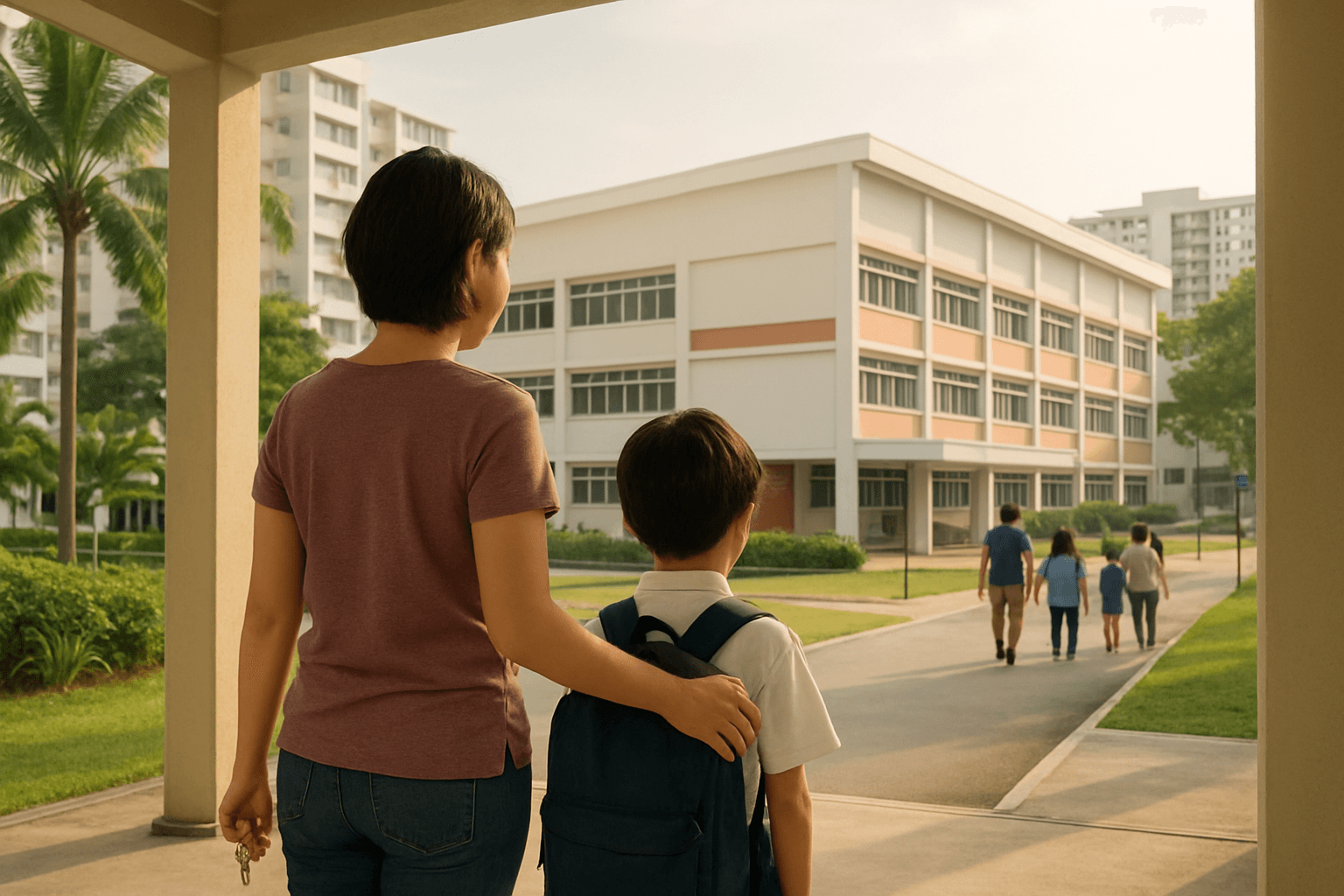
Yes, your child can still need to ballot even if you live within 1km of a school. The simple reason is this: distance improves your priority, but it does not reserve a seat. If a school has more applicants than vacancies in the same priority band, MOE may still conduct balloting. This guide explains how the 1km rule works, why nearby families can still miss out, and what parents should check before relying on a move for Primary 1 registration.
Can there still be balloting for P1 registration even if I live within 1km?
Yes. Living within 1km improves priority, but you can still ballot if the school has more nearby applicants than places in that group.
Yes. Living within 1km can improve your child's priority, but it does not guarantee a place. MOE explains on its page about balloting that balloting can still happen when a school receives more applications than vacancies in a phase.
A simple example shows why. If a school has 20 places left for a group of applicants, and 35 children in that same priority group all live within 1km, some of those families may still need to ballot. The move helped them enter a stronger queue, but it did not remove the competition inside that queue.
The most useful way to think about it is this: within 1km is an advantage, not a seat reservation. If you want the full context on phases, vacancies, and balloting, start with our Primary 1 Registration in Singapore guide.
All About Primary Schools' Balloting History
Assume there are 50 places in P2C. Further assume the following number of applicants: < 1 km - 40 1-2 km - 20 > 2 km - 10 Total number of applicants = 70 In this instance, all living within 1 km will get in, and hence, no balloting for those in the < 1 km category. With 10 places left, the 20 applicants staying 1-2 km from the school will go through the balloting. Those in the > 2 km category will not even have the chance to participate in the balloting. For those staying > 2 km, it is only prud
All About Primary Schools' Balloting History
If you do not have any schools within 1km away, there are still schools that accept SC within 1 to 2km, and some without ballots. If you do not have any schools within 1 to 2km, or do not want to face the ballots, there are also schools that accept SC > 2km without ballot. It's just a matter of prioritising what you want.
How does the 1km rule actually work in Singapore Primary 1 registration?
MOE uses home-school distance as part of the priority order when applications exceed vacancies. Closer homes are prioritised within the relevant group, but distance alone does not guarantee admission.
The 1km rule is part of MOE's priority system. It is not a stand-alone promise of admission. When applications exceed vacancies, MOE uses the registered home address to determine Home-School Distance, and it applies priority by citizenship first, then by distance within the relevant group. MOE also makes clear that the address used for registration matters, so parents should understand the official home address rules before assuming a move will help.
One detail many parents miss is how the distance is measured. Since the 2022 exercise, MOE has said that distance is calculated using the school's land boundary rather than a single point on the building, as noted in this parliamentary reply on home-school distance changes. That means a home that looks "very near" on a property portal or map may still fall into a different band from what a parent expects.
The practical takeaway is this: distance is a sorting rule. It helps decide who is considered earlier when a school is oversubscribed, but it does not create extra places. For a broader overview, see Primary 1 Registration Distance Priority: How Home-School Distance Works.
All About Primary Schools' Balloting History
No, it means that the school only accepted registrants who live within 1km. If you refer to last year's balloting info at - http://www.kiasuparents.com/kiasu/system/files/2007+MOE+P1+Phase+2C+Balloting+Info.pdf It is mentioned in the document under point 3 that Nanyang only have spaces for children who have registered in the school and are living within 1km of the school. All children living outside of 1km are unsuccessful in their registration .
All About Primary Schools' Balloting History
hi all, i’m very new in this forum… I hav a yr 2005 boy whom we going to register him for P1 next year so i’m very stress now coz i’m SPR & not really know the education system here in SG… ok, wat i wan to know is if we register under phase 2C in a very popular school, will we stand a higher chance if we stay within 1km? how the balloting actually takes place for 2C? i heard tat if the application (for 2C) for those who stays within 1km is already exceed the vancancies, then the balloting will b
Have More Questions?
Get personalized guidance on schools, tuition, enrichment and education pathways with AskVaiser.
Try AskVaiser for Free →Why do some schools still ballot even for families living nearby?
Some schools still ballot within 1km because many nearby families are competing for too few places.
Because nearby families can still outnumber the places available. This happens most often at popular schools, where many applicants may already live within 1km long before registration opens.
There are a few common reasons. Some schools attract families who planned their housing around the school years in advance. Some schools have very limited places left by the time most parents enter the exercise, so even a large nearby catchment becomes competitive. In some years, a new housing cluster nearby can also push up the number of applicants quickly.
This is the mistake many parents make: they confuse "nearby" with "safe." A school can be close to home and still be hard to get into. If you are deciding between a high-demand school and a more realistic option, our guide on whether to pick a popular dream school or a safer nearby school can help. For a wider view of current demand, MOE's vacancies and balloting updates are more useful than rumours or old anecdotes. For a broader overview, see Primary 1 Registration After Moving House: Should You Use Your Old or New Address?.
All About Primary Schools' Balloting History
My ex-colleague's case is an example. The school that he registered his son in had 68 places last year, but there were 69 applicants. All 69 applicants stayed within 1 km. Hence, there was balloting within 1 km last year in that school.
All About Primary Schools' Balloting History
For many \"hot\" schools - P2A > 2 km now prepare standby plan(s). In the event need to ballot & they got balloted out under 2A - they will enrol the child into their nearby neighbourhood school, under P2C < 1 km. Some 2A > 2 km smart : devise strategy. Example Make use of child's grandparents address to enrol under 2A : if grandparents' house happen to be < 2 km, from these popular, \"hot\" schools. This way : they can enrol their child under 2A 1 to 2 km, instead of > 2 km. So if 2A > 2 km bal
What happens when there are too many applicants within the same distance band?
If applicants in the same priority group exceed the vacancies, MOE may ballot among those children.
If too many applicants fall into the same priority group, MOE may ballot among them. This is the part that catches many parents off guard. Living within 1km improves your position compared with families who are farther away, but it does not remove competition from other families who are also within 1km.
For example, imagine several Singapore Citizen families applying in the same phase, all using accepted home addresses, and all living within 1km of the school. If there are fewer places than applicants in that band, the remaining places still have to be allocated somehow. That is where balloting can come in, as MOE explains on its page about how balloting works.
A good parent shorthand is this: distance can move you into a better lane, but it cannot empty the lane for you. For a broader overview, see How to Read Past Balloting Data Before Chasing a Popular Primary School.
All About Primary Schools' Balloting History
Hi!can anyone enlighten me on hw the P1 balloting works?e.g i’m in P2C n available vancanies are 50 does that mean the total of applicants who lives < 1km is less than 50 do not need to be balloted?? tks KO NAh
All About Primary Schools' Balloting History
Yes, we are aware. A quick eyeball shows that if balloting is <1km, then it is most likely that all players involved are <1km, like we have all along suspected. Good luck for this year's P1 registration!
What should parents check before relying on distance?
Before relying on distance, check the address, your likely phase, the school's competition level, and whether you have a workable backup plan.
- ✓Confirm that the address you plan to use is your child's genuine home address and fits MOE's home address guidance.
- ✓Check whether the move actually changes your distance band. Moving from outside 1km to within 1km usually matters more than moving from 700m to 400m.
- ✓Look at the registration phase you are likely to enter, because competition can feel very different depending on the phase. Our explainer on [Primary 1 registration phases](/blog/primary-1-registration-phases-singapore) can help you judge this more realistically.
- ✓Watch MOE's vacancies and balloting updates during the exercise instead of relying only on hearsay or old stories.
- ✓Check whether the school has a pattern of pressure in the phase you expect to enter. Our guide on [how to read past balloting data](/blog/how-to-read-past-balloting-data-before-chasing-a-popular-primary-school) shows what parents usually look for and what they often overread.
- ✓If you have moved recently, keep supporting records such as updated address records, tenancy or purchase documents, and recent utility statements in case clarification is needed. These are examples, not an official guaranteed checklist.
- ✓Keep at least one realistic backup school in mind, so your family is not depending entirely on one high-pressure outcome.
Important misunderstanding: within 1km is not the same as automatic admission
Within 1km helps, but it is still only a priority advantage, not an automatic offer.
Within 1km improves your place in line, but it does not reserve your seat. The common mistake is treating a priority band as a guarantee, especially after spending time and money moving house. For a broader overview, see Primary 1 Registration Unsuccessful: What Happens If You Do Not Get Your Preferred School.
All About Primary Schools' Balloting History
There is no official breakdown on applicants by distance. You can only get this information from the school admin during the registration period. Balloting history only tells you the \"cut-off\" distance group for balloting, so if there's balloting for >2km, you won't know how many are <1km & how many between 1-2km.
All About Primary Schools' Balloting History
Yes. Yes. You may place your name in the waitlist immediately after balloting, but schools will usually encourage you to secure a place for your child first in another school. There is no such thing as appeal. The registration process is transparent, so on what basis do you want to appeal? There is such a thing called waitlist, though.
Does moving house before registration improve your odds?
Moving can help, especially if it changes your distance band, but only if the address is genuine and accepted under MOE's rules.
It can, but mainly when the move changes your priority position in a meaningful way. The biggest gain usually comes when a move shifts you into a better distance band, such as moving from outside 1km to within 1km. By contrast, moving from one address already within 1km to another even closer address may not change much if both homes fall into the same band and the school is heavily oversubscribed there.
Parents also need to weigh the real-world costs honestly. A move can mean higher rent or mortgage payments, a longer commute, childcare disruption, or a home that no longer suits the family once registration is over. If the target school is still likely to ballot among many nearby applicants, the move may improve your odds without making the result secure.
There is also a compliance issue. MOE takes a serious view of using an address only for registration. Its home address rules state that if the information cannot be verified or the address was used improperly, there can be consequences, including a transfer out of the school. If you are deciding between an old and new address after a move, read our guide on Primary 1 registration after moving house before making assumptions.
The safest rule of thumb is simple: move because it works as a real home first, and treat any registration benefit as a bonus rather than the only reason for the move.
All About Primary Schools' Balloting History
I have not registered any yet... but based on advice given, balloting is already required for <1km.... me outside 1km, heart freeze liao…. So will go register elsewhere ba… Did you go to MTS to check with them on the status of applicants? Like if they are all within 1km?
*** READ ME FIRST !!! - P1 Registration FAQ ***
Can someone tell me if this rule is new starting from this year or was it around before? Extracted from MOE FAQ under Proximity to School FAQ 4. How long do we need to stay in the address used to register our child during the P1 Registration Exercise? In a small number of cases, there may be situations where the families are unable to remain at the address for the entire duration of the primary school studies. Even so, a child who gains priority admission into a school through his/her distance c
What should you do if your chosen school is consistently oversubscribed?
If a school is consistently oversubscribed, keep a backup plan. Distance can improve your odds, but it should not be your only strategy.
Treat distance as one part of your plan, not the whole plan. If a school regularly faces heavy demand, the practical move is to prepare both a first-choice strategy and a fallback strategy before registration begins.
In practice, that means watching MOE's vacancies and balloting updates during the exercise, being realistic about the phase you are entering, and identifying one or two alternative schools your family can genuinely accept. Parents sometimes feel that choosing a backup school means they are giving up on the preferred school. In reality, it means they are reducing panic and making better decisions under pressure.
If your child is unsuccessful, there is still a pathway forward through the next eligible phase or, after Phase 2C Supplementary, a posting to a school with available vacancy. Our guide on what happens if you do not get your preferred school explains what that usually looks like for families.
The calmest families are usually not the luckiest. They are the ones who planned for both outcomes.
All About Primary Schools' Balloting History
Hi, it's my first time to post question here Please help I am quite anxious of P1 registration of my son which is due this year. He will be P1 by next year. I just want to know the balloting of within 1KM of the school, what if my son was not selected during the Phase 2C? Can I still register him in my second option for school? What if it is full too? Can you pls tell me the steps / tricks on how to go about this... My first option of school is, we definitely wait for the ballot Phase 2C due to
[Central] Primary Schools
For RVPS in P2B, I think there is not need to ballot regardless of distance, according to historical data http://www.kiasuparents.com/kiasu/event/p1-registration-2012-phase-2b For P2C, I think balloting will be required for 1-2km RVPS will be my back up in P2C as I stay almost next to it I am going for ACJS in P2B and stay within 1-2km of it. Looks like there is no need to ballot for my boy. I hope! I am praying very hard for it
If I am already within 1km, is there any point moving even closer?
Usually not. The bigger benefit comes from moving into a better distance band, not from getting slightly closer within the same band.
Usually, no. The bigger change is crossing into a better distance band, not shaving off a few hundred metres within the same band. If your current home is already comfortably within 1km, moving even closer may not materially improve your outcome at a school that already has too many nearby applicants.
A practical way to think about it is to ask two questions. First, does the move actually change the admission logic MOE will apply, or are you still in the same band? Second, is the home still workable for the family after registration, not just during registration? For many families, the smarter decision is not to chase the smallest possible number on the map, but to understand whether the move changes anything meaningful at all. If you want a clearer picture of how this priority works, our guide on Primary 1 registration distance priority explains it in plain language.
All About Primary Schools' Balloting History
So far for <1km no balloting. 1-2km balloting probably. https://www.kiasuparents.com/kiasu/article/toa-payoh/ [/quote]This year could be different. With the new housings and the gc that I’m in everyone trying phase 2c are within 1km. High chance of balloting! Don’t even know if I should risk it
All About Primary Schools' Balloting History
Hi, I am considering to move within 1km to Fairfield Methodist Primary school, may I know if balloting required for 2B <1km ? Thanks
Have More Questions?
Get personalized guidance on schools, tuition, enrichment and education pathways with AskVaiser.
Try AskVaiser for Free →