
No Car, No Helper: Is a Nearby Primary School the Better Choice in Singapore?
How to weigh commute load, care arrangements, and school fit when your family relies on public transport.
For many families choosing a primary school without private transport or domestic help, a nearby school is often the smarter option because it cuts travel strain, reduces pickup stress, and makes backup planning simpler. A farther school can still be worth considering if the fit is clearly better and the route, care plan, and emergency arrangements are realistic in everyday life, not just on paper.
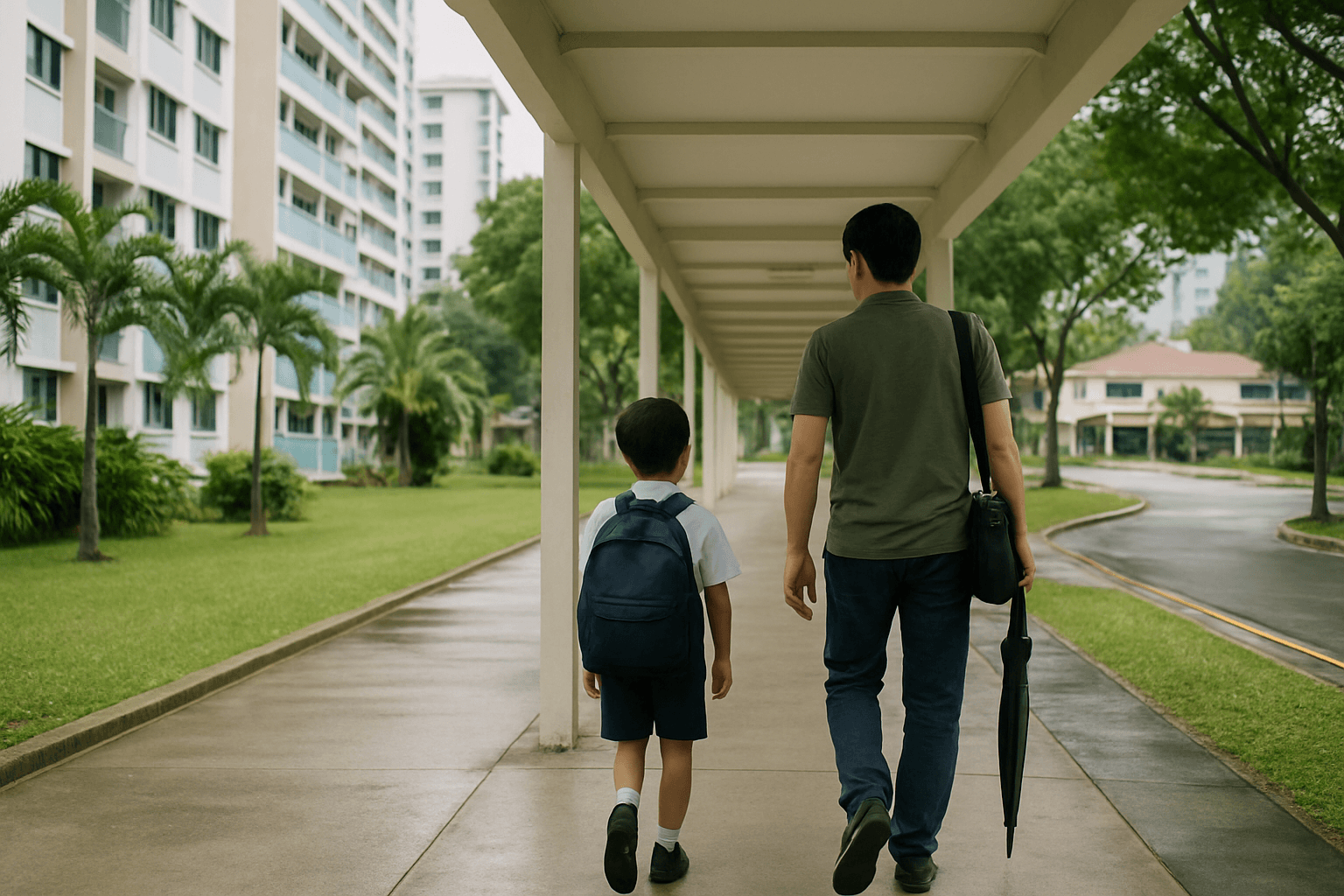
For many families in Singapore, yes — a nearby primary school is often the better choice if you have no car and no helper. The real question is not just which school is closest. It is which school your family can handle calmly every weekday for six years, including rainy mornings, tired children, work deadlines, and the occasional last-minute problem.
Is a nearby primary school usually the better choice if we have no car or helper?
Often yes. If your family has no car or helper, a nearby school usually makes daily life more manageable.
For many families, yes. A nearby school usually reduces the daily friction that parents feel most when there is no private transport and no domestic helper at home. Shorter travel often means less rushing in the morning, simpler pickup after school, and fewer days where one delay throws the whole routine off.
This matters most in ordinary school days, not just emergencies. A parent taking the MRT and bus with a Primary 1 child may manage it at first, but the strain often shows up on wet mornings, after a tiring day, or when work starts early. If you also have a preschooler, an older sibling, or grandparents helping only sometimes, a nearer school can make family coordination much easier.
That said, nearby is not automatically best. If a farther school is a clearly stronger fit for your child and the route is still manageable, it can still be the better choice. A useful rule is this: if two schools are both acceptable, give real weight to the one your family can sustain more easily. School choice is a six-year routine, not a one-time win. If you are also planning registration strategy, our Primary 1 Registration guide gives the bigger picture.
[Geylang] Primary Schools
For primary schools, I recommend going for convenience than popularity. Reason is the kids are still young, and travelling time should not be long enough to tire them out, even for those driving. Have you seen children dozing off in the parents car (some in an awkward position, especially straining their necks) because they have to wait up earlier than their peers to reach these “better” schools to feed their parents “ego”. Please note that the above is just my PERSONAL view as I have gone throu
Malaysian mum needs help finding kindy in Singapore
Hi everybody, My family is relocating to Singapore this February and Aidan will turn 2 on 15 February. I plan to enter Aidan into kindergarten when he turns 3. We’ll be living at Kovan Melody and we won’t have a car so it would be great if I could find a good place that’s not to far. I am a stay-at-home mum so the convenience, while not everything, will be very helpful as my maid only focuses on housework, not caring for Aidan. I would be really grateful to hear some suggestions so I can start r
What daily logistics matter most for parents without private transport or domestic help?
Commute, timing, care coverage, and backup planning matter most. These often affect family life more than the school name itself.
The biggest issues are usually commute, timing, care coverage, and backup planning. Many parents start with school reputation or registration chances, but the harder question is what the school day actually looks like from the moment you leave home to the moment your child is safely supervised after dismissal.
Morning routine matters more than many parents expect. A school that requires one parent to leave home early, make more than one transfer, and still reach work on time can create pressure every day. Pickup is often the second weak point. If a parent has to leave the office early, or there is a tight handover between dismissal and student care, even a good school can become tiring to maintain.
Small disruptions add up quickly. Rain can turn a short walk into a slow, messy trip. A missed bus can mean a late arrival and an anxious child. If siblings have different school locations or dismissal times, what looked workable on paper may become awkward in practice. Emergencies test the plan even more clearly. If your child feels unwell, forgets something important, or needs to be collected unexpectedly, can someone get there without turning the day upside down?
A simple way to judge a school run is this: do not assess it only on a smooth day. Assess it on a difficult day when the weather is bad, the child is tired, and work is busy. That version tells you whether the routine is strong or fragile. For a broader overview, see Primary 1 Registration Distance Priority: How Home-School Distance Works.
[Ang Mo Kio] Primary Schools
My girl will be enrolling in a primary school next year too. I feel where you stay will play a big part in deciding on which pri school your child will study at eventually. Why do we need to compare which primary schools your child will study in ? I think this create an unhealthy system in which most parents will strive to get their child into these perceived good schools. ( If they score well in those schools, it is expected of them but if they do not, these children will enter different second
[Ang Mo Kio] Primary Schools
There are other places besides the main gate (dual carriageway with 2 lanes per side) where the girls can alight. Eatery as mentioned by mrswongtuition are within walking distance or nearby if one does drive and explore. For those who are late, yes, there are bound to be, it is probably because they are stuck in expressway rather than due heavy traffic along the main road. So if you change your mind and your DD get in, not to worry as more information will be provided during orientation and it a
Have More Questions?
Get personalized guidance on schools, tuition, enrichment and education pathways with AskVaiser.
Try AskVaiser for Free →How do I judge whether a school is truly nearby in practical terms?
Measure nearby by door-to-door effort, not straight-line distance. A school can look close on a map and still feel hard every day.
Treat nearby as a door-to-door question, not a map question. A school may look close by distance and still feel difficult if the route involves a long unsheltered walk, awkward crossings, crowded transfers, or unreliable timing during the morning rush.
There is no single distance that is automatically too far for every family. What usually matters more is whether the route is short, simple, and repeatable. One easy bus ride may be more manageable than a technically closer school that requires several crossings and a transfer. For younger children, simplicity often matters more than absolute distance, especially if adult accompaniment is still needed.
The best test is to try the route at the time you would actually use it. Do it on a weekday morning, not just on a weekend. If possible, do it with your child and imagine the child carrying a bag, walking more slowly, or having a tired day. Then picture the rainy version of the same trip. Nearby is the school you can still manage when conditions are less than ideal.
If you are also thinking about registration distance, that is a separate issue from daily convenience. This guide on how home-school distance works for Primary 1 registration explains that side of the decision. For a broader overview, see Primary 1 Registration: Should You Pick a Popular Dream School or a Safer Nearby School?.
[Jurong East] Primary Schools
there are 4 primary schools within 1 Km from my place: Yuhua, Fuhua, Jurong East and Princess Elizabeth. for 2C, we’d like to try Princess Elizabeth, but I’m afraid if we are not lucky enough, we may not have the chance to go into any of the 4 schools. How can we stratigise so that we can try our preferred school? many thanks for the advices from experienced parents.
[Geylang] Primary Schools
Ironically, I do not have a primary school even within 2km for my boy. The nearest is HGS though. My primary school is Yu Neng. Which is quite far from Geylang Serai. My ideal school is Kong Hwa though. Any kind soul can shed some light?
A school that looks close on the map is not always the easiest school to live with daily.
Do not confuse map distance with daily ease. The route has to work in real life, not just look short on paper.
The real burden is not distance alone. It is the full effort of getting there, getting home, and handling rainy days, late dismissals, and unexpected pickups when there is little backup at home. For a broader overview, see Popular Primary School vs Neighbourhood School in Singapore: Which Is Better for Your Child?.
[Geylang] Primary Schools
Not sure why you would want to consider http://www.kiasuparents.com/kiasu/school/macpherson-primary-school if you stay around the area because you should be close to http://www.kiasuparents.com/kiasu/school/maha-bodhi-school too, which is clearly the better choice in this case.
[Geylang] Primary Schools
Hi, If you lived within the vicinity of the following schools, which would you choose? 1) Kong Hwa School 2) Tao Nan School 3) Ngee Ann Primary School 4) Geylang Methodist School 6) Tanjong Katong Primary School 7) MacPherson Primary School Saint Stephen School
What school features become more important when family transport is limited?
Care arrangements, dismissal timing, and pickup logistics matter more when your family has limited transport support.
When transport support is limited, the school's practical setup matters more. Before-school supervision, after-school care, dismissal timing, and pickup expectations can affect your routine almost as much as the commute itself.
For working parents, the key question is not just whether care exists, but whether it matches the family's actual hours. A school that is slightly farther away may still work well if there is reliable care and a smooth handover after lessons. On the other hand, a nearer school can still be difficult if dismissal timing leaves a supervision gap or if collection arrangements are hard to coordinate.
Parents should also look at how much margin the routine allows. If your job starts early, can you realistically manage drop-off without being late most days? If meetings run long, is there a safe plan for your child after dismissal? If the child has CCA or enrichment later in primary school, does the journey home become too long for a young student?
Many parents treat these details as admin matters to sort out later. They are not. They are part of school fit. A strong care setup can make a school feel effectively closer than a shorter-distance option with weak daily support.
[Geylang] Primary Schools
Hi Candymum, Those unsuccessful in Tao Nao, Kong Hwa and Geylang Methodist Primary will go for Ngee Ann but this school only left with 4. The next school will be Tanjong Katong Primary School. Tangjong Katong is more popular than Eunos becos it is so called an international school. Alot of foreign students too. They have a lot of variety of sports eg. bowling etc which other schools don't have. I guess Eunos Primary is less popular becos it is in Eunos area which is quite jam in the morning & ev
[Geylang] Primary Schools
School vacancies out ! http://www.moe.gov.sg/education/admissions/primary-one-registration/vacancies/#geylang How to pick the right school ? http://www.straitstimes.com/the-big-story/ask-sandra-p1-registration/story/how-pick-the-right-school-20130620
When is a farther school still worth considering?
A farther school can make sense when the fit is meaningfully better and the commute is supported by a realistic daily plan.
A farther school can still be the right choice if the fit is clearly stronger and the commute is genuinely sustainable. The real test is not whether the route seems acceptable on a good day. It is whether your family can manage it without constant lateness, fatigue, or last-minute scrambling.
There are sensible reasons to choose the farther option. Some parents value a school's culture, support style, or overall environment. Some already have an older child there, which may simplify family coordination overall even if the school is not the closest. Some families can handle a longer route because one parent has flexible work arrangements or because the public transport journey is direct and predictable.
What makes the farther choice workable is usually not determination alone, but structure around it. If your child can handle the route with adult accompaniment at first, if there is reliable after-school supervision, and if both parents know who handles delays and sick days, the extra distance may be manageable. If the plan depends on perfect timing, occasional favours from relatives, or a parent rushing across town every time something goes wrong, it is probably weaker than it looks.
A useful insight here is simple: a farther school works best when support is built in, not improvised.
[Serangoon] Primary Schools
ChiefKiasu Wrote [quote]4. And finally, there's the question of practicability. It wouldn't make sense for a child who stay at one end of the country spend hours travelling to a school on the other end of the country. Singapore may be small, but not that small. [/quote]With the sentence above, I believe the system still needs additional tweaking. 2A/2B in my opinion should not be abolished. However, there should be a limit set for 2A. Places after Phase 1 should be apportioned too, accordingly w
[Sembawang] Primary Schools
Hi all, When do you all start thinking about which primary school you want to put your son/daughter to? I think it is very scary topic nowadays. I am an ex student of Bukit Merah Primary school ( which is where Gan Eng seng Primary occupying now). My hubby is from Xin Ming Primary school (Hougang) . We are staying in Sembawang. There are only 2 schools which was closer to our place Canberra primary & Sembawang Primary. Are these 2 primary comparable to the rest of them?
What do parents often overlook when choosing a school mainly for reputation?
Many parents underestimate the daily commute burden. Reputation does not remove fatigue, rain-day delays, or pickup stress.
The biggest blind spot is underestimating the daily burden of getting there and back. A school can be well regarded and still be the wrong choice if the routine leaves the child tired, the parents stressed, and the whole family dependent on fragile logistics.
Reputation does not shorten the morning commute, make rain less disruptive, or solve emergency pickups. A child who starts the day already exhausted from travel may not benefit from the school in the way the family hoped. A parent who spends every afternoon watching the clock to make collection on time may carry that stress for years.
Another common mistake is comparing schools by name but not by school-day load. A quick weekend drive or map estimate can hide the real experience of peak-hour buses, waiting time, or walking with a six- or seven-year-old. Parents also tend to forget how much harder routines become once siblings, enrichment schedules, changing work hours, or occasional caregiver help are added to the picture.
A better comparison is not prestigious school versus ordinary school. It is strong fit with a sustainable routine versus attractive reputation with recurring stress. If you are weighing that trade-off, this guide on choosing a popular dream school or a safer nearby school can help.
Preschools prepared your kids well for Singapore primary?
For parents who have already been through the pre-school days and with kids now in primary schools (Singapore schools), can you share your comments on your kid's previous preschool and their curriculum - specifically if they have prepared your child properly for the Singapore education system ? (not discussing the international or foreign schools system here) Nowadays, there are so many pre-schools and childcare centres with many learning methods. Parents currently at the pre-school stage will b
[Ang Mo Kio] Primary Schools
Hi Parents, I stay in Bishan and I’ve two kids, one is registering for P1 next year and the other is registering for P1 the year after. I am an old boy of Catholic High and my wife is an old girl of St Nick’s. BUT we have chosen not to put our kids in those schools, for several reasons: 1. We wanted them to go to school with students of different races/social class. 2. We wanted them to attend school together (I’ve a boy and a girl). 3. We didn’t want to put too much stress on them. I’ve spent t
How should working parents think about before-school and after-school care?
Care arrangements are not an afterthought. Without a helper, they often determine whether the school works at all.
Treat care arrangements as part of the school choice from the start. For families without a helper, this is often the factor that decides whether a school is truly workable.
The core questions are practical. Can your child be supervised before lessons if your workday starts early? What happens after dismissal if both parents are still at work? If transport is delayed or a meeting overruns, is there a stable plan that does not rely on frequent last-minute rescue from relatives or friends?
Common possibilities may include school-based student care or a nearby private student care option, but these are examples, not assumptions. Availability, timing, and handover arrangements differ by school and area. It is worth asking not just whether care exists, but how the transition works each day and what happens if your child needs to stay a little longer or be collected unexpectedly.
It also helps to think about stamina. A long day that combines school, care, and a lengthy journey home may be manageable for some children and draining for others. School fit is not only academic. It is also about whether the school day matches your child's energy level and your household's rhythm.
[Geylang] Primary Schools
[Moderator's note: Topics merged.] hi all!! Glad i found tis website!.. my son is due for pri 1 sch registration next year and i am at a loss what school is good... below are the schools of consideration : geylang methodist primary st hilda's primary kong hwa primary ngee ann primary anyone knows the pros and cons of the above schools? would appreciate all the help !!! thanks!!!! :mrgreen:
[Geylang] Primary Schools
Please double check that your statistics refers to those residing 1-2km from the school. For registration using caregiver's address, MOE will categorise it as registration within 1-2km even if the caregiver stays <1km from the school. If you fail in Phase 2C, you will need to register in Phase 2C supplementary. At that point, you can register in any schools that has vacancies left in Phase 2C (taking into consideration your success rate based on distance too, as that is already the second last r
What simple checklist can parents use before deciding?
Use this compare-and-test checklist for each school. The goal is to find the routine your family can actually sustain.
- ✓Can we do this route calmly every school day, not just for a short trial period?
- ✓Does the route still feel manageable in rain, peak-hour crowds, and on tired mornings?
- ✓Is the journey simple enough for our child's age, confidence, and current need for adult accompaniment?
- ✓Who will handle drop-off on normal days, and who will handle pickup?
- ✓What is our backup plan if one parent is delayed, unwell, travelling, or suddenly unavailable?
- ✓Have we confirmed before-school care, student care, or other supervision if we need it?
- ✓Will this school choice make sibling schedules much harder to coordinate?
- ✓Can we reach the school reasonably quickly if our child is unwell or needs to be collected unexpectedly?
- ✓If the commute turns out to be slightly harder than expected, would we still choose this school?
- ✓Are we choosing this school because it truly fits our child, or mainly because of reputation?
Should I choose the nearest primary school if another school looks stronger on paper?
Yes, often. If the nearest school is a decent fit and the convenience gap is large, a smoother daily routine may matter more than a small difference on paper.
If the nearest school is a solid fit, choosing it is often the wiser long-term decision for a family without a car or helper. Daily sustainability matters more than many parents first expect. A school that is easier to reach can reduce stress, preserve your child's energy, and make the full primary school journey easier to manage.
That does not mean the nearest school should always win. If the farther school is clearly a better fit for your child in ways that matter to your family, and you have tested the commute and care plan honestly, it may still be worth choosing. The practical question is whether the difference between the schools is large enough to justify the ongoing transport and care burden.
In many real cases, parents are not choosing between an excellent school and a poor one. They are choosing between two acceptable schools, with one creating a much smoother weekday routine. In that situation, convenience is not a shallow reason. It is part of fit, because a routine your family can maintain consistently usually supports the child better over time.
If you want to think through that trade-off more broadly, Popular Primary School vs Neighbourhood School in Singapore is a useful next read.
[Toa Payoh] Primary Schools
Unfortunately, this is Phase 2Cs where you don’t exactly have a choice. You can only pick the nearest one or one that guarantees you a place. Otherwise, your options may be severely limited if you miss this phase. Learn to like the school if you must. After all, all schools are good schools.
[Jurong East] Primary Schools
FMz, provided ur kids select a school that is 'reachable', hee... My dd wanted to go to NHPS (her best fren going there) and HPPS (her cousins there) and we had no choice but to reject her as we do not stay within 1km of either school. Even if we move house, we would still need to ballot
Have More Questions?
Get personalized guidance on schools, tuition, enrichment and education pathways with AskVaiser.
Try AskVaiser for Free →