
Primary 1 Registration for Divorced Parents in Singapore: Who Registers and Which Address Counts
A practical guide to choosing one parent to handle the application, using the child’s real home address, and preparing the right records if questions come up.
For Primary 1 registration divorced parents in Singapore, the safest approach is to let one parent lead the application, use the child’s real main residence, and keep matching address and custody-related records ready. The key test is simple: which home is the child’s actual school-week base?
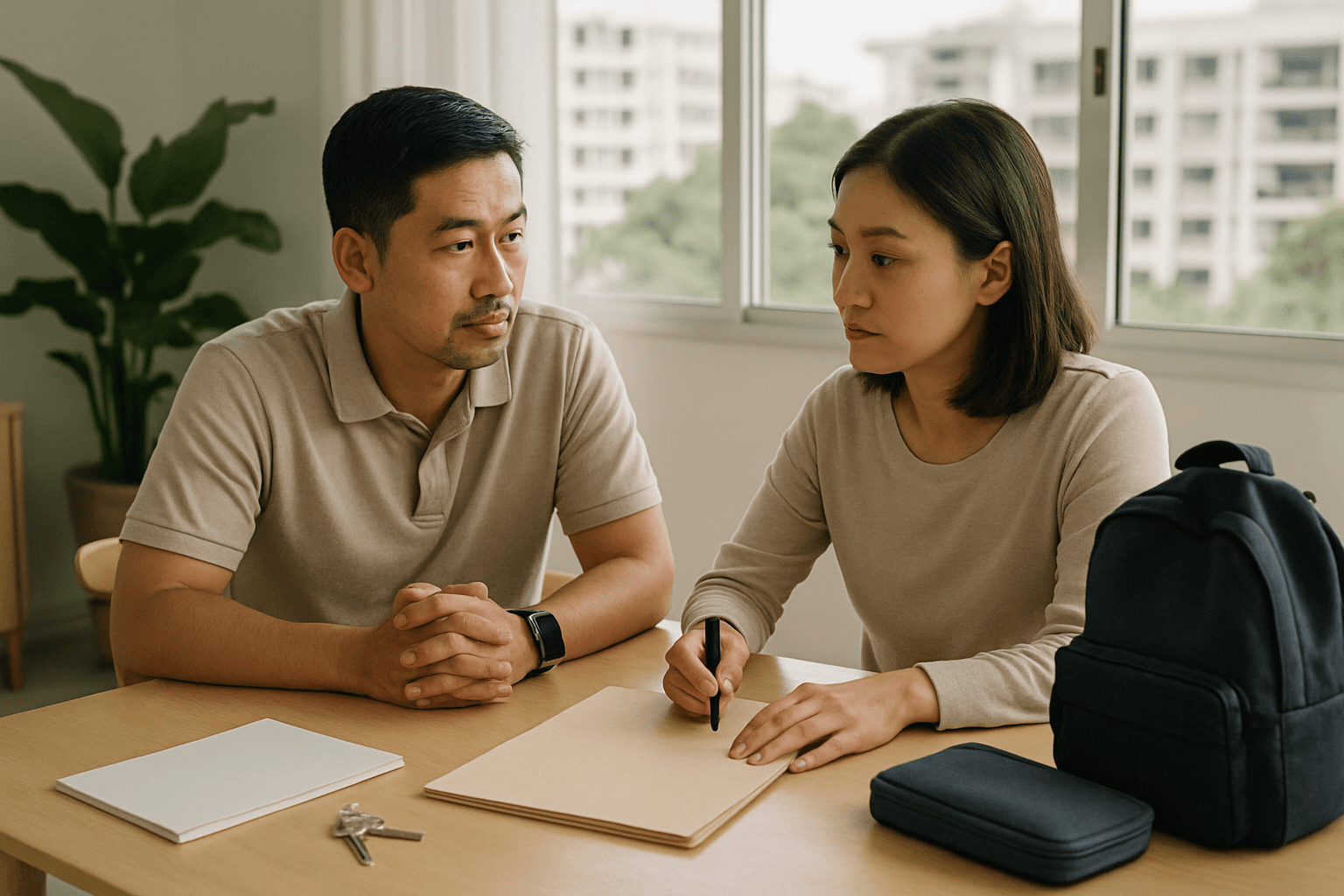
For divorced or separated parents, Primary 1 registration usually comes down to three practical questions: who will handle the form, which address best reflects the child’s real home, and what records should be ready if MOE asks for support. If you are still planning your school options, start with our full Primary 1 registration guide, then use this article to sort out the co-parenting and address questions.
In a divorce or separation, who should handle the Primary 1 registration?
Choose one parent to run the application, even if both parents still help make the school decision.
Usually, one parent should be the main application lead. That parent does the practical work: collecting documents, checking the address, submitting the form, and replying quickly if MOE or the school needs clarification.
The other parent can still stay involved in the school decision. The point is not to exclude either parent; it is to avoid duplicate work and conflicting details. Many problems happen because both parents assume the other has checked the form, the address, or the supporting records.
A workable split is simple. One parent prepares and submits the application. The other reviews the final details before submission, especially the school choice, the address, and the child’s particulars. If there is a court order or written arrangement that affects school decisions, start there and keep a copy ready. One child, one application, one lead parent. For a broader overview, see Primary 1 Registration in Singapore: How It Works, Balloting Risk, and How to Choose a Realistic School Plan.
Give citizens priority in Primary 1 registration
Ha.ha. maybe next time the P1 registration phase can propose like that, just a suggestion: Phase 1 – Existing siblings in the Primary school except PR siblings. Phase 2A(1) – No Change Phase 2A (2) – No Change Phase 2B – No change Phase 2C – Singapore Citizenship Only. Phase 2C Supplementary - Singapore Citizenship Only Phase 3A – Permanent Residents Phase 3A Supplementary - Permanent Residents Phase 4 – Non Citizen.
Preparing Your Child for Primary School:Parent Seminar - MOE
Preparing Your Child for Primary School: A Parent Seminar by MOE Starting primary school is a big step in your child's life. To help you better understand primary school programmes and enable you to make key education decisions, the Ministry of Education will be conducting a seminar on Primary School Education. At the seminar, parents can look forward to sharing sessions by the school principal and a parent volunteer, as well as view the various programmes our primary schools provide. The Primar
Which address should you use if the child mainly lives with one parent?
Use the home that is genuinely the child’s main school-week residence.
Use the child’s real main residence, not whichever parent’s address looks more convenient on paper. In practice, the safest address is usually the home where the child sleeps most nights, keeps school things, does homework, and starts the school day.
A helpful shortcut is to ask: which home functions as the child’s school base? For example, if the child stays with the mother on school nights, gets ready for school there, and leaves for school from there, that address is usually the stronger choice. The same logic applies if the father is the weekday caregiver.
What matters is not just that the address belongs to a parent. It is whether the address matches the child’s actual day-to-day routine. If you need a broader explanation of how address issues work, see Which Home Address Counts for Primary 1 Registration in Singapore? and Primary 1 Registration Distance Priority: How Home-School Distance Works.
[Geylang] Primary Schools
Please double check that your statistics refers to those residing 1-2km from the school. For registration using caregiver's address, MOE will categorise it as registration within 1-2km even if the caregiver stays <1km from the school. If you fail in Phase 2C, you will need to register in Phase 2C supplementary. At that point, you can register in any schools that has vacancies left in Phase 2C (taking into consideration your success rate based on distance too, as that is already the second last r
2B Primary one registration question
Hi, Hope all is well. I have been serving as an active community leader in one GRC for over 2 years. Just before primary one registration, if we move to a new address, are we able to register the child in 2B phase for schools within 2km in the new address?
Have More Questions?
Get personalized guidance on schools, tuition, enrichment and education pathways with AskVaiser.
Try AskVaiser for Free →Why parents should not assume a parent-linked address will be accepted automatically
A parent-linked address is not enough if it does not match where the child really lives.
A parent’s name on a lease, NRIC record, or utility bill does not by itself prove that the child truly lives there. For school registration, convenience is not the same as credibility. MOE’s Primary School Transfer FAQ is not a Primary 1 divorced-parent rule, but it does show that residential records matter in school-related processes.
The practical lesson is straightforward: do not plan around an address that looks strategic but does not match the child’s real living pattern. For a broader overview, see Primary 1 Registration Distance Priority: How Home-School Distance Works.
Share with us your kid's P1 registration experience
Hi parents, I've gone through 2 rounds of registration for my kids - Phase 2B 5 years ago (2006) and Phase 2A2 (2010). For son's P1 registration at Pei Hwa then, there was just 1 stop - ie to submit documents for verification. No guarantee at Phase 2B, just a high chance of getting in. Today's registration for daughter is slightly longer - 3 'stops'. Station 1 is at ground floor where a lady will make sure we are eligible for Phase 2A2. If so, then we proceed to the hall on 2nd floor. Station 2
Give citizens priority in Primary 1 registration
Not sure if this has been mentioned in KSP forum? From 2010, Singapore Citizens (SCs) will be given an additional ballot slip (i.e. two chances instead of one), while Permanent Residents (PRs) will retain one ballot slip whenever balloting is conducted by any school during the P1 Registration Exercise. SCs will therefore have a higher chance of securing a place for their child in a school of choice when there is balloting. Giving Singaporeans two chances during balloting will retain the underlyi
What proof should parents prepare if MOE asks where the child lives?
Prepare a few matching records that show where the child actually lives and who is acting for the child.
There is no fixed divorced-parent Primary 1 checklist in the source material provided, and MOE’s available school transfer FAQ does not set out a P1-specific list for these situations. The practical approach is to prepare records that support the child’s actual living arrangement.
Common examples parents often gather include a parent’s NRIC showing the residential address, tenancy or home ownership documents, custody or court papers if they exist, and ordinary records that show the child is based at that home in daily life. Depending on the family, that could include childcare or school correspondence, medical letters, or other routine mail sent to the same address.
The key is consistency, not volume. A neat stack of documents is less useful if they point to different homes. A better test is this: if MOE asked why this is the child’s home, could you explain it clearly and back it up with a few matching records? If not, tidy the paperwork first. For broader preparation, see Primary 1 Registration Documents Checklist: What Singapore Parents Commonly Prepare.
Give citizens priority in Primary 1 registration
http://www.guidemesingapore.com/permanent-residence/singapore-pr-pros-and-cons.htm Quote from above : If your children are school-aged, they are high on the priority list, behind citizens, to enter public schools of your own choosing. Non PRs are at the bottom of the list and are often left with no choice when it comes to schools.
Share with us your kid's P1 registration experience
First thing to do after being balloted out, is to put your child's name under the school's wait list. After then, I've wrote in to MOE, called/met the school's Principal for discussion. Telling them all my problems and how the registration system had affected us (because I have only 1 school within 2km and NO school within 1km). With this factual, MOE has verified and consulted the school. My son was then placed on the highest priority in the waiting list .. and fortunately by early Nov, we were
What if the child stays in both homes but spends school nights with one parent?
Even in shared care, use the home that anchors the child’s weekday school routine.
Base the registration on the child’s main home, not on a split between two addresses. Shared care does not automatically mean there are two equally strong school addresses.
The practical questions are usually more useful than legal labels. Where does the child wake up on most school mornings? Where are uniforms, books, and homework kept? Which home makes the before-school routine realistic without constant travel strain? The answers usually point to one address more clearly than parents first think.
For example, a child may spend weekends with one parent but still live with the other parent during the school week. That is usually still a one-home school routine. In a more balanced schedule, one home may still be the realistic anchor because the child studies there, travels to school from there, and is supervised there on weekdays. Think of it as identifying the child’s school base, not measuring which parent contributes more. For a broader overview, see Primary 1 Registration After Moving House: Should You Use Your Old or New Address?.
[Jurong East] Primary Schools
After Day 1 of Phase 1 Registration (29/6/11) Jurong East School Total Vacancy Vacancy for Phase 1 Number of Children Registered Fuhua Primary School 270 270 98 Jurong Primary School 270 270 112 Yuhua Primary School 270 270 74
School Placement Exercise for returning S'porean children
Singaporean children returning from overseas and wishing to join secondary schools and junior colleges at the start of the academic year in 2010 can register for the School Placement Exercise from August 3. http://www.moe.gov.sg/education/admissions/returning-singaporeans/
What should parents do if custody or living arrangements are still unsettled before registration?
Settle the address and decision-making question early, and do not rely on a disputed arrangement at the last minute.
Try to settle the address and authority question before the registration window opens. A common mistake is to choose the most attractive address first and assume the family arrangement can be fixed later. That is risky because the paperwork may end up telling a different story from the child’s actual routine.
A better approach is to write down the current working arrangement, gather any custody-related papers early, and agree on what the application will say before anyone submits anything. Even a simple written summary between parents can help prevent last-minute contradictions.
If there is a real dispute about who can act for the child or where the child should live, treat it as a legal issue as well as an admin issue. MOE’s Primary School Transfer FAQ points parents who need help applying for a court order to the Singapore Courts website, the Family Justice Courts Help Centre, or the Syariah Court where relevant. That FAQ is about transfers, not P1 registration, but the message is useful: when authority is genuinely disputed, formal clarification is safer than a rushed registration decision.
[FREE] P1 Registration webinar by KiasuParents!
We know that many parents worry about picking the “right” primary school , wondering how it might affect their child’s future. If this sounds familiar, please join us for the KiasuParents Huddle webinar on 25 June 2025 , where we’ll unpack what really matters when choosing a primary school. Entry is free , thanks to the generous support of our sponsor Jopez Academy! Find out more https://www.kiasuparents.com/kiasu/activities/kiasu-parents-huddle-primary-1-prep-how-to-choose-a-school-and-ease-the
Share with us your kid's P1 registration experience
My P1 registration story.... My dd was due for P1 registration 4 yrs ago and since I also have a ds (2 yrs apart), it makes sense to choose a co-ed school. The best co-ed sch around my neighbourhood (1-2km) is Rulang Pri Sch. Cos dd is the 1st born and having no experience whatsoever with the pre-P1 registration exercise, I was too late in being a PV for the school. Then i started to pull all strings (my great grandfather helped to start the sch during the pre-war, kampung days, my late father h
How should divorced parents coordinate if both are still involved in school decisions?
Keep one parent as the admin lead, but make sure both parents review the same facts and documents.
Use a shared process, but keep one operational lead. In practice, that means one parent handles submission and incoming queries, while the other parent checks the draft before the form is filed.
The most important thing is that both parents work from the same facts. The child’s address, school choice, and any custody-related documents should not be discussed in two different versions. Small inconsistencies create stress, and they usually come from poor coordination rather than bad intentions.
A simple shared folder can help. Keep the draft application details, proof of address, identity records, and any relevant legal papers in one place so both parents are reviewing the same documents. If one parent speaks to the school or MOE, send a short written update afterwards. The goal is not perfect harmony. The goal is one clean record with no conflicting story.
Preschools prepared your kids well for Singapore primary?
For parents who have already been through the pre-school days and with kids now in primary schools (Singapore schools), can you share your comments on your kid's previous preschool and their curriculum - specifically if they have prepared your child properly for the Singapore education system ? (not discussing the international or foreign schools system here) Nowadays, there are so many pre-schools and childcare centres with many learning methods. Parents currently at the pre-school stage will b
About registration at sec sch after PSLE school posting
Yes, parents need to go on the registration day as there’re briefing by principal/teachers about the school, buying of textboks and uniform and also filling in some official forms. also better to bring along your results slip as some schools may require u to fill in some info (if u can remember all your grades then no need to bring).
Can we use a grandparent’s address or another relative’s home for Primary 1 registration?
Only if the child truly lives there as the main home. A closer but convenience-only address is risky.
Only if that address is genuinely the child’s main home in practice. A convenience address is not the same as a residence.
If a grandparent’s home is where the child actually lives most of the time, sleeps on school nights, and is cared for as part of the normal routine, that may be more defensible than a parent’s address used only for weekends or paperwork. But if the child mainly lives elsewhere and the relative’s address is being used because it is closer to a preferred school, parents should not assume that is a safe plan.
The same caution applies to mailing addresses. Where letters are sent is not automatically where the child lives. A useful test is this: if you removed the address from the application, would the child’s real daily routine still point there? If not, it is probably not the right address to rely on.
Give citizens priority in Primary 1 registration
BTW I wrote ths to ST but it never got posted: In her letter, Mrs Agawal have hit the gist of why PR students should not be given equal chance for Primary 1 registration. She says that if her children were unable to secure a place in a good public school, why would her family to stay? A Singpore citizen will never be able to say that. We are here to stay and as such deserve the right to choose before a permanent resident. My son, a 4th generation Singaporean, was not able to secure a place in a
Give citizens priority in Primary 1 registration
Agree with what you say..as a father, i would also wan my son to study in a school near home and not subject him to the journey to and fro from a school 10KM away.... courtesy of MOE. Their existing policy of Primary School Registration is a total disgrace. Why give equal rights to non-citizens?? Those within the PAP party and working senior management level MOE staff can easily get school under Phase 2B, do we citizens have such luxury? My son lost both ballots in Phase 2C and Phase 2C Supp. MO
What is the safest way to prepare before the Primary 1 registration window opens?
Align on one defensible address, choose one submitting parent, and prepare the paperwork early.
- ✓Agree on one main address that matches where the child actually lives on most school nights.
- ✓Decide which parent is the application lead and who will review the final form before submission.
- ✓Check that the planned registration address does not conflict with NRIC records, housing documents, and the child’s day-to-day correspondence.
- ✓Gather common supporting records early, such as identity documents, proof of address, and any existing custody or court papers.
- ✓If the child spends time in two homes, write down which home is the school-week base and why.
- ✓If the living arrangement is still changing, resolve obvious disputes before filing rather than betting on a convenient address.
- ✓Read [our full Primary 1 registration guide](/primary-1-registration-singapore-guide), [Which Home Address Counts for Primary 1 Registration in Singapore?](/blog/which-home-address-counts-for-primary-1-registration-in-singapore), and [Primary 1 Registration After Moving House: Should You Use Your Old or New Address?](/blog/primary-1-registration-after-moving-house-old-or-new-address) if your address plan is still not firm.
Have More Questions?
Get personalized guidance on schools, tuition, enrichment and education pathways with AskVaiser.
Try AskVaiser for Free →