
The Real Cost of Primary School in Singapore: What Parents Should Budget Beyond Fees
Transport, student care, meals, uniforms, books, enrichment, and the family time a school routine can consume.
Beyond school fees, parents should budget for transport, student care, meals, uniforms, books, supplies, enrichment, and the time needed to keep the school routine working. In practice, location and after-school logistics often shape the real cost as much as the fee itself.
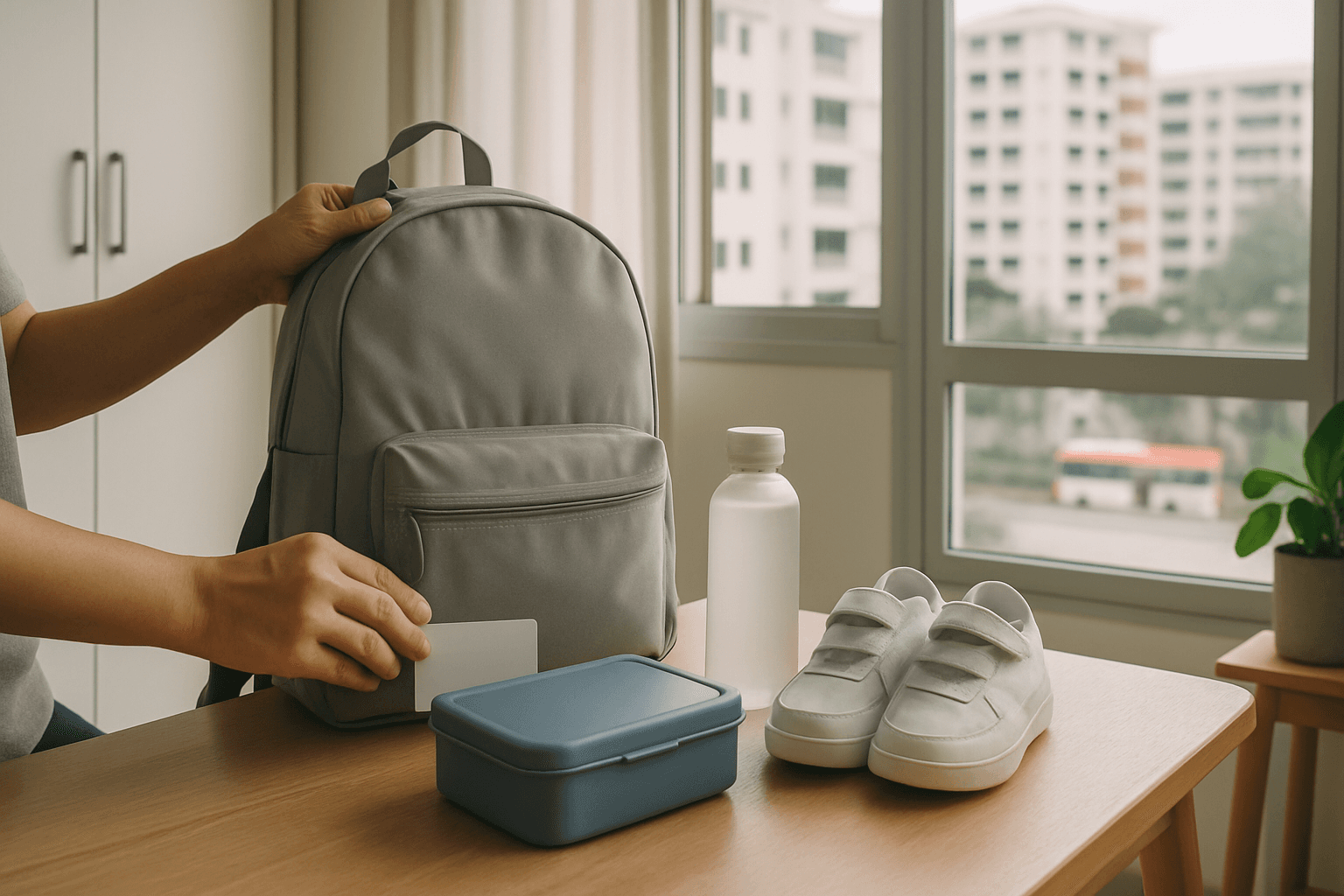
The cheapest school fee is not always the cheapest school overall. For many families in Singapore, the bigger cost comes from the routine around school: how the child gets there, who handles dismissal, whether after-school care is needed, and how much time the arrangement takes every week.
If you are comparing schools for Primary 1, look beyond fees early. It is easier to choose a school that fits your daily life than to realise later that the commute, care arrangement, or family schedule is too costly to sustain for six years.
What is the real cost of primary school in Singapore beyond school fees?
School fees are only one part of the total cost. The real budget usually depends more on transport, student care, meals, uniforms, supplies, enrichment, and family logistics.
The real cost of primary school in Singapore is the full cost of making the school choice work day to day, not just the fee on paper. For most families, the biggest non-fee costs are transport, student care, meals, uniforms, books, supplies, enrichment, and the time needed to manage the routine.
A school that looks cheaper at first can still cost more overall if it needs a school bus, daily paid care, or a long commute. A practical way to compare schools is to think in three layers: school fees, recurring monthly costs, and start-of-year or occasional costs. Then add one more layer that many parents miss: time and logistics. If you are still narrowing options, start with our Primary 1 Registration in Singapore guide and compare each school as a family routine, not just a fee line. The key idea is simple: the cheapest fee is not always the cheapest school.
Pre-school fees
Honestly, the top range “premium” schools are way over-charging. It doesnt sound right for some pre-school fees to be 20K or more per year (SG univeristy fees??). But again, why shouldn’t their owners do so since Singaporean parents “want the best” for the kids and the schools have ever growing waiting lists? They can always use rentals or better teachers/curriculum as an excuse to charge 2K a month (who really knows?). I believe pre-school education is very important. I am definitely prepared t
Fees at Secondary School
Hi MdmKS, apart from the standard school fees which can be found at the MOE website ($5 + $13 + $13), the others vary from schools to schools. Of course, IP independent school fees is different, range from $200 to $300 per month. For my case, - lockers is not compulsory, if needed, is separate charges. - Chinese readers digest, weekly newspaper, additional chinese materials (eg. compulsory story book and poems). I just paid a $33 for these. - English readers digest and year 1 orientation tee and
What everyday costs should parents budget for first?
Budget first for the costs you will feel every month, especially transport, meals, student care, and replacement supplies.
Start with the costs that repeat most often: transport, meals, and after-school care. Then add the smaller but regular items such as stationery top-ups, replacement shoes or socks, water bottles, and basic school materials. These items may look manageable one by one, but repeated spending across six primary school years changes the picture.
A useful way to plan is to split your budget into monthly running costs and start-of-year purchases. For example, one child may walk home and need only occasional spending money, while another may need a school bus, buy lunch in school, and attend student care five days a week. The official school fee may be similar, but the family’s monthly outlay is very different. Parents often underestimate these recurring costs because they arrive in small pieces instead of one obvious bill. For a broader overview, see Primary 1 Registration Distance Priority: How Home-School Distance Works.
Preschool for < SGD 1000
There are lots my dear! Mostly those very ex ones are 'paying for the curriculum' but doesn't guarantee you good teachers or in other aspects. In fact, some which are in the mid range are quite good in most aspects too. Go online search for the lists of cc, including the govt link then call them up to make enquiries/check out their websites if there are any and finally, go 'spot check' on the school to have a feel of it's overall environment. Most schools would prefer you to make arrangement/app
Pre-school fees
That's right! My ideal budget is about SGD700-800 per month (before or after subsidy is OK). For this, I am looking at the mid-range child-care centres and higher-end kindergartens. There is a difference in the number of hours hence the child-care centres are expected to be priced higher comparatively speaking. While there is (or should be) some correlation between the price and quality, this is not always the case hence parents must know what we are paying for. Do we know what we are paying for
Have More Questions?
Get personalized guidance on schools, tuition, enrichment and education pathways with AskVaiser.
Try AskVaiser for Free →How much can transport add to the cost of a primary school choice?
Transport can turn a low-fee school into a higher total-cost choice if your child needs a school bus, multiple transfers, or regular car drop-offs.
Transport can be the swing factor in the real cost of a school choice. If a child can walk, take one simple bus ride, or travel on an existing caregiver route, the arrangement is usually easier and cheaper to sustain. If the journey needs a school bus, multiple public transport legs, or regular car drop-offs, both cost and stress rise quickly.
MOE says parents can check with the school about school bus service, and the school can refer them to the bus operator for route details, as explained in this MOE FAQ on school bus arrangements. Use MOE SchoolFinder or the school's website to get contact details, then ask for the actual route, pickup point, timing, and quote before you commit. Do not assume a bus will definitely serve your block or that the fare will be small. This matters most when you are comparing a nearby option with a more popular school farther away, and our guide on how home-school distance works can help you think about location more realistically. If the commute already looks tiring in Primary 1, it is usually a warning sign rather than a problem that will solve itself. For a broader overview, see Primary 1 Registration: Should You Pick a Popular Dream School or a Safer Nearby School?.
Secondary School Fees -- Please share your school fees
You could get the information from the school website. Independent school fee is around $300 per month for S’pore citizens.
[Geylang] Primary Schools
For primary schools, I recommend going for convenience than popularity. Reason is the kids are still young, and travelling time should not be long enough to tire them out, even for those driving. Have you seen children dozing off in the parents car (some in an awkward position, especially straining their necks) because they have to wait up earlier than their peers to reach these “better” schools to feed their parents “ego”. Please note that the above is just my PERSONAL view as I have gone throu
When does student care become a major hidden cost?
Student care becomes a major hidden cost when your child needs supervision after dismissal on most weekdays, especially if both parents work standard office hours.
Student care becomes a major cost when school dismissal times and work schedules do not match. For some families, it is occasional backup. For many working parents, it is a fixed part of the school plan from Monday to Friday. Once that is the case, it should be treated like a core monthly bill, not a last-minute add-on.
The practical question is not just whether student care exists, but whether it reliably covers the hours your family actually needs. One family may manage a nearby school because a grandparent can do pickup. Another may need supervised care until evening because both parents work later and there is no regular caregiver. Fees, vacancy, programme hours, and holiday coverage can differ across centres, so check availability early instead of assuming you can sort it out after registration. A simple rule helps here: if your school choice only works when several backup adults stay free every afternoon, the routine is probably more expensive than it first appears. For a broader overview, see Popular Primary School vs Neighbourhood School in Singapore: Which Is Better for Your Child?.
Preschools prepared your kids well for Singapore primary?
For parents who have already been through the pre-school days and with kids now in primary schools (Singapore schools), can you share your comments on your kid's previous preschool and their curriculum - specifically if they have prepared your child properly for the Singapore education system ? (not discussing the international or foreign schools system here) Nowadays, there are so many pre-schools and childcare centres with many learning methods. Parents currently at the pre-school stage will b
Pre-school fees
I think not very necessary unless got money to burn. Ds went to an ordinary childcare and still did very well for primary school. No correlation in my humble opinion. Some ordinary childcare centres have good teachers too and prepare kids better for primary school. Some parents mentioned that Montessori schools may not prepare kids well enough for Singapore primary school system. I think how the kid turns out also depends on parental guidance, exposure to enrichment classes, circle of friends et
How do uniforms, meals, books, and supplies affect the yearly budget?
These yearly and termly expenses are easy to overlook, but they recur often enough to affect the total budget in a meaningful way.
These items are smaller than transport or student care, but they create regular spikes in spending, especially at the start of Primary 1. Parents commonly budget for uniforms, PE attire, shoes, socks, bags, water bottles, books, stationery, and basic learning materials. The exact list differs by school, so treat these as planning categories rather than an official checklist.
What many parents overlook is the replacement cycle. Children outgrow uniforms. Shoes wear out mid-year. A lost water bottle or damaged school bag becomes another unplanned purchase. Meals work the same way: even if each canteen purchase seems small, daily spending across a full school year still counts. These are steady costs rather than dramatic ones, but steady costs matter when you are comparing two schools over six years. For a broader overview, see How to Read Past Balloting Data Before Chasing a Popular Primary School.
Pre-school fees
I totally agree that good pre school is important. However, it need not be the high end ie expensive preschools. From the examples of the outstanding students I see with excellent primary school and PSLE results, very few were from high end pre schools. In fact have seen many inverse correlation cases ie those who go high end preschools not adjusting well to local school system and ending with mediocre if not below average primary school results. IMHO, an averagely priced pre school with a reaso
Pre-school fees
Hi Nicolenonis A kid coming from a well to do family (I hate to use the word ‘elite’) will have a higher probability (not 100%) that he/she will do well in the future. Simply, their parents will have more resources to help them turn out successful. This is a fact of any capitalist society. I would not think this is unfair. Hence it is important, in a generally meritocratic education system, like the primary school system in Singapore, the playing field is levelled somewhat and the chances of suc
What enrichment and extra learning costs should parents watch for?
Watch for optional but common spending on tuition, enrichment, holiday programmes, competition prep, and extra learning materials.
The main extra learning costs to watch are tuition, subject enrichment, holiday programmes, competition prep, revision materials, and online learning resources that are not officially required but can become common in some circles. Not every school creates the same spending pressure. Sometimes a child genuinely needs extra support. Sometimes parents start paying because it feels like everyone else is doing it.
A useful filter is to ask whether the activity is required, strongly encouraged, or simply optional, and then ask whether your child actually needs it now. Open houses can help parents get a feel for school culture and expectations; Schoolbag's guide to primary school open houses explains how these visits help families understand the environment before deciding. This also connects to the wider question of popular versus neighbourhood schools, because the real cost sometimes comes from the culture around a school rather than from the school fee itself. Optional spending becomes expensive when it starts to feel mandatory.
School fees at independent schools
Hi This is what I learned about the school fees at independent schools. Please provide more info if you have. Independent schools charge school fees of $300 to $400 / student / month. If you are the top 10% of the school cohort, you are given some ‘scholarship’ where your school fees are exempted. How does the school determine who are the top 10% each year? The top 10% of the sec 1 cohort of the school is based on PSLE results, the top 10% of the sec 2 cohort is based on the sec 1 results, and s
School fees at independent schools
The scholarship is capped at $200 per month. The lowest cut-off for this scholarship so far is PSLE T-score 260.
What is the family time cost of a school choice?
A school that is hard to run day to day can cost the family in work time, energy, and caregiver strain even if direct fees look low.
Time is a real cost because adults spend it, children feel it, and families reorganise around it. A school that is far away may require earlier wake-ups, tighter handoffs between caregivers, more rushed evenings, and less flexibility when a parent has meetings, a younger sibling falls sick, or dismissal arrangements change. None of this shows up on a fee table, but it affects whether the school choice is sustainable.
MOE's primary placement guidance for returning Singaporeans reflects how proximity to home is a practical factor in school planning, which is a useful reminder that location matters beyond convenience alone. In real life, a school can look affordable until you count the extra travel time, the earlier work cutoff, or the repeated need for grandparents, helpers, or paid backup care. Think of this as the hidden operating cost of the school. If a school takes too much time to run, it can become expensive without looking expensive.
Pre-school fees
I read in the newspapers a couple of time already that some parents were putting their kids into a very popular and expensive (about SGD1.5K per month) pre-school but during the interview told the reporter that they were really feeling the pinch. Each month they were so tempted to withdraw due to their tight budget but for the sake of their child/children each month they doggedly persevere. My question is Why? My heart actually breaks for such parents because they love their kids so much that th
Sengkang/punggol primary school - input from parents of kids in schools in these area?
~ starting to think about primary school registration (applying this year, 2025) and it’s giving me a headache. The schools my kid has a good chance of getting in (2B - 1km) are: 1)Nativity primary 2)Mee Toh 3) Rivervale primary My kid is really quite nerdy and has a hard time finding friends because of her subject-specific interests (usually science-related). Has expressed a preference for co-ed, but I don’t know how seriously to consider her input. Nan Chiau (phase 2b) seems impossible because
How should parents compare two schools with different cost profiles?
Compare total cost, not just school fees. Look at monthly spending, yearly spending, and the family effort needed to keep the arrangement working.
Compare the full routine side by side, not just the official fee. Put School A and School B on one page and fill in the likely monthly costs for each, including transport, meals, and student care. Then add the yearly or occasional costs such as uniforms, books, and replacement items. After that, add one more line that many parents skip: time burden. How long is the commute, who handles pickup, and how much backup coordination does the family need each week?
This usually makes the trade-off much clearer. A more popular school may have no real cost advantage once you add daily transport and paid care. A nearby school may look less exciting at first but save the family time, stress, and recurring cash costs for years. If you are weighing aspiration against practicality, our article on whether to pick a popular dream school or a safer nearby school can help. Parents usually make better decisions when they ask three questions together: what do we pay every month, what do we pay across the year, and what does this school cost us in time and energy?
[Geylang] Primary Schools
[Moderator's note: Topics merged.] hi all!! Glad i found tis website!.. my son is due for pri 1 sch registration next year and i am at a loss what school is good... below are the schools of consideration : geylang methodist primary st hilda's primary kong hwa primary ngee ann primary anyone knows the pros and cons of the above schools? would appreciate all the help !!! thanks!!!! :mrgreen:
Pre-school fees
Hi everyone! I am actually curious about parents view on present pre-school fees. In the past it used to be more affordable. Now when i look at the prices, it cost nearly $2000.00 per term and that is like 4 months right? So I will be paying lets say... $6000.00 per year. Just a rough guage. May i ask what are some of your views on this topic? Would you spend that amount on pre-school? Or do you think somewhere less expensive would be good enough and that these expensive one are just overchargin
What do parents commonly misunderstand about affordable schools?
Low school fees do not automatically mean low total cost. A school is affordable only if the whole routine is affordable.
The common mistake is assuming that an affordable school is simply one with lower official fees. In practice, a school is affordable only if the whole routine is affordable. A low-fee school that needs paid transport, daily student care, and constant schedule juggling may cost more than a nearby alternative that fits your family's working hours.
The overlooked costs are often the ones without an invoice: caregiver strain, tired children, reduced work flexibility, and a household that runs on backup plans. Before you commit, ask not just whether you can get in, but whether your family can realistically live with the routine for six years.
List of mixed primary schools in Singapore
And there are 14 girls-only primary schools: CHIJ (Katong) Primary School CHIJ (Kellock) CHIJ (Our Lady of Good Counsel) CHIJ (Our Lady of the Nativity) CHIJ (Our Lady Queen of Peace) CHIJ St Nicholas Girls’ (Primary) Haig Girls’ School Marymount Convent School Methodist Girls’ School (Primary) Paya Lebar Methodist Girls’ School (Primary) Raffles Girls’ Primary School Singapore Chinese Girls’ School (Primary) St Anthony’s Canossian Primary School St Margaret’s Primary School
Moving to Singapore and looking for a good Secondary School
My son has gone through 3 international schools in Singapore, although none of those u mentioned. I am beginning to realize that the local system might be better for a child that is average and above. By local system, I do include the 3 local international schools - SJI (I have heard many good things about this school from separate sources), ACS International and Hwa Chong International. If your child excels in Math, all the more u should consider the local system. My son is slightly above avera
Have More Questions?
Get personalized guidance on schools, tuition, enrichment and education pathways with AskVaiser.
Try AskVaiser for Free →