
Local Primary School vs International School in Singapore for Non-Citizen Families
A practical guide to admission certainty, curriculum fit, cost, and long-term family plans.
Choose a local primary school if lower cost and long-term integration into Singapore matter most and your family can live with admission uncertainty. Choose an international school if you need a more predictable admissions path, a more portable curriculum, or a smoother option if your family may move again.
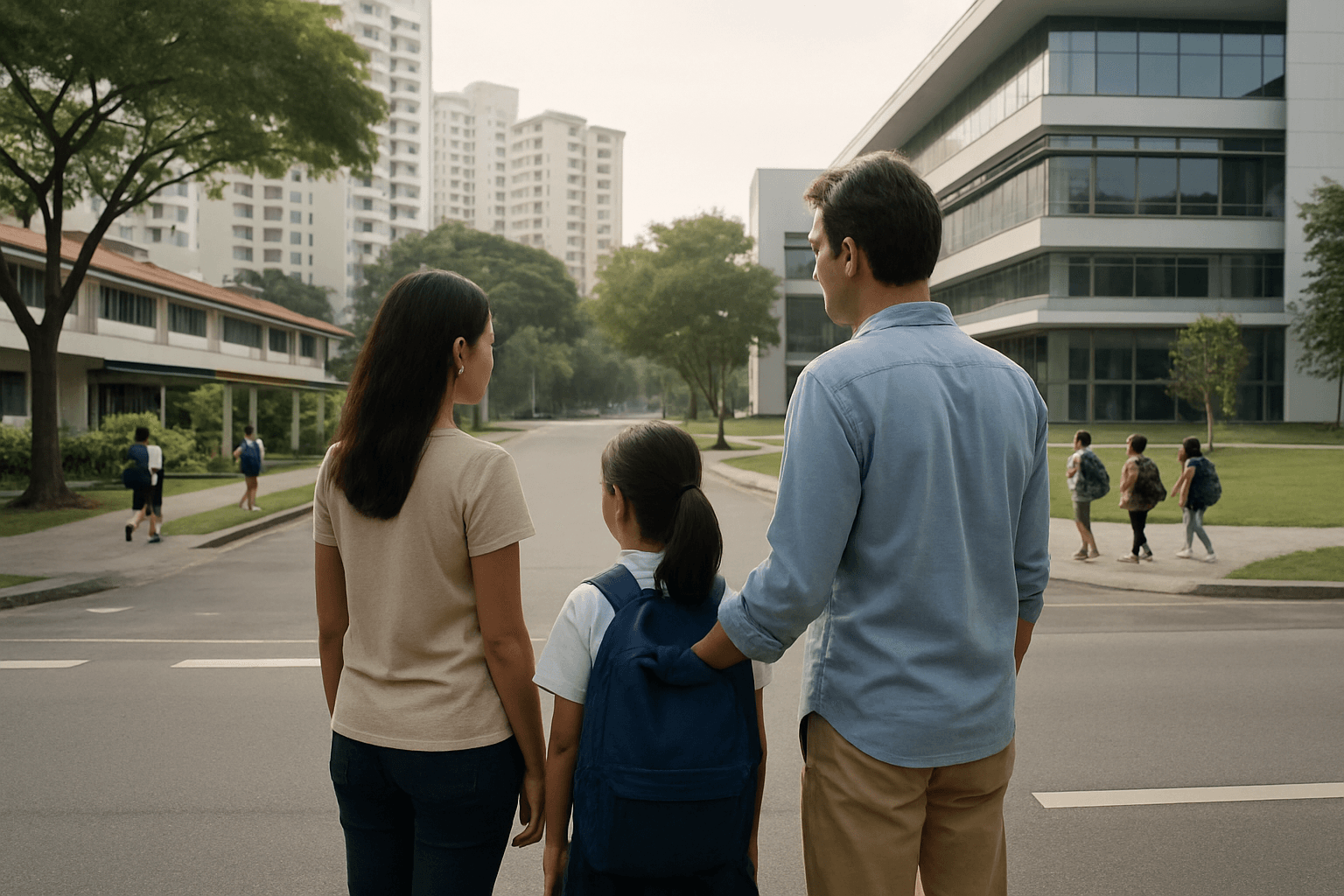
For most non-citizen families, this is not a prestige question. It is a planning question. A local primary school usually makes sense when affordability and integration into Singapore life matter most and you can cope with a less predictable admission outcome. An international school usually makes sense when you need a more predictable school place, want a different curriculum style, or may relocate again. The four questions that matter most are simple: can you realistically get a place, can you afford it over several years, will the curriculum suit your child, and how long do you expect to stay in Singapore?
What is the short answer: should a non-citizen family choose a local primary school or an international school in Singapore?
Local school is usually better for affordability and local integration. International school is usually better for predictability and easier continuity if your family may move again.
The practical answer is this: choose a local primary school if cost and long-term integration matter most, and choose an international school if admission predictability and curriculum portability matter more. For non-citizen families, the local route is usually the lower-cost option, but it is usually not the lower-risk option. The international route is much more expensive, but it can be easier to plan around if you need a confirmed school place by a fixed date or expect another move later.
A useful way to think about the choice is through four filters. First, is a local school place realistically available, or are you treating hope as a plan? Second, can your family afford the international-school bill not just this year, but for several years if needed? Third, which learning environment suits your child better: a more structured Singapore pathway or a different international curriculum style? Fourth, is Singapore a short stop or a long-term base for your family? If you want the broader local context first, start with our guide to Primary 1 Registration in Singapore.
entry to local schools for foreigners
hi everyone, i am thinking of re-locating to singapore with my family. School is a top priority for my 3 kids and i am wondering if there are eligibility issues since we are not Singaporeans by birth. My eldest Joel will be just right for Primary 1 next year. Any restrictions to local boarding for my children? Or should i just go to international schools? any advice welcome. :?
School Placement Exercise for returning S'porean children
To add on: fees for international students in local schools are higher than for citizens or PRs. And another consideration: how do you want your kids to feel about Singapore as they grow up, and when they are adults? If they go to local school, they will make Singapore friends, and get to know Singapore in a way students of international schools do not, and are likely to feel that Singapore is their \"home base\". However, if the time in Singapore is expected to be temporary, and they regard US
Do not treat a local primary school place as automatic if your child is not a citizen.
For non-citizens, local school is often the cheaper option, but not the one to plan on blindly.
This is the mistake that creates the most avoidable stress. A local school may be cheaper, but it is not the option to assume will simply work out. Even in MOE's FAQ on international student readmission, outcomes can be handled case by case rather than guaranteed. If your child must start school by a fixed month, keep a backup instead of waiting for the local route to become clearer. For a broader overview, see Who Is Eligible for Primary 1 Registration in Singapore?.
Moving to Singapore and looking for a good Secondary School
My son has gone through 3 international schools in Singapore, although none of those u mentioned. I am beginning to realize that the local system might be better for a child that is average and above. By local system, I do include the 3 local international schools - SJI (I have heard many good things about this school from separate sources), ACS International and Hwa Chong International. If your child excels in Math, all the more u should consider the local system. My son is slightly above avera
International school or local school?
I think MOE is not strict if it is admission to ACS International, SJI International & Hwa Chong International? i.e. Singaporeans are allowed to study there. Not long ago, there was a write-up in ST about these 3 schools. Seems like they are popular with parents with deep pockets whose kids had fared poorly in PSLE. At the end of 6 years, the kids get an IB diploma and then they fly off to UK/USA to get their uni degrees.
Have More Questions?
Get personalized guidance on schools, tuition, enrichment and education pathways with AskVaiser.
Try AskVaiser for Free →How realistic is admission to a local primary school for non-citizens?
A local primary school place is possible, but it is not something non-citizen families should count on without a backup.
It is possible, but parents should not build their entire plan on the assumption that a local Primary 1 place will come through. The local system is shaped by available places, where families live, and demand at individual schools. MOE has said that school planning takes account of residential areas because it is in a child's interest to study near home and avoid long daily travel, as explained in this MOE reply on nearby schools. That matters because many parents spend too much energy on one well-known school and too little on realistic options near home.
The practical takeaway is simple: if you want the local route, apply with a backup mindset. If your family needs a school start date you can plan around, submit international-school applications in parallel rather than after a local outcome disappoints you. If your budget only works with a local school, widen your expectations early instead of fixating on a small group of popular names. It also helps to understand the wider system through our guides on who is eligible for Primary 1 registration, how home-school distance works, and what happens if you do not get your preferred school. Competition at sought-after schools is a real part of the landscape, as discussed in this CNA commentary.
entry to local schools for foreigners
Foreigners are eligible to register for local Primary Schools in Phase 3 of the registration process. Places in majority of the schools would have been filled up by Singaporean and Singapore PR by end of phase 2C Supplementary. Nevertheless there will still be some schools with balanced places.
School Placement Exercise for returning S'porean children
Hi We are considering repatriation back to SG around mid 2023. My daughter would have finished up G10 in an IB school and we were initially considering between a local international school or taking the SPERs for JC in Sep/Oct. However, we read Google reviews and found the local international schools unimpressive. And only one of them was willing to take our daughter midterm. If we were to wait to take SPERs and want to continue with the IB track, there’s only 2 local MOE IB schools and results
How do local primary schools and international schools differ in curriculum and teaching style?
Local schools are generally more structured and built for the Singapore pathway. International schools usually offer different curriculum models that can be easier to carry across countries.
The biggest difference is not the label on the school gate. It is the learning system your child is entering. Local MOE primary schools are part of the Singapore pathway, which is generally more structured, more standardised, and designed for continuity within Singapore. The wider journey includes PSLE later in primary school, so even the early years sit inside a system with a clear long-term progression.
International schools are not one single model, but many use different curricula, pacing, and assessment styles from MOE schools. In practice, that can mean different classroom routines, different ways of reporting progress, and a pathway that is often easier to continue if the family relocates. A child who likes structure, adapts well to routine, and may stay in Singapore for many years can fit naturally into a local school. A child who has already moved countries, or may move again soon, may benefit from a curriculum that transfers more smoothly. The most useful question is not which system sounds more impressive. It is whether you want a system built for Singapore continuity or one built for cross-border continuity. For a broader overview, see Primary 1 Registration Unsuccessful: What Happens If You Do Not Get Your Preferred School.
Local Vs International School
This topic has been discussed extensively on various expat's forums. From most expats' point of view, Singapore eductaion system is of rote learning while International schools provide all rounded education. Personally I don't agree. My view is basically you got rip-off of by paying $25K to $30K school fee per year in most International schools. Discipline is somehow lacking and you also need to be aware that their academic level is much lower than the mainstream schools. If I were you, I will p
Local Vs International School
International school is expensive.Academically may not be on par for Maths.International schools encourages students to think out of the box.It has a good culture and nationality mix.Proficiency in languages are better. Local schools syllabus is good but parents stress up the child more.It does not allow the playful and late-bloomers to come-up.It makes students adher to follow the rules from step1.... step n.Teachers fine-tune the students to do things in a single track way.So if MOE puts a dif
What is the real cost difference for a non-citizen family?
Local school is usually far cheaper. International school can be a major multi-year financial commitment, even before you add transport and other fees.
In most cases, the local-school route is much cheaper than the international-school route, but the smarter comparison is total family cost, not tuition alone. MOE has stated that government spending per student is much higher for Singapore Citizens than for permanent residents and non-resident students, and that this is reflected in school fees, as noted in this parliamentary reply on student expenditure and fees. Even without the same level of subsidy, a local MOE school is usually far less expensive than an international school.
What parents often miss is where the rest of the spending goes. Local school may mean lower fees but more attention to transport, student-care arrangements, school-based expectations, and outside enrichment depending on your work schedule and your child's needs. International school usually means a much larger annual tuition commitment, and that commitment can continue for several years. So the money question is not just, "Which school costs less this term?" It is, "Which path can we sustain without financial strain or daily logistical chaos?" In many families, local school saves money if the place comes through and the routine works. International school usually buys more planning clarity, but at a much higher long-term price. For a broader overview, see Primary 1 Registration: Should You Pick a Popular Dream School or a Safer Nearby School?.
All About International Schools
As a Singaporean citizen, MOE would expect your son to go to a local school; that is, the dual nationality does not excuse someone from the duties, responsibilities and privileges of Singaporean citizenship. Therefore, like single-nationality Singaporeans, you will have to apply, through the international school, for special permission from MOE to attend an international school. MOE will treat the application on a case-by-case basis. Clearly, if you apply to an international school associated wi
All About International Schools
International Schools are great for character building. While the students there are not as academically inclined as those in the main streamed schools, they are confident and have very wide array of knowledge through hands-on experiences. However, there are a few points to note before you enrol your child: (1) Finance. International education is very expensive and you will probably have to work out if you really can afford it in the long run ; elementary, middle, high schools and overseas unive
Which option is better if your family may leave Singapore in a few years?
If you may leave Singapore in a few years, international school is often the more practical choice because transfer continuity usually matters more than local integration.
If your stay is likely to be short, an international school is often the safer planning choice. The main reason is portability. Families who may relocate in two to three years usually care less about deep integration into Singapore's school system and more about whether the next school overseas will understand the curriculum, school reports, and learning pace with minimal friction.
This is where parents often choose too narrowly for the present city and forget to choose for the next one. If your likely next move is to another country where international-school pathways are common, a more portable curriculum can reduce disruption later. Families on overseas postings often think this way because education continuity shapes whether a move feels manageable for the child, as reflected in this Today article on overseas postings and children's education. If your Singapore stay is short and you need a school place you can plan around, international school is often the more practical answer even if it is not the cheaper one.
International School choices for secondary level
Hi, I have seen some parents pulling their children out from the local schools after their kids did not perform well enough in PSLE to get into the better secondary schools. So instead of settling with a neighbourhood school, they have chosen the “expensive” path to enrol their children in international schools. Any idea how these schools are in terms of curriculum, teaching staff, enrolment etc? Are they good ? ACS (International) SJI (International) Hwa Chong International
Malaysian coming S'pore for Secondary School Education
My daughter is from JB and started her education in singapore since Primary 1. I suggest that u first go to the ICA building to apply for a student pass in order to study in singapore. Are u considering to live in singapore or let her cross the causeway everyday? it would be very tiring to choose the latter. the cca's will be very long and by the time ur child reach home, ur child won't even have the energy to complete ur homework. futhermore, sec schs in woodlands area is not very good. My P6 d
Which option is better if you plan to stay in Singapore long term?
If you expect to stay in Singapore for many years, a local school is often the more natural fit if a place is available and your child can handle the system well.
For long-stay families, a local primary school often makes more sense if you can secure a place and your child is ready for the environment. The main advantage is continuity inside Singapore. Your child builds local friendships, becomes more embedded in everyday Singapore life, and stays inside the mainstream pathway rather than running on a separate track.
The tradeoff is that the route that fits long-term life better is not always the easier one to access in the short term. Local integration comes with a less predictable entry path and a more structured system. International school can still be the better answer for a long-stay family if your child needs that environment or if portability remains important to your family's identity and future plans. A good way to frame it is this: if Singapore is home, local school is often the more natural system; if Singapore is part of a mobile family life, international school may still be the safer hedge. If you are comparing realistic local options, our guide on whether to pick a popular dream school or a safer nearby school can help you think more practically.
Moving to Singapore and looking for a good Secondary School
Hi Singaporenew, First of all, let me welcome you to Singapore. Can I suggest you to attend the open house of all the independent schools such as ACS, RI, SJI? Maybe could just walk into the schools to talk to their principals to find out more about their curriculum and to clear your doubts. Do bring your boys along to take a look at the environment. Your kids should be able to fit in socially since they have lived in Asia for a period of time. Hope you find an idea school for your boys. All the
Changes in S'pore Education System
Singapore's education system must move beyond emphasis on results By Ca-Mie De Souza, Channel NewsAsia | Posted: 14 August 2008 1839 hrs SINGAPORE : Singapore's Education Minister Ng Eng Hen said the country's education system must move beyond academic achievements and offer students more individual attention . Dr Ng was outlining the future education system at the 4th anniversary Public Lecture at the Lee Kuan Yew School of Public Policy on Thursday. In 1980, only 58 per cent of Primary 1 stude
How do language needs affect the choice?
Language readiness matters more than many parents expect. Daily classroom confidence can matter as much as academic ability.
Language is often the hidden deciding factor because it affects daily confidence, not just academic results. Local schools usually place children in a stronger Singapore English environment, and some children may also need to navigate additional language expectations within the local system depending on their school pathway and subjects. For some children, that is a major advantage because it accelerates fluency and local confidence. For others, especially children still settling into English or recovering from a recent move, the adjustment can be heavier than parents expect.
The practical question is not whether your child speaks some English. It is whether your child can learn, follow instructions, join in socially, and recover emotionally in that language environment day after day. A child who is already confident in English and adapts quickly may manage local school well. A child who is bright but still hesitant in classroom English may cope better in a setting where the curriculum pace, language support, or transition feels gentler. If you are unsure, do not reduce the issue to test performance. Language comfort often shapes whether a child feels safe and capable every morning.
Preschools prepared your kids well for Singapore primary?
For parents who have already been through the pre-school days and with kids now in primary schools (Singapore schools), can you share your comments on your kid's previous preschool and their curriculum - specifically if they have prepared your child properly for the Singapore education system ? (not discussing the international or foreign schools system here) Nowadays, there are so many pre-schools and childcare centres with many learning methods. Parents currently at the pre-school stage will b
International students applying to Singapore Pr schools
I don't know much about the English test. Here is the announcement MOE put out earlier this year. 10. MOE will be making changes to the AEIS-Primary (AEIS-Pri) test for IS seeking admission into our primary schools from the 2023 academic year. Since its inception, AEIS-Pri comprises tests for English and Mathematics. For AEIS applications from July this year, AEIS-Pri will no longer offer the English test. Instead, IS must take and meet or exceed the required score for the relevant Cambridge Eng
What type of child tends to fit better in a local school versus an international school?
Children who handle structure and faster adjustment often fit local schools well. Children who need a different pace or more cross-border continuity often fit international schools better.
The most useful approach is to match the school to your child's learning style, resilience, and tolerance for structure. Children who adapt quickly, cope well with clear rules, and are not easily unsettled by a more established system often manage local schools better. Children who need a different pace, have moved countries several times, or benefit from a more transfer-friendly environment may do better in an international school.
A few common scenarios make this clearer. A child who is academically strong, socially flexible, and likely to stay in Singapore for many years may settle well into a local school if a place is available. A child who has already changed countries twice and may move again soon may benefit from the continuity of an international curriculum. A child who thrives on routine but is anxious about change may still do well locally if the family prepares early and keeps the commute simple. A child who is capable but already overwhelmed by language or transition stress may be better served by a gentler move first. School fit is not about status. It is about how much friction your child can realistically absorb.
What should non-citizen parents check before deciding between a local primary school and an international school?
Use four practical filters: place, price, child fit, and family timeline.
- ✓Ask first whether a local primary school place is realistically available for your child, or whether you need a more predictable backup from the start.
- ✓Check whether your budget can carry the full international-school cost for several years, not just the first year.
- ✓Compare your child's readiness for a more structured local curriculum against a different international curriculum model.
- ✓Be honest about your family timeline and whether Singapore is likely to be a short stay or a long-term base.
- ✓Look closely at commute time and after-school care, because a manageable daily routine matters more in the primary years than many parents expect.
- ✓Consider language readiness, especially whether your child can function confidently in a stronger English environment day after day.
- ✓Decide whether your family values local integration more or curriculum portability more.
- ✓If your answers are mixed, choose the option that reduces risk for your real timeline rather than the option that sounds ideal on paper.
Have More Questions?
Get personalized guidance on schools, tuition, enrichment and education pathways with AskVaiser.
Try AskVaiser for Free →