
Should Student Care and Commute Matter More Than School Name for Primary 1?
A practical Singapore guide for parents choosing a Primary 1 school that works in real daily life.
Yes, for many families, student care, transport, and commute should matter more than school name for Primary 1. A school that fits your child’s energy, your work schedule, and your after-school plan is often a better long-term choice than a better-known school that creates daily strain.
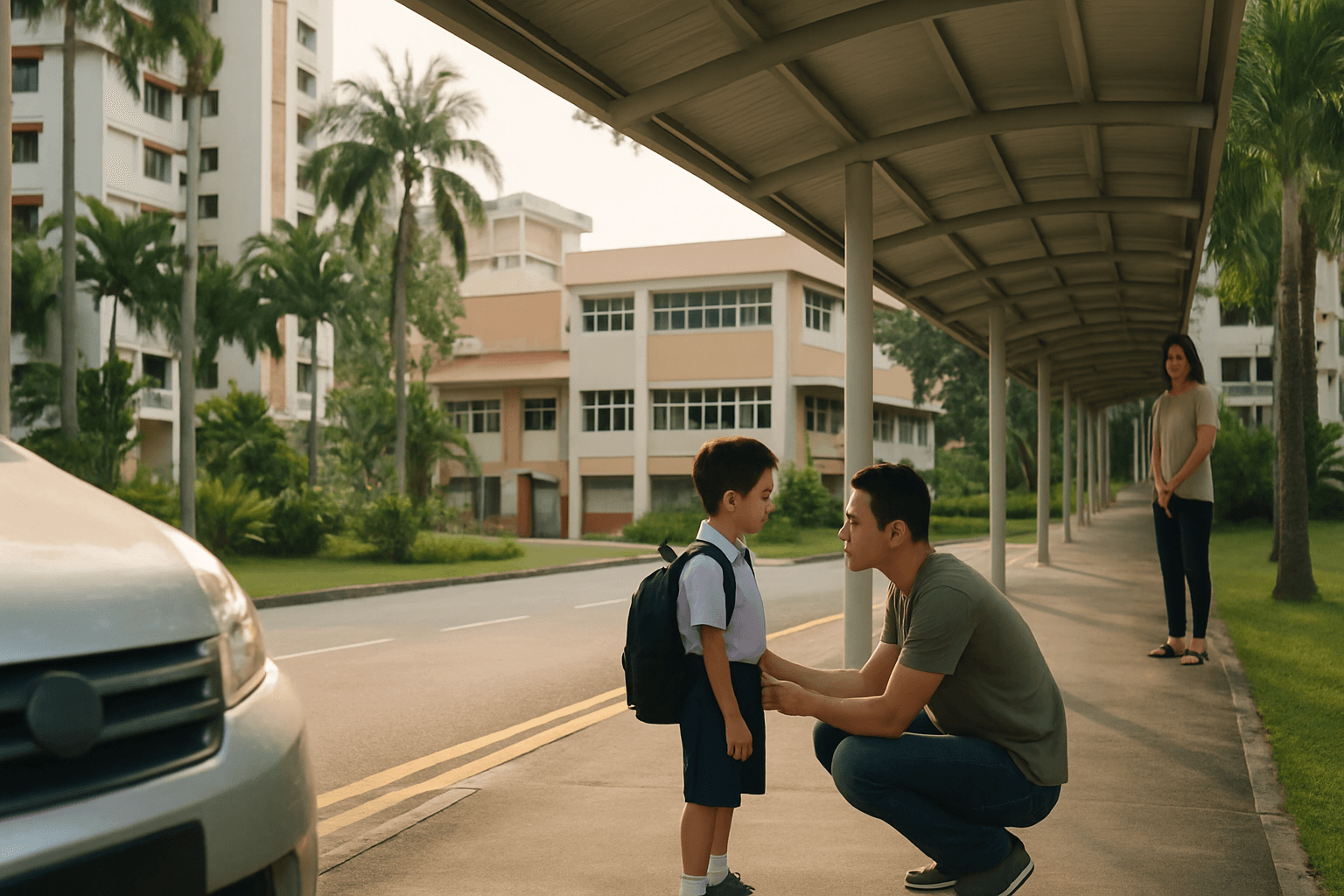
If you are choosing between a more convenient school and a more famous one, start here: for many Primary 1 families, daily logistics should carry more weight than school name. A six- or seven-year-old has to live that routine every weekday. In practice, that means looking hard at home-school distance, after-school care, transport reliability, and whether your family can repeat the plan calmly from Monday to Friday.
Short answer: should student care, transport, and commute matter more than school name for Primary 1?
Usually yes. For many Primary 1 families, a reliable daily routine matters more than a better-known school name.
For many families, yes. If your Primary 1 plan depends on reliable pickup, workable student care, manageable mornings, and a school run your household can sustain, those practical factors usually deserve more weight than reputation alone.
This is not an argument against a well-known school. It is an argument for choosing a school routine your child can actually live with. A rested child who gets to school calmly, knows what happens after dismissal, and still has some energy at home will often settle better than a child in a more prestigious school but under constant time pressure.
A useful way to think about it is this: school name matters on registration day, but school routine matters every weekday. If you want the wider admissions context, start with our Primary 1 Registration in Singapore guide.
Are All Primary Schools The Same?
A lot of people underestimate the role parents play in the education landscape. In every school, the “parent support group” synergy can be a powerful source of strength for further improvements. A school with a better track record attracts parents who want the same for their children. Higher expectations will also lead to higher demands on the school teachers. In some schools, it is not uncommon for parents to voice their concerns to the school leaders, even to the ministry if teachers or exam p
All about Transferring to Other Primary Schools
Hi, my boy is in P1 this year, studying in Gong Hwa Primary School. We currently live in Pasir Ris and my boy managed to get in last year as my husband is Alumni and ex student in the school. Fast forward to now and I would like to transfer him to Primary schools within Pasir Ris. Reason being though we managed to secure a school bus for him, he has to board the bus at 6am and I have to wake up earlier at 5am. I’m pretty burnt out and the school bus fees are not cheap for 1 way. The journey home
Why daily logistics matter more at Primary 1 than many parents expect
Primary 1 is an adjustment year, so commute stress and after-school uncertainty often hit harder than parents expect.
Primary 1 is an adjustment year, not just a school placement. Six- and seven-year-olds are learning new rules, longer days, new classmates, and more independence all at once. When the routine around school is already tiring, even a capable child can become slower in the morning, more emotional after school, or more resistant to the next day.
What many parents underestimate is the cumulative effect of small frictions. A slightly earlier wake-up, a longer trip, uncertain pickup, a handoff to student care, and a rainy-day delay may each look manageable on their own. Together, they can turn an ordinary weekday into a stressful one.
That is why proximity is not just a comfort issue. In a MOE forum reply, MOE said it is in a child’s educational interest to study near home because this reduces commuting time, leaves more time for other activities, and is more convenient for families. Parents sometimes treat distance as a tie-breaker. In reality, it often shapes the child’s whole first year. For a broader overview, see Primary 1 Registration Distance Priority: How Home-School Distance Works.
All About Preparing For Primary One
Starting primary school? This is a big milestone. Do enjoy the journey with your child! :rahrah: https://www.straitstimes.com/singapore/education/the-st-guide-to-preparing-your-child-for-primary-1 Parents often confuse being ready for school with being academically capable in skills like reading and counting. Instead of focusing solely on academic progress, it is more important to make learning an enjoyable process, and help your child have a swift and happier adjustment to primary school. Here
All About Preparing For Primary One
First of all, how far are u from the school? Within 1km or 1 - 2km? If near, don't take school bus, send yourself. Any balloting history for the neighbourhood school under 2C?
Have More Questions?
Get personalized guidance on schools, tuition, enrichment and education pathways with AskVaiser.
Try AskVaiser for Free →What school name actually gives you — and what it does not
School name can signal reputation, but it does not solve daily logistics or guarantee a better fit for your child.
A school name can give parents confidence. It may signal a strong reputation, a community many families actively want, or a sense that the school is a safer bet. Those are real reasons some parents lean toward a better-known school.
What school name does not automatically give you is a shorter journey, easier pickup, better student care access, or a child who adapts smoothly. Parents sometimes overread reputation as a proxy for everything else. It is not. A more popular school can still mean rushed mornings, costly transport, and tired evenings.
It can also be harder to secure in the first place if demand is high. If you are weighing reputation together with admissions realism, our guides on how home-school distance works and whether to choose a popular dream school or a safer nearby school will help.
A simple insight line for parents: brand shapes expectations, but routine shapes the actual school experience.
Top Primary school?
To be fair, I think people should not tag “good” or “bad” to a school. I don’t think there is really a “bad” school in Singapore. To me, the most important thing is the teacher your child gets. You can have very lousy teachers in the popular “good” schools as well. Or you can have very good teachers in the normal neighbourhood schools. Academic excellence is not the only thing to look for in primary school education, what about character building ? team work ? All these should be equally importa
Which are the Primary Schools that comes with Student Care ?
Hi Just wondering if anyone knows which are the primary schools that have student care in the premises ?
Is there an official "too far" commute rule for Primary 1?
No. There is no official commute cutoff here, so judge the full routine rather than a made-up time limit.
No fixed universal commute limit appears in the source material, so do not anchor your decision to an invented number. Judge the whole routine instead: wake-up time, number of handoffs, route predictability, rainy-day resilience, and how your child typically looks and behaves after a normal school day. If the plan already feels rushed before school even starts, treat that as a warning sign. For a broader overview, see Popular Primary School vs Neighbourhood School in Singapore: Which Is Better for Your Child?.
[Central] Primary Schools
Hi everyone, im new here. Next year my son starts P1, he has already secured a place in River Valley Primary School due to his mum is a former student. Currently, we are discussing whether to let him study at Zhangde Primary as it is walkable distance from our house (less than 10 mins). Everyone know these two schools well? We are driving him to school so we would like to know how is the traffic there in the morning? There is no place to place our car so we just park outside the school? Can anyo
All about Transferring to Other Primary Schools
Primary schools normally have a class size of maximum 30 for P1 and P2 (I think it's MOE policy) so unless there are parents who give up their confirmed places, it is unlikely there will be any vacancy until P3, where schools are allowed to have 30++ for each class. For normal transfer (P3 and above), from my observation of popular primary schools, priority is usually given for students with very good academic and/or CCA achievements. All the best to your child!
How should parents think about commute time for a six- or seven-year-old?
Judge commute by its effect on the full day, not just the minutes on the road.
The most useful question is not "How many minutes is acceptable?" It is "What does this commute do to the rest of the day?" A route that looks fine on a map may still mean a much earlier wake-up, long waiting time, traffic uncertainty, more transfers, and less recovery time after school.
A manageable commute usually protects sleep, keeps the morning calm, and leaves some energy for lunch, homework, play, dinner, and bedtime. A difficult commute often shows up indirectly. The child drags through breakfast, falls asleep in transport, becomes cranky after dismissal, or has no buffer when traffic, rain, or a caregiver change happens.
Parents also sometimes assume that driving or a school bus automatically solves the problem. Not always. Local reporting by TODAY shows that safety concerns, bus fees, heavy school bags, and time savings all affect transport decisions. School bus arrangements can also raise route and drop-off concerns, as reported by The Straits Times.
A practical check helps more than a guessed time limit. If possible, test the route at the actual morning timing, imagine the rainy-day version, and ask who takes over when one adult cannot. Travel time is part of the school day too. For a broader overview, see How to Read Past Balloting Data Before Chasing a Popular Primary School.
All about Transferring to Other Primary Schools
I'm afraid you have the process mixed up. You should: 1. Apply first, 2. Think / decide later. (And not consider first, apply when you've made up your mind) Not point thinking or considering now when: 1. the school(s) may not have vancancies, or 2. the school(s) have vacancies but you are not high on their priority list. Talks about psyhoing your child or deciding between school a and school b are meaningless until you have something concrete on your hand. And I'll expand the options to waitlist
School-based Student Care or Community-based Student Care?
School-based student care centres are able to work closely with schools to align and integrate programmes, said Education Minister Heng Swee Keat. Currently, most children are spending more time in their schools because of CCAs and single-session school hours. Is it a wise move to keep the children in school even after school hours? As parents, how do you feel about the idea of a school-based student care service? Would you want your children to spend most of their time in school? http://i49.tin
When should student care become a deciding factor?
If the school choice only works when student care works, then student care is part of the school decision, not an afterthought.
If your school choice only works because student care is supposed to fill the gap, then student care is already part of the school decision. It should not be treated as something to sort out after admission.
This matters most when both parents work full-time, pickup timing is tight, grandparents cannot do daily transport, or there are siblings with different school hours. In these situations, the real question is not whether student care would be helpful. It is whether the school remains workable without a reliable before-school or after-school arrangement.
A common parent mistake is asking only, "Is there student care?" The more useful questions are practical. Where is it located relative to the school? How does the child get there after dismissal? Who covers school holidays or sudden changes? Is there a workable backup if the usual adult is unavailable? Availability, timing, vacancy, fees, and handoff arrangements are not standard across providers.
Think in ordinary-day terms. A school may look fine on paper but still force one parent to leave work early every day. Another school may be manageable in the morning yet hard to sustain after dismissal because the child cannot move smoothly from school to care. If student care fails for one week, and the whole plan collapses, that is a sign it deserves serious weight now.
Home or After School Care?
Most student care caters from lower to upper primary, but the upper primary numbers may be lesser as by then, most have CCAs, tuitions, or have become independent enough to go home on their own, etc. It is quite normal that there are many more lower primary students than upper primary ones in the student care.
What goes into choosing a suitable Secondary School
Saw this being shared in the parents groupchats. https://www.thewackyduo.com/2022/11/how-to-choose-secondary-school-guide.html https://i.imgur.com/fDkJSy6.png\"> https://www.thewackyduo.com/2022/11/how-to-choose-secondary-school-guide.html It's time to choose a secondary school. Choosing a secondary school is a completely different process than primary school. One tends to choose a primary school based on distance or affiliation. Picking a secondary school is a different ball game. Grades play a
What is the real trade-off between prestige and family sustainability?
The better school is usually the one your family can sustain calmly every weekday, not the one that sounds best on paper.
The real trade-off is not famous school versus convenient school. It is aspiration versus repeatability. A more prestigious school may feel like a stronger long-term bet, but if it creates daily exhaustion, fragile logistics, and constant adult stress, the cost is paid every weekday.
This is where parents should think beyond admission day and imagine an ordinary Tuesday after one term. Who wakes the child? Who handles the journey? Who picks up? What happens if one parent has a meeting or a caregiver is unwell? If the plan only works when everything goes right, it is not a strong plan.
There is also an admissions angle. When a school has more applicants than places, home-school distance can affect priority, as noted in this MOE FAQ. So a nearby school may be not only easier to manage but also more realistic to secure. Our guide to Primary 1 distance priority explains that part, and our article on popular versus neighbourhood schools looks at the wider choice.
A useful takeaway: choose the school your family can keep saying yes to every morning.
All about Transferring to Other Primary Schools
It is not surprising to hear that the top students in some primary schools are aiming to go to better-name schools. Nothing wrong with transferring school but must bear in mind that there is a 1% risk that the child will not fit into school culture. Usually, those who get the first few positions in class or are in the so called best class for high ability learners will tend to transfer out. With this cycle, the more famous primary schools will have no lack of top potential students to bring glor
All about Transferring to Other Primary Schools
There must be a reason why the kid needs to be with the primary caregiver who is staying near to the preferred school. If the purpose is just for the address, then it is not right no matter if they ask for proof or not. Be truthful in your reasons for transfer (without putting down the current school of course) . There must be something you like about the school that other schools may not offer (all girls, specific programme etc) . Use those reasons instead of trying to build on something that m
When is a nearer school the better choice?
A nearer school is often the better choice when the family has limited backup care or the child gets tired easily.
A nearer school is often the better choice when the family has little spare capacity. That includes homes where both parents work fixed hours, grandparents can help occasionally but not every day, the child tires easily, or there is already a complicated sibling schedule. In these situations, convenience is not laziness. It is risk management.
Consider a household where both parents leave early and cannot easily step out during the day. A nearby school with a workable student care arrangement may be far more sensible than a better-known school that depends on a fragile chain of bus timing, office flexibility, and backup adults. Or think of a child who is slow in the morning, anxious with transitions, or emotionally spent after a long day. That child may cope much better with a shorter, simpler route even if the school is less sought after.
Parents sometimes worry they are giving up too much by choosing the nearer option. In practice, many are choosing calmer mornings, less transport stress, and a school life the child can actually enjoy. For a six-year-old, that is not a small advantage.
All about Transferring to Other Primary Schools
Application to waitlist won't be interested in your caregiver's address. However, if asked for a reason for transfer, especially by the schools that's not close to your place of residence, you can state that the schools in Toa Payoh (CHIJ TP and MCS) are closest to your daughter's primary caregiver. I would strongly suggest that you drop by the schools and ask them for their guidance in going about the transfer.
Student care near Bedok Green Primary
Hi my son is going to Bedok Green Primary school next year. Any good recommendation for student care nearby?
When might school name still justify a harder commute?
A harder commute can make sense if your family has strong support and your child genuinely copes well with the routine.
A harder commute can still be reasonable if the family has strong support and the child handles routine well. This is not a moral question. It is a capacity question.
For example, one parent may have flexible work and can do drop-off and pickup without daily panic. A reliable caregiver or driver may make the route predictable. Some children also tolerate travel better than others. They sleep early, wake without much difficulty, handle transitions well, and are not badly affected by longer days. In those cases, a more distant school may be realistic rather than aspirational.
The key is to pressure-test the plan honestly before treating reputation as worth the trade-off. If the arrangement depends on one grandparent always being available, one bus route never changing, and one parent never having late meetings, it is a fragile plan. If it still looks solid after you think through rainy days, work crunch periods, traffic disruption, and caregiver illness, then the harder option may be justified for your family.
If the better-known school is also oversubscribed, it helps to read our guide on how to read past balloting data and what happens if you do not get your preferred school.
Is going to a better school worth hour long travel times?
I feel that there is a great difference between students with cars and students with no cars studying in schools far away from home If the parents can bring the child to school / home from school , it will be much faster compared to public transport in most cases and the child can really have a rest and have a short sleep on the way to school . This is unlike children who do not have parents who own cars . They would have to wake up earlier , and rush to school as public transport is slower ( ma
All about Transferring to Other Primary Schools
is not a matter of easier or harder, rather it rely on first, whether got any vacancy arise in the first case. if no vacancy, zero chance. if got vacancy, then depends on who are the other competitors (if any), also seeking Transfer the same time as your child, where the school will assess your child together with others who also applied, concurrently. example you may think that your child come from a good school. But inside the high stack of Application Transfer forms received by school, there
How should parents compare two Primary 1 schools side by side?
Compare routine fit, not just reputation.
- ✓Compare the real door-to-door journey, not just the distance on a map.
- ✓Ask what time your child must wake up for each option and whether that morning feels calm or rushed.
- ✓Check whether there is a reliable student care plan for ordinary days, school holidays, and sudden work changes.
- ✓Compare who can do drop-off and pickup each day, and what backup exists if one adult is unavailable.
- ✓Think about your child’s temperament: does your child usually cope well with travel, transitions, and tired evenings?
- ✓Include transport costs such as bus fees, driving time, parking, fuel, or paid caregiver support.
- ✓Factor in sibling logistics, caregiver age, and whether one difficult route will affect the whole household.
- ✓Ask which option still looks manageable after one term, not just attractive before school starts.
- ✓If one school only works when everything goes perfectly, treat that as a warning sign.
- ✓If one school gives your child more sleep, more calm, and a clearer after-school plan, give that benefit real weight.
Have More Questions?
Get personalized guidance on schools, tuition, enrichment and education pathways with AskVaiser.
Try AskVaiser for Free →