
What Happens If a Primary School Has Vacancies After P1 Registration?
What leftover P1 places mean, who can still be considered, and what parents should do next.
If a primary school has vacancies after P1 registration, MOE still fills those places through the next eligible registration phase or MOE posting. A vacancy is an unfilled seat, not a free-for-all place any parent can take.
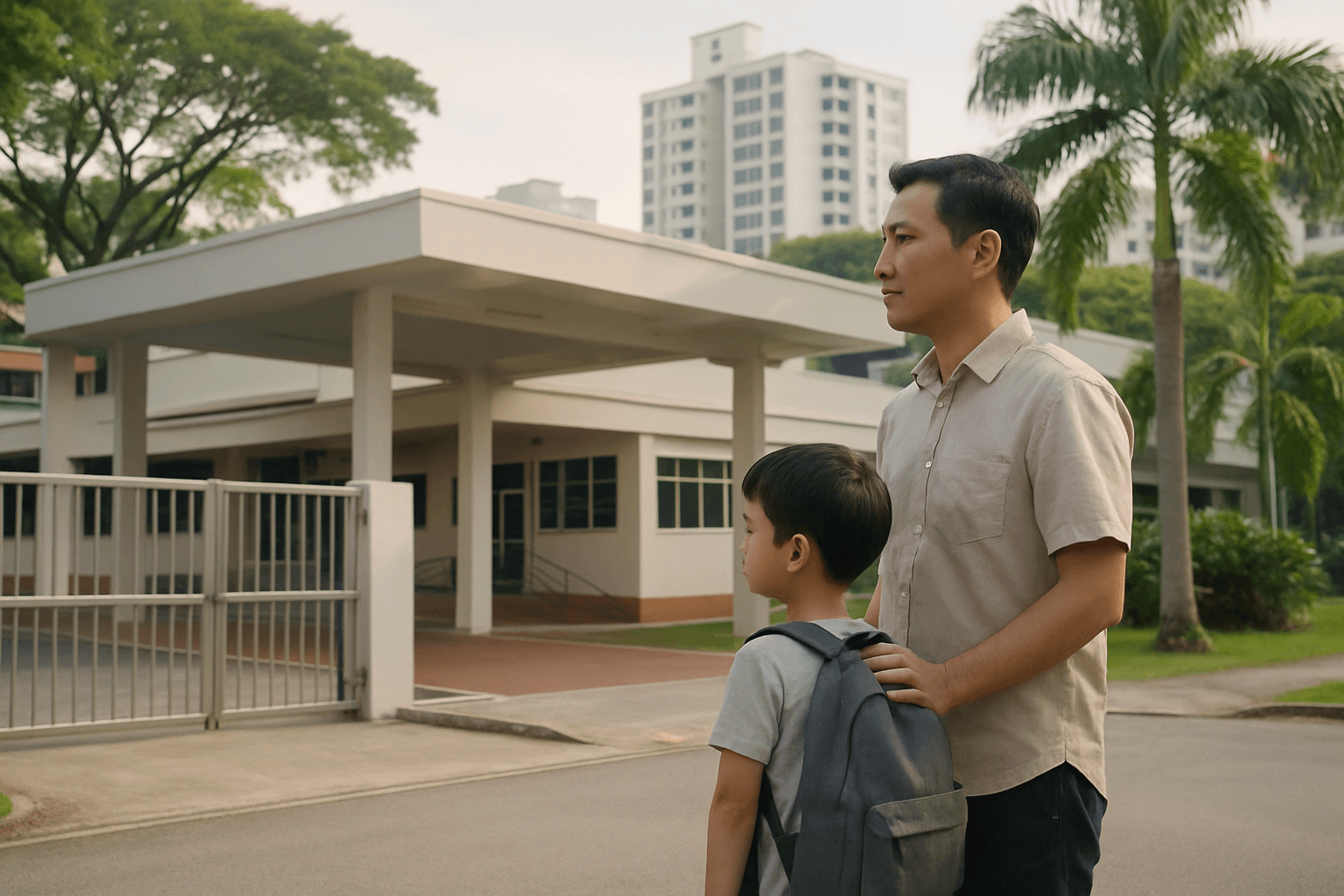
If a primary school still has vacancies after P1 registration, those places are still managed through MOE’s phase-based process. They are not open walk-in seats, and parents cannot simply take a place because a vacancy appears.
The key question is not only whether the school has space. It is whether your child is still in an official MOE route that can use that space, such as the next eligible phase or MOE posting after the later stages. In short: a vacancy is only useful if your child can still be considered for it.
What does it mean when a primary school still has vacancies after registration?
A vacancy means a P1 seat is still unfilled in MOE’s process. It does not mean the school is open for walk-in admission.
It means the school still has unfilled P1 places in MOE’s system. It does not mean the school is open for any parent to walk in and claim a seat.
During the Primary 1 exercise, MOE updates vacancies and applicant numbers as each phase progresses. A school may still show vacancies because earlier phases did not fill all available places, or because the exercise has moved into a later stage and some seats are still left.
The practical takeaway is simple: vacancy means an unfilled seat, not automatic admission. For example, a school may show 15 places left, but parents still cannot reserve one directly with the school. Your child must still go through the correct MOE step, and if the number of eligible applicants exceeds the remaining places, balloting can still happen.
If you want the bigger picture on how the phases fit together, our Primary 1 Registration in Singapore guide explains the full process.
[Punggol] Primary Schools
Parents enrolling to Punggol View Primary. There is a notice “Results of P1 Registration - Phase 2C Dear Parents, Please be informed that your child has been successful in securing a place for Primary One in Punggol View Primary under Phase 2C and you will received the official notification from us in two-three weeks’ time. We apologise for the miscommunication and delay as we are preparing a package to inform parents of the P1 orientation. Admin Office”
[Punggol] Primary Schools
Hi… currently can anyone remember how many registration are oversubscribed for the primary schools in Punggol? I only know Mee Toh oversubscribed by 51. But can’t remember Horizon Primary and Punggol View Primary are oversubscribed by how many… can anyone help? Did I miss out any other oversubscribed schools? I want to calculate how many SC students are still out there not having any vacancy on hand. Thanks in advance!
Who is usually considered for remaining primary school vacancies?
Remaining places are usually filled through the next eligible MOE phase, or through MOE posting after Phase 2C Supplementary.
Usually, the next eligible group in MOE’s process is considered first. If a child is unsuccessful in one phase, MOE allows the child to register for a school with available vacancies in the next eligible phase. MOE also says that if a child is unsuccessful in Phase 2C Supplementary, MOE will post the child to a school with an available vacancy. You can see this in MOE’s P1 registration page and FAQ on unsuccessful registration and posting.
In practice, this creates a few common situations. A family may miss out on a preferred school in an earlier phase, then look at schools with remaining places in the next phase. Another family may see a vacancy online, but if their child is no longer eligible for that phase, the seat is not available to them yet. A third family may reach the end of the exercise and be posted by MOE to a school with a vacancy rather than choosing freely from the list.
The key point is this: the seat matters only if your child is the next person MOE can still consider for it. For a broader overview, see Primary 1 Registration Unsuccessful: What Happens If You Do Not Get Your Preferred School.
[Central] Primary Schools
normally after all dust had settled after P1 registration Phases had ended, if vacancie(s) arise in the event a child withdraw from school before P1 Term 1 commence, transfer may take place. After 2B end, you may fill up the Transfer form, state down your reason(s) for Transfer that you were a PV before - so that P is aware, take notice of your unique application. However, it's up to individual school Principal (P) decision - who she want to take in. It is up to P whether or not she prefer to gi
[Central] Primary Schools
http://www.moe.gov.sg/education/admissions/primary-one-registration/vacancies/#header
Have More Questions?
Get personalized guidance on schools, tuition, enrichment and education pathways with AskVaiser.
Try AskVaiser for Free →Can parents just choose a school with vacancies after the main exercise?
No. Vacancies do not override MOE’s phase rules, eligibility rules, or the possibility of balloting.
No. A school showing vacancies does not give parents a separate right to choose it outside MOE’s P1 rules.
The real question is not only whether the school has space. It is whether your child can still be considered in the current or next official step of the P1 registration process. A school that looks available at one point may still receive more eligible applications than places. If that happens, MOE uses balloting.
This is where many parents misread the vacancy list. They treat it like a live stock counter, as if the seat belongs to whoever acts first. In reality, a school may show vacancies at the start of a phase, attract many families who see the same opening, and end the phase oversubscribed.
If you are weighing risk, it helps to understand the P1 phases and whether you are choosing a popular dream school or a safer nearby school.
All about Transferring to Other Primary Schools
Note that primary schools normally have a class size of maximum 30 for P1 and P2 (I think it’s MOE policy) so for most schools, unless there are parents who give up their confirmed places, it is unlikely there will be any vacancy until P3, where schools are allowed to have 30++ for each class. Or you can approach the schools that still have vacancies after P1 registration (all phases) for P1 and P2 transfers.
All about Transferring to Other Primary Schools
Parents, do take note of which primary school, u are attempting to seek Transfer into, for your P2 kid. 1) if is not a popular, just an ordinary neighbourhood school, vacancies may still arise at end of P2, for those seeking Transfer. 2) But, if is a highly popular GEP school like Raffles Girls' Primary (for example), If any vacancies (if any) were to arise during the course of entire P2, the school will rather \"keep\" or reserve these vacancies, wait until ... the end of P3, before start to co
What is the difference between vacancies, appeals, and transfers?
Vacancies are unfilled seats, appeals are requests to be reconsidered, and transfers are a separate move after placement.
Parents often mix these up, but they are not the same thing.
A vacancy is an unfilled P1 seat. It tells you that space exists in the system, but not who can take it. An appeal is a request to be reconsidered after your child does not get the outcome you wanted. A transfer is different again: it usually means moving a child who already has a school placement to another school.
The important parent point is this: a vacancy does not automatically become an appeal seat or a transfer seat. The source material here explains how vacancies are handled inside MOE’s registration process, but it does not set out one complete public workflow for every appeal or transfer scenario. So if your child has not yet secured a place, think in terms of registration and placement. If your child already has a school and you want another one, that is a transfer question, not a leftover-vacancy shortcut.
A quick reality check helps. If your child lost out in balloting and you ask to be reconsidered, that is not the same as claiming a vacancy. If your child has already been posted to a school and you later notice another school has space, that does not mean you can simply switch into that seat. For the next realistic steps after an unsuccessful result, see our guide on what happens if you do not get your preferred school. For a broader overview, see Who Is Eligible for Primary 1 Registration in Singapore?.
All about Transferring to Other Primary Schools
You don't get to decide when you can transfer. It depends on whether there's vacancy in the school you want, and whether the school accepts your child. You can start by waitlisting your child in the school you want after P1 registration closes. If you are lucky, transfer can happen before P1 starts, or you can wait indefinitely.
All about Transferring to Other Primary Schools
Primary schools normally have a class size of maximum 30 for P1 and P2 (I think it's MOE policy) so unless there are parents who give up their confirmed places, it is unlikely there will be any vacancy until P3, where schools are allowed to have 30++ for each class. I do know of a case where a student did not turn up since first day of P1. Around Term 2, a student from another school was transferred. This student was balloted out from earlier phase (parent volunteer). For normal transfer (P3 and
When do vacancies matter most in the Primary 1 process?
Vacancies matter most when your child is entering the next phase, waiting for an outcome, or being placed after the later stages.
Vacancies matter most at decision points: when a new phase opens, when your child is unsuccessful in a phase and needs the next option, and when MOE is placing children after the later stages.
That is why MOE’s vacancies and balloting page is most useful during the live exercise, not just at the end. The number helps you judge whether a school is still in play, but the more important question is whether your child is eligible to enter that phase.
Timing changes the meaning of the same vacancy count. Ten places left early in a phase may look comfortable, but ten places left at a school many parents see as a backup can disappear quickly once families start moving. Results are then released through the P1 Registration Portal and SMS, which is when parents need to decide their next official move fast.
A good rule of thumb is this: watch phase movement, not just vacancy numbers. If you want help judging whether a school is likely to stay safe, our guide on how to read past balloting data can help.
[Central] Primary Schools
Hi Msrajey, Hmm I think it is at the sole discretion of the principal to sieve out the applicants. Basically, we were given a form during registration as PV on the areas that we would like to contribute.. The numbers of PV that the school opens for registration has been dropping... Was 60 during my time then dropped to 30 last year. Seems like the number further dwindled into half this year, judging by Phase 2B's actual no. of applicants? Less PV = more vacancies for Phase 2C... When is your chi
All about Transferring to Other Primary Schools
Primary schools only process CURRENT year's Transfer forms' Application(s) submitted. Example If your son is 2023 P2 this year, if u submit the form this year, it means that u are seeking Transfer, to start 2024 P3 next year, in the new school. If your son is 2024 P3 next year, if you re-submit the form next year, means u want to seek Transfer, to start P4 in year 2025. When u want to submit the form, this year or next year, is entirely up to you. But u need to know that, in some primary schools
If my child missed P1 registration, can leftover vacancies help?
Sometimes. Leftover places can help only if MOE still has an official route to consider or place your child.
Sometimes, but only through MOE’s official process.
If your child was unsuccessful in an earlier phase, then yes: remaining vacancies can still matter because MOE allows registration for schools with vacancies in the next eligible phase. In that situation, the vacancy list helps you see which schools are still realistically available.
If the exercise is already near the end, or you are beyond the later stages, a visible vacancy does not mean you can choose that school directly. At that point, leftover places matter more as part of MOE’s placement process than as a route into a specific preferred school. After Phase 2C Supplementary, MOE posts unsuccessful children to a school with an available vacancy.
The practical mindset is this: leftover places can still help with placement, but they do not usually restore full choice. If you are dealing with an unsuccessful outcome, focus on the next official step quickly rather than waiting for a dream school to open up later.
[Punggol] Primary Schools
Hi Sweetbaby Yes all the primary schools have vacancies available in phase 2C. At the end of phase 2C, only Meetoh & Horizon had balloting. Edgefield phase 2C was full. Greendale has vacancies after phase 2C. There were 2 new sch for this yr intake: Punggol View & Punggol Green You can try to goggle in Kiasu Parents for last yr P1 registration. If I remember correctly Punggol View is starting the MOE Kindergarden registration in May. It is best to goggle in MOE website for further details.
[Punggol] Primary Schools
Published on Jun 19, 2015 Oasis of learning in Punggol, to fill young minds source http://mypaper.sg/top-stories/oasis-lea ... s-20150619 THREE new primary schools will open in Punggol next year to help meet the growing demand in the area. The schools - Oasis Primary in Edgefield Plains, Punggol Cove Primary in Sumang Walk and Waterway Primary in Punggol Drive - will be able to take in 210 pupils each . They are located near a number of housing projects. Waterway Primary, for instance, is locate
Important misconception: a vacancy is not a guarantee of admission
A vacancy is not the same as a guaranteed seat for your child.
A vacancy tells you that a seat exists. It does not tell you that your child can take it. MOE still applies phase rules, eligibility rules, and balloting if applicants exceed vacancies. Read vacancy data as a signal, not a promise.
Share with us your kid's P1 registration experience
First thing to do after being balloted out, is to put your child's name under the school's wait list. After then, I've wrote in to MOE, called/met the school's Principal for discussion. Telling them all my problems and how the registration system had affected us (because I have only 1 school within 2km and NO school within 1km). With this factual, MOE has verified and consulted the school. My son was then placed on the highest priority in the waiting list .. and fortunately by early Nov, we were
Share with us your kid's P1 registration experience
P1 registration experience… On the 1st day, went to the 1st choice school in the morning of 2/Aug to register… Actually I wanted to go on the last day to better gauge the chances as I was staying between 1-2km but the other half keep pestering me to go early… many parent still don’t understand the concept of balloting and priority and 3 days registration period… no sure why they always have the belief of 1st-come-1st-serve go later no place misconception even after much much explanation… No choi
Why a school with vacancies may still not be easy to get into
A school can still be competitive because remaining places often attract a fresh wave of eligible applicants in the same phase.
Because a school can look available and still attract more eligible families than it can accept.
What parents often overlook is that the vacancy count is only half the story. The other half is who is entering that phase. A school with 20 remaining places may still be risky if 30 or 40 families see it as one of the few schools left with visible space. In that case, the school can move from “still open” to “balloting needed” very quickly.
This happens especially with schools that are not the most famous, but are seen as reasonable backup choices. Once a phase begins, many families may move toward the same few schools with leftover places. So a school can be less oversubscribed than the headline popular schools and still not be easy to secure.
A useful way to think about it is: vacancy is a number; eligibility is the gate. The better question is not “Does the school still have space?” but “Can my child still be considered there in this phase, and is this risk worth taking versus my backup options?” That is the question that leads to better decisions.
All about Transferring to Other Primary Schools
P1 / P2 - 9 classes of 30 - total 270. P3 onwards - 7 classes of 40 - total 280 Assuming the school decides to max out, availability - 10. However, most schools would likely choose not to max it out. Thus, it’s unlikely to find 10 available places. Nonetheless, should there be places available, most likely recipients of such goodwill are often those that were previously balloted out in Phase 2A /2B /2C.
All about Transferring to Other Primary Schools
Since your kindergarten kid already successfully been enrolled into Kheng Cheng primary for next year 2022 Primary 1, just fill up the Wait list form for your other son, 2022 P3 next year. If you cannot find the Wait-list form on school website, can login Parents Gateway, check if the form is there. If Wait-list form also not found there, can email the school, request for one. If vacancies were to arise in 2022 P3, then Kheng Cheng primary will start to process the pile of Transfer Wait-list for
What should parents do if they want to try for a school with remaining P1 places?
Use vacancy data as a planning tool, then act through the MOE route that still applies to your child.
- ✓Check the current MOE P1 registration stage first, because a vacancy only helps if your child still has an official route into that part of the process.
- ✓Look at the latest vacancy figures during the live exercise, not old screenshots or forwarded messages, because the numbers can change within the same phase.
- ✓Confirm your child’s route and eligibility using our [Primary 1 Registration guide](/primary-1-registration-singapore-guide) and [eligibility guide](/blog/who-is-eligible-for-primary-1-registration-in-singapore) before treating any school as a real option.
- ✓Register through the official portal or process that applies to your child’s phase, rather than relying on informal calls or assuming a school can hold a seat for you.
- ✓Watch for outcomes through the P1 Registration Portal and SMS, and decide your next move quickly if the result is unsuccessful.
- ✓Keep backup schools ready instead of waiting for one preferred school to become easy late in the exercise.
- ✓Keep common records ready, such as your child’s identification details and any address-related documents that may be relevant; these are examples parents commonly prepare, not an official checklist, and our [documents guide](/blog/primary-1-registration-documents-checklist-what-singapore-parents-commonly-prepare) explains what families often gather.
Have More Questions?
Get personalized guidance on schools, tuition, enrichment and education pathways with AskVaiser.
Try AskVaiser for Free →