
Child Posted to a School Far From Home? What Singapore Parents Should Do Next
How to judge the commute, spot warning signs, and decide whether to make the posting work or ask about other options.
A school posted far from home is not automatically unworkable. Judge it by the real door-to-door journey, the number of transfers, route reliability, and your child's stamina, then build a practical support plan. If the commute is exhausting, unsafe, or repeatedly disrupting sleep and family routines, ask the school or MOE about possible next steps, but do not assume a change is guaranteed.
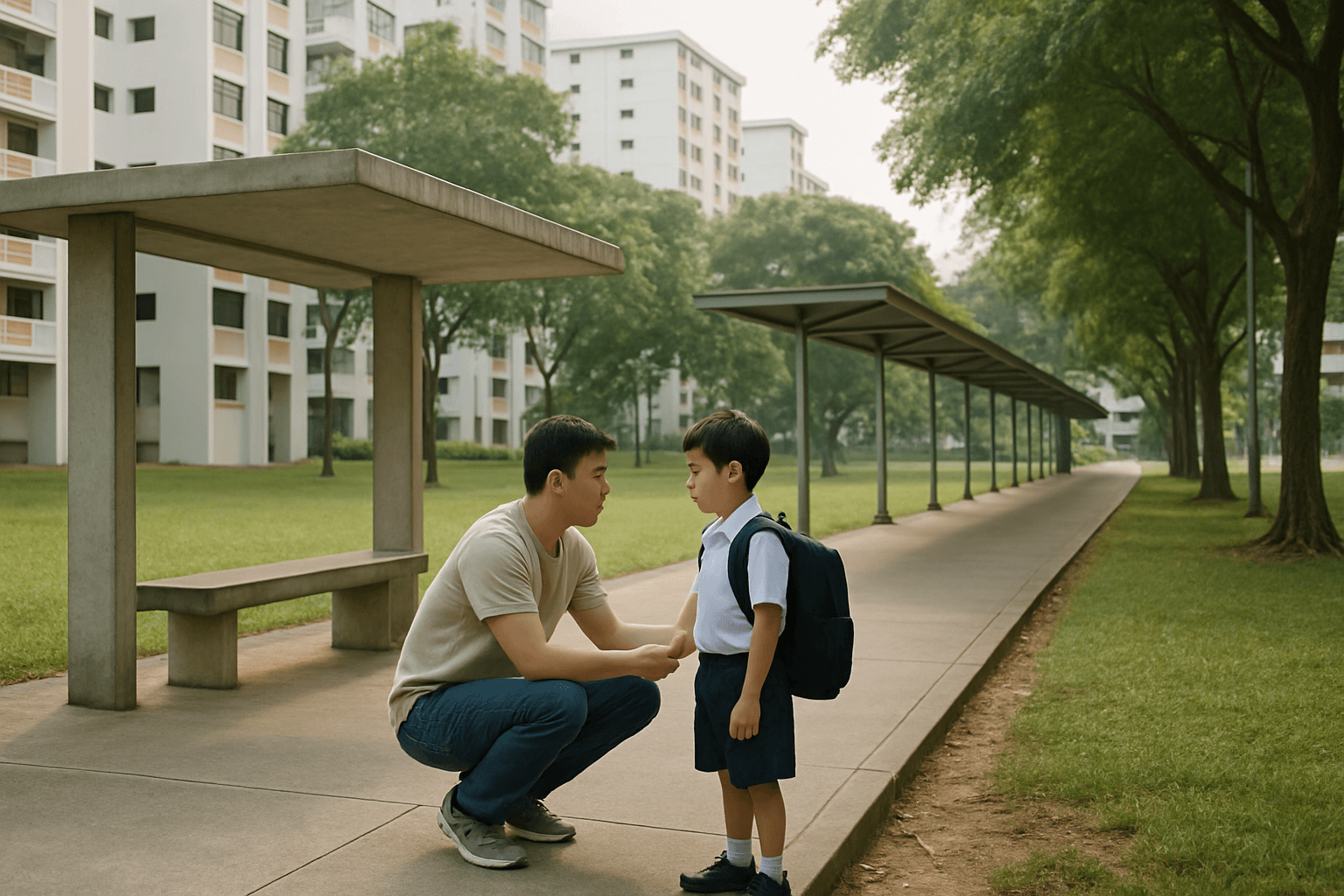
If your child is posted to a school far from home, first test whether the commute is actually manageable. The key question is not whether the school looks far on a map. It is whether the journey is safe, repeatable, and sustainable across real school days.
There is no simple public cutoff in the available sources that says a primary school is officially "too far." What matters more is the real daily burden: travel time, transfers, fatigue, punctuality, and whether your family can support the routine without constant stress.
What does it mean when your child is posted to a school far from home?
A far posting is not automatically a bad outcome, but it does mean the commute and daily routine need a serious reality check.
A far posting means you need to assess the daily journey before you worry about labels like "good school" or "bad school." The main question is simple: can your child get there safely, on time, and without starting the day exhausted?
In practice, the school itself may be acceptable while the daily logistics are the harder part. A longer but direct route may be fine. A supposedly nearer route that involves a rushed handoff, crowded transfers, or no reliable pickup plan may be tougher. That is why the first useful step is a route-and-routine check: actual weekday timing, who handles mornings, who handles dismissal, and what happens if your child is late, unwell, or overwhelmed.
If you are still working through the broader P1 process, our guide on Primary 1 Registration in Singapore and our article on what happens if you do not get your preferred school can help place this outcome in context.
Child leaving for overseas studies, how do you cope?
if my only child goes overseas to study, i will accompany him/her until the child settles down. no need to look after the husband. old enough to look after himself. just make sure he sends money over for the child's education.
School Placement Exercise for returning S'porean children
To add on: fees for international students in local schools are higher than for citizens or PRs. And another consideration: how do you want your kids to feel about Singapore as they grow up, and when they are adults? If they go to local school, they will make Singapore friends, and get to know Singapore in a way students of international schools do not, and are likely to feel that Singapore is their \"home base\". However, if the time in Singapore is expected to be temporary, and they regard US
How far is too far for a primary school child to travel each day?
There is no fixed public cutoff, so the better question is whether the commute is sustainable day after day.
There is no public MOE rule in the available sources that says a primary school commute becomes officially too far after a set number of minutes or kilometres. That is why parents should judge repeatability, not map distance.
A longer direct journey is often easier than a shorter but broken-up one. One child may do fine on one predictable bus ride. Another may struggle with a route that looks shorter on a map but requires a bus, a crowded MRT ride, another walk, and little room for delay. For a brand-new P1 child, tight transfers and fast-paced peak-hour movement often matter more than the headline travel time.
A useful test is this: can your child do this trip five days a week, including tired mornings and less-than-ideal weather, without losing sleep, arriving late, or becoming distressed? If the route only looks manageable on a smooth day, it is probably more fragile than it first appears. For a broader overview, see Primary 1 Registration Distance Priority: How Home-School Distance Works.
How far is too far?
10km from home to school… too much? Any parents have children who have to travel 10km from home to school? How they are coping? We are staying in Seng Kang, but school will be in Bishan. I’m very worried if the distance will be too much for my girl to cope?
How far is too far?
I think distance is pretty important especially for a primary one student. He or she will be too tired from the travelling. So is the parent who has to do the ferrying. THe time could be spent on other more meaningful activities. Best balance is try to get into the best school within 5km of your house. Of course, there is no such thing as best, i should say the most optimal and balanced one in terms of academic performance, environment etc. Balloting may be required but you at least stand a chan
Have More Questions?
Get personalized guidance on schools, tuition, enrichment and education pathways with AskVaiser.
Try AskVaiser for Free →What travel factors matter more than distance alone?
Door-to-door time, transfers, route reliability, and the final walk matter more than the number on a map.
Door-to-door time matters more than straight-line distance. Parents should count the whole trip: leaving home, walking to the stop, waiting time, transfers, road crossings, and the final walk to the school gate.
Transfers matter because every extra change adds friction. A single late bus can turn a manageable journey into a rushed one. Route reliability matters for the same reason. If one missed connection throws the entire morning off, the plan is weaker than it looks. The final stretch matters too. A route with a sheltered, simple walk may be much easier than one that requires your child to navigate crowded pavements or busy crossings.
Weather and dismissal timing also change the picture. A route that feels fine at 7am may feel much harder at 1pm when your child is hungry, tired, and carrying schoolwork. Think in school-day friction, not kilometres. Parents often underestimate how much small effort points add up.
If you are comparing this with how address distance works during registration, see our guide to Primary 1 Registration distance priority. Registration priority and commute burden are related, but they are not the same question. For a broader overview, see Primary 1 Registration Unsuccessful: What Happens If You Do Not Get Your Preferred School.
How far is your kid's childcare from your home?
Some good childcare recommended here are located a bit far from my home, e.g. 2 MRT station+15 mins walk, or 25 mins walk without shelter, etc. I am wondering how long is the journey for your kids to go to their childcare/kindergarten? I am afraid kids will feel tired if it is a bit far or need transit for transportation… Thanks!
School Placement Exercise for returning S'porean children
Hi We are considering repatriation back to SG around mid 2023. My daughter would have finished up G10 in an IB school and we were initially considering between a local international school or taking the SPERs for JC in Sep/Oct. However, we read Google reviews and found the local international schools unimpressive. And only one of them was willing to take our daughter midterm. If we were to wait to take SPERs and want to continue with the IB track, there’s only 2 local MOE IB schools and results
When can a far school still be manageable?
A far posting is usually workable when the route is simple, the child is coping, and the family support plan is boringly consistent.
A far school is usually manageable when the route is simple and the support around it is steady. That can look like one direct bus, one adult escort every morning, or a fixed student care arrangement that removes last-minute pickup stress.
Age and independence matter. Some older primary children cope well with a familiar route after practice. A new P1 child may need much more help even if the trip looks reasonable on paper. Families also cope better when the backup plan is clear: who steps in if it rains heavily, a bus is missed, or the child feels unwell?
For example, one family may find the posting workable because mornings are handled by a grandparent and the child goes straight to a predictable after-school arrangement. Another may cope because the route is longer than expected but direct, calm, and easy to repeat. Practical routine-building, like the habits discussed in this KiasuParents piece on preparing for school, often makes more difference than parents expect.
A manageable far posting is not one that looks ideal on paper. It is one that stays stable even on ordinary, slightly messy weekdays. For a broader overview, see Primary 1 Registration: Should You Pick a Popular Dream School or a Safer Nearby School?.
Child leaving for overseas studies, how do you cope?
go along and spend time with him/her. see that the child is able to settle down first. since only child, then don't have to worry about what is going on at home. husband is old enough to look after himself.
Child leaving for overseas studies, how do you cope?
My elder one will be going overseas to study and my younger one.has no time for me so I have plenty of free time n nothing to do. It is very hard and sian to want to do things to fill up that loneliness and free time but I force myself to do it. Forced myself to go for yoga lessons once a week. Wanted to give up after 1/2 lessons but force myself to go. Now enjoy the lessons so much. No need companion. Just go, hi and bye to classmates (if dont like to socialise) and enjoy the stretching exercis
When should parents treat the distance as a real problem?
Treat it as a real problem when the commute starts affecting sleep, punctuality, safety, or your child's ability to cope.
Treat distance as a real problem once it stops being just inconvenient and starts affecting the child's functioning or the family's ability to run a normal school week.
Common warning signs are repeated lateness, very early wake-ups that leave the child sleepy, tears or refusal before leaving home, frequent missed pickup arrangements, or a child who comes home too drained to eat, rest, or settle. Younger children may show this as meltdowns rather than saying the commute is too much. Parents sometimes misread that as poor adjustment to school when the bigger issue is exhaustion.
Be especially cautious if your child has health needs, therapy appointments, anxiety, low stamina, or is not yet ready to travel independently. The same route can be fine for one child and too heavy for another.
A simple rule helps: if the commute is affecting sleep, attendance, punctuality, or safety, it is no longer a minor inconvenience. For a broader overview, see Popular Primary School vs Neighbourhood School in Singapore: Which Is Better for Your Child?.
Need help with expat children finding public school
Hi skyblue, Not sure how to help since you did not specifically mention what kind of help you need. So here's some general information. To find out how you can get your children admitted, go to this MOE (Ministry of Education) website: http://www.moe.gov.sg/education/admissions/international-students/ As far as I know, there is no Tanglin Street in Singapore, only a Tanglin Road. So if you are indeed going to live along Tanglin Road, then you should probably check out schools in http://www.kiasu
Away on school posting day
I’ve made the mistake of booking our holiday without checking the school posting dates. I understand that the school posting result is tentatively out on 19 Dec and we are to report to the posted school on 20 Dec. Would anyone know what we need to do if we are away during those days ? Could we report to the school after 20 Dec ?
What practical options do parents have after a far school posting?
Start by making the current posting more workable, then ask about official options only if the burden still looks unsustainable.
Start by fixing the daily routine before assuming a school change is the only answer. Many families can make a difficult posting workable once they identify the actual pressure point.
Sometimes the problem is morning escort, not distance. Sometimes it is the trip home. Sometimes it is the gap between dismissal time and who can receive the child. Practical options include testing a different route, arranging adult escort only for the harder leg of the journey, exploring student care near school or near home, or adjusting family schedules so the child is not rushing from wake-up to school gate every day.
It is also worth speaking to the school early if you already see recurring logistics problems. The school may be able to clarify reporting time expectations, dismissal routines, waiting arrangements, or other practical details that help you plan more safely. If the arrangement still looks unsustainable after proper trial runs, you can ask through official channels whether any transfer or vacancy-based option is possible. Do not plan on a change until it is confirmed.
Many parents frame this as a school-choice problem when it is really a daily-support problem. Broader reporting, such as this Straits Times article on supervision strain, is a useful reminder that school logistics can quickly affect the whole household.
Moving to Singapore and looking for a good Secondary School
We will be moving to Singapore soon with our kids. Our oldest is 12 and needs a solid International secondary school, as he is very bright and particularly talented in maths. So far we have applied to UWC, SJI International and SAS. Does anyone have info on these schools and their academic quality? We are looking for a school with a detailed reporting system, streaming in Maths and if possible English and a school ethos that drives children to excel within their potential. We do not want a schoo
School Placement Exercise for returning S'porean children
Yes. But you should let the school know as early as possible - I don't think they can turn you down without a very good reason. Each school may have different requirements though, so it would be good to ask early. My kids did that 3 times during the times we were overseas - P2/4, P4/6, and P6 (older girl was S2 then, and it was under the \"immersion\" scheme and we had to pay extra because she wasn't on LOA by then). It can be rather troublesome as we had to get uniforms and books, even though i
Can parents appeal or request a change if the school is too far?
You can ask, but a far posting by itself does not guarantee a change.
You can ask, but distance alone does not guarantee a different school. Use the school's official contact route or MOE's FAQ and enquiry channel. Be concrete: explain the actual door-to-door journey, where the route breaks down, what safety or caregiving issues exist, and why the plan is not sustainable for your child.
Parents often prepare practical supporting material such as route screenshots, estimated timings, work-shift constraints, medical or therapy schedules, or notes about why the child cannot manage the journey safely. These are examples, not an official checklist. The safest mindset is simple: ask early, explain clearly, and keep an interim commute plan in place while waiting for an answer.
Appeal Secondary One Posting
You should go to school where the appeal is successful to get the transfer form then bring it to the posted school to get them to endorse
Appeal Secondary One Posting
Yes, I agree. Since the posted school is so far, might as well try appealing. I hope your son's first choice school is temasek, because this is important. If your ds is prefect or represents the primary school in concerts/competitions, you should try to point that out in the appeal papers too.
How can you test the commute before committing to a plan?
Do a real school-day simulation so you see the actual burden, not just the planned one.
- ✓Leave home at the same time your child would need to leave on a real school day.
- ✓Take the exact route you are considering, including walking time, waiting time, and every transfer.
- ✓Test it on a weekday morning if possible, so you see the actual crowding and traffic pattern.
- ✓If the route depends on public transport timing, try it more than once instead of assuming one smooth trip is typical.
- ✓If possible, do one trial with your child carrying a school bag and water bottle so the effort feels more realistic.
- ✓Watch how your child seems on arrival, not just how long the trip took.
- ✓Test the return journey too, because afternoon fatigue can make the trip home feel much harder.
- ✓If you can, do one trial in less ideal conditions such as rain or heavier crowding.
- ✓After the trial, ask whether this feels repeatable five days a week, not just possible once.
How do you decide whether to keep the posting or keep looking for another option?
Choose the option your child and family can sustain every week, not the one that looks best on paper.
Keep the posting if the route is safe, predictable, and sustainable with your family's real weekday support. Keep looking for another option if the plan already depends on daily luck, repeated rushing, or a child who is clearly not coping.
A good decision usually becomes clearer after a few honest route trials. If your child arrives calm, the pickup plan is solid, and the family can absorb normal delays, the posting may be fine even if it is not nearby. If every morning requires perfect timing, backup is weak, and your child is already losing sleep, the problem is unlikely to disappear just because everyone "gets used to it."
Many parents end up weighing convenience against school reputation. If that is your real dilemma, our pieces on choosing a popular dream school or a safer nearby school and popular primary school versus neighbourhood school can help you think about the trade-off more clearly.
The better choice is usually the one your child can live with every day, not the one that sounded best during registration.
Stay at Home Child or After School Care Student?
Hi, In a dilemma at this point in time. My maid is taking care of house (so far, this maid is still good), DS1 attending P1 next year (am session). So the question is: Should I get maid to bring him home? Or, should I leave DS1 in After School Care? What do you think is the better option? Pointers to consider: - if child at home, maid cannot do funny things like befriending other maids or invite people to come into house - if child in after school, maid won't be able to do funny things to DS1 if
Moving to Singapore and looking for a good Secondary School
My son has gone through 3 international schools in Singapore, although none of those u mentioned. I am beginning to realize that the local system might be better for a child that is average and above. By local system, I do include the 3 local international schools - SJI (I have heard many good things about this school from separate sources), ACS International and Hwa Chong International. If your child excels in Math, all the more u should consider the local system. My son is slightly above avera
Have More Questions?
Get personalized guidance on schools, tuition, enrichment and education pathways with AskVaiser.
Try AskVaiser for Free →