
GEP Thinking Skills: What Singapore Parents Should Know
A practical guide to the higher-order thinking GEP is meant to develop and what that means for your child.
GEP thinking skills centre on analysis, problem-solving, creativity, synthesis, and independent inquiry rather than memory alone. Children are typically expected to handle unfamiliar tasks, justify their reasoning, and connect ideas across topics. For parents, the real question is not only whether a child scores well, but whether the child enjoys and copes with deeper, less routine thinking.
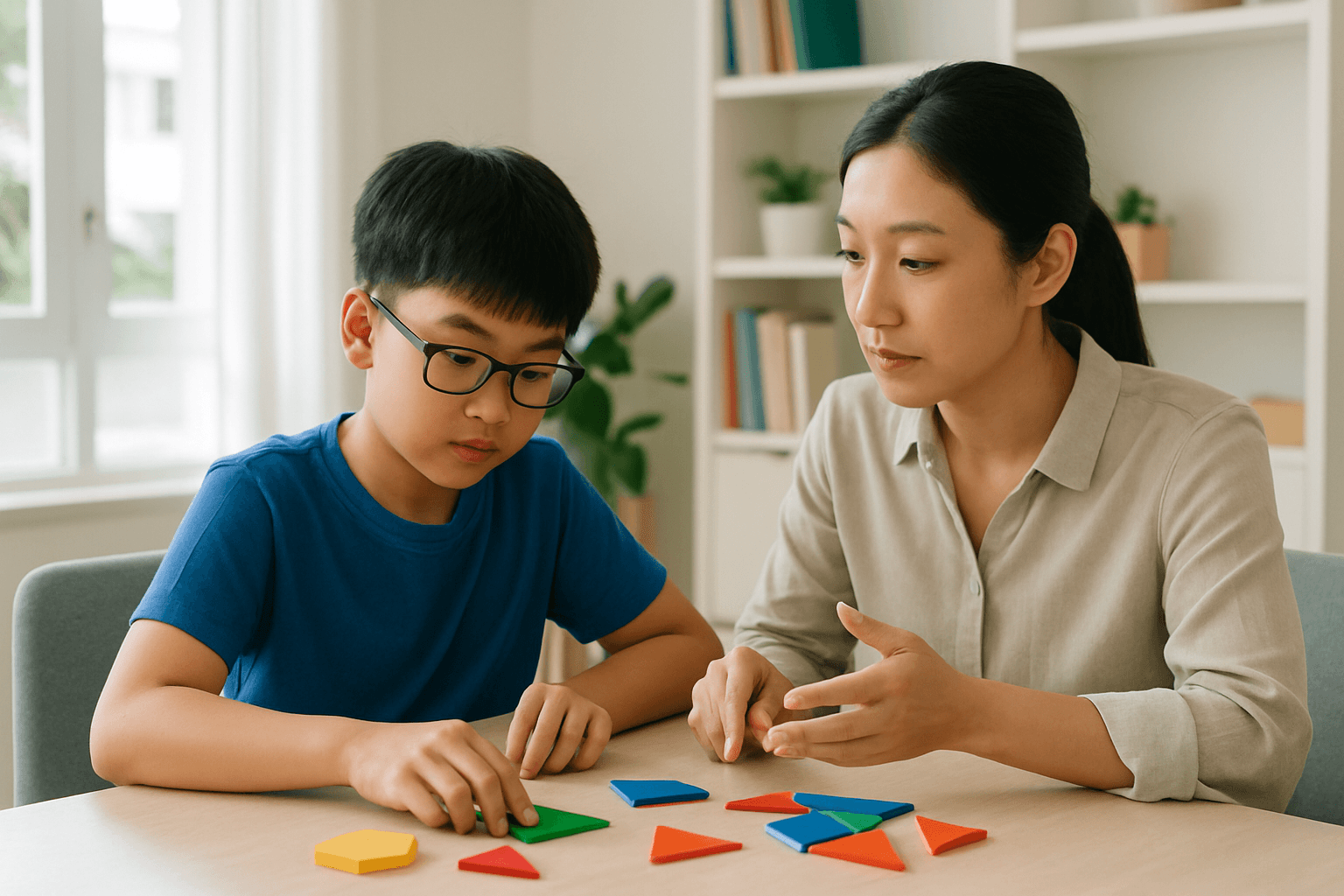
GEP emphasises higher-order thinking more than factual recall alone. In everyday terms, that means reasoning through unfamiliar questions, spotting patterns, comparing ideas, and explaining why an answer makes sense. This guide shows what those skills look like in class, how GEP differs from mainstream learning, how selection connects to thinking, and what parents should weigh before deciding if it suits their child.
What kind of thinking skills does GEP emphasise?
GEP emphasises analysis, problem-solving, creativity, synthesis, and independent inquiry rather than memory alone.
The short answer is higher-order thinking. In parent-friendly terms, GEP is commonly associated with analysis, problem-solving, creativity, synthesis, and independent inquiry rather than factual recall alone.
That means a child is not only expected to get the answer, but to work with the answer. A child showing GEP-style thinking may spot patterns quickly, compare two possible explanations, notice a hidden assumption, or explain clearly why one method makes more sense than another. In maths, that may look like finding more than one path to a solution. In language or humanities, it may look like drawing inferences, defending a view with evidence, or connecting ideas across texts and topics.
A useful way to think about it is this: GEP values depth over repetition. It asks children to think beyond the obvious, not just remember what they were taught.
If you want the wider context first, start with our Gifted Education Programme (GEP) in Singapore: A Parent's Guide or the simpler overview on what GEP is in Singapore. For a plain-English explanation of critical thinking as a learning habit, this parent-friendly overview is also useful background.
GEP and IQ
To me GEP is about if you have it, you nurture it. There is a certain advantage in putting a child in GEP, if she has what it takes. First, you have more resources in the education system dedicated to educating the child. Second, the academic road is somehow smoother. The GEP label helps somehow. I once asked one of my GEP students to ask her teacher how GEPPers do traditionally in PSLE. She came back with the report that they have had people who got B in PSLE math so far. While most do get A*,
All About GEP
The Singapore GEP has always claim that the selection is not an IQ Test. So they will not sleect based on IQ. The purpose of GEP is to train future leaders for Singapore .. I think So the ability to understand and solve problem is pretty important. That's why Social Studies is 5th subject in GEP and they will have to pass it.
What does this look like in a real classroom?
It often looks like open-ended tasks, deeper discussion, and questions that require children to explain and refine their thinking.
In class, these thinking skills usually show up as richer questions and less step-by-step hand-holding. Instead of only practising one standard method, children may be asked to compare methods, justify choices, or test whether a rule still works when the question changes.
For example, a maths task might ask a child to solve a pattern problem in two different ways and explain which strategy is more efficient. A science discussion might ask what would happen if one condition changes and why the result may differ. A language or social studies task might ask children to compare viewpoints, infer motives, or support an opinion using evidence from a text.
These are examples, not an official task list. The practical point is that the child is expected to do more of the intellectual lifting. Instead of waiting for the teacher to model every step, the child may need to explore, make a case, revise an idea, and tolerate not knowing immediately.
That is often what parents notice first. The work is not only harder because there is more of it. It is harder because it expects better reasoning. For a broader overview, see GEP vs Mainstream Primary School: What Is Different?.
All About GEP
I read many interesting concerns on the GEP ... Let me share some of my thoughts on these ... Why force your kids to a GEP if she /he is meant for it. Don't believe those crap training centre ..Let nature take it course My daughter is in P6 GEP at RGPS and had just completed her PSLE like all other 50K kids in her cohort. She is now enjoying herself with her fellow P6 GEP at the Sentosa UnderWater World. She was posted to RGPS from CHIJ Pri (Toa Payoh) in 2008. As a child , she was always more s
All About GEP
Parents that pay thousands of dollars to try to get their children into GEP: Yes, GEP is a coveted programme. Yes, GEP allows your dd/ds to be able to have a higher chance of getting into an IP school. But bear in mind that the programme is immensely challenging. Your child will have to juggle tonnes of projects and lots of HW and at the same time prepare for the all-important PSLE. And if you PUSH for your child to get into GEP by loads of tuition classes, ask yourself: Will he/she be cope? Wil
Have More Questions?
Get personalized guidance on schools, tuition, enrichment and education pathways with AskVaiser.
Try AskVaiser for Free →How is GEP different from mainstream primary learning?
Mainstream learning is usually broader and more structured, while GEP typically goes deeper, faster, and more abstract for children who need more challenge.
Mainstream primary learning is designed to build a strong foundation for most children. That usually means clearer structure, more guided progression, and a pace that works for a full class. GEP is meant for children who grasp concepts quickly and need more depth, more abstraction, and often more independence.
In practical terms, a mainstream lesson may focus on mastering a concept accurately and steadily. A GEP-style lesson is more likely to push into comparisons, extensions, exceptions, or alternative strategies once the basic concept is understood. The biggest difference is not simply more worksheets or harder vocabulary. It is the level of thought expected from the child.
This is why parents should avoid treating the choice as prestige versus non-prestige. Mainstream and GEP serve different learning needs. A child who likes structure and routine may do very well in mainstream. A child who gets restless once the basic idea is clear may benefit from a more stretched environment.
If you want a fuller side-by-side comparison, see our guides on GEP vs Mainstream Primary School, whether GEP is better than mainstream primary school, and the real advantage of GEP vs mainstream. For a broader overview, see GEP Selection Process in Singapore: Stage 1 and Stage 2 Explained.
All About GEP
GEP Status in Secondary Levels 1.What happens after the primary GEP? After Primary 6, retention of the GEP status and promotion to the next level of gifted education is based on: ■performance in the GEP from Primary 4 to 6, including a pass in Social Studies ■attitude towards work and the enrichment programme ■performance at the PSLE 2.What percentage of the Primary 6 GEP pupils meets the criteria for retaining the GEP status? Each year approximately 99% of the pupils meet the criteria. For more
All About GEP
GEP curriculum covers the same content areas as those in mainstream but is extended in breath and depth. And GEP students will sit for the same PSLE and proceed to IP or O level, just like mainstream students. Sounds quite like IP, where students are exposed to an enriched curriculum but also learn the same syllabus and sit for the same A level exam as mainstream students. Or A level students taking H3 subject with extended contents but only the standard syllabus H2 content results will count to
What parents often misunderstand about GEP thinking skills
GEP is not simply a prize for high marks. It is more concerned with reasoning, flexibility, and how a child thinks through unfamiliar problems.
A common mistake is to treat GEP as a reward for very high marks. Strong grades can matter, but GEP is not mainly about memory, routine accuracy, or being top in every subject. It is more about reasoning flexibility and how a child handles unfamiliar tasks.
One child may be average-looking on standard worksheets but unusually strong at spotting patterns, asking sharp questions, or explaining a new idea clearly. Another child may score near-perfect marks through practice and memorisation but become stressed when a question is ambiguous or has more than one possible approach.
High marks can start the conversation. They do not settle the fit.
In GEP, the process matters as much as the answer. For a broader overview, see How Do I Know If GEP Is a Good Fit for My Child?.
Is GEP really necessary?
Is GEP really necessary? If it’s designed to cater to kids with special needs, yes. If the intention is to groom leaders or specialists in a developing country to raise the quality of the human resource, yes. But Singapore has progressed beyond this need. Unfortunately, the GEP is used as a guaranteed passport to an elite education. This is the grand prize that pushes all parents to overdrive. So much is invested in so few, and these few are given the best tools and resources. And at the end of
All About GEP
for what it’s worth from the viewpoint of a 过来人, the GEP is not a measure of how smart or successful a kid is… there are just some aspects of GE kids that make them GE kids. if people think getting into GEP means getting a guaranteed ticket to success in life (defined as top universities, high paying jobs) then do think again. there are many from non GEP who do better, and get paid better. there are many in GEP who live very alternative lives. i think the main difference in GEP cohorts (in the p
How does GEP selection relate to thinking skills, and how do children get in?
Selection is meant to spot reasoning potential and learning style, not just content mastery or memorisation.
At a broad level, GEP selection is intended to identify children with strong reasoning potential, not just children who already know more content. That is why parents should look beyond current exam scores when thinking about fit. A child may perform well through drilling and memory, but a programme like this is more closely connected to how the child processes patterns, ideas, and problems.
Because official details can change, it is safer not to rely on hearsay about exact test components or cut-offs. The more useful parent question is this: when your child faces something unfamiliar, does the child stay curious, test possibilities, and explain their thinking, or does the child shut down unless the format is familiar?
Useful home clues include a child who enjoys puzzles without being pushed, notices patterns independently, asks repeated "why" questions, or can talk through how they arrived at an answer. Another encouraging sign is comfort with challenge. Some children do not mind being wrong at first if they are interested in figuring things out. That matters more than many parents realise.
If you want the process itself explained, read our guide on the GEP selection process in Singapore. The best mindset is to treat selection as a fit check, not a verdict on a child's future. For a broader overview, see GEP vs High Ability Programme in Singapore: What’s the Difference?.
All About GEP
Zakashi, Screening test marked by school. Selection test marked by MOE. Top 1% of the entire P3 cohort offered GEP. There is no reserved list to GEP. You can be stronger in one, but you must be strong on both. The GEP programme is very rigorous. The student would not be able make it she/he is not strong on both. Hence GEP emphasis on English, Maths and does well in general ability questions.
All About GEP
Hi NJmom, Congratulations to your child being selected for the selection test! Which means your dd is among the top 4000 P3 student in Singapore. That's some recognition! So far from what I have found out, the GEP programme are a course designed to cater for a different group of students, for those intellectually gifted kids. Thus, the learning concepts and assumptions are completely different from our main stream. There will be alot of research work and like what fairy has mentioned in her post
How does GEP compare with the High Ability Programme?
Both are meant for advanced learners, but parents should compare the actual learning experience and support, not just the label.
The safest broad comparison is that both GEP and High Ability Programme models aim to support advanced learners, but parents should not assume the labels mean the same thing. The more useful comparison is in the learning design, support structure, school context, and what day-to-day lessons actually feel like.
When parents compare the two, the practical questions are usually better than the branding questions. How much depth is there in real lessons. Is the child grouped with similarly advanced peers all the time or only for some activities. How much independent thinking is expected. What teacher support is available when the work becomes more open-ended or demanding.
Think of this as comparing learning environments, not programme names. Two options may both promise stretch, but the experience for your child can still be very different.
For a deeper Singapore-specific comparison, see our guide on GEP vs High Ability Programme in Singapore and the wider context in Why Singapore Is Moving from GEP to HAP.
GEP Preparatory Program
Good morning Angelight, Gifted Education Programme (GEP) is not a PSLE preparatory program. As stated in MOE’s website that Ministry has recognized that children have varying abilities, it’s not a sound practice to give every child the same education and to expect him/her to move at the same pace as his/her peers. Those intellectually gifted children need high degree of mental stimulation. Normally, intellectually gifted children are very inquisitive, fast learners and with very high level of re
GEP Preparatory Program
Having checked with parent chatgroups, here is my humble assessment of the TOP 3 GEP Preparatory Program specialists . EduCHAMPS academy https://www.theeduchamps.com/gep-preparation-class-2/ • 2 branches – Novena and Katong. • 6 to 10 students per class • Known for following a patented Advanced Brain Training and 5 ‘A’s Method to bring out the full intellectual potential in students • 100% passed the GEP Screening test (1st round). 68% passed the GEP Selection test (2nd round) and got into the P
What are the benefits and trade-offs of GEP?
For the right child, GEP can build stronger reasoning and independence, but the faster pace and deeper demands can also create stress and fatigue.
For the right child, GEP can be genuinely valuable. A stronger peer group and a deeper curriculum can help a child feel intellectually stretched instead of under-challenged. Over time, that can strengthen reasoning, build confidence with complexity, and encourage more independent learning. Children who enjoy difficult questions often benefit from having room to explore ideas properly rather than moving on once the basic answer is found.
The trade-off is that deeper and faster learning can also feel heavier. Some children thrive on challenge but get worn down by the pace. Others are bright enough for the work but dislike ambiguity, prefer routine, or become anxious when there is less hand-holding. In those cases, the programme may still be possible, but it may not be healthy or enjoyable.
Parents often miss the fit problem because the grades still look fine. Watch for a child who becomes unusually perfectionistic, resists discussion-based work, avoids tasks with no obvious right answer, or starts saying they are "not good enough" despite performing well. Those are not small mood issues. They are useful signs about fit.
If you want a closer look at day-to-day demands, read What Is the GEP Workload Like?. For a parent-facing perspective on how challenge can feel in real life, this article on the life challenges of a GEP student in Singapore is a helpful reminder that academic strength and daily fit are not the same thing.
All About GEP
Thank you for sharing your thoughts here. I am not too sure if I want my son to go for GEP. If he is indeed smart then I think he can also do well in a normal stream. On the other hand, I also see the value of putting the top thinkers together to sharpen them. So am in a dilemma if he indeed gets it. Your daughter seems to have adjusted to the GEP class very well.
Advice needed for GEP parent and child
My child is in GEP P6. They got in without enrichment. I would say that GEP is not only challenging in terms of the curriculum, but also needs a strong sense of ownership and independence from the kids. It is more difficult for parents to keep track of their work (many in loose worksheets) and catch them in time if they miss deadlines (so many of them). They also need to make sure the very nitty gritty stuff, like filing being done timely and neatly (necessary for revising). More challenging for
Which schools offer GEP, and why does school context matter?
School context matters because commute, peer environment, and daily routine can affect fit almost as much as the programme itself.
For parents making real decisions, the main point is that GEP is linked to specific school settings rather than being something every primary school offers in the same way. That means school context matters more than many families expect.
A demanding learning environment feels very different depending on the rest of your child's day. A long commute can make an already intensive programme feel much harder. A child who would otherwise cope well may become more tired, more irritable, or less willing to engage deeply after school. On the other hand, a school that is manageable for travel and daily routine may leave more energy for thinking-intensive work, CCAs, and family time.
The social environment also matters. Some children enjoy being surrounded by peers who think quickly and ask big questions. Others need more time to adjust and may find the shift in pace or peer comparison unsettling at first. Neither reaction is unusual.
So when comparing schools, look beyond the programme label. Travel time, the child's temperament, sibling logistics, after-school schedule, and the general school environment often shape day-to-day experience more than parents expect. When you are making a live school decision, confirm the current school options through official channels and then judge the practical fit from there.
All About GEP
Hi folks, I was browsing reddit, and came across this today: https://www.reddit.com/r/singapore/comments/qlplx5/getting_into_a_primary_school/?sort=confidence On reddit, several students who went through GEP said that they were \"trained\" by enrichment for GEP, and they got in. However, once they were in the GEP programme, they struggled to stay on par with their really gifted peers, who just breezed through difficult tests. Can any parent who went through this with their children or similar, h
All About GEP
Personally I think if your child qualify for GEP, then why not? I am skeptical about the effectiveness of the prep program for GEP but let’s say your child qualify for GEP without any prep program, the more you should let he or she undergo the GEP program. My reason is simple and straightforward. I think the ability and potential of each child is different. That is why not everyone can achieve the same results in any given examination. Some will score better than the rest no matter how. The GEP
How can parents support a child in GEP appropriately, and what happens after primary school?
Support thinking at home without over-coaching, and remember that post-primary choices still need separate planning because GEP is only one stage of the journey.
The most helpful support is usually not more drilling. It is a home environment where thinking is normal. Ask your child why they think something is true, what other explanations might fit, or how they know an argument is strong. Let them sit with a difficult question before stepping in. Read together and compare viewpoints. Talk about current events and ask what evidence supports a claim. If you want simple ways to build these habits, this piece on building critical thinking skills gives practical ideas that work beyond GEP too.
The main mistake to avoid is turning GEP into a family status project. When parents over-focus on results, children often become more fearful of challenge, not better at handling it. A thinking-intensive programme works best when a child has room to struggle, make mistakes, and refine ideas without treating every setback as a sign of failure.
After primary school, families still need to make fresh decisions. GEP does not automatically settle the next pathway, and it should not be treated as a guarantee of future success. Parents still need to think about school culture, academic pace, confidence, interests, and whether options such as IP or O-Levels suit the child well. If you are planning further ahead, these guides on choosing IP or O-Levels and choosing a secondary school in Singapore are useful starting points.
The best closing reminder is simple: GEP is a fit question, not a status question. If you are still unsure, our guide on how to know if GEP is a good fit for your child can help you think about suitability more clearly. MOE has also spoken more broadly about balancing academic rigour with the wider skills children need to thrive, as noted in this parliamentary reply.
All About GEP
Sigh. There are lots of \"GEP preparatory courses\" out there but they are merely preying on the parents' inherently yearning that their kids are out to do \"big\" things. We regularly monitor these threads to ban anyone that tries to promote such services. Such courses are bad because they may actually cause the GEP team to upscale their questions to really find truly gifted children! If your child is really gifted, her natural curiosities and talents should stand out clearly. There should be n
GEP and IQ
For gifted children - they don't necessary make it into GEP because of the test and if children perform well for test... As such, gifted child don't just grow overnight... I suggest you contact the GEP department and ask them to support your child... so technically you need some suitable document from a psychologist doing an IQ test and recommendation on how the school can support the child. my younger child is in p2 this year and GEP is working closely with the school at times (LOL) to support
Have More Questions?
Get personalized guidance on schools, tuition, enrichment and education pathways with AskVaiser.
Try AskVaiser for Free →