
How to Judge Secondary School Culture, Discipline and Support in Singapore
A practical parent guide to school fit under MOE Full Subject-Based Banding
When choosing a secondary school, parents should first look at three things: whether the school's everyday culture suits the child, whether discipline is clear and fair, and whether support is visible when students struggle. Under Full Subject-Based Banding, these matter because students need to manage mixed classes, subject-level decisions and a more flexible school day. The strongest clue is not the brochure. It is how the school works on an ordinary day.
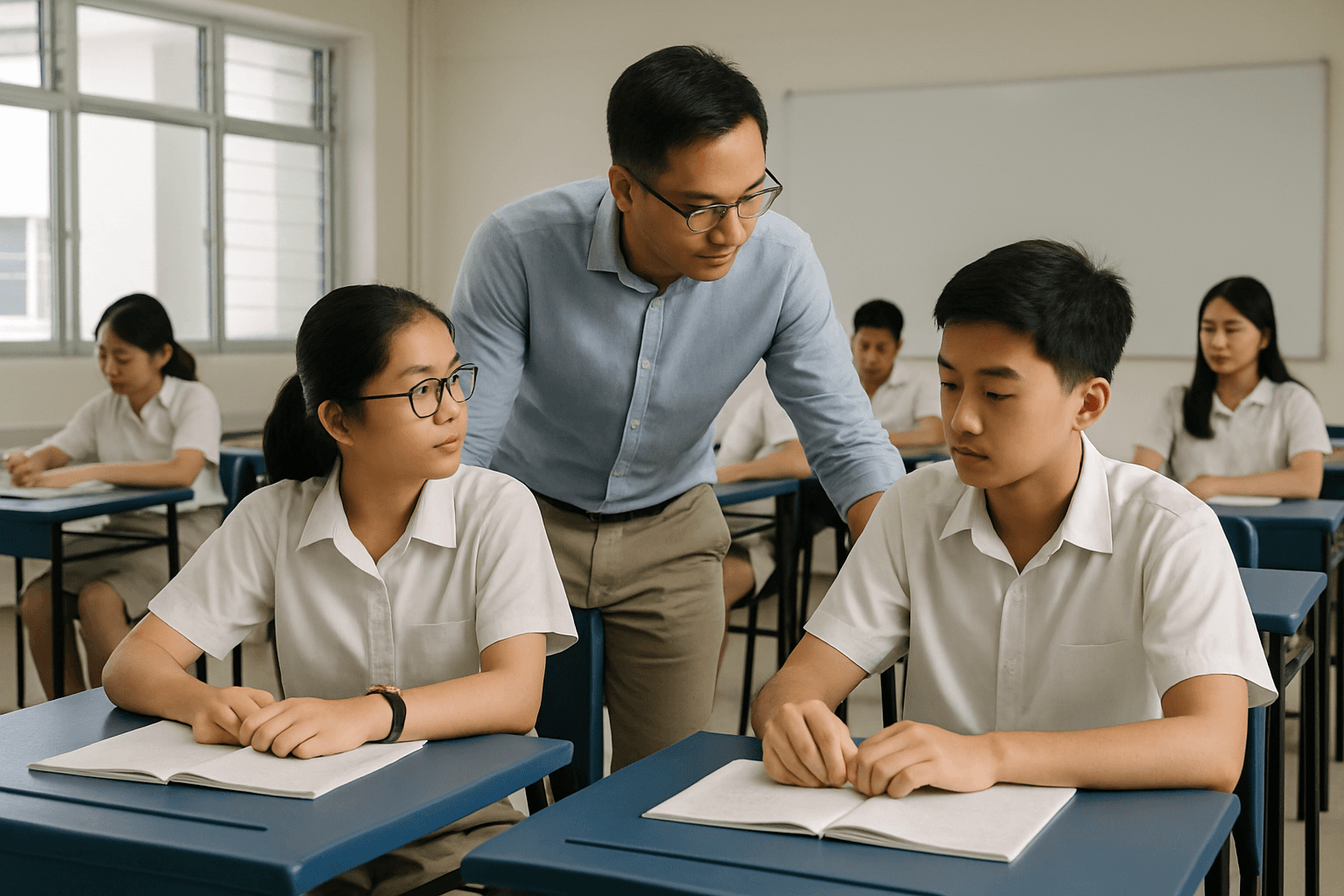
School culture is not a slogan. It is what your child experiences every day: how students behave, how teachers respond, how discipline is carried out, and whether help appears early when a student starts to struggle. Under MOE Full Subject-Based Banding, this matters even more because students may be in mixed form classes and take subjects at different levels. The goal is not to find the "best" school on paper. It is to find the school where your child is most likely to settle, cope and keep learning.
What does school culture really mean in a secondary school?
School culture is the school's daily operating style: how students behave, how teachers respond, and whether your child is likely to feel safe enough to learn and ask for help.
School culture means the school's everyday operating style, not its values statement on a banner. Parents should read it through ordinary signs: whether students greet teachers respectfully, whether classrooms feel calm or noisy, whether teachers correct behaviour promptly, and whether a child who looks lost is likely to be noticed. MOE's guidance on choosing a suitable secondary school also encourages parents to look beyond cut-off points and consider a school's ethos, programmes and fit.
A useful way to think about culture is this: what does the school expect students to do on their own, and what does it actively help them with? Some schools run on tight routines, frequent reminders and close follow-up. Others expect students to organise themselves and seek help independently. Neither model is automatically better. The better model is the one your child can function in consistently.
This is where many parents get misled by reputation. A school can be respected and still be a poor fit for a child who is anxious, slow to warm up or easily discouraged. At open house, pay attention to what looks normal rather than what looks staged. If students seem comfortable speaking with teachers, movement around the school feels orderly, and adults seem alert without sounding harsh, that usually tells you more than a polished presentation.
Insight line: culture is the school's default setting. Your child will experience that every day, not just on special occasions. For a broader overview, see What Is Full Subject-Based Banding in Singapore? A Parent's Guide to Secondary School Subject Levels.
What goes into choosing a suitable Secondary School
Hi there, Recently a relative asked me how I choosed my kid’s Secondary School and I kind of got a shock, I had no answer. It was simply just based on the results. My relative came then with a list of important factors that he thought would be helpful to help his kid cope with the stresses of school. I thought that I would help him make this post to help him make a better decision (the kid will be going into the Secondary School in next year). So here goes, considering grades what else should he
What goes into choosing a suitable Secondary School
Saw this being shared in the parents groupchats. https://www.thewackyduo.com/2022/11/how-to-choose-secondary-school-guide.html https://i.imgur.com/fDkJSy6.png\"> https://www.thewackyduo.com/2022/11/how-to-choose-secondary-school-guide.html It's time to choose a secondary school. Choosing a secondary school is a completely different process than primary school. One tends to choose a primary school based on distance or affiliation. Picking a secondary school is a different ball game. Grades play a
How can parents tell if a school's discipline style suits their child?
Look for discipline that is firm, predictable and fair, then ask whether that level of structure matches how your child actually responds to expectations.
Judge discipline by consistency, not by how strict the school sounds. The real question is whether expectations are clear, follow-up is predictable, and consequences help students recover instead of simply labelling them as "problematic".
A structured school often helps a child who forgets homework, struggles with punctuality or waits too long before asking for help. A more self-managed environment may suit a child who already keeps track of work well and does not need much external prompting. That mismatch matters more than many parents realise. A child who needs reminders can drift badly in a school that assumes students will sort themselves out. A child who is already responsible may feel constantly on edge in a school where every small slip is handled heavily.
Ask concrete questions, not broad ones. Ask what happens when a student is repeatedly late, misses assignments, uses devices wrongly or disrupts class. Ask who follows up first, how quickly parents are informed, and whether the response changes if the issue keeps recurring. Schools rarely describe themselves as too rigid or too loose, so the useful clues are in the process.
What parents often misunderstand is this: good discipline is not mainly about punishment. It is about whether the school prevents small problems from becoming bigger ones.
Insight line: the right discipline style should help your child recover from mistakes, not become afraid of making them. For a broader overview, see What Happens in Secondary 1 Under FSBB?.
BANDING Of Secondary School.
Don't think the banding of secondary schools will be publicly available from 2012 onwards. As a guide, parents can refer to the last published banding in 2011. Here is the link http://www.moe.gov.sg/media/press/2011/09/recognising-best-practices-of-schools.php For ease of reference, the Express and NA banding of schools are in Annex F1 and F2 respectively. Can check out the rest of the annexes for other information relevant to your child's edu needs
[Ang Mo Kio] Primary Schools
My girl will be enrolling in a primary school next year too. I feel where you stay will play a big part in deciding on which pri school your child will study at eventually. Why do we need to compare which primary schools your child will study in ? I think this create an unhealthy system in which most parents will strive to get their child into these perceived good schools. ( If they score well in those schools, it is expected of them but if they do not, these children will enter different second
Have More Questions?
Get personalized guidance on schools, tuition, enrichment and education pathways with AskVaiser.
Try AskVaiser for Free →What should good pastoral care look like in a secondary school?
Good pastoral care helps a student settle, cope and recover when they struggle. It should be visible in daily school life, not only during crises.
Good pastoral care means students are helped to settle, cope and recover when things go wrong. It is not just the existence of a counsellor. In practice, parents should look for form teachers who know students well, Secondary 1 transition support, clear ways for students to seek help, sensible follow-up when friendship or stress issues arise, and constructive communication with parents when needed.
This matters most for children who are quiet, anxious or slow to adapt. Many students do not openly say, "I am not coping." They withdraw, become unusually silent, stop handing in work, or suddenly resist going to school. In a stronger support culture, an adult notices the pattern early. That could be a form teacher checking in after a few off days, or a counsellor introduced as a normal source of support rather than someone students only see in crisis.
Do not get distracted by labels such as "student development" or "pastoral team". Schools package support differently. Ask practical questions instead. If a Secondary 1 student has friendship conflict, refuses to join activities, becomes very stressed before tests or goes quiet in class, who usually notices first? What happens next? How are parents involved? Those answers tell you more than programme names.
A school can have support services on paper and still feel hard to access. What you want is visible support, not just available support. For a clearer picture of daily arrangements under Full SBB, parents can also read what happens in Secondary 1 under FSBB.
Insight line: support matters most when a child is not doing well yet, but not yet in crisis. For a broader overview, see What Do G1, G2 and G3 Mean in Secondary School?.
BANDING Of Secondary School.
Hi! leongheng70, You are to take some points into consideration when you make selection of secondary school: (a) distance to school Secondary school education is different from primary school education and students are to attend CCA at least once a week or twice a week till 5 pm or later. Your son will be very tired if he has to travel far to school from Mondays-Fridays. Furthermore, a lot of projects and class tests during secondary school education (including those neighbourhood secondary scho
BANDING Of Secondary School.
U mean based on latest Banding 2012? MOE has removed Banding of schools. If not, which Sec Schools are u keen to find out?
How does MOE subject-based banding affect daily school life?
Full SBB gives students more flexibility in how subjects are taken, but parents should still ask how the school organises classes, subject levels and support day to day.
Under MOE's Full Subject-Based Banding framework, students in mainstream secondary schools can take subjects at levels that better match their strengths, interests and learning needs. From the 2024 Secondary 1 cohort onwards, students are posted into Posting Groups 1, 2 and 3 rather than the old Express, Normal and Normal (Technical) streams. The aim is a more flexible school experience that is less tied to one broad label.
One day-to-day change is the use of mixed form classes. MOE explains that students from different subject levels learn together in the same form class for parts of school life, while taking some subjects at levels suited to them. For many children, this is healthier than being defined by a single stream label. A child can need more support in one subject and still be stronger in another.
What parents should ask is how the school runs this in practice. How are timetables coordinated? How are students supported if they are coping well in one subject but struggling in another? How does the school discuss movement between subject levels with families? Policy flexibility only helps if the school explains it clearly and reviews it sensibly.
It is also worth knowing that not every school implements Full SBB in exactly the same way. Schools with specialised curricula, including some Integrated Programme and whole-school specialised setups, may operate differently from mainstream schools. If you are still getting familiar with the system, these guides on what G1, G2 and G3 mean, whether students can take mixed subject levels under FSBB, and whether Full SBB is the same as streaming are useful next reads. For a broader overview, see How G1, G2 and G3 Subjects Work for O-Levels.
Time to ponder -- Subject-Based Banding (SBB)
Time to ponder -- Subject-Based Banding (SBB) Subject-Based Banding (SBB) will be implemented from the 2008 P5 cohort. It will replace the merged and EM3 stream. Depending on their performance in P4, students will be streamed into classes taking 4 standard classes with Higher Mother Tongue(HMT) , 4 standard subjects or a combination of standard and foundation subjects. Are these equivalents to the earlier EM1, EM2 and EM3? 4S + HMT --> EM1 4S --> EM2 Combination of standard and foundation subjec
Subject Based Banding
Hi, Anybody knows what is Subject Based Banding? My boy is in P4 Maris Stella. Any parents who has done this option thingy before in Maris Stella? Pls share… Thanks.
What should parents ask during open houses or school visits?
Use open houses to test fit, not just to collect brochures or compare reputations.
- ✓Ask what usually happens when a student is repeatedly late, misses homework or breaks classroom rules.
- ✓Ask how the school supports shy, anxious or slow-to-settle students during Secondary 1.
- ✓Ask who notices first when a child is struggling: form teacher, subject teacher, year head or counsellor.
- ✓Ask how and when parents are updated if a student is not coping academically, socially or emotionally.
- ✓Ask how Full Subject-Based Banding is organised in daily lessons, mixed form classes and subject-level groupings.
- ✓Ask how the school reviews whether a child should stay at the same subject level or move later.
- ✓Ask what kind of student tends to thrive in the school and what kind may need more adjustment time.
- ✓Observe whether students seem respectful, relaxed and comfortable approaching teachers.
- ✓Notice whether the school feels orderly without feeling tense or overly harsh.
- ✓Ask how the school guides students towards O-Level combinations and later routes such as JC, polytechnic or ITE.
What are the warning signs that a school may not suit your child?
The biggest warning sign is mismatch. If the school's pace, structure or social atmosphere does not suit your child, the name alone will not fix that.
The clearest warning sign is mismatch between the school's pace and your child's needs. A fast, competitive environment may motivate one child but overwhelm another who needs reassurance and a steadier start. A relaxed environment may feel pleasant at first but frustrate a child who needs tighter routines and clearer follow-up.
Look for patterns, not one dramatic red flag. If your child seems visibly intimidated on campus, answers about support are vague, teachers feel hard to approach, or the school talks mainly about prestige and results without showing how students are supported, those are reasons to probe further. Another warning sign is when the school seems to work best for only one type of learner, such as the very independent or already highly driven.
Parents also sometimes miss quieter forms of mismatch. A capable but slow-to-adapt child may struggle in a school where students are expected to seek help quickly on their own. Another child may dislike a school not because it is "bad" but because the social atmosphere feels rough, loud or emotionally distant. If several small things feel off, take that seriously instead of dismissing it because the school's name is strong.
A single awkward interaction at open house is not decisive. But vague answers across several areas usually matter.
Insight line: school fit is less about status and more about whether your child can function well there every week.
SOS - Advice needed for secondary school selection
Hi all Need urgent advice on secondary school selection for my boy who scored 234; we are thinking of the following schools in north area: 1. Xinmin Sec 2. Zhonghua Sec 3. Chung Cheng Yishun 4. Maris Stella High 5. Presbyterian High 6. Ang Mo Kio Sec Can anyone provide advice if the above choices make sense? Thanks in advance! :thankyou:
Beyond AL/PSLE scores - Choosing Secondary School
Hi everyone, I’ve noticed a lot of discussions here about PSLE posting and how tough it can be to shortlist secondary schools — especially when trying to consider more than just the cut-off points. I recently built a free website called School Advisor SG that might be useful for parents going through this process. It helps you explore schools holistically, by combining publicly available data on: PSLE cut-off points (2024) Sports & CCA performance (from national competitions) Primary–secondary a
How do school culture and support affect O-Level preparation?
Culture affects O-Level readiness mostly by shaping habits, confidence and how quickly a child gets help when they start to struggle.
School culture affects O-Level readiness mainly through habits, confidence and consistency. It does not guarantee grades, but it does shape whether a child stays engaged enough to build towards them steadily.
A school with clear routines, timely feedback and adults who notice problems early often helps students recover faster when they slip. For example, a Secondary 1 student who loses confidence after struggling in one subject may regain momentum if a teacher checks in early and the school gives sensible guidance on subject level and support. In another school, help may technically exist but the student may not feel comfortable asking for it, so the problem quietly spreads to other subjects.
The same goes for work habits. A child who needs external structure may slowly build the routines needed for upper secondary work in a school that follows up on homework, punctuality and revision habits. Without that structure, the same child may remain inconsistent even in a school with a strong academic reputation.
This matters under subject-based banding because subject levels can affect later combinations and options. Parents do not need to map out every exam decision in Secondary 1, but they should understand how early subject choices connect to later outcomes. Our guide on how G1, G2 and G3 subjects work for O-Levels explains that more directly. For broader context on why mixed-class learning became part of the system, The Straits Times' reporting on students taking classes together across former stream lines and MOE's press release on greater flexibility through Full SBB are useful background.
Insight line: culture does not decide results, but it can make steady preparation much easier or much harder.
All About Preparing For Secondary One
Does anyone have advice on Bedok South and Bedok View? What is the culture like and are the students well-behaved? My DS scored lower than expected and we are really worried now. Appreciate any help! Glad to reciprocate by providing advice on preparation for Sec 1 for Cedar, Temasek and Chung Cheng. Based on DD’s experience and my colleagues’ sharing sessions.
All About Preparing For Secondary One
Hi, Thanks so much. I wanted to know which subjects are examinable and if this varies from school to school. This information will help in selecting Secondary school. My kid will be in new AL scoring system and choice of school matters. So I want to make an informed choice. It may a bit too early but just wanted to have some information.[/quote]Most Secondary schools will have common (standard) subjects for O-Level and N-Level, with exception that some offer Higher Chinese or Third Language. The
How should parents think about JC, polytechnic, ITE or other post-secondary routes when choosing a school?
Choose a school that builds your child's strengths, confidence and self-management. That usually keeps more future options open than choosing by name alone.
Choose a school that helps your child build strengths and stay open to progression, not one chosen mainly for image. The practical question is not just, "What route sounds impressive now?" It is, "Will this school help my child keep developing from where they are today?"
Under Full SBB, that usually means looking for a school that explains subject pathways clearly, helps students build confidence in key subjects and supports them in managing work independently over time. A child who steadily improves, takes suitable subject levels and learns how to recover from setbacks often keeps more options open than a child in a supposedly stronger environment who becomes discouraged and underperforms.
If future ceilings worry you, listen carefully to how the school talks about progression. Do staff explain subject pathways calmly and clearly? Do they help families understand how different subject levels may affect later choices? Do they speak respectfully about different post-secondary routes, or only celebrate one narrow definition of success? Schools that understand growth usually prepare students for a wider range of realistic next steps.
If pathway questions are your main concern, these guides on whether taking G1 or G2 limits future options, whether G1 or G2 students can still go to JC, poly or ITE, and JC entry for FSBB students will help you think more clearly.
Which Secondary Schools?
if you can provide the following info, then you may get more help 1) you prefer mixed school or single sec school 2) you prefer schools affiliated to a JC 3) which cca your kid wants to join 4) what scores you think your kid will get for his PSLE 5) you prefer your kid to study in a school where his/her score is in the top 10% of the cohort? bottom 10% of the cohort? or about the same as most of the cohort? cheers
Choosing Secondary school
Hi, Wonder if anyone knows what happens in this Secondary School selection scenario : If there are 10 places left in School A and 20 pupils with EXACTLY the same PSLE score apply, how does MOE decide which 10 to take into the school. Does it matter in this case whether the child had put School A as the first choice? This impacts what schools to put as 1st and 2nd choice - whether the common advise of putting the dream school which is just out of range of the child’s mark is a wise thing to do. P
Is a more supportive school always better than a more demanding one?
No. The better school is the one that gives your child the right mix of support and stretch.
No. The better school is the one that gives your child the right mix of support and stretch.
Parents often frame this too simply as "strict versus caring" or "supportive versus high standards". In reality, the stronger schools usually combine both. The real difference is where the balance sits and whether that balance suits your child. A very independent child may find constant monitoring irritating. A child who is still shaky after PSLE may need warmer relationships and clearer check-ins before higher pressure becomes useful.
A practical test is to ask what happens when an average student, not a top student, starts to struggle there. If the answer sounds thoughtful and specific, the school probably understands support. If the answer is mainly that students should toughen up or simply work harder, that may be a poor fit for children who need guidance before they can improve.
Think of it this way: the right school should not feel easy, but it should feel workable. Your child should be stretched enough to grow and supported enough not to shut down.
Moving to Singapore and looking for a good Secondary School
My son has gone through 3 international schools in Singapore, although none of those u mentioned. I am beginning to realize that the local system might be better for a child that is average and above. By local system, I do include the 3 local international schools - SJI (I have heard many good things about this school from separate sources), ACS International and Hwa Chong International. If your child excels in Math, all the more u should consider the local system. My son is slightly above avera
Is Singapore’s education system too stressful?
I found this interesting post and comments and was wondering what could be your views of all the kiasu-parents here? To read the article: http://sg.yfittopostblog.com/2010/07/30/is-singapores-education-system-too-stressful/
Have More Questions?
Get personalized guidance on schools, tuition, enrichment and education pathways with AskVaiser.
Try AskVaiser for Free →