
What Documents Are Needed for MOE Primary 1 Registration?
A practical Singapore parent guide to the documents to prepare first, what is commonly useful, and what matters in special cases.
Most parents should prepare core identity and citizenship documents first, then keep proof of address, family-authority records, and other supporting documents ready if their case is not straightforward. A simple way to stay prepared is to sort everything into four folders: identity, status, address, and special-case support.
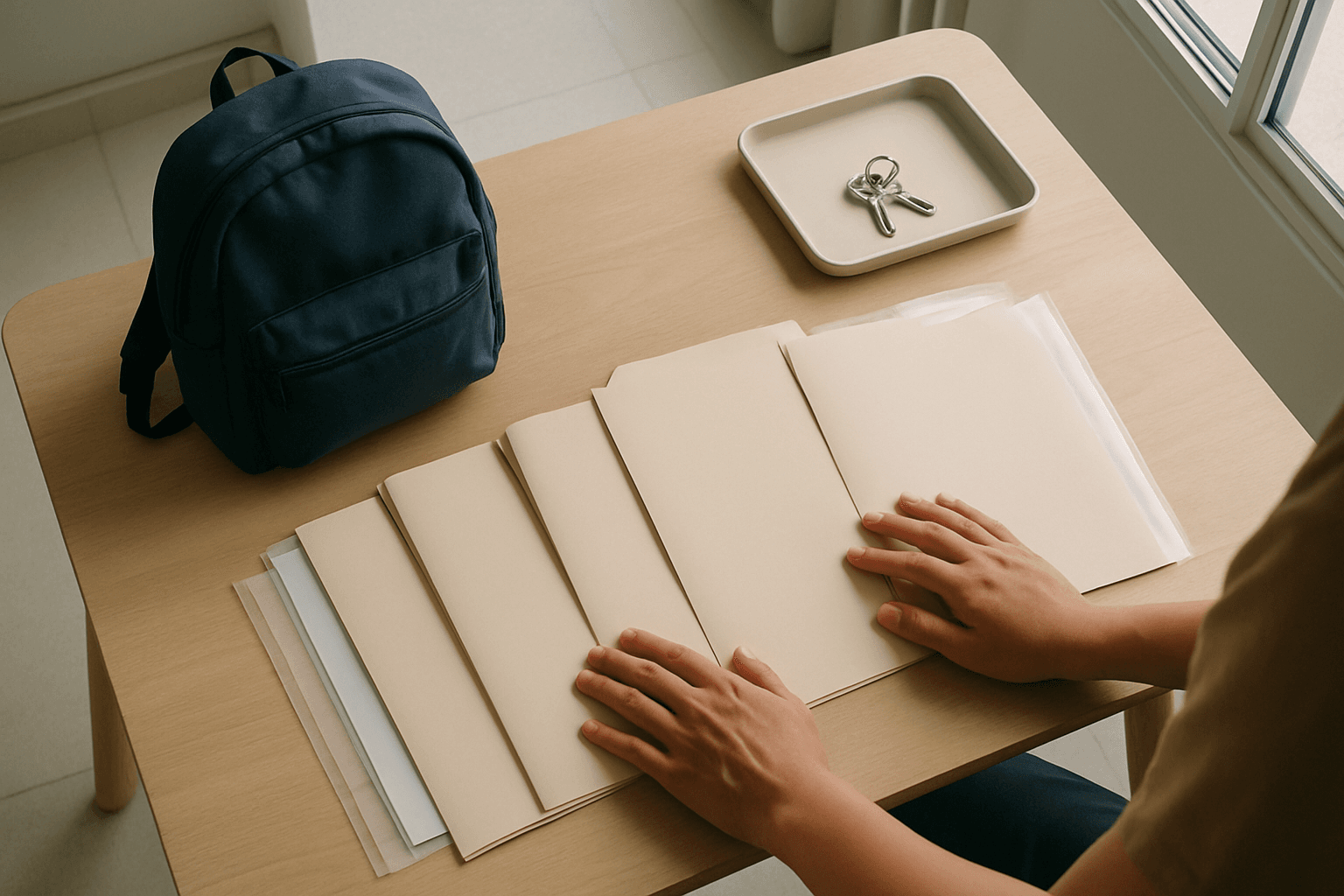
For Primary 1 registration, parents should usually start with documents that show who the child is, who the parent or guardian is, and the child’s citizenship or residency status. After that, it is sensible to prepare address records and any extra supporting papers that fit your family’s situation, especially if you recently moved, have overseas documents, or have custody or guardianship arrangements.
The official sources reviewed for this article did not provide one exhaustive MOE checklist covering every family situation. So instead of pretending there is a single fixed list, this guide focuses on the document categories Singapore parents commonly prepare and the situations where extra paperwork often becomes important.
What documents are needed for MOE Primary 1 registration in Singapore?
Prepare core identity and citizenship records first, then keep address, family, and special-case supporting documents ready if they apply to your child.
Start with the child’s identity and status documents, then add supporting records that fit your family’s situation. In practice, most parents prepare documents that show who the child is, who is registering the child, what the child’s citizenship or residency status is, and where the child lives. If your case is less straightforward, such as a recent move, shared custody, guardianship, or overseas-issued records, prepare extra documents early rather than wait to be asked.
Common examples parents usually keep ready include the child’s birth or identity records, the registering parent’s identification, and some form of address record. These are practical examples, not a guaranteed official submission list for every child. The most useful mindset is this: think in categories, not one perfect checklist.
If you want the broader process around timing, phases, and school choice, our Primary 1 registration guide is the best next read. For official process questions, MOE’s Primary 1 registration FAQ is also useful.
For Reference for P1 registration: MOE Official Letters
Question With regards to the P1 registration exercise, is it necessary to produce NRICs of both parents even if the parents are divorced? Will it be sufficient to produce the NRIC of the parent who has custody of the child, along with any document proving the divorce? MOE's reply Dear Mr xXx, Thank you for your email on 16 July 2012. We would like to share that as you did not provide further information, you may wish to know that the parent who has sole custody of the child will need to produce
MOE Kindergarten
https://www.moe.gov.sg/news/press-releases/online-process-for-moe-kindergarten-registration-exercise-and-refinements-to-admissions-framework Online Process for MOE Kindergarten Registration Exercise & Refinements to Admissions Framework 1. MOE will implement an online process for the MOE Kindergarten (MK) Registration Exercise and make refinements to the MK Admissions Framework. NEW ONLINE REGISTRATION PROCESS FOR MKS 2. Currently, parents interested in registering their child for an MK have to
What are the most common categories of documents parents should prepare?
Sort your papers into four groups: identity, citizenship or residency, address, and family or special-case supporting records.
Most families can sort their documents into four groups: identity, citizenship or residency status, address, and family or special-case support. This is the easiest way to prepare because it matches the questions schools or MOE may need clarified: who is the child, who is registering the child, what is the child’s status in Singapore, and is there anything unusual about the living or family arrangement.
A straightforward case usually means a thinner folder. For example, a Singapore citizen child living with both parents may only need a small core set of records. A child born overseas, living at a recently changed address, or being registered under a custody arrangement usually needs more supporting papers. The sharper takeaway is simple: the more your situation needs explaining, the more your documents should tell a clear story.
Parents often lose time searching for a master list that covers every case. A better approach is to sort papers by identity, status, address, and family authority first. Once you do that, missing gaps usually become obvious. For a broader overview, see Who Is Eligible for Primary 1 Registration in Singapore?.
MOE Kindergarten
Morning mummies and daddies. Would like to ask if any of you have considered sending your children to MOE Kindergartens or whose children are in MOE Kindergartens. Am recruiting parents to do a 1-hour interview. I am especially interested to talk to parents who registered under phase 1 or 2. Please contact me at 90493798 if you’re interested. There will be compensation. Thanks! Priority Order (PO)\tEligibility 1\t MOE will reserve one-third of places for Singapore Citizen (SC) children from hous
MOE Seminar for parents
Just find this info, hope it will be usefull for parents who are registering their child this year for 2011 intake http://www.moe.gov.sg/events/seminars-for-parents/
Have More Questions?
Get personalized guidance on schools, tuition, enrichment and education pathways with AskVaiser.
Try AskVaiser for Free →What identity and citizenship documents are usually needed?
Have the child’s and parent’s key identity documents ready, and check that names, dates, and identity details match across them.
Parents should usually have the child’s and the registering parent’s identification records ready so names, dates of birth, identity numbers, and status details line up across the registration. Common real-world examples include the child’s birth certificate, passport, identity details where relevant, and the parent’s NRIC or passport. In some cases, the child’s citizenship or immigration status documents may also matter.
This is where small errors often cause avoidable delays. A slightly different spelling, a missing middle name, or an old identity number on one record can trigger clarification later. Before registration opens, it is worth checking that the child’s full name and date of birth appear consistently across the documents you plan to rely on.
These examples are common preparations, not a fixed official list for every applicant. If your child’s status has changed recently, or if the child has overseas-issued records, prepare more than the bare minimum. One extra supporting document is usually more useful than one rushed explanation. For a broader overview, see Primary 1 Registration Distance Priority: How Home-School Distance Works.
Preparing Your Child for Primary School:Parent Seminar - MOE
Preparing Your Child for Primary School: A Parent Seminar by MOE Starting primary school is a big step in your child's life. To help you better understand primary school programmes and enable you to make key education decisions, the Ministry of Education will be conducting a seminar on Primary School Education. At the seminar, parents can look forward to sharing sessions by the school principal and a parent volunteer, as well as view the various programmes our primary schools provide. The Primar
MOE Kindergarten
In terms of priority, the MOE K has been tweaked to 500m to 1km, 500m to 1km, >1km. lyra: you should consider attending their open house this Saturday (14 April). Most of your queries could be answered by their representatives and you can also check out the environment of the kindergarten.
What address or residency documents may be relevant?
Keep reasonable proof of where the child lives, especially if your school plan depends on distance or your address situation is not simple.
Address records matter because many parents plan their school choices around home-school distance, and distance can matter when a school is oversubscribed. That is why it is sensible to keep reasonable proof of where the child lives, especially if you recently moved, are staying with relatives, or are living in a rented property. Common examples parents often prepare include a tenancy agreement, a recent utility bill, or official mail showing the parent’s residential address. These are practical examples, not confirmed universal requirements.
Parents sometimes assume that checking a school on planning tools is enough. It is not. School planning tools help you estimate distance and shortlist schools, but they do not replace documents if your address needs to be verified. If your strategy depends heavily on living near a target school, read our guides on how home-school distance works, which home address counts, and what to consider after moving house.
A useful rule of thumb is this: if your address story needs explaining, prepare documents that explain it clearly.
MOE Kindergarten
On choosing MOE Kindy, parents must like the fact that there will be no spelling, little handwriting practise, near to zero homework (with perhaps parents-child project to work at home). In my opinion, it is a play based curriculum that is trying to work out as good as the “branded” preschools. There are class projects that get students to research, explore and present. Reading programme in English and Mother Tongue is decent. (I, for one would prefer a child to learn to recognise Chinese charac
MOE Kindergarten
Lyra MOE kindy gives priority to Singapore citizens within 1km. They also got some traits like the P1 registration. So it helps if you are staying within if there are limited vacancies. You can also increase your chance by stating on the registration form that you are ok with the alternate session which means you register for either session instead of die die can take am only. Appears that am session is more popular. Does your child go for any classes at all? If so, he/she should be able to adap
What family-related documents might be needed in special situations?
In custody, guardianship, or one-parent registration cases, prepare documents that show who is authorised to register the child and make school decisions.
If one parent is registering alone, the parents are separated, or a guardian or caregiver is acting for the child, family-related documents can become important. The point of these records is practical: they help show who is authorised to handle the registration and make school decisions for the child. Common examples include custody orders, guardianship papers, or a consent letter where one parent is not present. In some families, it is also helpful to keep documents that clearly show the child’s relationship to the adult handling the registration.
This is one area parents often underestimate. Schools cannot safely infer legal authority from family context alone. If the adult registering the child is not obviously the person entitled to act, the documents need to make that clear.
The takeaway is simple and worth remembering: do not just prove who the child is. Prove who can act for the child when that is not immediately obvious. For a broader overview, see Primary 1 Registration After Moving House: Should You Use Your Old or New Address?.
MOE Kindergarten
Hmmm… Is there a specific forum for parents registering for MOE Kindergarten @ Sengkang Green Primary School?
MOE Kindergarten
Hi, it’s my son 3rd day at MOE kindergarten & i had 2 sleepless nights. It was so tough in this kindergarten where my son is the pioneer batch and i enrolled as the pcf school my son was in n2 had not offered k1 anymore but move to moe kindergarten. It was such a nightmare that i wanted to cry…can someone in MOE kindergarten tell me. 1. Is it logical to start a pm kindergartem class with 4 students and 3 in kcare ( as 1 not require kcare). What is the typical.class size? 2. What is the typical r
What documents should parents of non-citizens or children with overseas records prepare?
If your child has overseas records or non-Singapore status, keep passports, overseas documents, immigration records, and translations ready if relevant.
Families using non-Singapore documents should expect to prepare more supporting paperwork than families whose records are fully local and straightforward. Common examples include the child’s passport, overseas birth certificate, immigration or residency records, and translations if the original documents are not in English. These are common examples parents often gather in advance, not a definitive official checklist for every status category.
The practical reason is simple. Overseas records are more likely to need clarification, especially if names are formatted differently, the child has more than one nationality, or the family moved recently. A clear translation and a consistent set of identity records can save time if questions come up.
If you are still working out whether your child falls within the usual local registration pathway, our guide on who is eligible for Primary 1 registration is a helpful next step. Separately, if you are not enrolling your child in a local primary school because the child is overseas or you are pursuing another education pathway, MOE may ask for supporting evidence rather than just an explanation, as reported by CNA. That is a different situation from standard registration, but it is a useful reminder that special cases usually need documentary support.
[Ang Mo Kio] Primary Schools
Please view the web link for updates of the latest vacancy situation. https://www.moe.gov.sg/admissions/primary-one-registration/vacancies#Ang-Mo-Kio
List of mixed primary schools in Singapore
I’ve been trying to find a list of mixed primary schools in Singapore, but could not find any on MOE website. I don’t want to go to every school website just to check, very tedious. Is such a list available anywhere? Thanks in advance!
What supporting records are useful even if they are not always required?
Keep extra backup documents in both digital and physical form so you can respond quickly if the school or MOE asks for clarification.
Backup documents are often what save time when something needs checking. Even if a document is not part of the main submission, it can help you answer a question immediately instead of delaying the process. Useful examples include scanned copies of identity documents, an extra piece of address proof, marriage or custody records where relevant, overseas certificates, and translations kept together with the originals.
This matters most when your case is only slightly outside the simplest scenario. A parent who moved recently may not know which address document will be most useful if asked. A non-citizen family may have one document proving identity and another proving status. A separated parent may have enough to begin but still need authority papers if clarification is requested.
One practical point parents often overlook is format. The reviewed sources do not spell out whether originals, scans, or copies will be requested in every case, so the safest approach is to keep both clear digital scans and accessible physical documents ready. Think of backup records as your buffer: they are not always needed, but when they are, they are usually needed quickly.
All About Preparing For Primary One
according to MOE, no need for P1 preparatory class, they stress many times, and they said all kindergarten should be able to prepare the child to primary 1… but parents are too kiasu they prepare them for P1… by the time these kids go to P1, they know most things so those din go to such classes, felt left out and their parents also will send them to classes… never ending… sigh…
MOE Kindergarten
Just checking if any parents enrol in MOE K in let’s say am/pm and then another child care for the other half of the day? The only reason I’m considering MOE K is for the priority admission to the primary school but do not want to compromise on my child’s learning. Other than logistics, are there other considerations?
How should parents prepare documents before registration day?
Use a simple document workflow before registration day so small errors do not become last-minute problems.
- ✓Check that names, spellings, dates of birth, and identity numbers match across documents
- ✓Confirm that passports or other status documents you may rely on are still valid and not expired
- ✓Save clear digital scans of key records in one labelled folder
- ✓Keep clean hard copies of your main documents together in a physical file
- ✓Group papers under child identity, parent identity, address, and special-case support
- ✓Keep overseas records and their translations together if they apply
- ✓Prepare one extra piece of address proof or family-authority evidence in case verification is needed
- ✓Review your school-choice plan early if it depends on distance, a recent move, or an unusual living arrangement
What are the common mistakes parents make with P1 registration documents?
The most common problems are mismatched details, outdated address records, and missing support for special situations.
Most delays come from small inconsistencies, not major problems. Common examples include different spellings of the child’s name across records, an outdated home address on one document, assuming one ID document will cover a more complicated family situation, or leaving custody, guardianship, overseas-birth, or translation papers until the last minute. The key insight is simple: if your documents tell different stories, registration gets slower.
Share with us your kid's P1 registration experience
Hi parents, I've gone through 2 rounds of registration for my kids - Phase 2B 5 years ago (2006) and Phase 2A2 (2010). For son's P1 registration at Pei Hwa then, there was just 1 stop - ie to submit documents for verification. No guarantee at Phase 2B, just a high chance of getting in. Today's registration for daughter is slightly longer - 3 'stops'. Station 1 is at ground floor where a lady will make sure we are eligible for Phase 2A2. If so, then we proceed to the hall on 2nd floor. Station 2
MOE Kindergarten
My nephew went to MOE Kindergarten and he really struggled when he went to P1. Because MOE Kindergarten is just 4 hours and cover the basics, there was not time to reinforce and practice what is covered so the child forgets. Also, the curriculum is not enough to help the child transition to P1. They do not teach writing, spelling, phonics, addition and subtraction while my nephew’s classmates already know. Felt so bad for him as he really had a hard time adjusting academically and felt demoraliz
Have More Questions?
Get personalized guidance on schools, tuition, enrichment and education pathways with AskVaiser.
Try AskVaiser for Free →