
Does Living Within 1km Guarantee Primary 1 Admission in Singapore?
Being nearby improves priority, but it does not secure a place.
No. Living within 1km can improve your child’s priority in Singapore Primary 1 registration, but it does not guarantee a place. If a school has more applicants than vacancies, nearby families can still face balloting or miss out.
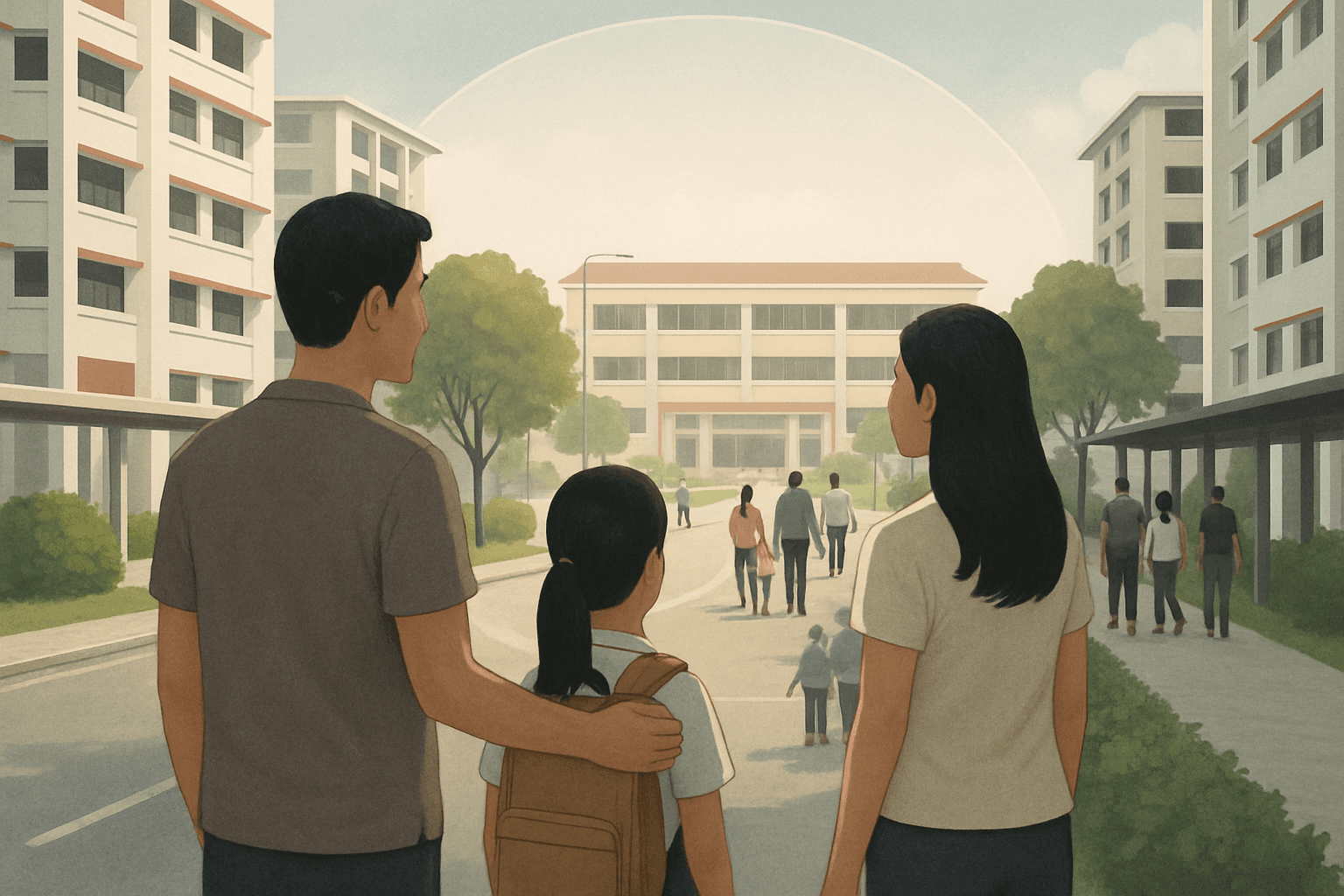
No, living within 1km does not guarantee Primary 1 admission in Singapore. It can improve your child’s priority in the Primary 1 registration process, but it is only one factor in the outcome.
The key thing many parents overlook is that distance only matters within MOE’s wider framework: your child’s citizenship group, registration phase, and the number of places left at that stage still affect the result. If a school is oversubscribed, even families living very close can still face balloting or miss out.
A simple way to think about it is this: 1km gives you better odds, not a reserved seat.
Short answer: does living within 1km guarantee Primary 1 admission?
No. Living within 1km improves priority, but it does not guarantee a Primary 1 place.
No. Living within 1km improves your child’s chances, but it does not guarantee a place.
In Singapore, distance is a priority factor, not a guaranteed-entry rule. It only comes into play when a school has more applicants than vacancies in that phase. If the school is not oversubscribed, distance may not decide anything. If it is oversubscribed, being within 1km can put your child ahead of some other applicants, but it still does not create an automatic right to a seat.
The practical takeaway is simple: nearer means stronger odds, not certain admission. For a popular school, even a large group of nearby families may still need to ballot for the remaining places. For a broader overview, see Primary 1 Registration in Singapore: How It Works, Balloting Risk, and How to Choose a Realistic School Plan.
[Bedok] Primary Schools
Telok Kurau Primary School has places only for children who have registered in the school and are living within 1km of the school. Therefore, children living outside 1km of the school are unsuccessful in their registration. No balloting will be conducted in Telok Kurau Primary School. Temasek Primary School has places only for children who have registered in the school and are living within 1km of the school. Therefore, children living outside 1km of the school are unsuccessful in their registra
[Central] Primary Schools
2012 end of Phase 2C (for 2013 P1 intake - born 2006, year of doggie) 1)\tAnglo-Chinese (Junior)\t Balloting was conducted for Singapore citizenship children, residing within 1km of the school. 64 registered, 54 places detailed breakdown of past P1 Registration info :- click \"P1 Intake 2010 to 2013\" http://www.acsjunior.sg/en/section/804 P1 Orientation :- http://www.acsjunior.sg/docs/Forms/P1%20Orientation%202012.pdf PSLE 2011 (ACS J) Quality passes :- http://www.acsjunior.sg/docs/Information/
How does distance work in Singapore Primary 1 registration?
Distance is used as a priority band after citizenship, not as a guarantee of admission.
Distance works as a priority band, not as a promise of admission. When a school has more applicants than vacancies, MOE considers applicants in a fixed order. Broadly, Singapore Citizens are considered before Permanent Residents, and distance is then used within those citizenship groups.
In plain language, a Singapore Citizen living within 1km is ahead of a Singapore Citizen living between 1km and 2km, who is ahead of a Singapore Citizen living beyond 2km. The same pattern then applies for Permanent Residents. That means a Permanent Resident family within 1km is not automatically ahead of all other families; citizenship still comes first.
The address that counts is the registered home address used for registration, and MOE measures home-school distance to the school’s land boundary, not simply to the gate. If you want the technical rules, see MOE’s pages on how home-school distance is measured and which home address counts for registration. If you want a parent-friendly explanation, our guide on how home-school distance works breaks it down clearly.
[Bedok] Primary Schools
2012 end of Phase 2C (for 2013 P1 intake - born 2006, year of doggie) 1)\tRed Swastika primary\t Balloting was conducted for Singapore citizenship children, residing within 1km of the school. 40 registered, 15 places http://www.redswastika.moe.edu.sg/cos/o.x?c=/wbn/pagetree&func=view&rid=1127697 2)\tTemasek primary \t Balloting was conducted for Singapore citizenship children, residing within 1km of the school. 52 registered, 34 places http://www.temasekpri.moe.edu.sg/cos/o.x?c=/wbn/pagetree&fun
[Bedok] Primary Schools
http://www.moe.gov.sg/education/admissions/primary-one-registration/vacancies/#bedok If only they can just list down the % from each group of distance category for those who applied..
Have More Questions?
Get personalized guidance on schools, tuition, enrichment and education pathways with AskVaiser.
Try AskVaiser for Free →Why do some children living within 1km still miss out?
Because there can still be too many applicants for too few places, even among nearby families.
The main reason is simple: there can still be more nearby applicants than places.
What matters is not the school’s total intake, but how many vacancies are left in the phase your child enters. Some places may already have been taken earlier, and MOE also reserves places across the registration exercise to keep access open for later phases, as explained in its Primary 1 framework changes announcement.
A common example is a popular school where many Singapore Citizen families living within 1km apply in the same phase for a small number of remaining places. Some of those families will still miss out. Another situation that surprises parents is when a Permanent Resident child living within 1km is still behind Singapore Citizen applicants who live farther away, because citizenship is considered first.
So when a nearby family does not get in, it is usually not because distance stopped mattering. It is because distance was only one step in a longer queue. For a broader overview, see Primary 1 Registration Phases in Singapore: What Each Phase Means for Your Chances.
[Ang Mo Kio] Primary Schools
@boyz Do take note that if you are using a caregiver's address to register, you will be considered to be in the 1 - 2 km category, even if the actual distance is within 1km. Taken from http://www.moe.edu.sg/education/admissions/primary-one-registration/statutory-declaration/ : If statutory declaration is used, children who are registered using either the grandparent’s or the parent’s sibling’s address and residing within 1 km or between 1 km and 2 km of the school of choice are balloted together
[Central] Primary Schools
http://www.moe.gov.sg/education/admissions/primary-one-registration/vacancies/#central
Important nuance: close is better, but close is not guaranteed
Treat 1km as a queue advantage, not a guaranteed seat.
Think of 1km as a queue advantage, not a reserved seat.
If your school plan only works when one nearby school definitely accepts your child, the plan is too fragile. Good Primary 1 planning means using proximity as an advantage while still preparing for a different outcome. For a broader overview, see Which Home Address Counts for Primary 1 Registration in Singapore?.
[Bedok] Primary Schools
For Temasek Primary, there were some years where P2C <1km no need to ballot. Now that SC have priority over PRs, the odds are quite good if <1km. Blk 46~50 enbloc and many residents left. Now these are mostly rented to PRs and S Pass holders. Plus a big part of the area ard TP is not very populated with few HDBs.. Further up north, these HDBs are within 1km of Red Swastika and yu neng, and these pple may prefer the other 2 primary schools. So, for <1km, chances is pretty good, but Not w/o risk.
[Kallang] Primary Schools
Phase 2B balloting on Wed, 25 July (for 2013 P1 intake: kids born 2006, year of puppy) http://www.moe.gov.sg/education/admissions/primary-one-registration/balloting/ Kallang Schools 1.\tHong Wen \tBalloting will be conducted for SC children residing between 1km and 2km of the school.
When does balloting happen, and can nearby families still be affected?
Balloting happens when applicants exceed vacancies, and families within 1km can still be included.
Balloting happens when a school has more applicants than vacancies in a registration phase. MOE says balloting can happen from Phases 2A to 2C Supplementary, and its balloting guide explains the general process.
For nearby families, the important point is this: distance can improve your child’s queue position, but it does not remove ballot risk. If too many children fall into the same phase, citizenship group, and distance band, the remaining places are decided by ballot. For example, if many Singapore Citizen families all live within 1km and apply in the same phase for a small number of remaining places, some of them can still lose out even though they are all nearby.
That is why parents sometimes hear two statements that sound contradictory but are both true: more nearby children were admitted, and some nearby families still did not get in. Proximity helps, but oversubscription can still force a ballot among families who are already close. For a broader overview, see How to Read Past Balloting Data Before Chasing a Popular Primary School.
[Bedok] Primary Schools
Phase 2B balloting on Wed, 25 July (for 2013 P1 intake: kids born 2006, year of puppy) http://www.moe.gov.sg/education/admissions/primary-one-registration/balloting/ Bedok Schools 1.\tRed Swastika \tBalloting will be conducted for SC children residing between 1km and 2km of the school. 2.\tTemasek \tBalloting will be conducted for SC children residing outside 2km of the school.
[Ang Mo Kio] Primary Schools
2012 end of Phase 2C (for 2013 P1 intake - born 2006, year of doggie) 1)\tAnderson Balloting was conducted for Singapore citizenship children, residing within 1km of the school. 67 registered, 36 places http://www.andersonpri.moe.edu.sg/index.php?option=com_content&view=article&id=14&Itemid=15 2)\tCHIJ St. Nicholas Girls\t Balloting was conducted for Singapore citizenship children, residing within 1km of the school. 42 registered, 18 places detailed breakdown past P1 Registration statistics (Pha
What should parents do if the preferred school is nearby but popular?
Aim for the nearby school, but decide on a realistic backup before registration starts.
Treat the nearby school as a target, not a certainty.
Start by working out which Primary 1 registration phase your child is likely to enter, because the real competition depends heavily on when your child can apply. Then check whether the school has a pattern of oversubscription rather than assuming that short distance makes it safe. Our guide on how to read past balloting data can help you judge that more realistically.
After that, choose at least one backup school that your family can genuinely accept. Ask the practical questions now, not after results are released: Is the commute manageable? Would your child still have a reasonable daily routine? Would you still be comfortable with this school if the first choice does not work out? Parents who only discuss alternatives after registration results are out are usually planning too late.
If you want the full overview, start with our Primary 1 registration guide and keep this follow-up handy on what happens if you do not get your preferred school.
[Ang Mo Kio] Primary Schools
My girl will be enrolling in a primary school next year too. I feel where you stay will play a big part in deciding on which pri school your child will study at eventually. Why do we need to compare which primary schools your child will study in ? I think this create an unhealthy system in which most parents will strive to get their child into these perceived good schools. ( If they score well in those schools, it is expected of them but if they do not, these children will enter different second
[Bedok] Primary Schools
When will you be registering for your child? To go by the grassroot leader way, you need at least 3-4 years. As for PV, you may like to indicate in the PV application form of your intention to move wihin 1 km of the school. This will increase your chance of being selected as a PV.
Should you choose a home based on school distance alone?
No. Proximity can help, but it should not be the sole reason for a housing decision.
No. Distance can help, but it should not be the only reason to buy or rent a home.
Living near a school can still be worthwhile because it may reduce travel time and daily stress. MOE also notes that travel time and cost are valid factors when choosing a school. But that is not the same as guaranteed admission.
A realistic example is a family that moves within 1km of a well-known school expecting a secure place, only to find later that the school is still heavily contested in their child’s likely phase. They may still benefit from a shorter commute if they get in, but they also need a backup plan because distance alone does not remove competition.
One technical point many parents overlook is that home-school distance is measured using MOE’s method, not whatever a property agent, condo brochure, or map screenshot suggests. Before making a housing decision tied to Primary 1 plans, it helps to read our guides on which home address counts and whether to use the old or new address after moving.
[Bukit Panjang] Primary Schools
This is the scenario for ALL schools, not only these three schools. What is the distance of the schools from your house?
[Geylang] Primary Schools
Please double check that your statistics refers to those residing 1-2km from the school. For registration using caregiver's address, MOE will categorise it as registration within 1-2km even if the caregiver stays <1km from the school. If you fail in Phase 2C, you will need to register in Phase 2C supplementary. At that point, you can register in any schools that has vacancies left in Phase 2C (taking into consideration your success rate based on distance too, as that is already the second last r
What are the most common mistakes parents make about Primary 1 registration?
The most common mistake is confusing 1km priority with guaranteed admission.
The biggest mistake is treating 1km as a promise instead of a priority. Once parents make that mental mistake, other errors tend to follow.
One common error is assuming any address near the school is automatically safe without checking the child’s likely phase, citizenship group, and the school’s history of oversubscription. Another is relying on an address that would be hard to defend if questions are asked. MOE takes home address declarations seriously, and its FAQ on false address information makes clear that serious consequences can follow.
In real life, parents often prepare ordinary records that help show the address is genuine, such as updated NRIC address details, tenancy or purchase documents, utility records, or other documents showing the family actually lives there. These are common examples, not an official fixed checklist, and what MOE asks for can differ by case. If you are getting organised, our article on documents parents commonly prepare is a practical starting point.
Another mistake is spending all your energy trying to prove you are within 1km while spending almost none deciding what counts as an acceptable backup school. In practice, that second decision is often the one that saves the most stress.
[Central] Primary Schools
http://www.moe.gov.sg/education/admissions/primary-one-registration/vacancies/#header
Share with us your kid's P1 registration experience
P1 registration experience… On the 1st day, went to the 1st choice school in the morning of 2/Aug to register… Actually I wanted to go on the last day to better gauge the chances as I was staying between 1-2km but the other half keep pestering me to go early… many parent still don’t understand the concept of balloting and priority and 3 days registration period… no sure why they always have the belief of 1st-come-1st-serve go later no place misconception even after much much explanation… No choi
If I live within 1km, am I ahead of every family who lives farther away?
Only within the same phase and citizenship group. It improves priority, but it still does not guarantee a place.
Not ahead of every family. Within the same registration phase and citizenship group, yes, being within 1km puts your child ahead of applicants in the 1km to 2km band and beyond 2km. But the full queue is not one straight line.
In practice, citizenship and phase still matter first. For example, a Permanent Resident child within 1km may still be behind Singapore Citizen applicants who live farther away. And even among Singapore Citizen families within 1km, there can still be balloting if too many apply for the places left. The useful takeaway is this: 1km gives better priority in the right context, but it does not outrank every other factor.
[Geylang] Primary Schools
Balloting within 1km. Those living more than 1km auto out. http://www.moe.gov.sg/education/admissions/primary-one-registration/balloting/
[Geylang] Primary Schools
latest update: day 2 (Phase 2B), 9.25 am Kong Hwa yesterday @ end of day 1, 68 registered for 40 vacancies. out of 68 registered: 55 (SC) stay within 1 km. No PR. http://www.moe.gov.sg/education/admissions/primary-one-registration/vacancies/#geylang school request those out of 1 km to withdraw, try other school elsewhere. if out of 1 km, no chance to ballot. balloting (for < 1km) takes place next Wed, 25 July time: 9 am, morning venue: once you enter school compound, signboard will be placed up
Have More Questions?
Get personalized guidance on schools, tuition, enrichment and education pathways with AskVaiser.
Try AskVaiser for Free →