
How Many Backup Schools Should You Shortlist for Primary 1 Registration?
A practical P1 shortlist rule for Singapore parents balancing school preference, distance, and everyday family life.
Most Singapore parents should shortlist 2 to 4 schools total for P1 registration. A strong list usually includes one preferred school, one or two realistic backups, and at least one school your family can manage calmly in daily life. This is a practical rule of thumb, not an official MOE requirement.
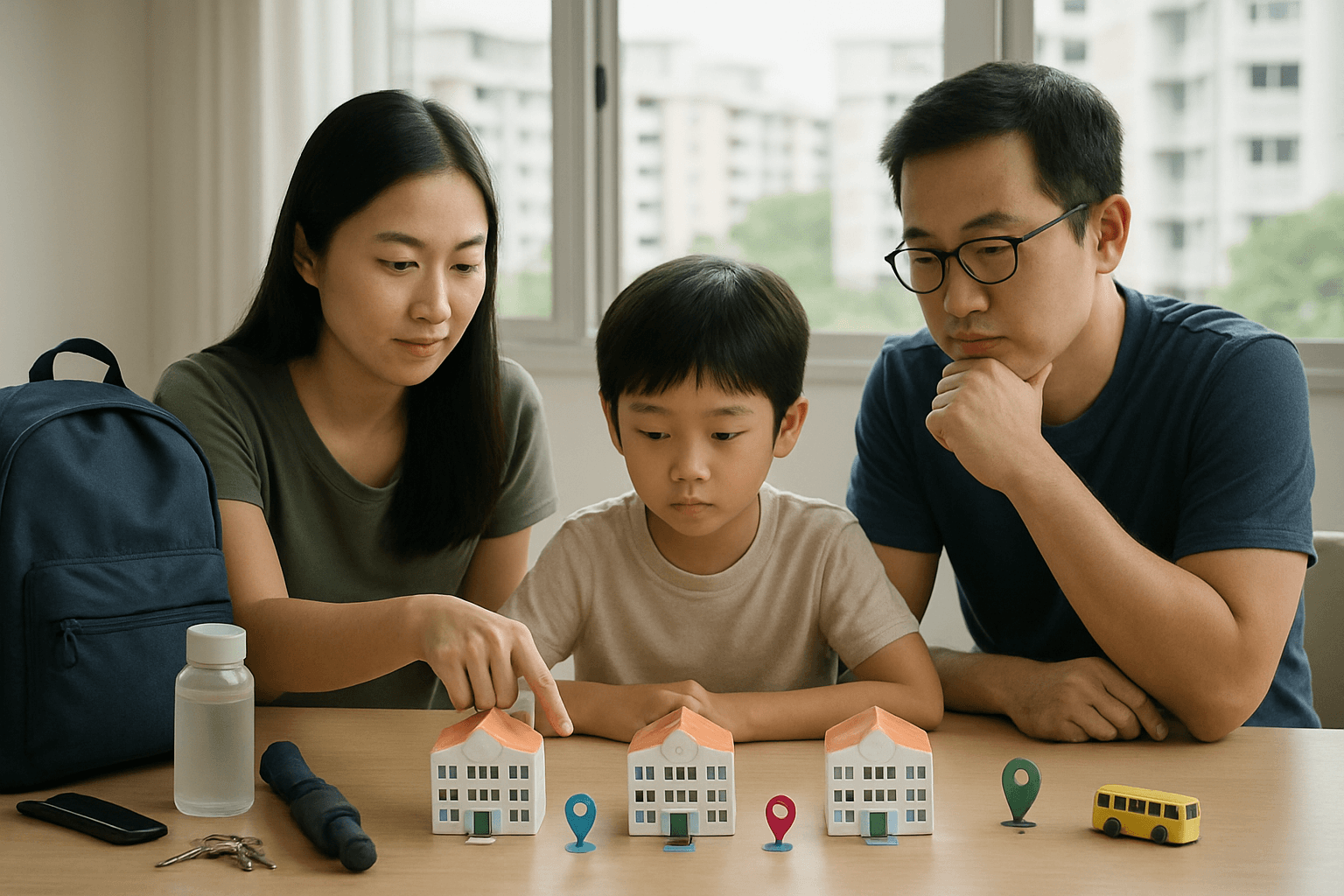
For most families, 2 to 4 schools total is enough for P1 registration. In practice, that usually means one first choice, one or two realistic backups, and one fallback you can genuinely manage if needed. There is no official MOE number you must hit. The goal is not to collect as many school names as possible. It is to build a shortlist that still works if your first choice does not. If you are still mapping the bigger process, start with our Primary 1 Registration in Singapore guide, then use this article to test whether your shortlist is actually usable.
How many backup schools should you shortlist for Primary 1 registration?
Most families should shortlist 2 to 4 schools total for P1 registration. Treat that as a planning rule of thumb, not an official requirement.
For most families, 2 to 4 schools total is a sensible working range. That usually means one first choice, one or two genuine backups, and, if needed, one fallback that is less ideal but still workable. There is no fixed official MOE rule saying parents must shortlist this number. It is simply a practical range that helps families plan without getting lost in too many options.
Too few schools can leave you exposed if your preferred option turns out to be more competitive than you expected. Too many schools can create a false sense of security, especially when some of those names are schools you would not actually want to accept. A useful shortlist is not a long list. It is a clear decision plan.
The simplest way to think about it is this: your shortlist should protect your family from a bad outcome, not just reflect your ideal outcome. A strong example is a family choosing one school they really want, one nearby school they would be comfortable with, and one more practical fallback that fits transport and student-care plans. A weak example is a family naming three aspirational schools and calling two of them backups when all three carry similar stress and uncertainty. For a broader overview, see Primary 1 Registration in Singapore: How It Works, Balloting Risk, and How to Choose a Realistic School Plan.
Share with us your kid's P1 registration experience
P1 registration experience… On the 1st day, went to the 1st choice school in the morning of 2/Aug to register… Actually I wanted to go on the last day to better gauge the chances as I was staying between 1-2km but the other half keep pestering me to go early… many parent still don’t understand the concept of balloting and priority and 3 days registration period… no sure why they always have the belief of 1st-come-1st-serve go later no place misconception even after much much explanation… No choi
Share with us your kid's P1 registration experience
:rotflmao: and some believed that once registration is accepted means place in school is confirmed.
What is a sensible shortlist size for most Singapore families?
For many families, 3 schools is the most comfortable middle ground. Most do not need more than 4.
A sensible shortlist is short enough to compare properly and broad enough to give you a real fallback. Two schools can be enough if both are genuinely workable and your first choice is not a high-risk gamble. Three schools is often the sweet spot because it gives you a preferred option, a strong backup, and a fallback that keeps weekday life manageable.
Four schools can make sense when your first choice is a popular school, when grandparents or student-care arrangements limit your options, or when both parents need more time to test travel and pickup tradeoffs. Beyond that, many parents stop making clearer decisions and start reacting to school names, hearsay, or reputation.
A practical test is this: if you cannot explain in one sentence why each school is on your list, the list is probably too long. Parents usually make better decisions when every school has a clear role. That is especially true when you are also weighing registration phases and how much weight to give distance priority. For a broader overview, see Primary 1 Registration: Should You Pick a Popular Dream School or a Safer Nearby School?.
[Punggol] Primary Schools
Published on Jun 19, 2015 Oasis of learning in Punggol, to fill young minds source http://mypaper.sg/top-stories/oasis-lea ... s-20150619 THREE new primary schools will open in Punggol next year to help meet the growing demand in the area. The schools - Oasis Primary in Edgefield Plains, Punggol Cove Primary in Sumang Walk and Waterway Primary in Punggol Drive - will be able to take in 210 pupils each . They are located near a number of housing projects. Waterway Primary, for instance, is locate
[Punggol] Primary Schools
Hi all kiasu mummy, I’m new here, I need some advise from all of you. My girl will be register her primary school end of July under phase 2C. Within 1km Compassvale primary school Edgefield primary school Punggol view primary school Punggol green primary school Rivervale primary school Which one would you recommend and why?very urgent !! Thanks
Have More Questions?
Get personalized guidance on schools, tuition, enrichment and education pathways with AskVaiser.
Try AskVaiser for Free →What makes a school a true backup, not just a second preference?
A true backup is a school you can genuinely live with, not just one that ranks below your first choice.
A true backup is a school your family can honestly accept in real life. It is not just a school that ranks below your first choice. Parents often confuse a second preference with a backup, but they are different. A second preference is still mostly about desire. A backup is about whether the school works if that becomes the final outcome.
A real backup usually passes three tests. The commute is manageable on ordinary weekdays, not just on a best-case day. The care plan works, whether that means parents, grandparents, transport, or student care. And the adults in the family agree that if this school becomes the outcome, they can move forward without feeling trapped or resentful.
For example, a school that sits on the route to a parent's workplace may be a stronger backup than a better-known school that needs two bus changes and a difficult pickup routine. A school grandparents can consistently help with may be a better fallback than a school with a stronger reputation but no workable caregiving plan. Popularity does not make a school a good backup. Workability does. For a broader overview, see Primary 1 Registration Distance Priority: How Home-School Distance Works.
Choosing Secondary school
I think you have to watch out for point 3 in the chart - 3. Pupils from primary schools which has an affiliation will take priority in posting to its affiliated secondary school if they have opted for that school as the first choice. If you have the \"privilege\", take advantage of it. Otherwise, consider its impact on the number of available vacanies left for \"non-affiliated\" students.
Top Primary school?
in my opinion, I do not believe in ranking primary schools as these are totally nonsense… Primary school is an early stage of education for young kids especially from P1-P3. We should not emphasis too much on academic results. By ranking schools, it put pressure to the principals to emphasis on results & thus favours better students than the average students. This will have negative effect on the average students… Education have to be fair to ALL students… this is just my opinion and i hope pare
How should you build your shortlist around distance and daily logistics?
Start with schools that fit your daily routine first, then narrow by preference and confidence.
Start with weekday reality, not school branding. P1 registration decisions affect the morning rush, heavy-rain pickup, enrichment timing, grandparents' availability, and how tired your child will be on normal school days. A school can look acceptable on paper and still be a poor backup if the travel and care plan are shaky.
A useful test is this: if your child were posted to this school tomorrow, could your family run the routine for a full year without constant strain? If the honest answer is no, it should not stay on the shortlist. This matters even more for parents who rely on grandparents, split pickup duties, or need student-care options nearby.
Distance can also shape admissions outcomes, so shortlist planning should connect daily life with registration strategy. If you are comparing schools near different addresses or trying to understand how location affects your options, it helps to read our guides on how home-school distance works and which home address counts. The practical takeaway is simple: a backup school should make family life more stable, not more fragile. For a broader overview, see How to Read Past Balloting Data Before Chasing a Popular Primary School.
All About Preparing For Primary One
Dear parents, I hope parents could share your experience regarding the preparation for primary school and time schedule spend with your kids everyday. I have a son of 6 this year going to P1 next year. I would like to find out with parents things that you are doing with your child prior going P1, cos I do not want to react too kan-jiong or too relax in front of my child. I am particularly concerned about the 3 main subjects being taught in P1 and wonder should I expect him to be able to do the a
All About Preparing For Primary One
First of all, how far are u from the school? Within 1km or 1 - 2km? If near, don't take school bus, send yourself. Any balloting history for the neighbourhood school under 2C?
How should your shortlist change if you are targeting a popular school?
If the first choice is popular, make the backups more realistic, not equally risky.
If your first choice is a popular school, your backups should become more realistic, not more aspirational. One common mistake is building a shortlist of three schools with similar demand risk and calling two of them backups. That is not a backup strategy. It is three versions of the same gamble.
A stronger approach is to keep the dream school if it matters to you, then pair it with at least one school that is more manageable in both demand and daily routine. For many families, the healthiest shortlist looks like this in principle: one school you are excited about, one school you feel calm about, and one school you know you can handle.
Older community snapshots such as KiasuParents' 2021 Phase 1 results and 2019 Phase 2A1 analysis can be useful for one reason: they remind parents that demand can be tight and can shift from year to year. They should not be read as a forecast for your registration year. Use them only as context, then compare that with your own tradeoffs using our guides on dream school versus safer nearby school and how to read past balloting data.
All About Preparing For Primary One
My son is going primary 1 next year and I am eligible for phase 2b under a good school but it took two hours of time of bus transport to n fro from home. The kid have to be at the bus stop at 6am waiting for bus. That school have proven track record for the past many years because of it’s strict standards. Now, my headache is there Is a relatively new school which is only a few years old n has not proven track records n the highest psle scores is 230plus. This school is just downstairs my home b
All About Preparing For Primary One
hi Celyw, your child is more than ready for P1 at least, he should be fine. a) Speech & drama whether English or Chinese Speech & drama - can help your child in P1 Show & Tell. Nowadays a high percentage of marks are allocated for P1 Show & Tell. i) for K2, some Montessori kindergarten set tests for K2 kids close to K2 Term 4, to assess readiness. Some minor non Montessori kindergarten also do this. However, most or majority of non Montessori kindergarten, church kindergarten do not set tests fo
What is a practical way to rank your options before P1 registration starts?
Rank each school by commute, family fit, realism, and your willingness to accept it if needed.
Use the same four checks for every school you are considering: weekday travel, pickup and care plan, how realistic the school feels for your situation, and whether your family would accept the outcome without ongoing regret. Writing down the answers side by side is more useful than relying on school reputation or friends' opinions.
Then give each school a clear role: first choice, strong backup, or workable fallback. That framing keeps the shortlist honest. A school cannot really be called a backup if the family is quietly hoping never to deal with it. If you already know you would reject it emotionally or logistically, remove it now rather than later.
School visits and open houses can help here because fit becomes clearer when you picture your child there every day. While they are written for secondary school selection, Schoolbag's pieces on what to look out for when comparing schools and how visiting schools helped one parent decide capture a habit that is just as useful for P1: seeing the environment often tells you more than a school name does.
Does school conduct test before allow the kid to reg Pri 1?
I have not heard of Primary schools giving entrance exams as part of the initial Primary One Registration process. I don't think that will come down well at all, as it implies that parents will be FORCING their pre-schoolers to take up all sorts of academic courses just to ace the entrance tests. However, if you want to transfer your child to another school after Primary One, the new school may require your child's exam results and even conduct assessment tests.
All About Preparing For Primary One
located in the west ... a) littleinkpot has P1 prep class:- http://www.littleinkpot.com/primary-1-preparatory-class.html sounds interesting:- http://www.littleinkpot.com/uploads/6/6/0/6/6606333/primary_1_prep_class-may_2011.pdf b) Frontier community centre. receive pretty, good feedback from many parents whose kids attend this P1 Prep class (both English, Maths). A lot of kids staying in the West go for this. limited vacancies left (call up Frontier cc fast) i)\t P1 Prep English:- $125 per Term
What should families do if every school on the shortlist feels uncertain?
If nothing feels safe, widen the search a little or rethink your non-negotiables instead of forcing a weak list.
If every option feels shaky, the problem is usually not that you need more school names. It is that the shortlist is too narrow, too aspirational, or too disconnected from family logistics. In that situation, widen the search slightly or rethink which factor you are treating as non-negotiable.
Some parents keep every school within a very tight prestige zone and then feel trapped when all of them look risky. Others refuse to consider a school that is actually the easiest for commuting and care because it was never part of their original picture of a good outcome. When this happens, step back and ask which tradeoff hurts less: a school that feels less exciting, or a daily routine that becomes exhausting.
Your goal is not a perfect shortlist. It is a shortlist with at least one outcome your family can live with calmly. If you are worried about what happens when the preferred option does not work out, our guide on what happens if your P1 registration is unsuccessful can help you plan the next step more clearly.
All About Preparing For Primary One
You should have seen the way the mum drilled the poor child, depriving him of food till he completed his revision. Obviously, an uninterested child will only retain the information into his short term memory. Preparing a child for primary 1 is more than just the academics. There are several areas that parents have to take note of. Does your child know how to clean up after himself if he does a big business in the toilet? Does your child know how to wash his hands correctly and rinsed his hands p
All About Preparing For Primary One
Starting primary school? This is a big milestone. Do enjoy the journey with your child! :rahrah: https://www.straitstimes.com/singapore/education/the-st-guide-to-preparing-your-child-for-primary-1 Parents often confuse being ready for school with being academically capable in skills like reading and counting. Instead of focusing solely on academic progress, it is more important to make learning an enjoyable process, and help your child have a swift and happier adjustment to primary school. Here
What do parents often overlook when choosing backup schools?
Parents often focus on reputation and underestimate commute stress, pickup plans, and whether the fallback is truly acceptable.
Many parents compare school reputation carefully but do not stress-test the weekday routine. The blind spots are usually ordinary ones: who handles pickup on rain days, whether grandparents can help consistently rather than occasionally, whether a sibling schedule makes the route unrealistic, and whether the adults would still feel okay if the backup became the final outcome. A good line to remember is this: a backup school should solve stress, not create a new kind of it.
All About Preparing For Primary One
hi, wonder sending my child to pcf kindergarten is enough to prep for pri one. can anyone advise? :?
All About Preparing For Primary One
What you and your child achieve out of such programs really depends on what is the focus of the program. What are you looking for in a short course? - Exposure to Primary school like worksheets (MCQ)? - Gain certain knowledge/skills? - Asses if your child needs extra help/coaching before Primary 1? For the classes I conduct, it's more of exposure to school worksheets (understanding how does MCQ work) and identifying their weak areas so that parents can work on them before they officially start P
Should I add more backup schools just in case?
Usually no. Add another school only if it gives you a genuinely usable fallback, not just one more name on the list.
Usually no. Adding more names does not automatically strengthen your plan if the extra schools are just as unrealistic, equally competitive, or hard for your family to manage. In many cases, a longer list simply creates more anxiety and weaker comparisons.
A better response is to improve the quality of the shortlist. If you are worried about a popular first choice, replace one weak option with a school that is closer, more manageable, or easier for your family to accept. For example, swapping a far-away prestige school for a nearby school with a workable pickup plan often improves your shortlist more than adding a fourth or fifth uncertain option.
A simple rule helps here: add a school only if it gives your family a genuinely different and usable fallback. If it is just another name with the same problems, it is not adding safety.
Top Primary school?
for me, there is only one school within 1km from my place...it is a good one, but...i don't have any girls. i will need to ballot for a place for one sch within 1-2km from my place (next nearest school). if *touch wood*, balloting is unsuccessful, i will go for the next nearest neighbourhood school. for this, i am wary that this school focus its resources on the 'diamond' class and streaming starts as early as end of P1! getting him into such class will be my next best bet. so neighbourhood scho
All About Preparing For Primary One
Sorry, I'm a bit blur. :oops: Why do we need to \"prepare\" our child for P1? I always thought that those preschool enrichment classes ie ICR, MPM, Berries, are sufficient because surely we don't expect our children to know all the P1 syllabus on their first day in school? :yikes:
Have More Questions?
Get personalized guidance on schools, tuition, enrichment and education pathways with AskVaiser.
Try AskVaiser for Free →