
Primary School Travel Time Singapore: How to Compare Commute vs Reputation for Primary 1
A practical guide for parents deciding whether a better-known school is worth a longer daily commute in Primary 1.
There is no official MOE maximum travel time for Primary 1 in Singapore. For most families, the better choice is the school with the shorter, simpler, and more reliable door-to-classroom journey unless the farther school offers a clear advantage that genuinely matters and your family can support every day. Compare the real routine, not the school name alone: wake-up time, route complexity, school bus fit, pickup support, and whether the plan still works on rainy or overtime days.
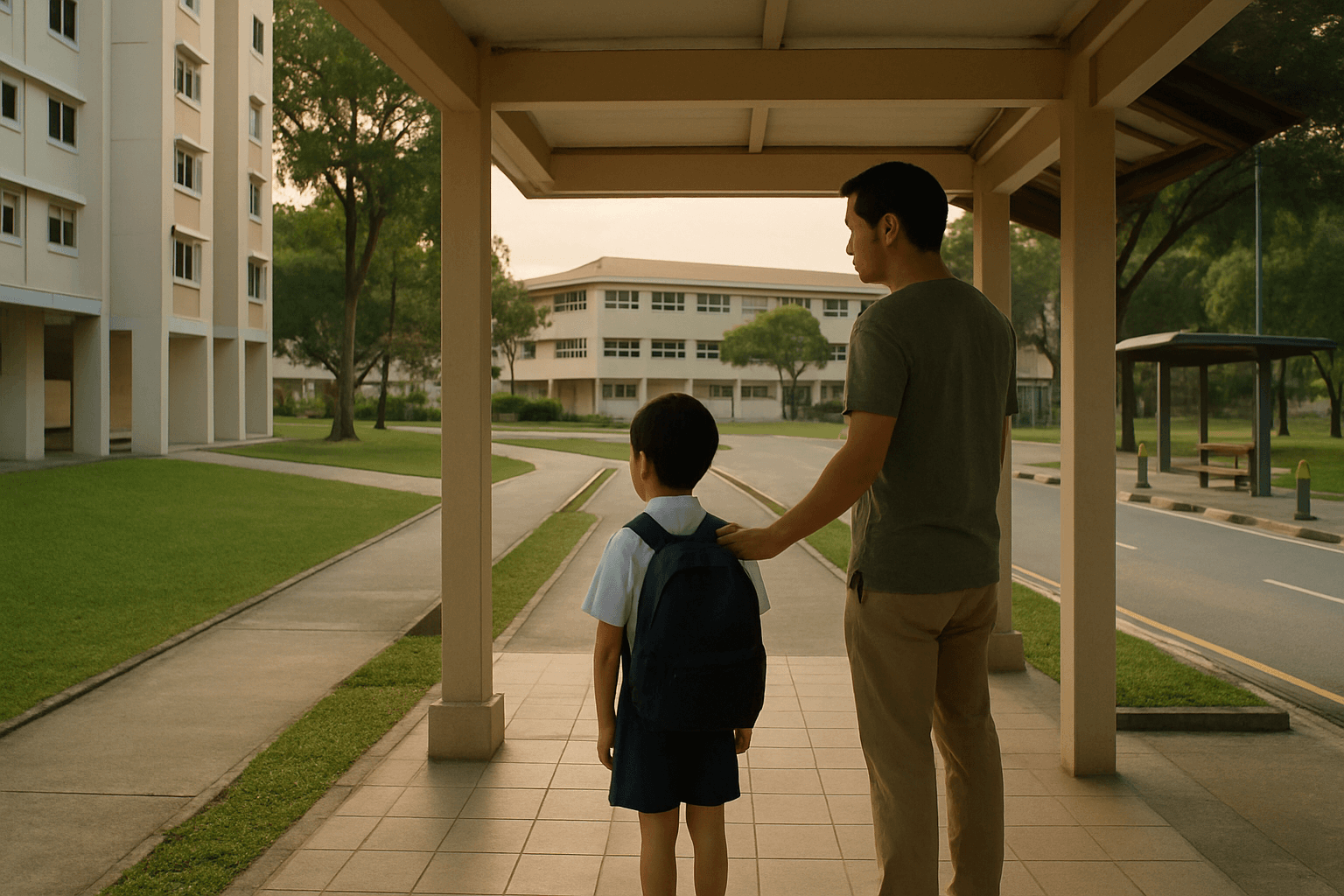
When parents compare primary schools, reputation often gets the most attention. But for a six- or seven-year-old, a better question is what the school choice will feel like on an ordinary weekday morning and afternoon.
There is no official MOE rule that says a Primary 1 commute must stay under a certain number of minutes. In practice, the better test is whether the route is short enough, simple enough, and reliable enough for your child and family to repeat calmly over the full primary school journey.
What should parents really compare: school reputation or daily routine?
Treat the decision as a six-year weekday routine, not just a school-status choice. The better school is the one your child and family can sustain calmly.
The real question is not “Which school sounds better?” It is “Which school can our family run smoothly every weekday for six years?” Once a child starts Primary 1, the school choice becomes a daily system: wake-up time, breakfast pace, transport handover, pickup planning, after-school care, and how tired your child is by evening.
That is why a more well-known school is not automatically the better choice. A school with stronger word-of-mouth may still create rushed mornings, a very early school bus pickup, or pickup arrangements that depend on several adults. A nearby school that is less talked about may give your child more sleep, calmer mornings, and an easier adjustment to formal schooling.
A useful way to think about it is this: choose the school your family can live with, not just admire from afar. If you are still comparing broader tradeoffs, our guides on Primary 1 Registration in Singapore and popular primary school vs neighbourhood school can help you frame the decision more realistically.
[Geylang] Primary Schools
For primary schools, I recommend going for convenience than popularity. Reason is the kids are still young, and travelling time should not be long enough to tire them out, even for those driving. Have you seen children dozing off in the parents car (some in an awkward position, especially straining their necks) because they have to wait up earlier than their peers to reach these “better” schools to feed their parents “ego”. Please note that the above is just my PERSONAL view as I have gone throu
[Pasir Ris] Primary Schools
So for parents still thinking which primary school to choose in Pasir Ris, the facts are all here. The same old arguement remain: Small fish in big pond or big fish in small pond But always remember, all primary schools are good school in Pasir Ris as long as it is convenient for you and your little one loves them. More and more neighbourhood schools are producing good results. No point making the kids travel long distance just to go to a branded school.
What does MOE actually say about home-school distance and travel time?
MOE treats distance as a convenience factor in admissions, but it does not publish a fixed official maximum travel time for Primary 1.
MOE treats home-school distance as a family convenience factor in Primary 1 registration, not just a preference. In MOE's FAQ, the Home-School Distance category is described as being for the interest and convenience of the family and the child, and families admitted under that category are expected to live at that address for the child’s primary school years. The same source does not give a fixed maximum travel-time rule for Primary 1.
MOE also notes that school bus arrangements are handled through the school and bus operator, so parents should confirm route practicality before assuming transport will be easy. If your family may move, read how home-school distance works together with whether to use your old or new address before finalising your shortlist.
[Toa Payoh] Primary Schools
MommyK, From MOE website http://www.moe.gov.sg/education/admissi ... llocation/ \"Home-School Distance Category Parents may check the home-school distance category from the OneMap SchoolQuery Service managed by the Singapore Land Authority (SLA). Alternatively, they may check with the schools directly on the distance between their home and the schools in June.\"
[Ang Mo Kio] Primary Schools
My girl will be enrolling in a primary school next year too. I feel where you stay will play a big part in deciding on which pri school your child will study at eventually. Why do we need to compare which primary schools your child will study in ? I think this create an unhealthy system in which most parents will strive to get their child into these perceived good schools. ( If they score well in those schools, it is expected of them but if they do not, these children will enter different second
Have More Questions?
Get personalized guidance on schools, tuition, enrichment and education pathways with AskVaiser.
Try AskVaiser for Free →How much travel time is practical for a Primary 1 child in Singapore?
Do not judge by minutes alone. A shorter, simpler, and more predictable route is usually more practical than one with transfers, long waits, or daily uncertainty.
There is no single minute count that works for every child. What matters more is the full route from home to classroom. A shorter, more direct route is usually easier to sustain than a commute with waiting, transfers, congestion, or daily rushing.
For example, a twenty-minute walk through the estate or one direct school bus ride may be very manageable because the routine is simple and predictable. By contrast, a similar total time made up of a bus ride, an MRT transfer, and a final walk in wet weather can feel much heavier for a young child. The same is true for car travel: a route that looks short on a map may still be stressful if morning traffic, drop-off queues, or parking pressure make the timing unreliable.
A useful test is this: stop asking only “How many minutes?” and start asking “How many moving parts?” Think in door-to-classroom time, not map distance alone. If possible, test both routes during the actual morning peak and imagine doing them on rainy days, late-start days, and days when your child is moving slowly. For a broader overview, see Primary 1 Registration After Moving House: Should You Use Your Old or New Address?.
[Pasir Ris] Primary Schools
Hi, I'm in the same dilemma as you. Do you think it is possible to have a school visit?
[Bukit Timah] Primary Schools
For those interested in Bukit Timah Primary, do feel free to drop by its thread to find out more info. You can also drop me a PM to find out more about the school, if you would like to. In terms of school hours, school starts at 7.25am (most children are in school by 7.20am) and ends at different times depending on which days (some days are shorter, e.g. Fri). Tue and Thu are CCA days (2-4pm); Mon is Supplementary Class Day but only for P4-6. P1 and P2 do not stay back for CCAs or extra lessons,
What does a long commute actually cost a family every day?
A long commute usually costs sleep, buffer time, and parent coordination. The real burden comes from small daily frictions that repeat every week.
The cost is usually not just transport fare or fuel. It is the strain added to the whole day. A longer commute often means an earlier alarm, less morning buffer, more risk of lateness when it rains, and more dependence on grandparents, helpers, or backup transport when the original plan breaks.
This is why long school journeys often feel heavier than they look on paper. One extra transfer means one more point where things can go wrong. A very early school bus pickup may reduce parent driving but still cut into the child’s sleep. A farther school can also make after-school life harder if student care ends at a fixed time or pickup has to be squeezed around office hours.
A simple insight helps here: a long commute is not one problem; it is a chain of small frictions repeated five days a week. Parents often underestimate that repetition. What seems acceptable when choosing a school can feel very different by the third month of Primary 1. For a broader overview, see Primary 1 Registration: Should You Pick a Popular Dream School or a Safer Nearby School?.
[Bukit Timah] Primary Schools
Since all parents from all over SGP are willing to send their kids to the school, MOE should move the school to a more centrally location and build a SUPER CAMPUS, likes ITE Simei and ITE Choa Chu Kang, to accomodate the kids, so everybody will be happy......Just look at our Raffles family in Bishan.....
Preschools prepared your kids well for Singapore primary?
For parents who have already been through the pre-school days and with kids now in primary schools (Singapore schools), can you share your comments on your kid's previous preschool and their curriculum - specifically if they have prepared your child properly for the Singapore education system ? (not discussing the international or foreign schools system here) Nowadays, there are so many pre-schools and childcare centres with many learning methods. Parents currently at the pre-school stage will b
When does school reputation matter more than distance?
Give reputation more weight only when the school’s strengths are meaningful to your family and the commute is still stable enough to support daily life.
A farther school can be worth it when the school offers a real advantage that your family genuinely values and can actually use. That advantage might be the school culture, a teaching style you strongly prefer, a programme that fits your child well, or a family connection that makes the school feel like a real fit. The key is that the benefit should be specific. “It is famous” on its own is usually not enough.
The tradeoff also makes more sense when the transport plan is solid. For example, the farther school may have a direct school bus route that works for your block, a grandparent may live nearby and handle pickup comfortably, or an older sibling may already be in the school so the routine is already built around that location.
A good test is whether the reputation translates into something your child will actually experience while the family still functions well. If your child stays rested, the route is predictable, and neither parent needs to keep stretching work arrangements just to make the school choice work, the extra distance may be reasonable. If you are weighing a dream school against a safer option, see Should You Pick a Popular Dream School or a Safer Nearby School? and How to Read Past Balloting Data Before Chasing a Popular Primary School. For a broader overview, see Popular Primary School vs Neighbourhood School in Singapore: Which Is Better for Your Child?.
Top Primary school?
To be fair, I think people should not tag “good” or “bad” to a school. I don’t think there is really a “bad” school in Singapore. To me, the most important thing is the teacher your child gets. You can have very lousy teachers in the popular “good” schools as well. Or you can have very good teachers in the normal neighbourhood schools. Academic excellence is not the only thing to look for in primary school education, what about character building ? team work ? All these should be equally importa
Top Primary school?
Honestly I am not sure if there is such a thing as a top primary school based on the efforts of the school. All schools have the same mission set by MOE to deliver the same thing. If you hear from them, even teachers they have no control, it's all from MOE. So what then would you consider as top primary school? It definitely cannot be results alone because results are typically parents-driven in today's context in some schools. Every school has the best cream of the crop and the worst performers
When should convenience win over reputation?
Convenience should win when the commute is likely to reduce sleep, increase stress, or depend on fragile transport and caregiving arrangements.
Convenience should usually win when the daily logistics are likely to affect sleep, punctuality, or your family’s ability to run the week without constant patchwork. This matters especially in Primary 1, when children are still learning new routines and cannot handle complicated transport arrangements as easily.
A nearby school often becomes the stronger choice when both parents start work early, when there is no car and the farther school needs multiple transfers, or when pickup depends on several caregivers taking turns. In those situations, the shorter route does more than save time. It protects consistency. It also makes it easier for a grandparent, helper, or student care arrangement to step in when one part of the plan fails.
Parents sometimes worry that choosing convenience means settling. In real life, many families find the opposite. A calmer commute can improve punctuality, reduce morning conflict, and leave the child with more energy for actual school life. The school name matters, but the daily experience matters more than many parents first assume.
[Bedok] Primary Schools
Distance is really 1 of the most important factor. My kids school is 2 bus stops away and within 1km so they can choose to walk or take bus. Since P2 they can go to school and come home on their own. Just need to go bus stop to fetch them. So convenience and save some $$ as no need school bus which is so exp. Plus even if you engage sch bus, got CCA or anything also must arrange own transport so sch bus is waste of money and not worth.. let alone the fact that you need to pay $$ for > 2 months o
[Bedok] Primary Schools
Do consider carefully on the distance to the school and the logistics. Just to share my experience. I am staying in the east and enrolled my dd when she was younger in St Anthony's Canossian Primary though I had priority in a branded school in the west. Never regretted it, the convenience of being near the school especially during her later years when there were cca, extra afterschool lessons and activities, I could ask my maid to assist bringing her back from school. The time saved on distance
How does commute affect a young child's energy and adjustment?
A tiring or stressful commute can make Primary 1 adjustment harder because it affects mood, rest, and readiness before the child even reaches class.
For a Primary 1 child, the commute is part of the school day. It affects how the day begins and how much energy is left by the time lessons start. A child who is already adjusting to new teachers, classmates, and routines may find a stressful journey harder than parents expect.
The signs are usually practical rather than dramatic. Your child may resist getting ready, move unusually slowly in the morning, look tired before school even begins, or come home too drained to enjoy the evening. Some children cope well in class but become irritable after school because the whole day, including the journey, is simply too heavy.
Do not overread one bad morning. Look for a pattern across ordinary school days. If one school setup clearly gives your child calmer starts and better energy by the end of the day, that is a real advantage even if the school is less prestigious. For Primary 1, travel time is not separate from learning readiness.
All About Preparing For Primary One
Starting primary school? This is a big milestone. Do enjoy the journey with your child! :rahrah: https://www.straitstimes.com/singapore/education/the-st-guide-to-preparing-your-child-for-primary-1 Parents often confuse being ready for school with being academically capable in skills like reading and counting. Instead of focusing solely on academic progress, it is more important to make learning an enjoyable process, and help your child have a swift and happier adjustment to primary school. Here
All About Preparing For Primary One
Was surfing around on understanding if I am well prepared on behalf of my DD1 for Primary 1 Chanced upon a few websites, thought to share though it could have been mentioned before Tips For Parents ◦Work on independent reading skills. ◦Set up a study area and regular study times that are not interrupted. ◦Learn to follow a routine with a lot of sleep and early mornings. ◦Practice organisation and planning by packing a daily bag with essentials for the day. ◦Talk about social skills and communica
What transport setups are most common for Singapore primary school families?
The common setups are walking, school bus, public transport, and car drop-off. Judge each one by reliability, simplicity, and parent effort, not convenience alone.
Many families use one of four common setups: walking, school bus, public transport, or car drop-off. These are practical real-world examples, not official categories, but they help because each one creates a different kind of daily effort.
Walking is usually the simplest option when the school is genuinely close and the route is safe and comfortable. It removes transfers and reduces waiting time. School bus arrangements can reduce parent driving, but they work well only if the pickup point, pickup time, and route are suitable for your family. As MOE notes in its FAQ, schools may refer parents to the bus operator, so it is worth confirming the actual arrangement rather than assuming the bus solves everything.
Public transport can work if the route is direct and the child is accompanied or otherwise supported appropriately, but MRT and bus combinations may feel tiring when the journey includes crowding, weather exposure, or multiple handovers. Car drop-off gives flexibility, especially for families with younger siblings or changing work schedules, but it can also become the most parent-dependent option if traffic and school-gate queues are heavy.
The best transport mode is usually the one with the fewest daily surprises, not the one that sounds most convenient in theory.
[Punggol] Primary Schools
Hi, I am considering between Punggol View and Changkat (Simei) for my daughter P1 in 2014. Appreciate your opinions. Punggol View - brand new school - not sure how the sch is in term of establishment, culture etc - convenience as it near to my place, I can send her in the morning - problem is who to fetch her - new building and up-to-date facilities Changkat (Simei) - my former school - near my parents’ place - slightly inconvenience > I have to drive & send her to school every morning, not sure
[Bukit Timah] Primary Schools
should be the same across all schs Registration at Primary School Registration is conducted at the primary school that you wish your child to be admitted into. The hours of registration are from 8.00 am to 11.00 am and from 2.30 pm to 4.30 pm on each scheduled registration day. Parents or a person authorized by the parents in writing (letter of authorization (72kb .pdf)) is to submit the registration form and required documents at the school of choice. From the 2012 P1 Registration Exercise onwa
How should working parents compare school choices differently?
Working parents should compare schools against real work hours and backup care, because the best-known school can become the hardest one to sustain.
Working parents usually need to compare schools against actual weekday constraints, not ideal plans. A school can look attractive until you map who handles morning prep, drop-off, pickup, and backup when someone is sick, delayed at work, or stuck in rain traffic.
This is where a farther school often becomes more expensive in time than parents first expect. One parent may be able to do the morning trip, but only by leaving home earlier than is sustainable. A grandparent may be willing to help with pickup, but only if the school is nearby. A student care arrangement may look workable on paper, yet the route home after care may still be difficult if the school sits far from your support network.
A practical mistake is testing only the best-case routine. Test the plan against the hard days instead: overtime, back-to-back meetings, a helper on leave, a rainy morning, or a sibling with a different dismissal time. If the school works only when everything goes right, it is probably not as workable as it looks. For broader admissions planning, start with Primary 1 Registration in Singapore so the transport question sits inside a realistic school strategy.
[Bukit Timah] Primary Schools
seriously? :shock: okay... do you happen to know the schooling hours for their p1 too?
[Pasir Ris] Primary Schools
Just curious why you're considering these two schools as they are pretty far from each other. Opposite ends of Pasir Ris to be exact.
What is a simple way to decide between two schools?
Use a side-by-side comparison that weighs daily sustainability against the school’s real strengths, not just its reputation.
- ✓Compare the full door-to-classroom journey for both schools, not just the map distance.
- ✓Check whether each route is direct or depends on transfers, waiting time, traffic luck, or several handovers.
- ✓Write down the actual wake-up time your child would need for each option and ask whether that still feels reasonable over six years.
- ✓Confirm who handles morning drop-off, after-school pickup, and backup on rainy days, sick days, and overtime days.
- ✓If you are counting on a school bus, verify the real pickup point and timing before treating it as a solution.
- ✓Name the specific strength of the farther school and ask whether it is a real fit for your child or mainly a reputation signal.
- ✓Test the plan without your best-case assumptions, especially if grandparents, a helper, or student care are part of the routine.
- ✓Ask the final question that often makes the answer clearer: if both schools were acceptable academically, which one would be easier for our family to live with every weekday?
Have More Questions?
Get personalized guidance on schools, tuition, enrichment and education pathways with AskVaiser.
Try AskVaiser for Free →