
How to Read Past P1 Balloting Data by Distance Band in Singapore
Use past distance-band results as a risk signal for your address, not as a promise of admission.
Past P1 balloting data by distance band shows where applications exceeded vacancies in earlier years, grouped by home-to-school distance. The useful parent reading is simple: which phase was crowded, how near to the school the pressure reached, and whether the same pattern has shown up more than once. The safest way to use the data is to compare several years, match it to your own address and likely phase, and treat it as a competition signal rather than a guaranteed admission threshold.
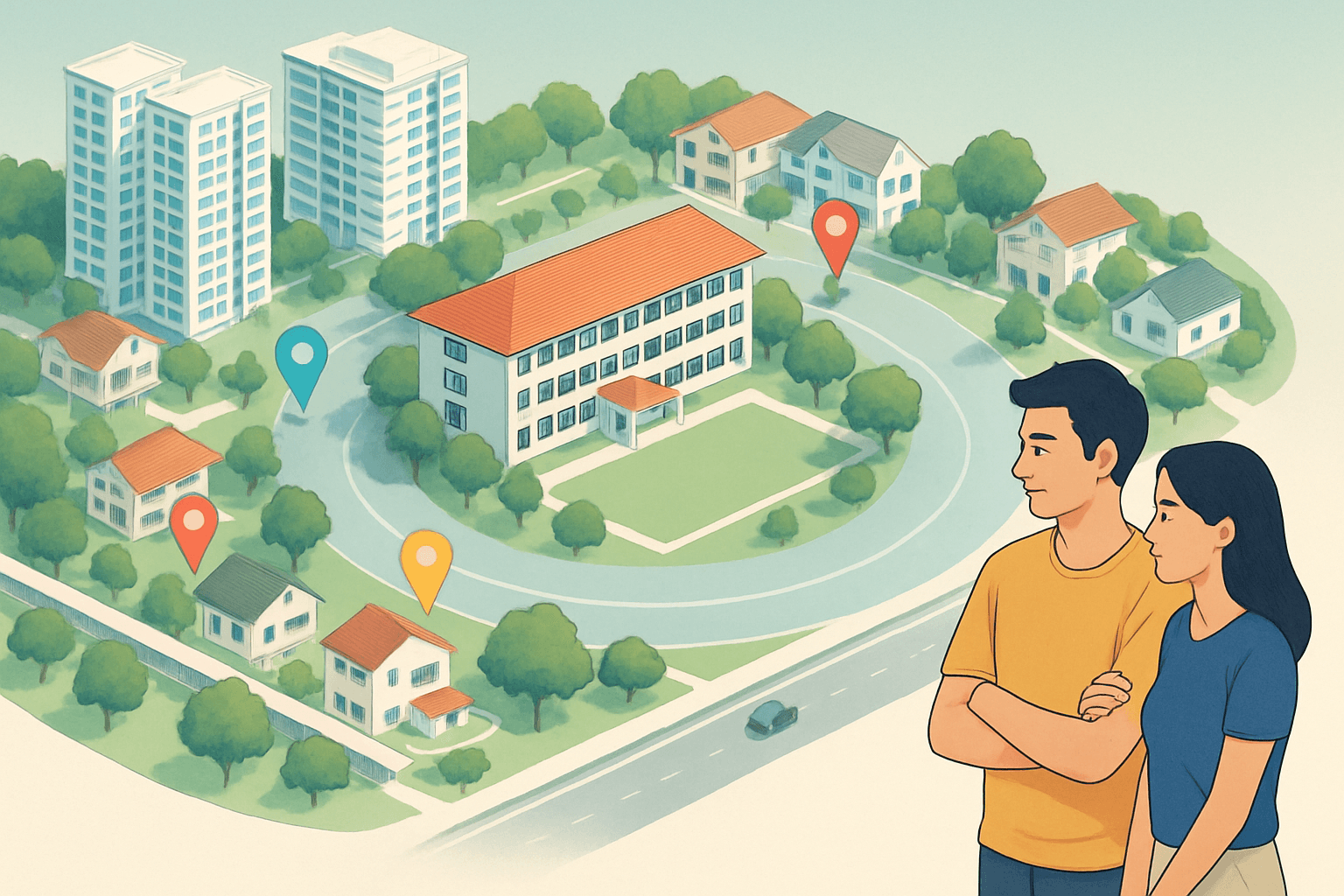
To read past P1 balloting data by distance, first check the year and registration phase, then see which distance band was balloted and whether that pattern repeated across several years. The data is most useful when you use it to judge risk for your own address and shortlist, not when you treat one historical band as this year's answer.
What does past P1 balloting data by distance band actually tell you?
It shows where past P1 demand exceeded vacancies, grouped by distance from home to school. Use it to see how crowded a school was for families in your distance range, not as a guaranteed cutoff.
It tells you where a school had more applicants than places in a past Primary 1 registration exercise, grouped by home-to-school distance. In plain English, it shows where the pressure was.
If a school balloted within a certain distance band, that means not everyone in that band could be admitted automatically in that phase that year. If there was no balloting, demand may have been easier to absorb in that phase. The practical takeaway is not "my child can get in" or "my child cannot get in." It is "this school was more or less competitive for families like mine."
The most useful mindset is this: balloting data shows historical crowding, not a permanent entry line. Think of it as a traffic report, not a reservation. For a broader overview, see Primary 1 Registration in Singapore: How It Works, Balloting Risk, and How to Choose a Realistic School Plan.
All About Primary Schools' Balloting History
Hi!can anyone enlighten me on hw the P1 balloting works?e.g i’m in P2C n available vancanies are 50 does that mean the total of applicants who lives < 1km is less than 50 do not need to be balloted?? tks KO NAh
All About Primary Schools' Balloting History
Yes, we are aware. A quick eyeball shows that if balloting is <1km, then it is most likely that all players involved are <1km, like we have all along suspected. Good luck for this year's P1 registration!
Where should parents get P1 balloting data and distance-band results?
Use MOE sources first for current-year vacancies and balloting updates, then use reliable historical summaries for comparison. If the source of a chart is unclear, do not treat it as decision-grade data.
Start with official MOE sources. MOE's Primary 1 registration FAQ points parents to the official vacancies and balloting updates during the exercise, and MOE's registration guidance helps you understand how the process works in the first place.
For past-year comparisons, parents often use historical summaries from community sites such as KiasuParents' Phase 2B analysis or broader demand discussions like Are top schools inaccessible to Phase 2C applicants?. These can be helpful for pattern spotting because they put results side by side, but they are still secondary references.
A simple rule saves time: if you cannot trace a chart or table back to official registration results, treat it as background reading only. Group-chat screenshots are often incomplete, cropped, or from the wrong year. For a broader overview, see Primary 1 Registration Distance Priority: How Home-School Distance Works.
All About Primary Schools' Balloting History
the historys are all here http://www.kiasuparents.com/kiasu/content/singapore-primary-1-registration-school-balloting-history
All About Primary Schools' Balloting History
You should first read http://www.kiasuparents.com/kiasu/forum/viewtopic.php?t=3311 for a clear overpicture of the P1 registration. For stats, http://www.kiasuparents.com/kiasu/content/singapore-primary-1-registration-school-balloting-history it is - click on your preferred area.
Have More Questions?
Get personalized guidance on schools, tuition, enrichment and education pathways with AskVaiser.
Try AskVaiser for Free →How do you read a school's distance-band balloting record step by step?
Check the year and phase, see whether balloting happened, note which distance band was affected, and compare that with your address across more than one year. Repeated pressure matters more than one standout result.
Begin with the right year and the right phase. A school can look calm in one phase and much tighter in another, so the first question is not just whether balloting happened, but when it happened.
Next, note which distance band was balloted and compare that with your own address. If your home falls into a band that has repeatedly been balloted, that is a stronger warning sign than a school that only showed pressure once, or only in a farther band. If your band usually still had places left, that suggests a lower-risk option, though not a risk-free one.
Then compare across several years instead of stopping at one dramatic result. A school that balloted once three years ago and then stayed calm is a different case from a school that keeps showing pressure in similar distance ranges. The first may have had a one-off spike. The second may simply be consistently hard to enter.
A realistic way to read the same table differently is this. School A balloted only once, and only in a farther band. That usually suggests that nearby homes were under less pressure. School B balloted more than once in nearer bands. That is a much stronger sign that even families living close to the school faced competition. School C swings around with no stable pattern. In that case, the key lesson is volatility, which means you should keep a more workable backup.
If your address seems close to a distance boundary, treat that as planning risk, not a technicality you can ignore. Do not build your whole shortlist around the more favourable band unless you are confident your address truly falls there. For broader context, it helps to read this alongside our main Primary 1 registration guide and our explainer on how home-school distance priority works. For a broader overview, see Primary 1 Registration Phases in Singapore: What Each Phase Means for Your Chances.
All About Primary Schools' Balloting History
Hi, I’m keen to find out the balloting history in 2011. The school of my choice definitely has balloting in Phase 2B last year looking at the respective chart. Just needed to know whether the balloting occured for those living within 1km, 1-2 km or more than 2 km. Please advise where I can find that. Thanks
All About Primary Schools' Balloting History
Have you check out this http://www.kiasuparents.com/kiasu/content/singapore-primary-1-registration-school-balloting-history ?
What does it mean when balloting happens in shorter-distance bands versus longer-distance bands?
Shorter-distance balloting usually signals stronger nearby demand, while longer-distance balloting suggests the pressure reached further out. It shows where competition was concentrated that year, not a fixed future boundary.
Balloting in a shorter-distance band usually means competition was strong even among families living nearer to the school. In practical terms, proximity did not make admission straightforward that year.
If balloting happened only in a longer-distance band, the school may still have been popular, but the pressure may have started further out. That usually suggests nearby homes had a better position in that year than families living farther away, though it still does not mean nearby admission was guaranteed.
The key idea is easy to remember: nearer bands tell you where the squeeze started, not where it will always end. Parents often overread a historical band as if it were a fixed line that will repeat. It is more useful to read it as a clue about where demand concentrated in that exercise.
This is why two schools with similar reputations can be very different choices for the same family. If one school repeatedly shows pressure close to the school while another only occasionally shows pressure further out, the first is usually the riskier bet for a nearby family, even if both are seen as popular. For a broader overview, see Primary 1 Registration: Should You Pick a Popular Dream School or a Safer Nearby School?.
All About Primary Schools' Balloting History
As said all along, not all schools will call up applicants greater than balloting distance. It largely depends on whether the school has the manpower and ability to do so (p/s: people should stop imaging that someone will alert them if there's balloting... hello, you are on your own). Also, do note that there's a \"cut off time\" for schools that do call to do so. If the staff login at 12pm and call up those presently in the system, those who register after 12pm would not have received any call.
All About Primary Schools' Balloting History
is there any link i can see the balloting history (breakdown by 1km, 1-2km, >2km)for P2B for Novena area?
How much weight should you give to one year of P1 balloting data?
Very little by itself. One year can mislead, so treat it as a clue and look across several recent years for a steadier signal.
Not much on its own. One year is a clue, not a conclusion.
A single year's result can look unusually crowded or unusually calm for reasons that do not repeat neatly. Demand can shift because of cohort size, a temporary popularity spike, new housing nearby, or changes in who applies in a given phase. That is why one difficult year should not automatically knock a school off your list, and one easy year should not make you overly relaxed.
Several recent years together are more useful because they show whether the pattern looks repeatable. If a school has come under similar pressure more than once, especially in the same phase or similar distance range, that is much more decision-useful than one isolated result. If the school swings sharply from year to year, the more important lesson may be unpredictability rather than accessibility.
Think of one year as a snapshot and several years as a trend. Parents who only read the latest result often end up reacting to noise instead of planning around patterns.
All About Primary Schools' Balloting History
See below. 2010, 2011, 2012, 2020 https://www.kiasuparents.com/kiasu/forum/viewtopic.php?f=5&t=91621&start=40 https://www.kiasuparents.com/kiasu/article/bukit-timah/
All About Primary Schools' Balloting History
Taking past 10 years data, there were balloting for SC < 1km in Phase 2B for every year except 2017, 2016 and 2009. In 2016, it was SC < 1km filled exactly, thus a close shave. 7 (or 7.5) out of 10 means SNGS is definitely high risk for balloting < 1km for SC in Phase 2B. Given the historical data and trending, with Phase 1 not much of a drop off vs last year, and Phase 2A1/2 still to come, best to get yourself mentally prepared with backup in Phase 2C, especially if the school is left with only
Which balloting patterns are actually useful when comparing schools?
Look for repeat balloting, repeated pressure in similar distance bands, and crowding that appears in the same phase over time. Consistency tells you more than one dramatic year.
The most useful patterns are repeated oversubscription, repeated pressure in similar distance ranges, and crowding that keeps appearing in the same phase. Those are the signs that a school's competition is not just a one-year accident.
A school that balloted more than once in similar bands is giving you a stronger signal than a school that had one isolated spike. A school whose demand regularly becomes tight in the same phase is also easier to plan around than a school that looks different every year. Stable difficulty is still difficulty, but at least it is easier to read.
What is less useful is prestige-only thinking. A so-called neighbourhood school with steady, moderate demand may be a more realistic choice for your address than a famous school with repeated near-home pressure. If you are comparing demand with broader school fit, How to Evaluate Primary Schools is a helpful companion read, as is our guide to popular primary schools versus neighbourhood schools.
The pattern worth trusting is not the most dramatic one. It is the one that keeps happening.
All About Primary Schools' Balloting History
I was looking at the past years balloting results, but don't seem to be able to understand the colour coding. Need some help here. If I stay within 1-2km of Rosyth School, does it mean that my child will stand a chance if I go in under Phase 2B i.e. PV?
All About Primary Schools' Balloting History
Hi all, Anyway to see balloting history of primary school registration breakdown by distance? I remember I used to be able to see. If not anyone have the breakdown for Raffles Girls Primary School? What are the chances for SC staying within 1 km? Thanks in advance!
What do distance bands tell you about your child's realistic chances?
Distance bands help you judge whether your address has historically faced tighter or looser competition. They are best used as a risk indicator, not as a yes-or-no prediction.
They tell you whether your address sits in a historically tighter or looser part of the competition. That is useful, but it is not the same as a guaranteed chance of admission.
If your home falls in a band that has often been balloted for the school and phase you are aiming at, that is a sign of higher risk. If your home falls in a band that usually still had room, that suggests a safer route. The right word is safer, not safe.
This is where parents often ask the wrong question. Instead of asking, "Can my child get in?" ask, "How much risk am I taking compared with my alternatives?" That is a much better way to shortlist schools.
A simple comparison shows why. Parent A lives close to School X, but School X has repeatedly shown pressure in nearby bands. Parent B lives a bit farther from School Y, but School Y's past pattern has been steadier and less intense. Parent A may still choose School X, but should do so knowing it is a higher-risk option. Parent B may have a more realistic path even without the stronger distance story on paper.
Distance bands are especially useful when they change your shortlist. If they do not affect your choice between a dream school and a more realistic one, you are reading the data but not really using it. If you are weighing that trade-off now, our guide on whether to pick a popular dream school or a safer nearby school may help.
All About Primary Schools' Balloting History
Phase 2C Supplementary , for 2016 P1 intake (born 2009) Schools Conducting Balloting, at P2C (Supp) (as at 14 August 2015) 1) CHIJ (Kellock) Balloting will be conducted for SC children residing outside 2km of the school. 2) Clementi Primary School Balloting will be conducted for SC children residing outside 2km of the school. 3) Concord Primary School Balloting will be conducted for SC children residing between 1km and 2km of the school. 4) Corporation Primary School Balloting will be conducted
All About Primary Schools' Balloting History
The school doesn't decide on this. At the beginning of the P1 registration, every school has a finite number of places. So, it depends on the number of places taken up in earlier phases. If balloting is only for SCs staying within 1 km of the school, you will be wasting your P2C chance if you insist on applying with the school even though you stay 1-2 km away from the school. Having said that, statistics are statistics. Registration situation differs every year. So, you need to keep track.
What do parents most often get wrong when reading balloting data?
The main mistake is treating past distance-band results as a promise for this year. Parents also overread one year, ignore phase effects, and forget that other priorities can shape the outcome before distance comes into play.
The biggest mistake is treating a historical distance band like a future promise. Other common errors are reading one year as destiny, forgetting that pressure can shift by phase, assuming distance works like a fixed cutoff, and ignoring how priority categories can affect who gets in before balloting even matters.
Balloting data is a compass, not a crystal ball. Use it to orient your shortlist, not to erase uncertainty.
Another mistake is staring at the school's numbers without relating them to your actual address, daily commute, and fallback options. Data is only useful if it changes a decision.
All About Primary Schools' Balloting History
I have added all the ballot history since 2009 :boogie: https://just2me.com/sgprimary/ Now also categorize by region, so easier to see and compare in 1 page eg. https://just2me.com/sgprimary/2010/yishun/ [/quote]Hi, I noticed that for Phase 2B, the number of applied exceed taken for many schools. Means need to ballot? it is different from the statistics here. Really need the historical statistics for Phase 2B :salute: https://www.kiasuparents.com/kiasu/article/singapore-primary-1-registration-sc
All About Primary Schools' Balloting History
Hi Parents, Looking for help in finding balloting history ( last 3-4 years maybe ) for few of our preferred schools ( e.g. Temasek Primary) with distance breakdown for phase 2C. The numbers in the elite website do not have breakdown according to distance. How can I find out if balloting was required for Temasek primary within 1km for 2018 or 2017 registration under phase 2C ? I’ll be registering my Daughter this year ( 2020 intake) as SPR. Thank in advance.
How should you compare two schools using the same balloting data?
Compare how often each school balloted, where the pressure appeared, and how stable the pattern was across years. The more useful question is which school is more realistic for your address.
Compare them on repeat demand, not on brand name or one memorable year. The practical parent question is not which school is more famous, but which school is more realistic for your address and likely phase.
Suppose School A is your dream school and had one very crowded year, but the pressure has not been especially stable. School B is less talked about, yet it shows moderate and more predictable demand over time. If your goal is to maximise the chance of getting a school you can genuinely accept, School B may be the better anchor choice even if School A stays on your ambitious list.
Another common comparison is between two schools in the same neighbourhood. One may show repeated pressure from nearer homes while the other only occasionally becomes tight in farther bands. For a family living nearby, those schools are not equally risky even if both are popularly seen as hard to get into. Reading them side by side usually gives a clearer answer than reading either school alone.
If both schools are competitive, look at which one is more stable to plan around. Some parents prefer the school with consistent difficulty because it is easier to make a realistic backup plan. Others still choose the higher-risk option because of programme fit or family priorities. Either choice can be sensible if you are making it with open eyes. For a wider lens on past demand, see how to read past balloting data before chasing a popular primary school.
All About Primary Schools' Balloting History
I found this online, if useful: https://sgschooling.com/year/ It has the balloting history for all the schools, though not separated by distance category. (I found it thru google and am not affiliated with it in anyway, so I can't vouch for its accuracy. That said, it looked accurate for the one school I remember.)
All About Primary Schools' Balloting History
san20sg: Yes, 2A1 has never been \"spared\" from balloting based on proximity since the beginning of time. It's just that prior to the \"40-seat\" rule, 2A1 & 2A2 had never been subjected to balloting. But proximity as the next important criteria has always been on MOE website under \"Balloting\": http://www.moe.gov.sg/education/admissions/primary-one-registration/allocation/
How should balloting data fit into your shortlist alongside distance, school fit, and daily logistics?
Use balloting data as one filter alongside travel, school fit, and a realistic backup plan. A strong shortlist balances ambition with schools your family can genuinely accept.
Balloting data should be one filter in your shortlist, not the final decision-maker. It helps you judge access risk. It does not tell you whether the school suits your child, your commute, or your family's daily routine.
A practical shortlist usually mixes aspiration with realism. Many parents do best with one or two schools they would be excited about, one or two that look more realistic for their address and likely phase, and at least one backup they can honestly live with. That is not being pessimistic. It is reducing stress before the exercise becomes competitive.
This is also where everyday life matters more than parents sometimes expect. A school may look attractive on paper, but a difficult commute, awkward caregiving arrangement, or mismatch with what your family values can outweigh the appeal of the name. If you want the bigger picture, start with our Primary 1 registration guide, then read what each registration phase means for your chances and what happens if you do not get your preferred school.
The best shortlist is not the one with the most impressive names. It is the one your family can use calmly, even if the results do not go exactly as hoped.
All About Primary Schools' Balloting History
Assume there are 50 places in P2C. Further assume the following number of applicants: < 1 km - 40 1-2 km - 20 > 2 km - 10 Total number of applicants = 70 In this instance, all living within 1 km will get in, and hence, no balloting for those in the < 1 km category. With 10 places left, the 20 applicants staying 1-2 km from the school will go through the balloting. Those in the > 2 km category will not even have the chance to participate in the balloting. For those staying > 2 km, it is only prud
All About Primary Schools' Balloting History
end of Phase 2B , as at Wednesday, 24 July 2013 (for 2014 P1 intake - born 2007, year of golden piggy) Balloting at Phase 2B - will be conducted on Friday, 26 July 2013. \t30 schools conducting Balloting (as at 24 July 2013)\t 1.\tAi Tong School \tBalloting will be conducted for SC children residing within 1km of the school. 2.\tAnglo-Chinese School (Junior)\t The school has places for only SC children residing within 1km of the school. No balloting will be conducted. 3.\tAnglo-Chinese School (P
Have More Questions?
Get personalized guidance on schools, tuition, enrichment and education pathways with AskVaiser.
Try AskVaiser for Free →