
How to Use Primary 1 Registration Trends When Moving House
How to compare addresses, balloting risk, and housing trade-offs without assuming any home guarantees a school place.
Use Primary 1 registration trends as a housing decision tool, not an admission shortcut. Past demand can show whether a school has repeatedly been oversubscribed, whether distance has mattered more than once, and whether two homes are likely to be genuinely different for registration. If both homes fall into the same distance band, the more expensive one may offer little extra admission advantage. The safest move is a home that still works for your family even if your preferred school does not.
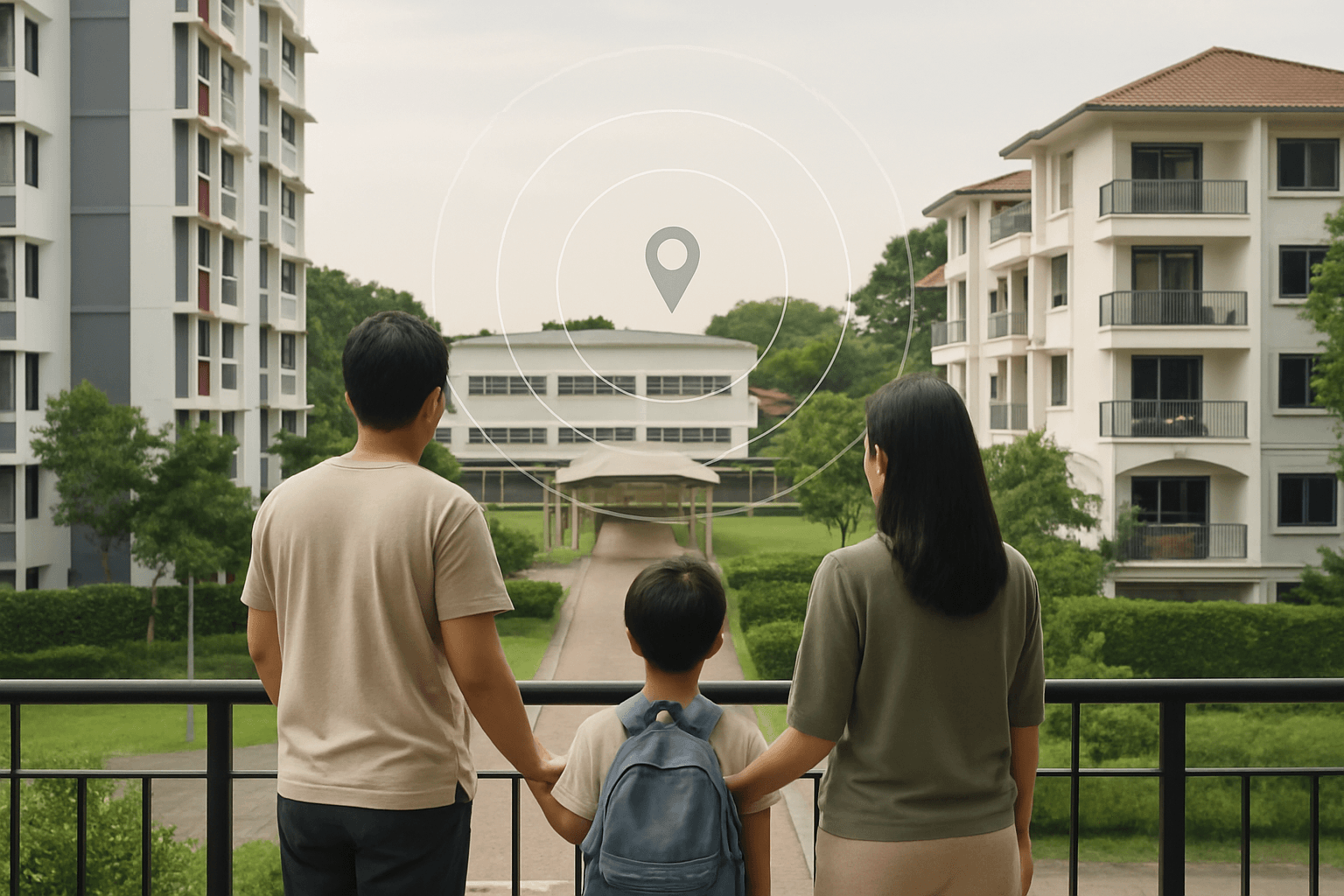
Yes, moving house can help with Primary 1 registration, but only in a narrow and practical way. A new home may place your child in a better home-school distance band if balloting happens, yet it does not secure a place by itself. The useful way to read registration trends is as a risk tool: do they suggest this school is usually manageable, sometimes tight, or consistently high-pressure, and does this address meaningfully change your position?
Can moving house help with Primary 1 registration?
Yes. Moving closer can improve your distance position if balloting happens, but it does not guarantee a place.
Yes, but only in a limited way. Under the MOE framework, parents can register for any school. If applications exceed vacancies, balloting may happen within the relevant phase and home-school distance band. That means a nearer address can improve your position when a school is oversubscribed, but it does not create automatic admission.
The simplest way to think about it is this: distance matters only when demand is tight enough for distance to matter. If two families apply in the same phase to an oversubscribed school, the family in a nearer distance band may be better placed, but that family can still face balloting if demand is heavy within that band too. So moving house is best seen as a way to reduce some risk and improve daily convenience, not as a guaranteed route into a school. If you want the full background first, start with our Primary 1 Registration in Singapore guide and then read how home-school distance works.
All About Primary Schools' Balloting History
The new home address can be used provided that you are able to produce evidence from the relevant authority that you have committed to the purchase of this property. In addition, you have to sign a letter of undertaking to move into the new property within two years of the child’s entry into P1. In the case of private property, you must produce the certified true copy of the Sales and Purchase Agreement. For the 2016 Primary One (P1) Registration Exercise, the date of commitment by the developer
All about Transferring to Other Primary Schools
To add, In this link https://va.ecitizen.gov.sg/cfp/customerPages/moe/explorefaq.aspx?Category=3645&utm_source=moe-corp-site&utm_medium=referral Look for Q. I have purchased a yet-to-be completed property and should be moving in after the property is completed. Can I make use of the new home address for Primary One (P1) registration?
What do past Primary 1 registration trends really tell parents?
Past Primary 1 registration trends show how competitive a school has been, not what will definitely happen next year.
They show past demand, not future certainty. The useful signals are whether a school has repeatedly filled up early, whether balloting has happened over several years, and whether pressure has remained strong across different cohorts. That helps you judge whether a school is usually calm, sometimes risky, or consistently competitive.
What trends cannot do is tell you that next year will look the same. A school that looked manageable before can tighten if there is a larger cohort or stronger neighbourhood demand, while a school that looked very difficult in one year can ease in another. Reporting such as MOE adding more places for a larger Dragon Year intake is a good reminder that yearly conditions do move. Parent takeaway: use several years of history to estimate risk, not to predict an outcome. For a broader overview, see Primary 1 Registration Distance Priority: How Home-School Distance Works.
All about Transferring to Other Primary Schools
I suppose before august, u will still be living in Punggol? Perhaps you still need some time to renovate, move/pack or settle down. Think it’s easier to transfer to TPY schools when your new premise is ready and settled.. perhaps register your child where your p2 is first and apply for transfer later. Better to start in a fresh year, say p3 and p1. If you have a caregiver for your p1 near TPY, u can try register p1 under that address...
All about Transferring to Other Primary Schools
Hi, i am moving house at early 2021. So will need to relocate my children school to new location. By Jan 2021, my eldest will start her first year of secondary school. Whereby my second daughter will be in P3. Would like to know when should i start to approach/register future school? Or am i being too kiasu in asking this question too early? Can i start to approach the future school to chop a seat? Any idea what is the procedure?
Have More Questions?
Get personalized guidance on schools, tuition, enrichment and education pathways with AskVaiser.
Try AskVaiser for Free →Which parts of the trend data matter when choosing a home?
Focus on repeated balloting, whether distance has mattered before, and whether the school stays competitive across several years.
Three signals matter most: repeated balloting, pressure within distance bands, and consistency over time. If a school has been oversubscribed again and again, that tells you the pressure is not just a one-year spike. If it usually becomes tight in the same phase, that helps you judge how much room there really is for your child. And if nearby families still face heavy competition, moving closer may reduce risk only slightly rather than dramatically.
This is where many parents avoid overpaying. If two homes are both likely to fall into the same distance band, the extra premium for the slightly nearer unit may buy almost no registration advantage. But if one address is likely to sit in a more favourable band and the school has a history of distance-sensitive balloting, that difference may be meaningful. A good rule of thumb is to look for patterns, not headlines. For a deeper read, see our guide on how to read past balloting data before chasing a popular primary school. For a broader overview, see Primary 1 Registration After Moving House: Should You Use Your Old or New Address?.
All About Primary Schools' Balloting History
After 2020, I think it is likely that Primary 1 registration would be made fully online in the future as in this year. Parents would have to adapt their registration strategy to a blind bidding after this year hiccups. Everyone’s best chance in any oversubscribed is the schools where you are <1km. It saves the primary schools the manpower to man the registration booths for the entire process and save them the trouble from the incessant phone calls to get updates of the number of applicants for e
All About Primary Schools' Balloting History
https://www.kiasuparents.com/kiasu/article/singapore-primary-1-registration-school-balloting-history/
How should parents compare two possible addresses near the same school?
First check whether the homes are likely in different distance bands. If not, compare them mainly on cost and family fit.
Start with one practical question: do these two homes likely fall into different distance bands, or are they effectively the same for registration purposes? If they are effectively the same, stop treating school access as the main reason to pay more. The decision then becomes mostly about budget, commute, space, and family convenience.
A common example is a family choosing between a slightly farther HDB flat and a much more expensive condo near the same school. If both addresses are likely in the same band, the condo may not offer a real registration edge. Another family may be comparing a unit that is likely just outside a key band with one that is comfortably within it. If the target school has repeatedly been tight, that difference may matter. This is why parents should check likely distance positioning first, then compare the total housing picture. The best question is not "which unit is closest" but "which home still works if the school result is not ideal.". For a broader overview, see How to Read Past Balloting Data Before Chasing a Popular Primary School.
All about Transferring to Other Primary Schools
Yes, you are allowed to move to a further location. No min occupation for your current house. The by distance requirement is only applicable for p1 registration.
All about Transferring to Other Primary Schools
hi may i check what are the procedures like for changing primary school ? because change of address
What do parents often overlook when moving for school access?
Parents often over-focus on proximity and under-check whether the address is a real, usable registration address.
They often focus on the map and forget the address rules. The registration address should be the real place where the registering parent and child are actually living, and MOE also requires families who gain priority through distance to keep residing there for the period stated in current rules. If parents live at different addresses, either parent's address may be used only if it is genuinely where the registering parent and child reside.
Two more checks matter. Home-school distance can change from year to year, so an address that looks safely placed now should still be checked again later. And false-address cases are taken seriously, as reported by The Straits Times. Before making assumptions, read our guides on which home address counts and whether to use your old or new address after moving.
2B Primary one registration question
Hi, Hope all is well. I have been serving as an active community leader in one GRC for over 2 years. Just before primary one registration, if we move to a new address, are we able to register the child in 2B phase for schools within 2km in the new address?
All about Transferring to Other Primary Schools
Huh? If you are going to move to Seletar area this year end, why are you registering in Tampines / Tampines area? You could have registered with a school in the Seletar area during Phase 2C or 2CS using your new address. As it stands, you are in breach of the 30 months rule if you have registered at Tampines Primary in Phase 2C and have no intention of staying at your place for 30 months. It’s best if you start to request for a transfer before MOE commence Phase 3 and before you start school.
How should you balance school access against housing cost and family life?
Use school access as one factor. The home should still make sense even if your preferred school does not work out.
Treat school access as one factor, not the whole decision. A home near a popular school can make mornings easier, shorten pick-up time, and reduce stress on rainy or busy days. But that same home may also mean a higher price, less space, or a worse work commute. If the family becomes financially stretched, the school benefit can come with a daily cost that is easy to underestimate.
A useful test is this: if your preferred school does not happen, would this still be a sensible home for the next few years? If the answer is yes because the area works well, the commute is manageable, and there are other acceptable schools nearby, the move is on firmer ground. If the answer is no because the property only makes sense for one school, you may be over-optimising. Insight line: buy the home, not the hope. Some parent discussions, such as this KiasuParents article on school-linked housing decisions, are useful because they show how easily school pressure can distort a housing decision.
All about Transferring to Other Primary Schools
There is, frankly, no strategy in getting a successful transfer for lower primary. You just have to apply and hope for the best. The number one consideration for a successful transfer is vacancy which is out of your control. If no one leaves, then there’s no space available and for popular schools, there could be up to 20 or 30 parents eyeing one vacancy. Schools may also give priority to applicants based on whether they have been balloted out from earlier phases and distance to home.
All about Transferring to Other Primary Schools
https://www.moe.gov.sg/primary/transfers “You can apply to transfer your child to a primary school nearer to your new residential address if your child is: - A Singapore Citizen (SC) or Permanent Resident (PR). - Currently in Primary 1 to 5. We will offer your child a school nearer to your new residential address which has available vacancies. Your child will have to report to the new school by the end of the reporting period to complete the school transfer. Your NRIC must be updated with your n
When is it sensible to move because of a primary school, and when is it not?
Moving for school is most sensible when the home already works well for the family and the school benefit is meaningful, not marginal.
It is usually sensible when the move already fits your wider family plans. That could mean you were planning to relocate anyway, the new home is affordable, the area suits your daily life, and there are several acceptable schools nearby rather than one all-or-nothing target. In that situation, school access is a useful tie-breaker.
It is usually not sensible when the family is making a large sacrifice for a small registration gain. A typical example is paying much more for a home that is only marginally better on distance while the school remains highly competitive and still likely to ballot. Another is moving to a place you do not genuinely want to live in just to chase one popular school. If you are not sure whether you are making a grounded decision or a dream-school decision, our article on popular dream schools versus safer nearby schools can help reset the comparison.
All about Transferring to Other Primary Schools
Within 6 years of primary school education, from (P1 to P6), note that u can only Transfer schools from (P1 to end of P4). Reason being, after end of P4, there is streaming, into P5 classes. End of P4 is the last whistle calling (blowing), for Transfer students to board (hop onto) another new train journey. Schools do not allow Transfer once start P5, in Upper primary years (P5 / P6). Schools consider these last 2 years as key PSLE preparatory years, won't allow Transfer. At what level, is your
All About Preparing For Primary One
Starting primary school? This is a big milestone. Do enjoy the journey with your child! :rahrah: https://www.straitstimes.com/singapore/education/the-st-guide-to-preparing-your-child-for-primary-1 Parents often confuse being ready for school with being academically capable in skills like reading and counting. Instead of focusing solely on academic progress, it is more important to make learning an enjoyable process, and help your child have a swift and happier adjustment to primary school. Here
What is a sensible way to use trends before house hunting?
Use trends to narrow your school options first, then test real homes against cost, distance, and family fit.
- ✓Shortlist a small group of schools you would genuinely accept, not just one dream school.
- ✓Look at several years of registration pressure so you can spot repeated patterns instead of reacting to one year's result.
- ✓Check the likely home-school distance category for each address using the OneMap School Query Service before assuming a home is close enough.
- ✓Compare at least two or three real homes side by side so you can see whether the school-access difference is meaningful or mostly cosmetic.
- ✓Weigh family trade-offs early, including work travel, childcare, grandparents, budget, home size, and lease or ownership plans.
- ✓Read the basics in our [Primary 1 Registration in Singapore guide](/primary-1-registration-singapore-guide) and our guide to [Primary 1 registration phases](/blog/primary-1-registration-phases-singapore).
- ✓Check address-use rules before committing, especially if you are between homes or parents live at different addresses.
- ✓Ask one final question before signing anything: if the preferred school does not happen, is this still a good move for our family?
What should you do if the preferred school still looks risky after moving?
Have a realistic backup school and make sure the home still works even if your first-choice school does not.
Keep a backup plan and judge the move on family value first. If the preferred school still looks competitive even after you move, the practical response is to identify a realistic second-choice school, check whether the new home still improves daily life, and make sure the housing decision does not depend on one admission result.
This matters because many families do not regret missing one school as much as they regret locking themselves into a poor housing choice. A home with manageable travel, decent nearby alternatives, and family support will still feel workable after registration. A home chosen only for one specific school can feel like an expensive bet. If you want to prepare for that scenario now, read what happens if you do not get your preferred school. Insight line: the right house should still be the right house after the ballot result.
All about Transferring to Other Primary Schools
You don't get to decide when you can transfer. It depends on whether there's vacancy in the school you want, and whether the school accepts your child. You can start by waitlisting your child in the school you want after P1 registration closes. If you are lucky, transfer can happen before P1 starts, or you can wait indefinitely.
All about Transferring to Other Primary Schools
Refer to https://www.moe.gov.sg/primary/transfers “ If you decide not to accept the school offered, or miss the reporting deadline, your child will remain in their current school.” Also, “We will offer your child a school nearer to your new residential address which has available vacancies .” There is no guarantee that the school (< 500m) nearest your house has available vacancies, and if it’s a popular primary school, it’s unlikely to have any available vacancies. Use STEPS if you don’t mind an
Have More Questions?
Get personalized guidance on schools, tuition, enrichment and education pathways with AskVaiser.
Try AskVaiser for Free →