
Moving House and Primary 1 Registration in Singapore: What Parents Should Sort Out Early
How a move can affect which address you use, how you shortlist schools, and what documents are sensible to prepare.
Moving house can affect Primary 1 registration because your address shapes school planning and, in some phases, home-school distance priority. The safest approach is to plan around the address you can honestly support at registration time, not the address you merely expect to use later. If your move timeline is uncertain, build school options around both the current and likely new address, keep at least one backup choice that still works if the move slips, and prepare common move-related documents in case proof is needed. A planned move does not automatically improve your child's chances unless the new address can actually be used under MOE's process.
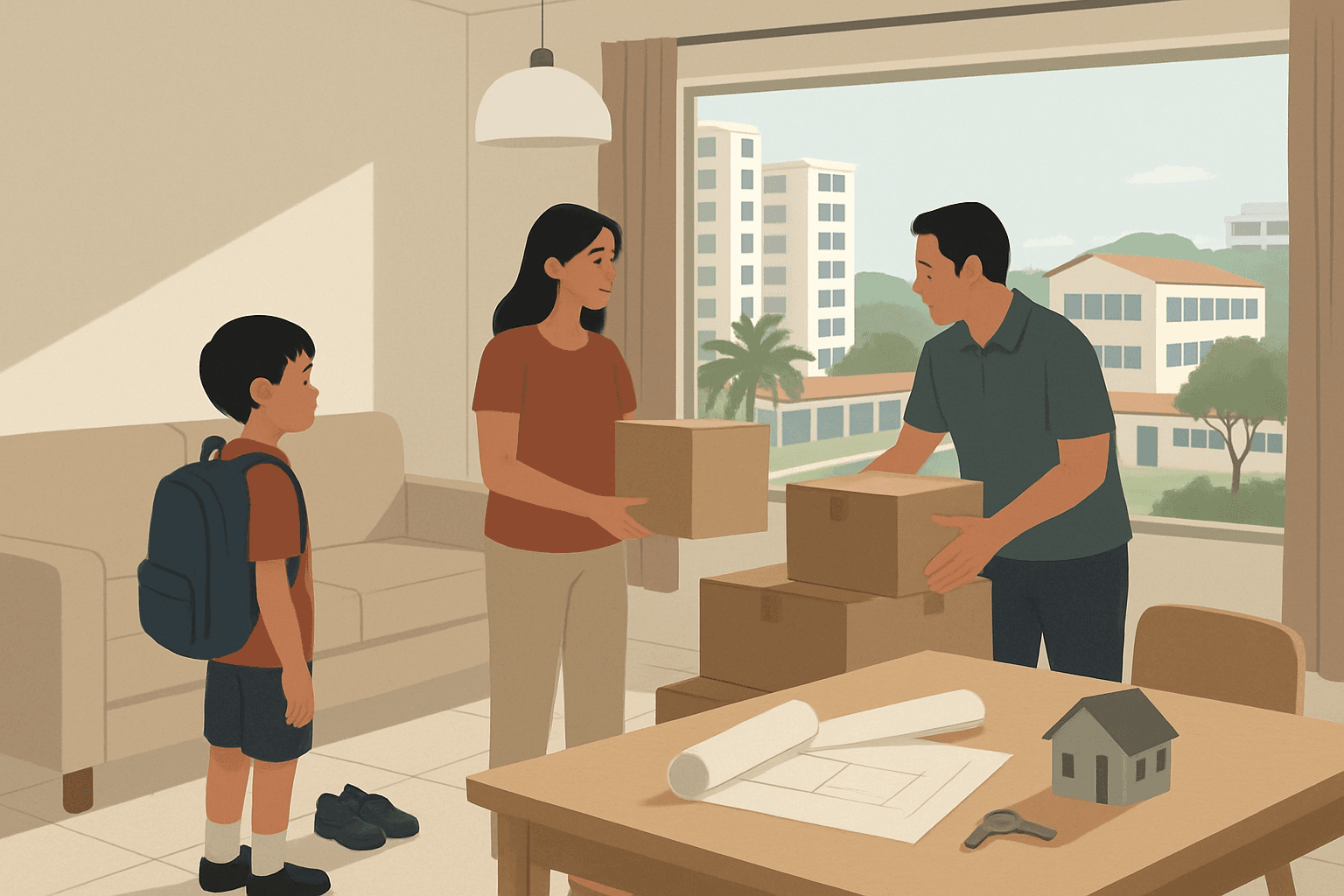
If you are moving house around the same time as Primary 1 registration, the move itself is not the main issue. The real issue is whether the address you want to rely on is actually usable when you register. That affects which schools are realistic to shortlist, whether home-school distance may help in the relevant phases, and what records you may need if your housing situation is still in transition. For most families, the practical work is to settle three things early: which address to plan around, how to build a school shortlist if the move date is not firm, and which move-related documents to keep ready.
What does moving house change in Primary 1 registration?
A house move can affect which address you can use, which schools are realistic, and what documents you may need.
Moving house can change three practical things: which address you can use, which schools are realistic to shortlist, and what supporting records you may need if your housing situation is still in transition. The main issue is timing. A home you expect to move into later is not always the same as an address you can already rely on for registration.
This matters most when your plan depends on being near a school. If your current home and future home place you in different distance bands for the same school, the move may change which nearby schools make sense to consider. But it does not change every part of the process. For example, Phase 1 is based on having an older sibling already in the school, so living nearby does not make a child eligible for that phase.
A simple way to think about it: treat the move as an address-planning issue first, not just a housing issue. A family waiting for resale completion, a family whose tenancy starts next month, and a family still waiting for key collection may all end up in the same neighbourhood eventually, but they may not have the same address options during registration. For a broader overview, see Primary 1 Registration in Singapore: How It Works, Balloting Risk, and How to Choose a Realistic School Plan.
All about Transferring to Other Primary Schools
Hi hennaoh, Please refer to the FAQ below. Does it address your situation? https://va.ecitizen.gov.sg/cfp/customerPages/moe/ExploreFaq.aspx?Category=3645&Mesid=422335 Q:- I am in the midst of purchasing a new resale property. The transaction will be completed soon and I will be able to move in prior to the commencement of the academic year. Can I make use of this new address to register my child? Answer: The resale Housing & Development Board (HDB) flat's/ private property’s address can be used
All about Transferring to Other Primary Schools
To add, In this link https://va.ecitizen.gov.sg/cfp/customerPages/moe/explorefaq.aspx?Category=3645&utm_source=moe-corp-site&utm_medium=referral Look for Q. I have purchased a yet-to-be completed property and should be moving in after the property is completed. Can I make use of the new home address for Primary One (P1) registration?
Which address should parents plan around if the move is not final yet?
If the move is not final, plan around the address you can genuinely support at registration time.
Plan around the address you can actually support when you register, not the one you hope to have later. That is the safest way to avoid building your school plan on an address that is not ready to be used.
In practice, parents often sit in one of a few grey zones. You may have bought a home but still be waiting for completion. You may have signed a tenancy agreement but the lease has not started. You may be preparing to move, but key collection or handover is not confirmed yet. In those situations, do not assume the future address is already usable just because the transaction is underway.
MOE notes in its FAQ that parents can register through an online form in the P1 Registration Portal using a new address if another address is not shown on the portal. The practical question is not just “Are we moving?” but “Can we use this new address properly in the portal, and can we support it if asked?” If that answer is still unclear, build your main plan around the home you can explain and document today. For a broader overview, see Which Home Address Counts for Primary 1 Registration in Singapore?.
All about Transferring to Other Primary Schools
Huh? If you are going to move to Seletar area this year end, why are you registering in Tampines / Tampines area? You could have registered with a school in the Seletar area during Phase 2C or 2CS using your new address. As it stands, you are in breach of the 30 months rule if you have registered at Tampines Primary in Phase 2C and have no intention of staying at your place for 30 months. It’s best if you start to request for a transfer before MOE commence Phase 3 and before you start school.
All about Transferring to Other Primary Schools
https://www.moe.gov.sg/primary/transfers “You can apply to transfer your child to a primary school nearer to your new residential address if your child is: - A Singapore Citizen (SC) or Permanent Resident (PR). - Currently in Primary 1 to 5. We will offer your child a school nearer to your new residential address which has available vacancies. Your child will have to report to the new school by the end of the reporting period to complete the school transfer. Your NRIC must be updated with your n
Have More Questions?
Get personalized guidance on schools, tuition, enrichment and education pathways with AskVaiser.
Try AskVaiser for Free →How does the timing of the move affect your school shortlist?
Base your shortlist on the address most likely to be valid when you register, and keep a backup list if the move may be delayed.
Your shortlist should follow the address most likely to be valid when you actually register. If the move is completed comfortably before the phase you are targeting, planning around the new home may be reasonable. If completion, tenancy start, or handover could slip, you need a second plan based on your current address.
A few common situations show why timing matters. If you have already moved and your records are in order before registration opens, your shortlist can usually focus on the new area. If registration opens while you are still waiting for completion or key collection, it is risky to shortlist only schools near the future home. If the move happens only after the relevant phase has passed, the new address may help with daily travel later, but it may not help for that earlier registration decision.
A good parent rule is this: shortlist for the address you can use, not the address you are emotionally attached to. Families who do this early usually make calmer choices and avoid last-minute scrambling. If you need to think through the distance side of the decision, our guides on home-school distance priority and popular versus safer nearby schools can help.
All about Transferring to Other Primary Schools
Hi, i am moving house at early 2021. So will need to relocate my children school to new location. By Jan 2021, my eldest will start her first year of secondary school. Whereby my second daughter will be in P3. Would like to know when should i start to approach/register future school? Or am i being too kiasu in asking this question too early? Can i start to approach the future school to chop a seat? Any idea what is the procedure?
All about Transferring to Other Primary Schools
Sorry, but it's getting kinda confusing. You are shifting house? Where to? I assume it's Toa Payoh since you are focusing on that area. If yes, that could legitimately be one of the reasons why you want to transfer. If not, you may want to consider schools nearer your new place. Whatever the case, it's good to register your interest with the schools now. You can call up the schools that you are interested in and ask for their school's procedures. Most will require you to fill up a form of some s
What proof of address or move-related documents are commonly prepared?
Prepare common move-related records early, but treat them as examples rather than a fixed MOE checklist.
MOE's exact requirements should be checked for the relevant registration year, but parents commonly prepare documents that help show the housing arrangement is real and current. These are examples, not an official or exhaustive checklist.
Common examples include a tenancy agreement, a completion or handover letter, sale and purchase documents, a recent utility bill, or updated address records. Some families also keep digital copies of emails or notices showing expected key collection, lease start, or occupation dates. Those extra records may not always be requested, but they are useful when you need to explain the timeline clearly.
The practical goal is simple: reduce last-minute scrambling. If your move overlaps with registration, gather what you already have, note what is still pending, and keep everything in one folder. That way, if you need to support the address later, you are not searching across lawyers' emails, landlord messages, and utility accounts. For a broader preparation guide, see our article on P1 registration documents parents commonly prepare.
For Reference for P1 registration: MOE Official Letters
From: xxx Sent: Thursday, 11 July, 2013 9:36 AM To: Contact Us (MOE) Subject: P1 Registration Hi, I am writing in to enquire the following for the purpose of Primary 1 registration. \"From MOE website: Proof of Purchase of Yet-to-be Completed Property An original Sales and Purchase document is required if the address of a yet-to-be completed private property is used for registration. The date of commitment by the developer in the Temporary Occupation Permit (T.O.P.) has to be within two years of
All about Transferring to Other Primary Schools
That's a tricky question. From MOE's website, it says: \"30-month stay requirement MOE recognises that some families are unable to remain at the address used for registration for the entire duration of the child's primary school studies. Even so, a child who gains priority admission through their distance category is required to reside at the address used for registration for at least 30 months from the start of the P1 Registration Exercise. For reference, the 2021 P1 Registration Exercise start
What parents commonly misunderstand about using a new address for registration
A planned move is not the same as an address you can safely use for registration.
A planned move is not the same as a usable registration address. Buying a flat, signing a lease, or expecting keys soon does not automatically mean the new address is ready to support your school plan. The safer question is: can we honestly explain this address and support it with records if needed? MOE has said it takes a serious view of false address declarations and address verification under the proximity policy, as reflected in its parliamentary reply on fraudulent declarations and reply on non-compliance. For a broader overview, see Primary 1 Registration Phases in Singapore: What Each Phase Means for Your Chances.
*** READ ME FIRST !!! - P1 Registration FAQ ***
2A need to apply at school , so withdrawal also need to be at school. Then go over to school B for registration. Consider time for travel, withdrawal take 5-10min. Buffer 1.5 hours would be safe if driving. If you can let us know your 2C choice , we can tell you the risk. It might be worth just to go 2C
*** READ ME FIRST !!! - P1 Registration FAQ ***
We will move to Singapore in December 2015 (house-hunt scheduled by company in November) which means we won’t have a local address to specify during the Primary 1 registration scheduled on August 27. Can someone give us ideas on how to go about the registration? Can we specify an office address (which is going to be near where we plan to look for a house), or our intended location (without a specific address) ? Really need help with these questions as MoE simply responded with “you need to have
How should families shortlist schools if the move may happen during the registration period?
Make one shortlist for your current address and one for the likely new address, then keep a backup school that works under both.
Build two shortlists early: one based on the current address and one based on the likely new address. Then identify at least one school that still feels acceptable under either scenario. That is usually the best way to reduce stress if the move date slips.
For example, one family may have a preferred school that only looks realistic if the new address can be used in time, but a second school that remains workable from the current home. Another family may discover that the future address opens up a more popular option, yet the safer choice is still a school they can reach reasonably well from both homes. A third family may find that the move barely changes the shortlist at all, which is useful because it stops them from over-planning around the move.
If your shortlist works only under the best-case moving timeline, it is too fragile. Parents often overlook that point because they focus on the hoped-for end state rather than the registration window itself. If you need a bigger-picture refresher first, start with our main Primary 1 registration guide and then compare it with our article on which home address counts.
All about Transferring to Other Primary Schools
You don't get to decide when you can transfer. It depends on whether there's vacancy in the school you want, and whether the school accepts your child. You can start by waitlisting your child in the school you want after P1 registration closes. If you are lucky, transfer can happen before P1 starts, or you can wait indefinitely.
Give citizens priority in Primary 1 registration
Ha.ha. maybe next time the P1 registration phase can propose like that, just a suggestion: Phase 1 – Existing siblings in the Primary school except PR siblings. Phase 2A(1) – No Change Phase 2A (2) – No Change Phase 2B – No change Phase 2C – Singapore Citizenship Only. Phase 2C Supplementary - Singapore Citizenship Only Phase 3A – Permanent Residents Phase 3A Supplementary - Permanent Residents Phase 4 – Non Citizen.
What should parents sort out before the move if P1 registration is coming up?
Use this checklist to reduce address confusion, missing documents, and last-minute shortlist stress.
- ✓Confirm the most likely move timeline, including completion, key collection, tenancy start, or handover dates.
- ✓Decide which address is genuinely usable for registration based on that timeline.
- ✓Check the current MOE FAQ instead of relying on old screenshots or forum memory.
- ✓Gather common supporting papers you already have, such as tenancy, completion, utility, or address-update records.
- ✓Shortlist schools under both the current address and the likely new address.
- ✓Keep at least one backup school option that still works if the move is delayed.
- ✓Make sure both parents understand which address timeline and document trail will be used if questions come up.
What are the common risk points if your address changes after registration?
The main risks are inconsistent records, missing support documents, and assuming the move changes school priority automatically.
The biggest risk is that your records stop telling one clear story. Parents sometimes register using one address, move later, and then assume the school priority picture has automatically changed. A safer working assumption is that the original registration basis still matters unless you have been clearly told otherwise.
Another common problem is document mismatch. For example, the registration details may reflect one home while later records show another, with no clear explanation of when the move happened. That can create unnecessary confusion even when the move itself is genuine. A third risk is timing. If a move delay or document issue causes a family to miss a phase they were eligible for, MOE says they can register in the next eligible phase but no priority will be given. In practice, that means timing mistakes can matter more than parents expect.
A simple habit helps: save what you declared, what changed, and when it changed. If your plans go off track, it is easier to explain the situation clearly and adjust your next step. If you want to prepare for a backup outcome, our guide on what happens if you do not get your preferred school is a useful next read.
*** READ ME FIRST !!! - P1 Registration FAQ ***
Can someone tell me if this rule is new starting from this year or was it around before? Extracted from MOE FAQ under Proximity to School FAQ 4. How long do we need to stay in the address used to register our child during the P1 Registration Exercise? In a small number of cases, there may be situations where the families are unable to remain at the address for the entire duration of the primary school studies. Even so, a child who gains priority admission into a school through his/her distance c
*** READ ME FIRST !!! - P1 Registration FAQ ***
For Singaporean - The child’s Singapore Birth Certificate - The child’s Singapore Citizenship Certificate for those who are not Singapore Citizens at the time of birth - Singapore NRIC of both parents or Entry / Re-entry Permits of parents if they do not possess Singapore NRIC - The child’s Immunisation Certificates For PR - The child’s Birth Certificate - The child’s Entry/Re-entry Permit - Singapore NRIC of both parents or Entry/Re-entry Permits of parents if they do not possess Singapore NRIC
If we move after registering for Primary 1, do we need to tell MOE or the school?
Usually, yes, but the exact update depends on what changed and which party needs the new information.
Usually, yes, you should keep your records updated, but the exact step depends on what changed and which party needs the information.
If you move after registration, the practical move is to keep your address documents in order, check whether the school or MOE needs an administrative update, and make sure the contact details they hold still match where your family can actually be reached. This matters most if the move happens close to later processing, orientation, or school communication periods. A simple way to stay organised is to keep the original registration details together with the later move documents, so you can show a clear timeline if needed.
What parents often overlook is not the move itself, but the gap between what was declared earlier and what their current records now show. Closing that gap early usually prevents confusion later.
[Punggol] Primary Schools
Hi parents, I am originally staying in Tampines and am moving to Punggol this month. As I am planning to register my child in P1 at Punggol next year, what are the steps I need to do, in order to register? Is it just popping by the Police Station to update my address will do?
[Punggol] Primary Schools
hi hi my understanding is can use the new address, but i think must provide HDB documentation. It is good to check on during P1 registration. BTW Meetoh is a very popular sch. If u r the ex-student, it should not be a prob to get a seat. But if u r under phase 2C, please prepare for balloting. This sch practically every yr needs balloting.
Have More Questions?
Get personalized guidance on schools, tuition, enrichment and education pathways with AskVaiser.
Try AskVaiser for Free →