
Primary 1 Registration for Twins in Singapore: How Applications and Balloting Usually Work
A practical guide to twin applications, balloting risk, and how to choose schools without assuming both children will move as one unit.
Primary 1 registration for twins in Singapore follows the same overall exercise as other children, but parents should plan as if each child’s registration and outcome must stand on its own. In practice, that means checking how the school or system handles twin applications, understanding that balloting can lead to both-in, both-out, or split results, and shortlisting schools based on what your family can actually manage if the outcome is uneven.
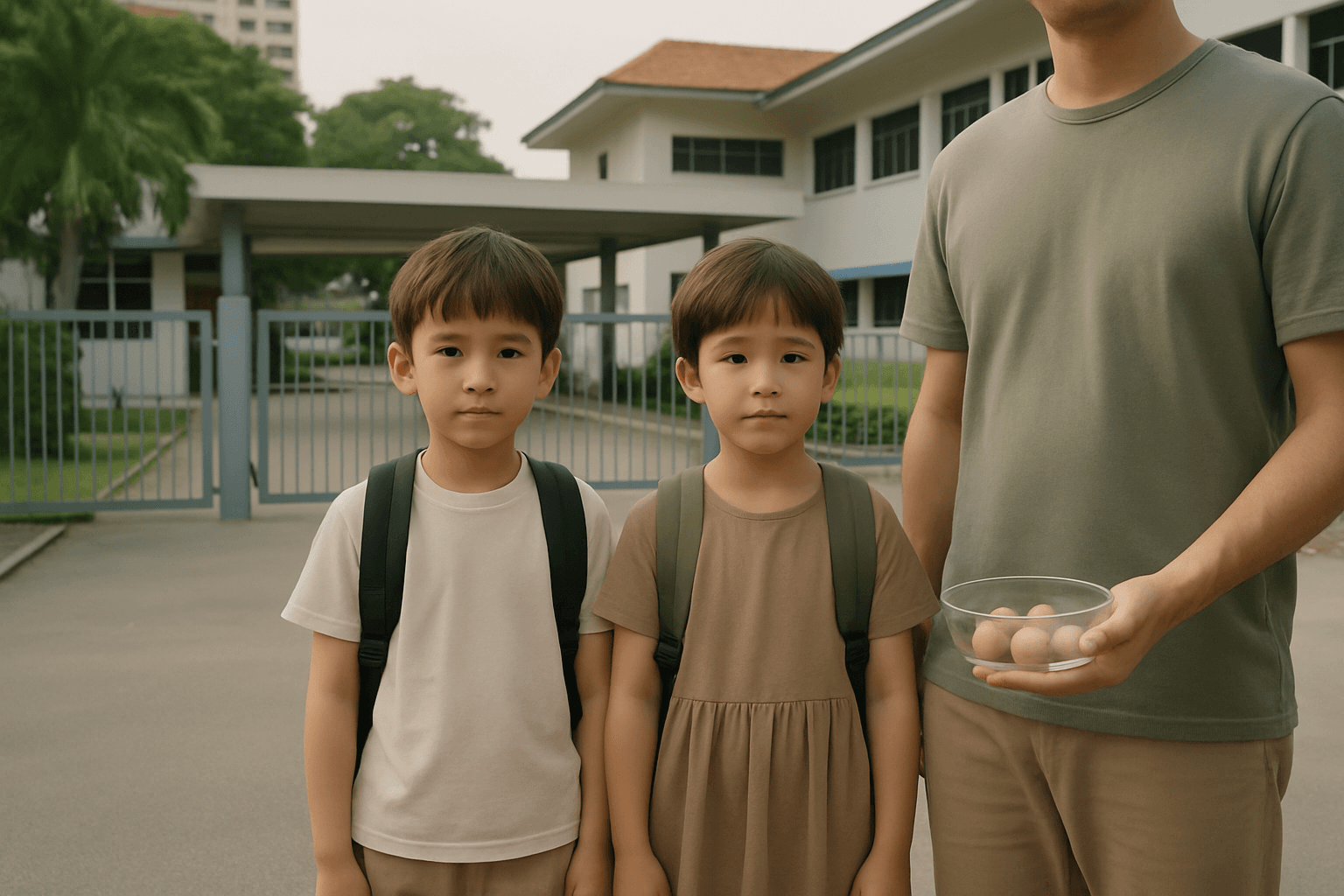
If you are registering twins for Primary 1 in Singapore, the safest starting point is simple: plan for two child-level outcomes unless the school clearly tells you otherwise. The real decision is not just which school you prefer, but whether keeping both children together matters more than taking balloting risk at a more competitive school.
How does Primary 1 registration work for twins in Singapore?
Twins join the same P1 exercise as other children, but parents should plan for two possible child-level outcomes rather than assume both children will move together.
Twins go through the same overall Primary 1 exercise as other children, but parents should think about it as one family decision that can still produce two separate outcomes. The twin issue is usually not a separate national process. It is the planning problem created when one school choice exposes two children to the same oversubscription risk.
That is why the first question is not only "Which school do we like?" It is also "How important is it that both children stay together if the school is competitive?" For some families, being in the same school is non-negotiable because transport, dismissal, and student care all depend on one routine. For others, a split outcome would be inconvenient but still manageable. That difference should shape your school choices before registration starts.
Think of twin registration as a school-choice problem before it becomes an admin problem. If you want a broader refresher on the overall process first, our Primary 1 Registration in Singapore guide covers the full parent overview.
Share with us your kid's P1 registration experience
Hi parents, I've gone through 2 rounds of registration for my kids - Phase 2B 5 years ago (2006) and Phase 2A2 (2010). For son's P1 registration at Pei Hwa then, there was just 1 stop - ie to submit documents for verification. No guarantee at Phase 2B, just a high chance of getting in. Today's registration for daughter is slightly longer - 3 'stops'. Station 1 is at ground floor where a lady will make sure we are eligible for Phase 2A2. If so, then we proceed to the hall on 2nd floor. Station 2
2021 P1 Registration Exercise for 2022 In-take
https://www.straitstimes.com/singapore/parenting-education/phase-2a2-of-p1-registration-begins-july-14-no-spots-in-6-schools [quote]All available spots at these schools were snapped up during the second phase: 1. Ai Tong Primary School 2. Catholic High School (Primary) 3. CHIJ St. Nicholas Girls' School (Primary) 4. Nanyang Primary School 5. Pei Hwa Presbyterian Primary School 6. Rosyth School[/quote]
Do twins each need a separate P1 registration application?
Do not assume one form or one entry covers both twins. Prepare each child’s details carefully and confirm the current submission method early.
Do not assume one submission automatically covers both children. A safe practical approach is to prepare as though each twin needs complete child-level details, then confirm the exact workflow for that year with the school office or the current MOE instructions.
In real life, the common problems are often administrative rather than strategic. Parents may assume the system already links both children correctly, only to realise later that one child’s details were entered differently, one record needs separate checking, or the school expects both children to be clearly identified as twins. Even if both children sit under the same parent account or registration process, that does not mean their cases will be treated as one admission outcome.
A useful rule is this: check each child’s name, birth details, and any relevant supporting records as if each place depends on its own accuracy. That mindset prevents avoidable mistakes and makes school follow-up much easier if there is a mixed result. For a broader overview, see How to Read Past Balloting Data Before Chasing a Popular Primary School.
2011 P1 Registration Exercise for 2012 In-Take
Parents of twins get to choose whether they want to consider their twins as one or two. If they decide to split the twins, they will have 4 balloting slips. Of course, under this circumstance, if only one of them gets selected, the parents will have to look for another school for the other one.
2011 P1 Registration Exercise for 2012 In-Take
Dear Parents For easier reference step by step guide line for Online Registration :- http://www.moe.gov.sg/education/admissions/primary-one-registration/files/p1-is-step-by-step-guide.pdf
Have More Questions?
Get personalized guidance on schools, tuition, enrichment and education pathways with AskVaiser.
Try AskVaiser for Free →How does balloting usually work when twins apply for the same school?
When a school is oversubscribed, balloting may decide who gets a place, and parents should not assume twins will automatically be processed as one ballot outcome.
If a school receives more eligible applications than available places in a phase, balloting may be needed. In simple terms, when demand exceeds vacancies, not every child can be offered a place at that stage. For twins, the practical point is that you should not assume they will automatically move through that ballot as one unit.
This is not a rare edge case at sought-after schools. Past reporting has shown early balloting pressure at schools such as CHIJ St Nicholas Girls', Catholic High and Henry Park Primary, and 67 primary schools were oversubscribed by Day 2 of Phase 2C in 2023. That is why families with twins should treat balloting risk as a real planning factor, not a remote possibility.
For parents, the useful way to think about it is simple. There are three realistic outcomes when both twins target the same competitive school: both get in, neither gets in, or the result splits. The hardest of these is often the split result, because it creates immediate family logistics problems. If you are considering a high-demand school, it helps to study past demand patterns before applying. Our guide on how to read past balloting data can help you judge whether a school is genuinely realistic. For a broader overview, see Primary 1 Registration: Should You Pick a Popular Dream School or a Safer Nearby School?.
[Bukit Timah] Primary Schools
should be the same across all schs Registration at Primary School Registration is conducted at the primary school that you wish your child to be admitted into. The hours of registration are from 8.00 am to 11.00 am and from 2.30 pm to 4.30 pm on each scheduled registration day. Parents or a person authorized by the parents in writing (letter of authorization (72kb .pdf)) is to submit the registration form and required documents at the school of choice. From the 2012 P1 Registration Exercise onwa
[Bukit Timah] Primary Schools
http://www.moe.gov.sg/education/admissions/primary-one-registration/vacancies/#bukit-timah end of day 1 (19 July) Phase 2B status update:- i) Nanyang 30 registered, 24 vacancies balloting takes place on 25 July (Wed) time: 9 am venue: The Gallery (level 4) ii) MGS 42 registered, 28 vacancies need to ballot. iii) RGPS 31 registered, 41 vacancies once exceed > 10 kids enrol tomorrow (day 2), high chance for > 2km enter balloting. iv) Pei Hwa 31 registered, 28 vacancies v) Henry Park 16 registered,
What happens if one twin gets in and the other does not?
If one twin gets in and the other does not, parents usually need to decide quickly whether split schooling is workable and what realistic next options remain in that cycle.
A split result is the outcome parents should plan for first, because it is usually the hardest to manage and may not have an easy administrative fix. If one twin secures a place and the other does not, contact the school promptly to understand what options remain in that registration cycle, but go in expecting a practical decision rather than a guaranteed remedy.
The real question is whether your household can absorb separate schools. One family may decide it is workable because grandparents can help, the commute is short, and both schools have compatible dismissal timings. Another family may find it unmanageable because both parents work full-time, there is one student care arrangement, and one pickup route is the only reason daily life functions smoothly.
What many parents underestimate is that missing a popular school can be simpler than getting a split result. If neither child gets in, the family moves on to the next workable option together. If only one gets in, the family has to decide whether to accept split schooling or pivot quickly. If you want to think through fallback paths early, our guide on what happens if you do not get your preferred school is a useful next read.
Give citizens priority in Primary 1 registration
Ha.ha. maybe next time the P1 registration phase can propose like that, just a suggestion: Phase 1 – Existing siblings in the Primary school except PR siblings. Phase 2A(1) – No Change Phase 2A (2) – No Change Phase 2B – No change Phase 2C – Singapore Citizenship Only. Phase 2C Supplementary - Singapore Citizenship Only Phase 3A – Permanent Residents Phase 3A Supplementary - Permanent Residents Phase 4 – Non Citizen.
Give citizens priority in Primary 1 registration
Not sure if this has been mentioned in KSP forum? From 2010, Singapore Citizens (SCs) will be given an additional ballot slip (i.e. two chances instead of one), while Permanent Residents (PRs) will retain one ballot slip whenever balloting is conducted by any school during the P1 Registration Exercise. SCs will therefore have a higher chance of securing a place for their child in a school of choice when there is balloting. Giving Singaporeans two chances during balloting will retain the underlyi
Should parents prioritise the same school or the stronger school option?
If keeping both children together matters most, a safer same-school option is often better than a more competitive choice. If you chase the stronger school, plan for the chance of a split result.
For most families, the better choice is the school plan you can still live with if the result is disappointing. That often makes a realistic same-school option more valuable than a more famous school with obvious ballot pressure.
Parents often frame this as school quality versus logistics, but for twins the more useful comparison is best-case prestige versus worst-case family strain. A school may look excellent on paper and still be a weak choice if one twin getting in and the other missing out would break your transport, care, or work routine. On the other hand, if a particular school genuinely feels worth the risk and your family can cope with a split outcome, it may still be a reasonable choice. The point is to decide with clear eyes, not with an assumption that both children will land together.
A simple rule helps here: choose the school plan you can manage on a bad day, not only the one you like on a good day. If you are weighing ambition against realism, our guide on popular dream schools versus safer nearby schools may help. For a broader overview, see Primary 1 Registration Phases in Singapore: What Each Phase Means for Your Chances.
[Bukit Timah] Primary Schools
a) 11 schools most highly sought after by parents (click on picture inside, one by one):- http://www.edvantage.com.sg/edvantage/photos/1226116/P1_registration_heads_to_ballot_boxes.html b) Parents rent condo, to enhance P1 balloting chance :- source http://www.edvantage.com.sg/edvantage/photos/1243954/Parents_rent_condos_for_better_P1_balloting_chance.html Schools that the paper spoke to said that parents risk having their child expelled if they are caught using a false address. Nanyang Primary
[Bukit Timah] Primary Schools
Phase 2C (day 2): @ 8.30 am http://www.moe.gov.sg/education/admissions/primary-one-registration/vacancies/#bukit-timah i) MGS (Bukit Timah) 25 applicants, 28 vacancies less than 1 km: 21 SC applied outside 1 km: 4 SC for MGS (a Top school): just solely concentrate on SC will do. ii) RGPS said later around 11.30 am closer to lunch time, then update figures. iii) Nanyang school didn't wish to reveal yesterday Day 1 number, by distance breakdown. said because ... still got people coming in to regis
Important reminder before you list schools for twins
Treat twin registration as something to clarify early, not as something that will sort itself out later.
Do not assume twins will automatically be treated as one admission unit just because they are siblings entering Primary 1 together. Ask the school early how twin cases are usually handled administratively, what you should prepare, and who to contact if the outcome is mixed. You are not looking for promises. You are looking for clarity before pressure starts.
Share with us your kid's P1 registration experience
P1 registration experience… On the 1st day, went to the 1st choice school in the morning of 2/Aug to register… Actually I wanted to go on the last day to better gauge the chances as I was staying between 1-2km but the other half keep pestering me to go early… many parent still don’t understand the concept of balloting and priority and 3 days registration period… no sure why they always have the belief of 1st-come-1st-serve go later no place misconception even after much much explanation… No choi
Share with us your kid's P1 registration experience
First thing to do after being balloted out, is to put your child's name under the school's wait list. After then, I've wrote in to MOE, called/met the school's Principal for discussion. Telling them all my problems and how the registration system had affected us (because I have only 1 school within 2km and NO school within 1km). With this factual, MOE has verified and consulted the school. My son was then placed on the highest priority in the waiting list .. and fortunately by early Nov, we were
What should parents clarify with a school before listing it for twins?
Clarify how twin applications are checked, what records parents commonly need ready, and who to speak to if only one child gets a place.
The most useful questions are practical. Ask how the school wants twin applications to be submitted or checked, whether there is any preferred way to flag that the children are twins, what parents usually need ready if records must be verified, and who handles follow-up if only one child is successful.
Common real-world examples of what parents often double-check include each child’s personal details, address-related records where relevant, and whether any supporting paperwork needs to be shown separately for each child. These are examples, not an official fixed checklist, because the exact documents can depend on the phase and the family’s situation. What matters is avoiding the assumption that one child’s records automatically cover both.
It is also worth asking what the school can and cannot advise if the result is mixed. That does not mean the school can promise an outcome. It means you will know whether you are dealing with a straightforward admin query or a fast family decision. If you are also sorting out what parents commonly prepare, see our guide to Primary 1 registration documents.
All About Preparing For Primary One
Starting primary school? This is a big milestone. Do enjoy the journey with your child! :rahrah: https://www.straitstimes.com/singapore/education/the-st-guide-to-preparing-your-child-for-primary-1 Parents often confuse being ready for school with being academically capable in skills like reading and counting. Instead of focusing solely on academic progress, it is more important to make learning an enjoyable process, and help your child have a swift and happier adjustment to primary school. Here
All About Preparing For Primary One
hi, for parents with kids in pre-nursery / nursery, these two initial years are “honeymoon” years, usually quite relaxed. But for parents with kids in k1, k2, where you are stepping on the final last lap accelerator for more oil to speed up momentum, help yr child prepare Pri 1, it is always good to attend - one year ahead in advance, the parents’ briefing on detailed Pri 1 curriculum. do not wait until the year when your child has started Pri 1, then come to attend such parents’ briefing. why ?
How should parents shortlist schools when twins are involved?
Build your shortlist around what your family can realistically manage, not only around school reputation. For twins, a workable backup matters more than usual.
Shortlisting for twins should combine school fit, family logistics, and a realistic view of demand. Start with schools you would genuinely accept, then pressure-test them against commute time, dismissal arrangements, student care, and how painful a split outcome would be. A school is not a strong twin option if the plan only works when everything goes perfectly.
Distance still matters, but it is not the only practical filter. Some parents can absorb longer travel because one parent works flexible hours or grandparents help daily. Others need a school that fits a tight drop-off and pickup routine. Oversubscription matters too. A school that feels like the obvious first choice may still be a weak twin choice if ballot pressure is high and your backup plan is poor.
A useful way to think about your shortlist is this: separate schools you truly want from schools you mention mainly because they are famous, familiar, or socially impressive. If home-school distance is part of your thinking, our guides on distance priority and which home address counts will help. Some parents also read practical address-planning discussions such as this KiasuParents article on using a new address for P1 registration, but that is a separate issue from twin handling and should be assessed carefully on its own facts.
[Bukit Timah] Primary Schools
Phase 2B balloting on Wed, 25 July (for 2013 P1 intake: kids born 2006, year of puppy) http://www.moe.gov.sg/education/admissions/primary-one-registration/balloting/ Bukit Timah Schools 1.\tMethodist Girls’ \tBalloting will be conducted for SC children residing within 1km of the school. 2.\tNanyang \tBalloting will be conducted for SC children residing between 1km and 2km of the school. 3.\tHenry Park \tBalloting will be conducted for SC children residing outside 2km of the school. 4.\tPei Hwa P
[Bukit Timah] Primary Schools
2014 July P1 Registration results (born 2008) http://www.kiasuparents.com/kiasu/content/bukit-timah a) Bukit Timah primary (co-ed) Phase 2B : 59 vacancies, 1 registered Phase 2C : 117 vacancies, 62 registered Phase 2C Supplementary : 55 vacancies, 51 registered Phase 3 (foreigners) : 4 vacancies b) Henry Park primary (co-ed) Phase 2B : 22 vacancies, 22 registered http://news.asiaone.com/news/digital1/2 ... s-phase-2b Phase 2C : 21 vacancies, 50 registered balloting required for SC, within 1 km c
What common mistakes do parents make in twin P1 registration?
The most common mistake is assuming both twins will automatically share the same admission outcome, then choosing schools as if no split result can happen.
The biggest mistake is planning for the best-case outcome only. Parents assume both twins will naturally end up with the same result, then build a school strategy that falls apart if one child gets in and the other does not.
That assumption often leads to other mistakes. Some families focus only on ultra-popular schools without deciding what they would actually do after an unsuccessful or split result. Others delay calling the school because they assume twin status will somehow make the process smoother than it is. Another common problem is spending too much time debating the prestige of the first-choice school and too little time testing whether the family can manage two different school routines if needed.
The core insight is simple: the risky part of twin registration is often not submitting the application. It is what happens to family logistics after the result.
P1 Preparation for parents of mutliples
Hi VVJJ, Welcome here! Guess there are quite a few twins who will be in P1 next year! Some of your problems are quite similar to me, maybe we should exchange notes! Which school are you looking at?
2021 P1 Registration Exercise for 2022 In-take
For SG50 babies registration, I really strongly advise applying to a very safe school that doesn’t require balloting (same advice as for Dragon year). You can find some gems out there across the island if u don’t restrict yourself only to a certain zone. People coming back from overseas have this advantage unless u need to squeeze in with your own parents’ existing accommodation. If you are dead set on Newton/Novena area, I would recommend renting/buying next door to SJIJ. Plenty of new & old ch
One twin got a place and the other did not. What should I do?
Contact the school promptly, find out what options remain in that cycle, and decide quickly whether split schooling is workable for your family.
Start by contacting the school quickly so you understand the immediate next steps available in that registration cycle, then make a practical family decision instead of waiting in confusion. The key question is whether split schooling is genuinely workable for your household.
If it is manageable, you may decide to proceed while adjusting transport, dismissal, or student care arrangements. If it is not manageable, you need clarity fast on what alternative options remain and what timelines apply in that cycle. In many cases, the most useful first conversation is not about arguing for a special exception. It is about understanding what the school can actually advise, what choices are still open, and how quickly you need to decide.
If you are still learning how the broader phase structure shapes outcomes, our article on Primary 1 registration phases will help you read the situation more clearly. Parents who want context on how competition can shift across phases sometimes also read practical community explainers such as this Phase 1 overview on KiasuParents, but use them as background, not as a prediction for your own year.
[Bukit Timah] Primary Schools
2012 end of Phase 2C (for 2013 P1 intake - born 2006, year of doggie) 1) Henry Park Balloting was conducted for Singapore citizenship children, residing within 1km of the school. 43 registered, 15 places PSLE 2011 Quality passes (A/A*) http://www.henryparkpri.moe.edu.sg/cos/o.x?c=/wbn/pagetree&func=view&rid=41039 2) Pei Hwa Presbyterian Balloting was conducted for Singapore citizenship children, residing within 1km of the school. 42 registered, 27 places PSLE 2009 to 2010 Quality passes (A/A*) h
[Bukit Timah] Primary Schools
Pei Hwa Presbyterian last year: July 2011 \"A spokesman for Pei Hwa said that there were a total of 70 children vying for 44 spots at Phase 2B , including those living within 2km of the school, who did Not need to ballot .\" 26 kids were out. This is quite a big number, almost can form one class of 30 students ! Going forward, Singapore Citizens staying more than 2 km can still apply for PV. However going forward, Pei Hwa Principal going to control the # of PV selected stringently this time roun
Have More Questions?
Get personalized guidance on schools, tuition, enrichment and education pathways with AskVaiser.
Try AskVaiser for Free →