
Primary 1 Registration for Working Parents: How to Choose a Low-Friction Backup School in Singapore
Use a weekday-routine test to compare commute, pickup, student care, and caregiver support.
Working parents should choose a Primary 1 backup school by testing the full weekday routine, not just home-to-school distance. In most cases, the better backup is the school with the simpler commute chain, more reliable pickup coverage, and a realistic after-school care plan near home or a caregiver. A useful rule is this: choose the school your family can sustain on a normal Wednesday for six years, not the school that only works on paper.
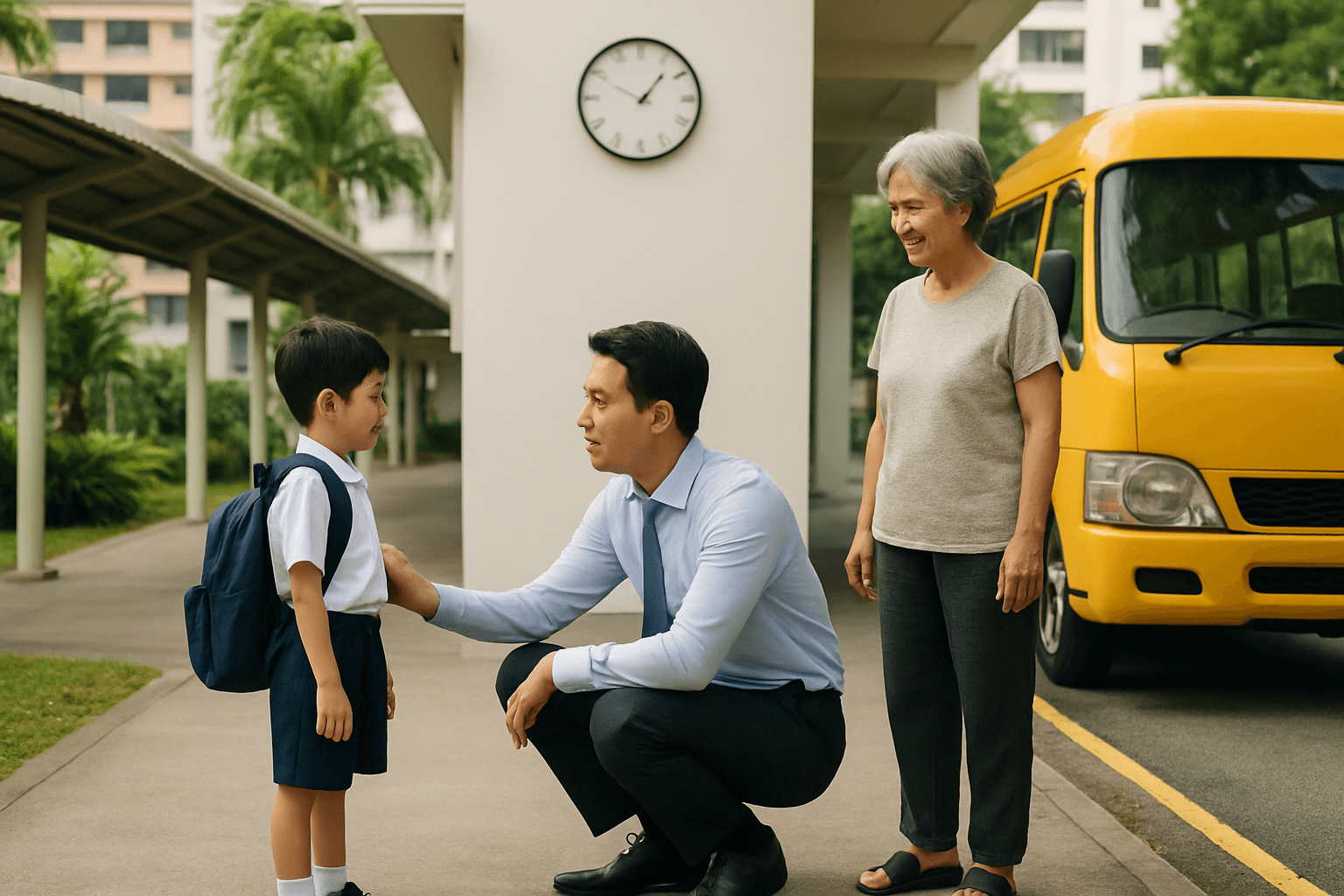
Many parents start Primary 1 school choice by comparing reputation, distance, or balloting risk. Working parents usually need a more practical filter. If your first-choice school is uncertain, your backup school should be the one your family can actually run on an ordinary weekday without constant rushing, fragile handoffs, or repeated early exits from work. This guide shows you how to test that backup choice using real daily logistics, not just school reputation or straight-line distance. If you need the wider registration context first, start with our Primary 1 registration guide.
What does a low-friction backup school mean for working parents?
A low-friction backup school is one your family can run calmly on ordinary weekdays, with workable commute, pickup, and after-school care.
A low-friction backup school is one your family can manage every weekday without depending on luck, repeated rushing, or daily last-minute fixes. It is not simply a school you are willing to accept if your preferred option does not work out. It is a school that fits the real routine: your child can get there on time, dismissal does not trigger a scramble, pickup is covered, and the plan still holds when work runs late or the weather is bad.
This matches MOE's broad advice on how to choose a school: parents should balance the child's needs with family priorities, and travel time is one of the practical factors to weigh. A shorter commute often means less fatigue for the child and fewer daily pressure points for adults.
The right mindset is to test the school as a six-year weekday routine, not a one-day registration choice. In real life, a school near a grandparent's block, a school that works smoothly with student care, or a school on a direct route may be a better backup than a more talked-about school with a harder daily chain. The right backup school is the one your weekday life can actually absorb. For a broader overview, see Primary 1 Registration in Singapore: How It Works, Balloting Risk, and How to Choose a Realistic School Plan.
All About Preparing For Primary One
Starting primary school? This is a big milestone. Do enjoy the journey with your child! :rahrah: https://www.straitstimes.com/singapore/education/the-st-guide-to-preparing-your-child-for-primary-1 Parents often confuse being ready for school with being academically capable in skills like reading and counting. Instead of focusing solely on academic progress, it is more important to make learning an enjoyable process, and help your child have a swift and happier adjustment to primary school. Here
All About Preparing For Primary One
Was surfing around on understanding if I am well prepared on behalf of my DD1 for Primary 1 Chanced upon a few websites, thought to share though it could have been mentioned before Tips For Parents ◦Work on independent reading skills. ◦Set up a study area and regular study times that are not interrupted. ◦Learn to follow a routine with a lot of sleep and early mornings. ◦Practice organisation and planning by packing a daily bag with essentials for the day. ◦Talk about social skills and communica
Which logistics matter most when both parents are working?
Prioritise the full commute chain, pickup coverage, after-school supervision, and how dependable your caregiver plan really is.
The biggest pressure points are usually morning send-off, afternoon pickup, the after-school window, and the reliability of the people in your care chain. Parents often focus first on distance and underestimate handoffs. A school can be fairly near and still be hard if nobody can pick up at the right time. A slightly farther school can be easier if the child can move smoothly to student care or to a grandparent who lives nearby.
The practical question is not just who can help, but who can help consistently. A grandparent who is free only on some weekdays is not the same as a caregiver who can cover every school day. A helper may be dependable at home but may struggle to handle a school run while also caring for a younger sibling. One parent may be willing to do pickup, but if that requires leaving work early almost every day, the plan is fragile from the start.
What most parents overlook is that the hardest part is rarely the best-case day. It is the ordinary day when meetings overrun, a child is tired, and everyone is moving on a tight clock. Your backup school should still work on that day. For a broader overview, see Primary 1 Registration Phases in Singapore: What Each Phase Means for Your Chances.
[Punggol] Primary Schools
Hi I need advise for primary registration. My son was born in year 2011 (registration year 2017) Within 1 km Mee Toh Pri Compassvale Pri Rivervale Pri North Spring Pri Sengkang Pri Which school is better & offer student care after school? Thanks.
All About Preparing For Primary One
Dear parents, I hope parents could share your experience regarding the preparation for primary school and time schedule spend with your kids everyday. I have a son of 6 this year going to P1 next year. I would like to find out with parents things that you are doing with your child prior going P1, cos I do not want to react too kan-jiong or too relax in front of my child. I am particularly concerned about the 3 main subjects being taught in P1 and wonder should I expect him to be able to do the a
Have More Questions?
Get personalized guidance on schools, tuition, enrichment and education pathways with AskVaiser.
Try AskVaiser for Free →How should you map the daily commute chain before choosing a school?
Test the whole morning and afternoon routine under real weekday conditions, not just the straight-line distance from home to school.
Do not stop at home-to-school distance. Map the full weekday chain from the person who sends the child in the morning to the person who takes over after school and eventually gets the child home. In some families, that means home to school, school to student care, student care to home. In others, it means home to school, school to grandparent, then grandparent to home after dinner. The route that matters is the route your family will actually use most days.
A useful rule is this: map the handoffs, not just the kilometres. A school that looks close on the map may still involve two transfers, an unsheltered walk, or a cross-town pickup. Another school may be slightly farther but easier because it sits on a direct bus route, near the main caregiver, or along a parent's normal commute.
If you can, test timings using weekday conditions rather than weekend estimates. Look at what happens at actual drop-off and pickup hours, not just off-peak travel times on an app. If one option works only when every train, bus, and meeting ends on time, it is not a low-friction backup. Realistic school choice is less about shortest distance and more about the fewest fragile steps. For a broader overview, see Primary 1 Registration Distance Priority: How Home-School Distance Works.
All About Preparing For Primary One
First of all, how far are u from the school? Within 1km or 1 - 2km? If near, don't take school bus, send yourself. Any balloting history for the neighbourhood school under 2C?
All About Preparing For Primary One
My son is going primary 1 next year and I am eligible for phase 2b under a good school but it took two hours of time of bus transport to n fro from home. The kid have to be at the bus stop at 6am waiting for bus. That school have proven track record for the past many years because of it’s strict standards. Now, my headache is there Is a relatively new school which is only a few years old n has not proven track records n the highest psle scores is 230plus. This school is just downstairs my home b
What should working parents check about after-school care and dismissal timing?
Check whether your child can be supervised smoothly after dismissal in a way that actually matches your work hours.
For many working families, the hard part begins after the school day ends. The key issue is not the dismissal time by itself, but whether your child can move into safe, reliable supervision without a daily scramble. That might be a school-based Student Care Centre, a grandparent collection plan, or another caregiver arrangement that genuinely matches your workday.
MOE notes that parents can ask about school-based Student Care Centres and school bus arrangements during school orientation. For backup-school planning, it is sensible to confirm these logistics early rather than assuming you will sort them out later. School-specific details matter here. For example, two schools may end at similar times, but one may have a much smoother handoff to student care while the other may require tighter pickup timing.
What often gets missed is the buffer. A school may look manageable on paper, but if the child still needs a separate transfer, a long wait, or a precisely timed collection, the routine can become stressful very quickly. A part-week arrangement is also less secure than it sounds. If a plan works only on three weekdays and falls apart on two, it is not really a backup plan. For a broader overview, see Primary 1 Registration: Should You Pick a Popular Dream School or a Safer Nearby School?.
Preparing Your Child for Primary School:Parent Seminar - MOE
Preparing Your Child for Primary School: A Parent Seminar by MOE Starting primary school is a big step in your child's life. To help you better understand primary school programmes and enable you to make key education decisions, the Ministry of Education will be conducting a seminar on Primary School Education. At the seminar, parents can look forward to sharing sessions by the school principal and a parent volunteer, as well as view the various programmes our primary schools provide. The Primar
Kindergarten that prepares child well for Primary 1
Hello all I am very concern of which nursery, kindergarten actually prepares a child well for primary 1. I was told that some church kindergarten does not prepare a child well for primary 1. I was also told that those good preschool are pat school house, chiltern house, eaton house… which you actually have to pay premium for their school fees. Whereby Nanyang kindergarten, St James kindergarten and Nafa kindergarten have a long waiting list which is impossible to get my child in. Can anyone plea
How do you choose between a closer school and a more desirable one?
If the more desirable school adds repeated commute or pickup stress, the closer and easier school is usually the better backup.
Use a simple working-parent rule: if the more desirable school creates recurring weekday stress, the closer or easier school is usually the better backup. The job of a backup school is to reduce daily friction, not to preserve a brand preference. That is also why MOE highlights travel time in its school-choice guidance. A shorter commute can mean more rest for the child and fewer daily costs in time and energy.
A common comparison looks like this. One school has the stronger name, but it requires daily car drop-off, a long pickup chain, or one parent leaving work early. Another school may be less talked about, but it is near home, near a grandparent, or easier to pair with student care. For a backup choice, the second school is often the more sensible one.
Parents sometimes worry that choosing the easier school means lowering their standards. In practice, it often means choosing the school your family can support consistently. If you are torn between status and daily fit, our guide on popular dream school or a safer nearby school can help you think through that trade-off more clearly.
[Punggol] Primary Schools
Hi all kiasu mummy, I’m new here, I need some advise from all of you. My girl will be register her primary school end of July under phase 2C. Within 1km Compassvale primary school Edgefield primary school Punggol view primary school Punggol green primary school Rivervale primary school Which one would you recommend and why?very urgent !! Thanks
All About Preparing For Primary One
hi, for parents with kids in pre-nursery / nursery, these two initial years are “honeymoon” years, usually quite relaxed. But for parents with kids in k1, k2, where you are stepping on the final last lap accelerator for more oil to speed up momentum, help yr child prepare Pri 1, it is always good to attend - one year ahead in advance, the parents’ briefing on detailed Pri 1 curriculum. do not wait until the year when your child has started Pri 1, then come to attend such parents’ briefing. why ?
What backup-school features reduce stress for families with fixed work hours?
Look for predictability, fewer handoffs, and a routine that still works when the day goes slightly wrong.
The most helpful features are usually simple rather than impressive. Working parents benefit from a manageable route from home or a caregiver's home, a realistic dismissal-to-care arrangement, and a pickup plan that still works when there is rain, traffic, or an overrunning meeting. A school may also be easier if it is close to the person most likely to handle pickup, even if it is not the absolute closest to your registered home address.
What you are really looking for is slack. A school that works only with perfect timing is usually a poor fit for fixed work schedules. Common stress-reducing features can include a direct route, fewer handoffs, a nearby caregiver, a practical student care arrangement, or a school bus option that you have actually verified. These are examples, not guarantees, because each school's setup differs.
One useful reminder is that admissions convenience and weekday convenience are not the same thing. A school may help on the distance side of registration but still be awkward for daily life. If distance is part of your planning, it helps to read our guide on how home-school distance works, but treat that as only one part of the decision.
All About Preparing For Primary One
:goodpost: Thanks so much for your great sharing! It really helps us as P1 parents from 2012! :lovesite:
All About Preparing For Primary One
You should have seen the way the mum drilled the poor child, depriving him of food till he completed his revision. Obviously, an uninterested child will only retain the information into his short term memory. Preparing a child for primary 1 is more than just the academics. There are several areas that parents have to take note of. Does your child know how to clean up after himself if he does a big business in the toilet? Does your child know how to wash his hands correctly and rinsed his hands p
How should you think about school choice if grandparents or a helper are part of the plan?
If grandparents or a helper are part of the plan, choose a school that fits their route, timing, and capacity, not just your own preference.
Treat the care chain as part of the school choice itself. In many Singapore families, grandparents, a helper, or a mix of both make the routine possible. That only helps if the school fits their location, mobility, and stamina. A grandparent who can manage morning drop-off may not be comfortable with a long afternoon wait or a crowded transfer route. A helper may be dependable but may not be able to do two separate school runs if there is also a preschool sibling to handle.
The better question is whether the arrangement is kind to the caregiver as well as workable for the child. A school near a grandparent's home can be much easier than a school near a parent's office because the handoff is simpler and less dependent on work timing. By contrast, a school that requires the helper to juggle multiple pickups, weather changes, and public transport transfers may look manageable on paper and feel exhausting by mid-year.
Treat the caregiver's route as the real route. If that route is tiring, complicated, or dependent on too many moving parts, the arrangement is weaker than it looks. Parents often think in terms of whether help exists. A better test is whether help remains realistic every weekday.
Preschools prepared your kids well for Singapore primary?
For parents who have already been through the pre-school days and with kids now in primary schools (Singapore schools), can you share your comments on your kid's previous preschool and their curriculum - specifically if they have prepared your child properly for the Singapore education system ? (not discussing the international or foreign schools system here) Nowadays, there are so many pre-schools and childcare centres with many learning methods. Parents currently at the pre-school stage will b
All About Preparing For Primary One
My girl is in P1 this year. Based on my experience, I think you are doing a fine job so far... As long as kids go to pre school, they are more or less ready for P1 because topics cover in first semester are very similar to what they will be learning in K2... I did buy some assessment books for my girl when she was in K2 because she had so much free time after school. Whether to draw up a time table is subjective... it definitely incultivate good habits which may be ideal when he starts P1. Prepa
Do not treat a backup school as a paper plan only.
A backup school only helps if the weekday logistics are real, confirmed, and supported by clean registration details.
A school can look fine in a spreadsheet and still fail in real life. The usual mistakes are choosing by reputation first, assuming pickup and after-school care will sort themselves out later, and underestimating how draining a tight weekday routine becomes over time. If your plan depends on a caregiver who has not firmly agreed, a bus route you have not checked, or one parent leaving work early every day, it is not really a low-friction backup.
Keep the registration side realistic too. Primary 1 registration runs through phases on MOE's official P1 registration page. If you need a simpler overview, see our guide to Primary 1 registration phases. MOE also states in its FAQ that if you miss a phase you were eligible for, you can still register in the next eligible phase, but you do not gain priority for missing the earlier one. Finally, avoid informal address workarounds. MOE takes home address declarations seriously, and parents should sort out address questions properly before locking in a plan.
How to Prepare For Primary School
You have to start teaching your child one to one and start from scratch. This is crucial year to prepare your child. Your child MUST be able to recognise high frequency words, can read, can spell some simple words, comprehend questions and answer logically, write neatly etc. please start preparing now before he goes P1. Share a personal experience with you. My friend has a son who enrolled in a new kindergarten in K2 this year. The boy's new teacher was shocked to discover that he could not reco
All About Preparing For Primary One
the standard of kindergarten and child care centres in SG varies from one another. Some kindy prepare kids well for P1, but other kindy not sufficient. The standard varies. moreover, P1 standard is getting higher and higher, each year. that is why some parents still prefer to send kids for P1 Prep course. if you think you come from a kindy where then standard is reasonable, then ok.
How can you shortlist 2 to 3 backup schools without overcomplicating the process?
Filter schools by commute, care, and pickup reliability first, then keep only the few that genuinely work for your family.
- ✓Start with schools your child can realistically reach from home or from the main caregiver's home on an ordinary weekday.
- ✓Remove any school that depends on daily perfect timing, multiple transfers, or a stressful cross-town pickup.
- ✓For each remaining school, write down who handles morning drop-off, normal-day pickup, and the backup if work runs late.
- ✓Keep only schools with a workable after-school supervision plan, whether that is a confirmed caregiver arrangement or a school-specific option you have checked.
- ✓Prefer schools that reduce handoffs by keeping the child close to home, a grandparent, or the person most likely to pick up.
- ✓Stress-test each option by asking whether the plan still works in rain, traffic, or an overrunning meeting.
- ✓Compare the schools that pass the commute and care test on long-term family fit, not just popularity or reputation.
- ✓Keep the shortlist small. Two or three realistic schools are usually more useful than a long list of theoretical options.
- ✓Before registration, recheck the current year's MOE Primary 1 registration page and, if distance may affect your planning, review our guide on [distance priority](/blog/primary-1-registration-distance-priority-how-home-school-distance-works).
Have More Questions?
Get personalized guidance on schools, tuition, enrichment and education pathways with AskVaiser.
Try AskVaiser for Free →