
Sibling Priority in Singapore P1 Registration: Half-Siblings, Step-Siblings and Adopted Children
What blended families should know before registration opens
Sibling priority can apply in blended families, but parents should not assume every sibling relationship is treated the same way. Half-siblings and legally adopted children are usually easier to support because the relationship is clearer on paper, while step-sibling cases are less straightforward and should be clarified early. The practical test is not only who lives together, but whether the relationship can be shown clearly with documents.
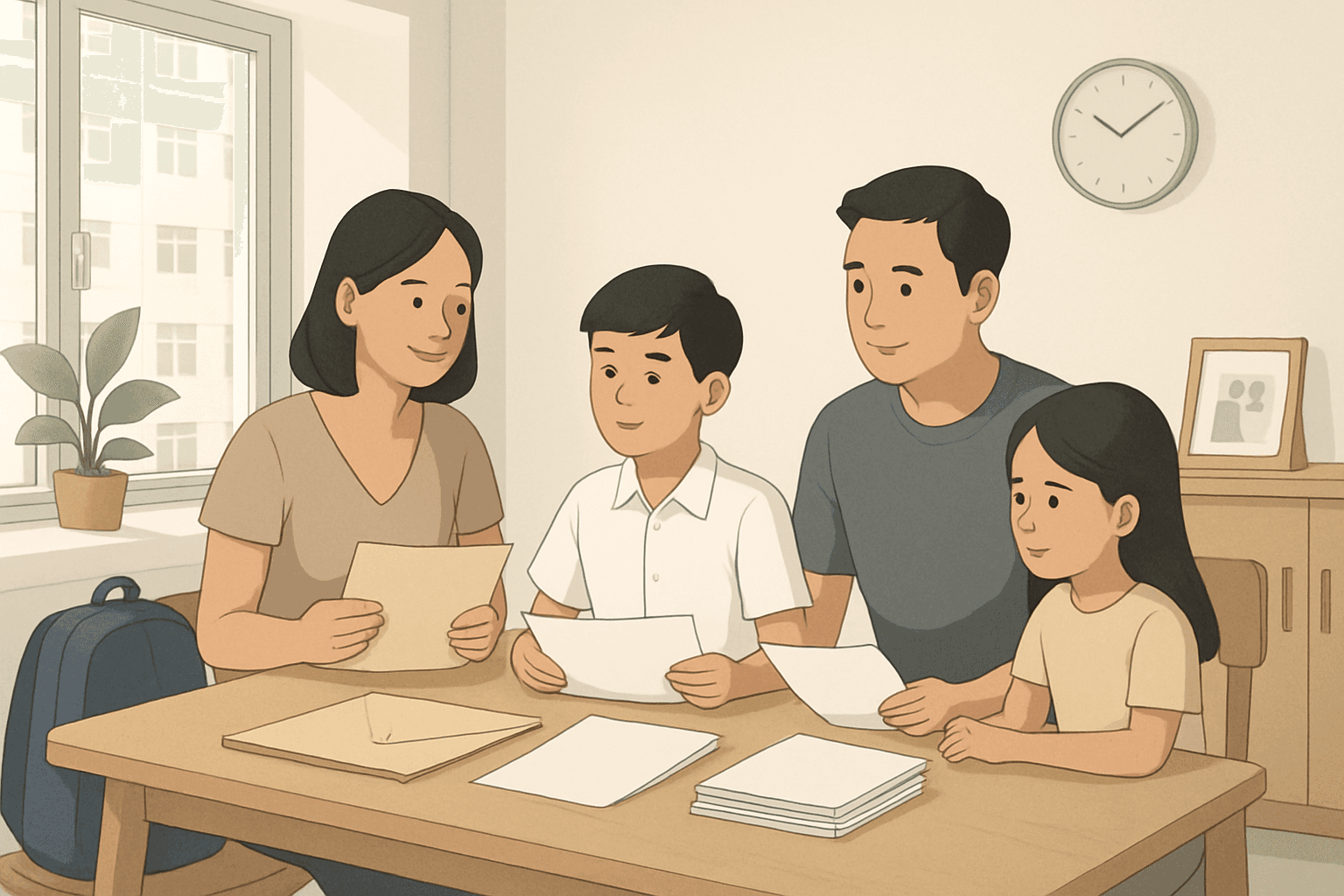
If your family is blended, sibling priority in Singapore Primary 1 registration may still apply, but the key question is not just whether the children live together. The real issue is whether the relationship is clear on paper and fits the registration process. Half-sibling and legally adopted sibling cases are usually easier to explain than step-sibling cases because the connection is more direct. This guide breaks down what parents should prepare, where confusion usually happens, and how to plan ahead when the family structure is not obvious from the form alone.
What is sibling priority in Primary 1 registration, in plain English?
It is the advantage a younger child may get when an older sibling is already in the school. In blended families, the practical issue is whether that sibling relationship is clear enough to be recognised and supported with documents.
Sibling priority is the advantage a younger child may get when an older sibling is already in the same school. Parent-facing guides often describe Phase 1 as the stage for children who already have siblings in the school, which is why many parents use “sibling priority” as shorthand for that part of registration.
For blended families, the key point is not simply whether the children share a home. The real question is whether the younger child can be recognised as that sibling for registration purposes and whether the relationship is easy to show on paper. For example, if your younger child is applying to the same school as an older half-sibling, do not assume the school will infer the link from a shared address or a similar surname.
A simple way to think about it: sibling priority is about the relationship, not just the household story. If you want the broader picture of when sibling-related priority matters, our guide to Primary 1 registration phases in Singapore explains how the process fits together. For a broader overview, see Primary 1 Registration in Singapore: How It Works, Balloting Risk, and How to Choose a Realistic School Plan.
Give citizens priority in Primary 1 registration
Ha.ha. maybe next time the P1 registration phase can propose like that, just a suggestion: Phase 1 – Existing siblings in the Primary school except PR siblings. Phase 2A(1) – No Change Phase 2A (2) – No Change Phase 2B – No change Phase 2C – Singapore Citizenship Only. Phase 2C Supplementary - Singapore Citizenship Only Phase 3A – Permanent Residents Phase 3A Supplementary - Permanent Residents Phase 4 – Non Citizen.
All About Getting Priority Registration
the changes made relates only to SCs over PRs. in each of the particular phase. see below: http://www.moe.gov.sg/media/press/2012/03/seven-new-primary-schools-for-2013-and-further-differentiation-and-outreach-at-p1-registration.php all the best to all for coming year registration.
Does sibling priority apply to half-siblings?
Often yes. Half-siblings are usually the most straightforward blended-family case, but parents should still be ready to show the shared parent clearly.
Usually, this is the clearest blended-family case to support, because half-siblings share one biological parent. That shared parent is the key link parents should be ready to show. A younger child and an older child may have the same mother but different fathers, or the same father but different mothers. Either way, the relationship is generally easier to explain than a step-sibling arrangement because the connection is direct.
In practice, parents commonly prepare documents that show the shared parent clearly. Examples may include both children's birth certificates, and any supporting papers needed if names changed after remarriage or if the family structure is not obvious at first glance. Different surnames do not automatically weaken the case. What matters more is whether someone reading the documents can quickly see how the two children are related.
A useful rule of thumb: a shared parent usually matters more than a shared surname. Parents often worry about names first, but the stronger question is whether the paperwork makes the biological link easy to follow. For a broader overview, see Primary 1 Registration Phases in Singapore: What Each Phase Means for Your Chances.
All About Getting Priority Registration
If your child qualifies under P2B, he or she will still have to wait till all Singaporeans who qualify under P2B get their places in the school.
Questions on new rules of P1 registration
With the announcement of the new rules of P1 registration - that citizens now have advantage over PRs, I have 2 questions: 1. Does the living distance to the school matter (ie 1 km away)? 2. If the PR has an older child in the school already, is priority given to the child’s younger sibling? Thanks!
Have More Questions?
Get personalized guidance on schools, tuition, enrichment and education pathways with AskVaiser.
Try AskVaiser for Free →Does sibling priority apply to step-siblings?
Usually not something to assume. Step-sibling cases are often the least clear, so parents should clarify early instead of treating them like automatic sibling-priority cases.
This is usually the least straightforward case, so parents should not assume step-sibling status alone is enough. Step-siblings are related through marriage, not through blood or adoption. That means the family relationship may be fully real in daily life, while still being less obvious in registration terms.
A common example is a remarried couple where one spouse's older child is already in the school and the other spouse wants to register a younger child from a previous relationship. Another example is two children from separate marriages now living together in one home, even though they do not share a parent. In situations like these, living as one family may help explain the context, but it does not by itself create the same direct sibling link that parents usually rely on in half-sibling or adoption cases.
If your case is step-sibling only, do not build your school plan on an assumption. Gather the documents you do have, such as marriage records and papers showing each parent-child relationship, then clarify early. The goal is to know whether your case is likely to need extra explanation before the registration window opens, not while time is running out. If you are planning across several schools, it also helps to understand the broader Primary 1 registration phases so you can keep a realistic backup route. For a broader overview, see Primary 1 Registration Documents Checklist: What Singapore Parents Commonly Prepare.
All About Getting Priority Registration
With increased population now, there is reason to ask for priority for Singaporean kids rather than priority for those with 3 children.
Give citizens priority in Primary 1 registration
How about a scheme where advantage points will be given. Such that if both parent are citizen, then awards like 20 points, then if completed NS, some more points, and etc. Scheme can be defined to include like sibling same school, PV, community work, stay near home, and etc and etc. . The more points you get put you higher for prioirty for the school of your choice. . .anymore new ideas, we have to help those civil servants to think I guess. .
Does sibling priority apply to adopted children?
Often yes. A legally adopted child is usually one of the clearest blended-family cases, provided the adoption is formally recognised and the documents are consistent.
Usually, an adopted child is one of the clearest blended-family cases to document, as long as the adoption is legally recognised and the records line up properly. Adoption is not just a household arrangement. It creates a legal parent-child relationship, which is why it is generally easier to support than an informal caregiving arrangement or a step-family situation with no adoption.
What parents often overlook is the paperwork trail after the adoption. If the child's surname changed, or if older records still show earlier details, bring the documents that connect the old records to the current ones. In practical terms, parents commonly prepare the adoption order together with the child's official identity or birth records and any other papers that help the school follow the family link without guessing.
The takeaway is simple: adoption usually helps because it puts the family relationship on legal paper. If a child is being raised in the household but the arrangement has not been legally formalised, do not assume it will be treated the same way. For a broader overview, see If Your Older Child Is Already in the School, Does Your Younger Child Automatically Get In?.
All About Getting Priority Registration
As long as the birthcert / document reflects the relationship, it should be fine. To be safe, call up the school to check.
All About Getting Priority Registration
Yes, all phases remain the same. And PRs in earlier phases still get in before SC in subsequent phases. The SC priority over PR only applies within the same phase.
What proof should parents prepare for blended-family sibling priority?
Prepare documents that show the family link clearly, plus any records that explain name differences, legal status, or a more complex family setup.
Prepare documents that answer two practical questions: how are the children related, and if the records look unusual, why. The source material does not provide an official fixed checklist for blended-family sibling claims, so it is better to think in terms of common examples than assume one standard set of papers fits every family.
Parents commonly gather birth certificates showing a shared parent, an adoption order where relevant, marriage documents in step-family situations, and custody or guardianship papers if the family arrangement is complicated. If names differ across records, parents often also prepare the documents that explain the change. If the school needs to understand the current living arrangement as part of the wider picture, address records may help support that story, but address proof is not the same as relationship proof.
The goal is not to submit every paper you own. The goal is to make the family story easy to follow. If one document shows the relationship clearly, that is usually more useful than a thick file of loosely related paperwork. For broader preparation, our guide to Primary 1 registration documents parents commonly prepare can help you organise what to bring.
All About Getting Priority Registration
When the actual P1 registration starts, you will receive, via your elder child, the formal registration form (the one with carbon copies) from the school. Fill in the form and ask your elder child to submit to the school. The form that you mentioned is something like an \"expression of interest\". The form that you will receive is the formal application. However, as you have already submitted the necessary documents to the school, you need not submit these documents again. Phase 1 will start on
All About Getting Priority Registration
Daddy D, Govt said not enough babies to replace us, so take in PRs and convert some to SCs. Now enough people, so limit PR application. Already PRs and new SCs are giving born-and-bred Singaporeans like us harder access into nearby schools. What’s next ? Given a ‘hot’ year for P1 registration like 2006, hubby & I were so relieved (very worried then) when son got into Pei Hwa (staying within 1km) but can you imagine those registering in 2012 ?
What if the siblings have different surnames or live in different households?
Different surnames or addresses do not automatically disqualify a claim, but they usually mean you should prepare clearer supporting documents and a simple explanation.
Different surnames or different addresses do not automatically rule out a sibling claim, but they often lead to more questions. A half-sibling may use another parent's surname. An adopted child may have a newer surname than older records show. Children in separated families may spend time across two homes even though the sibling relationship is genuine.
What schools are usually trying to understand is not whether the names match neatly, but whether the documentary link is clear. A matching surname can help, but it is not proof by itself. A shared address can support the household story, but it is also not proof of the sibling relationship by itself. Relationship and address are two different questions, and many parents mix them up.
If your records are not tidy, check them before registration starts. Compare the parent names, child names, and addresses across the documents you expect to use. If one child uses a different surname or stays at a different home part of the week, prepare a short explanation and the papers that support it. If address questions may also affect your school options, our guides on which home address counts and whether to use your old or new address after moving house may help, and this parent-facing explainer on how a new address can be used for Primary 1 registration shows why address issues often need separate planning.
All About Getting Priority Registration
http://www.straitstimes.com/BreakingNews/Singapore/Story/STIStory_579675.html \"THE current Primary 1 registration process will not be changed to give higher priority to children living very near to their school of choice - even if they live right across the street from it.\" :stupid: :stupid: :stupid: :stupid: Sad lah....
All About Getting Priority Registration
They should do it now and not in the future. As the news reported that Singaporean will be given absolute priority for the 2012 P1 registration. They should specify clearly, what they mean Singaporean. The pure SC or the impure SC (half PR / half SC parent with a SC child)? I am only 10% happy and not 100% happy with the news.
What do parents often overlook when claiming sibling priority in a blended family?
The biggest oversight is confusing a real family relationship with a clearly documented one.
The usual mistake is assuming the school will infer the relationship from the form, the surname, or the fact that everyone lives together. In blended-family cases, delays often happen because parents gather documents too late, rely on a shared address as if it proves the relationship, or only realise during registration that the children's records do not obviously connect. If the relationship is real, make the paperwork equally clear.
All About Getting Priority Registration
I was just wondering… Is there any priority for the child if the grandparent is from that particular school? Or only for the parents?
All About Getting Priority Registration
Yes, it is good that it is more stricter as the law requires the family to become SC. What about this coming 2012 P1 registration? Do they require both the parents and child to be SC before they are given absolute priority? I doubt so for I have found out the answer very clearly. It really bothers me. I really hope that KS parents will take action by investigating this issue.
How should parents plan ahead if they are unsure whether their child qualifies?
Prepare documents early, test whether the relationship is clear on paper, and do not build your whole school plan on an uncertain assumption.
Treat this as a documentation exercise first and a registration question second. A few months before the Primary 1 window opens, lay out the records you expect to rely on and ask a simple question: could someone outside the family understand the sibling link quickly from these documents? If the answer is no, use that time to gather missing papers or prepare a short explanation that connects the documents clearly.
This matters because school planning becomes riskier when a sibling claim is uncertain. If you are relying on a step-sibling situation or any setup that is not obvious on paper, avoid making one high-stakes school your only plan. Use our main Primary 1 registration guide to map out alternatives, and understand what happens if you do not get your preferred school. Competition can still be intense in later phases, as seen in reporting on oversubscribed schools during the P1 exercise.
A clear paper trail reduces stress. A backup plan reduces risk. Families usually need both.
Give citizens priority in Primary 1 registration
Not sure if this has been mentioned in KSP forum? From 2010, Singapore Citizens (SCs) will be given an additional ballot slip (i.e. two chances instead of one), while Permanent Residents (PRs) will retain one ballot slip whenever balloting is conducted by any school during the P1 Registration Exercise. SCs will therefore have a higher chance of securing a place for their child in a school of choice when there is balloting. Giving Singaporeans two chances during balloting will retain the underlyi
All About Getting Priority Registration
I am a former pupil of a primary school that I am trying to get my son into. However I only studied in that primary school from Primary 1 to 3. Am I still considered a former student of the primary school and qualify for Phase 2A? Also about giving Singapore Citizens priority. If my son is PR, and qualify for Phase 2A. Will he get priority of entry over SC in Phase 2B?
If my older child is already in the school, is sibling priority automatic for the younger one?
No. An older child in the school helps, but in a blended-family case you may still need to show clearly how the younger child qualifies as that sibling.
No. Having an older child already in the school helps, but in blended-family cases the younger child may still need to be shown as the relevant sibling in a way that fits the registration process.
This is where many parents get caught out, especially if the relationship is through remarriage only or the documents do not obviously connect the two children. If your family structure is straightforward on paper, the process is usually easier. If it involves half-siblings, step-siblings, adoption, different surnames, or separate households, do not treat the older child's enrolment as the only fact that matters. It is worth reading our related guide on whether a younger child automatically gets in when an older child is already in the school so you can separate common assumptions from what still needs to be shown.
All About Getting Priority Registration
Are you in any way affiliated to any of these schools you mentioned - old gal? PV? grassroot? If you are asking if they will offer priority based on your hubby being old boy from Maris Stella, the answer is no as there is no affiliation.
All About Getting Priority Registration
Hi, I am referring to the Singaporean priority system now. If I am balloted out from phrase 2C and I ended up in 2C supp for another school, will I still have priority over PR for the alternative school? Or that alternative school will admit the PR first in phrase2C and the remaining places in 2C supp will be whatever is left after PR got in in phrase 2C? Am trying to have back up plans in case I am balloted out of my preferred school. If 2C supp is the remaining places after PR got their places
Have More Questions?
Get personalized guidance on schools, tuition, enrichment and education pathways with AskVaiser.
Try AskVaiser for Free →