
Moved After Submitting Primary 1 Registration? What Singapore Parents Should Know
How a move can affect distance priority, address verification, and whether the school still fits your daily routine
A move after Primary 1 submission does not usually cancel the application, but the registration address still matters for distance priority and possible verification. Parents should inform MOE or the school early, keep proof of both addresses, and check whether the new home still makes the school run workable every day.
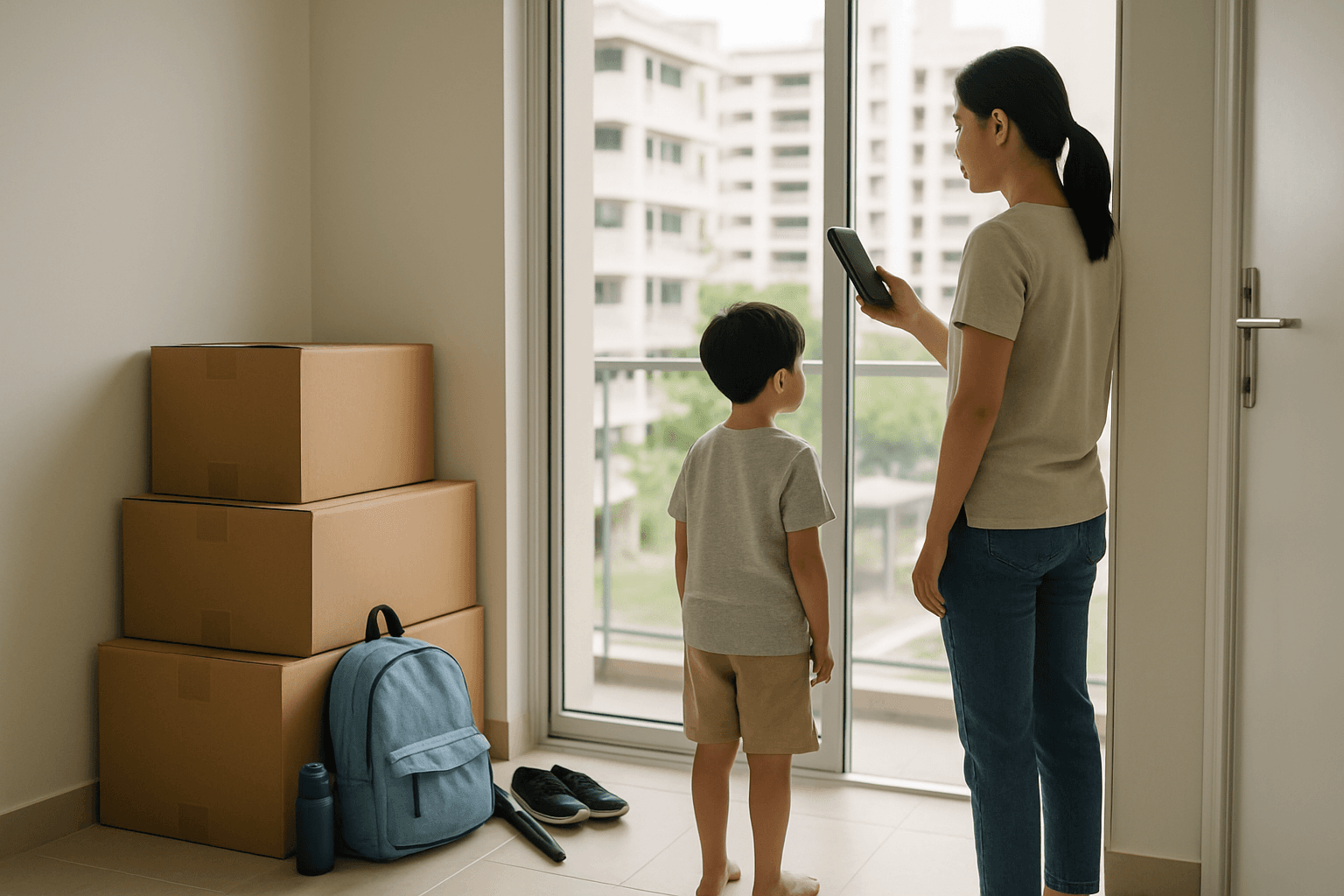
If you move after submitting Primary 1 registration, your application is not usually wiped out or automatically recalculated around your new home. But the move still matters. MOE uses the address declared at registration for home-school distance priority, and a later move can also create practical problems with school transport, student care, and daily caregiving. The safest way to think about it is simple: protect the registration record first, then re-check the weekday routine.
What happens if you move after submitting Primary 1 registration in Singapore?
A move after submission does not usually cancel the application, but the address used for registration still matters and should be clarified early.
The short answer is that your Primary 1 registration is not usually erased just because you moved. But the move still matters because MOE’s Primary 1 framework uses the address declared at registration for distance-based priority when a school is oversubscribed, as explained on MOE’s Primary 1 registration page and its Home-School Distance guidance.
In practice, parents usually run into one of three situations. Some move after submitting the application but before results are released. Some move after a place has already been allocated. Others move close to the start of school and realise the bigger issue is not the paperwork, but whether the school day still works. These situations do not all lead to the same next step, but they share one practical point: the move does not automatically update the registration record for you.
A useful way to think about it is in two parts. First, the address used at registration must still be truthful and supportable if MOE asks for proof. Second, your new home may change whether the school still works for drop-off, pick-up, transport, and care. Parents often focus on only one side. The safer approach is to check both early. For a broader overview, see Primary 1 Registration in Singapore: How It Works, Balloting Risk, and How to Choose a Realistic School Plan.
All about Transferring to Other Primary Schools
Hi hennaoh, Please refer to the FAQ below. Does it address your situation? https://va.ecitizen.gov.sg/cfp/customerPages/moe/ExploreFaq.aspx?Category=3645&Mesid=422335 Q:- I am in the midst of purchasing a new resale property. The transaction will be completed soon and I will be able to move in prior to the commencement of the academic year. Can I make use of this new address to register my child? Answer: The resale Housing & Development Board (HDB) flat's/ private property’s address can be used
All about Transferring to Other Primary Schools
To add, In this link https://va.ecitizen.gov.sg/cfp/customerPages/moe/explorefaq.aspx?Category=3645&utm_source=moe-corp-site&utm_medium=referral Look for Q. I have purchased a yet-to-be completed property and should be moving in after the property is completed. Can I make use of the new home address for Primary One (P1) registration?
Does a new address change your child's Primary 1 school placement?
Usually no. The important address for Primary 1 distance priority is the one used during registration, not the home you moved to later.
Usually, no. Parents should not assume a later move automatically changes the school outcome. For Primary 1, the key address is the one used at registration, because that is what feeds the distance category if the school is oversubscribed. MOE’s home address guidance and distance rules are the main references.
This is where many families get confused. Your current home and your registered address may no longer be the same, but that does not mean the system will simply replace the old address with the new one and rerun the result. In most cases, a later move does not rewrite the original application. What it can change is whether you need to explain the situation and provide evidence if the declared address is queried.
A practical takeaway: moving later is not the same as having registered wrongly. If your child has already been allocated a place, that place does not usually disappear just because the new home is farther away. The bigger risk is when the address used during registration cannot be supported, or looks inconsistent with the family’s actual living arrangement. For a broader overview, see Primary 1 Registration Distance Priority: How Home-School Distance Works.
All about Transferring to Other Primary Schools
https://www.moe.gov.sg/primary/transfers “You can apply to transfer your child to a primary school nearer to your new residential address if your child is: - A Singapore Citizen (SC) or Permanent Resident (PR). - Currently in Primary 1 to 5. We will offer your child a school nearer to your new residential address which has available vacancies. Your child will have to report to the new school by the end of the reporting period to complete the school transfer. Your NRIC must be updated with your n
[Punggol] Primary Schools
Hi parents, I am originally staying in Tampines and am moving to Punggol this month. As I am planning to register my child in P1 at Punggol next year, what are the steps I need to do, in order to register? Is it just popping by the Police Station to update my address will do?
Have More Questions?
Get personalized guidance on schools, tuition, enrichment and education pathways with AskVaiser.
Try AskVaiser for Free →When should parents tell MOE or the school about an address change?
Inform MOE or the school as soon as the move is known, especially if it changes your residence details, contact information, or school-day logistics.
Tell them as early as you can once the move is confirmed or clearly imminent. The official MOE pages do not set out a detailed post-submission address-change workflow for every scenario, so the practical move is not to wait for a perfect rule. It is to contact MOE or the school early if your residence details, contact information, or daily school arrangements have changed.
This matters even more when school is about to start. MOE’s guidance on reporting to school and transition to Primary 1 shows that orientation is when many parents sort out school bus, school-based student care, and other start-of-school logistics. If your move affects any of these, raise it before orientation if possible. If you cannot attend orientation because of the move or your schedule, contact the school and make alternative arrangements.
A simple insight helps here: early clarification is easier than late explanation. The main benefit of telling MOE or the school early is not only compliance. It is avoiding a last-minute scramble when transport, pick-up, or care plans no longer work. For a broader overview, see Primary 1 Registration After Moving House: Should You Use Your Old or New Address?.
For Reference for P1 registration: MOE Official Letters
http://www.kiasuparents.com/kiasu/forum/viewtopic.php?p=293646#p293646 Dear Sir/Madam, Thank you for writing to us on 12 November 2010. We wish to clarify that parents using address of rented apartment will not be at a disadvantage if the school should conduct balloting. We would like to share with you that the registration is done based on the NRIC address that is reflected on the parents' NRIC at the time of registration and the address used for the registration of a child (assuming Singapore
All about Transferring to Other Primary Schools
Huh? If you are going to move to Seletar area this year end, why are you registering in Tampines / Tampines area? You could have registered with a school in the Seletar area during Phase 2C or 2CS using your new address. As it stands, you are in breach of the 30 months rule if you have registered at Tampines Primary in Phase 2C and have no intention of staying at your place for 30 months. It’s best if you start to request for a transfer before MOE commence Phase 3 and before you start school.
What practical problems can come up after a move?
The most common problems are a longer commute, harder drop-off and pick-up, and care arrangements that no longer work smoothly.
For most families, the hardest problems are not on the registration form. They show up during the school run. A school that once seemed nearby can become tiring if the new home adds a long walk, a bus transfer, traffic delays, or an earlier morning start that does not suit a six- or seven-year-old.
The move can also break support arrangements that parents took for granted. A grandparent who could do pick-up may now be too far away. A school bus service may not cover the new address. A parent who used to manage drop-off before work may now be facing an extra detour every morning. Even when the school place stays the same, the daily routine can become much more fragile.
This is why parents should judge school fit by weekday reality, not just by the original registration plan. If you are rethinking whether the school still makes sense after the move, our Primary 1 registration guide and this piece on whether to pick a popular dream school or a safer nearby school can help you compare ambition against routine. For a broader overview, see Which Home Address Counts for Primary 1 Registration in Singapore?.
*** READ ME FIRST !!! - P1 Registration FAQ ***
2A need to apply at school , so withdrawal also need to be at school. Then go over to school B for registration. Consider time for travel, withdrawal take 5-10min. Buffer 1.5 hours would be safe if driving. If you can let us know your 2C choice , we can tell you the risk. It might be worth just to go 2C
*** READ ME FIRST !!! - P1 Registration FAQ ***
Can someone tell me if this rule is new starting from this year or was it around before? Extracted from MOE FAQ under Proximity to School FAQ 4. How long do we need to stay in the address used to register our child during the P1 Registration Exercise? In a small number of cases, there may be situations where the families are unable to remain at the address for the entire duration of the primary school studies. Even so, a child who gains priority admission into a school through his/her distance c
What if the new home is farther from the school than expected?
Re-check the school as a daily routine, not just a choice on paper. A workable commute matters more than a school name if the travel becomes too heavy.
Treat this as a routine test, not a map exercise. If you can, try the journey during actual school hours. A route that looks simple on a phone can feel very different once you add the walk to the bus stop, waiting time, crowded transport, rain, and the final walk into school. Young children also feel the strain more quickly than adults do.
Parents often discover the real issue only after moving. The school bus may not serve the new address. An MRT route may be direct, but the transfer and walk make the trip much harder. A grandparent may still be willing to help, but the longer handover makes the arrangement unreliable. In these cases, the school itself may still be fine. The problem is that the routine now depends on too many moving parts.
A useful rule of thumb is this: a school place is only as strong as the daily plan around it. If the move adds a little time and your transport and caregiver support still hold, staying with the same plan may be perfectly sensible. If every morning now requires tight timing, multiple adults, and no delays, that is a sign to raise the issue early and rethink the logistics honestly.
[Punggol] Primary Schools
hi hi my understanding is can use the new address, but i think must provide HDB documentation. It is good to check on during P1 registration. BTW Meetoh is a very popular sch. If u r the ex-student, it should not be a prob to get a seat. But if u r under phase 2C, please prepare for balloting. This sch practically every yr needs balloting.
2B Primary one registration question
Hi, Hope all is well. I have been serving as an active community leader in one GRC for over 2 years. Just before primary one registration, if we move to a new address, are we able to register the child in 2B phase for schools within 2km in the new address?
What documents or proof should parents keep after moving?
Keep evidence showing your old address, your new address, and the timing of the move. Examples help, even if there is no single official checklist.
Keep documents that help show where you lived, where you live now, and when the move happened. MOE’s home address guidance makes clear that parents may need to provide evidence that the information used for registration was true and accurate, but the official materials do not give one fixed post-move checklist.
That is why it is better to think in terms of useful evidence rather than one magic document. Common examples parents often keep include a tenancy agreement, sale completion or handover papers, utility or telecom bills, updated address records, or other dated documents that show actual residence. These are examples only, not guaranteed requirements.
It is also wise to keep proof for both addresses, not just the new one. If the move happened soon after registration, parents may need to explain the timeline clearly. This matters even more if the family was in a temporary rental, waiting for renovation works, staying with relatives for a short period, or moving in stages. In those cases, dated records help far more than memory. For more preparation ideas, see our guides on which home address counts for Primary 1 registration and documents parents commonly prepare.
*** READ ME FIRST !!! - P1 Registration FAQ ***
For Singaporean - The child’s Singapore Birth Certificate - The child’s Singapore Citizenship Certificate for those who are not Singapore Citizens at the time of birth - Singapore NRIC of both parents or Entry / Re-entry Permits of parents if they do not possess Singapore NRIC - The child’s Immunisation Certificates For PR - The child’s Birth Certificate - The child’s Entry/Re-entry Permit - Singapore NRIC of both parents or Entry/Re-entry Permits of parents if they do not possess Singapore NRIC
*** READ ME FIRST !!! - P1 Registration FAQ ***
We will move to Singapore in December 2015 (house-hunt scheduled by company in November) which means we won’t have a local address to specify during the Primary 1 registration scheduled on August 27. Can someone give us ideas on how to go about the registration? Can we specify an office address (which is going to be near where we plan to look for a house), or our intended location (without a specific address) ? Really need help with these questions as MoE simply responded with “you need to have
What parents often misunderstand about changing address after P1 registration
A move is not just an admin detail. It can affect both address verification and whether the school still fits your family’s weekday routine.
The two biggest mistakes are assuming the new address automatically replaces the old one, and treating the move as only an admin update. In reality, it can become both a verification issue and a routine issue.
There is also a more serious point. Under MOE’s home address guidance, MOE takes a serious view of intentional misuse of addresses in the Primary 1 process and may transfer a child out of the registered school, in its sole discretion, if it establishes abuse or if parents cannot provide evidence that the information declared was true and accurate.
Short version: a move is not just a change of postcode. It can affect both the truth of the registration record and whether the school still works every day.
*** READ ME FIRST !!! - P1 Registration FAQ ***
Will you still be staying with your in-laws if your son is admitted to a school in Sengkang? You should only register using the address where you will be physically located. By the way, if your son fails to get into the school in P2C, you can only register him in P2CS. Those popular schools will have their places filled by P2C, so is there any point in changing your address back to Sengkang?
All about Transferring to Other Primary Schools
hi may i check what are the procedures like for changing primary school ? because change of address
How should parents decide whether to keep the current school plan after moving?
Keep the plan if the commute and care arrangements still work comfortably. Reassess it if the move turns school days into a chain of timing risks and handovers.
Start with the basics. Confirm that the school place stands, make sure the registered address can still be properly explained if needed, and then test the new weekday routine honestly. Parents often make better decisions when they stop asking only, "Is this a good school?" and start asking, "Can we run this school day after day without burning out?"
For some families, the answer is still yes. If the move adds ten or fifteen minutes but the bus route, parent work schedule, and after-school care still hold, keeping the existing plan may be the simplest and best choice. For others, the move changes everything. A parent may no longer be able to reach school before office hours. A grandparent support plan may break down. A child may now need a much earlier start and multiple transfers.
When parents regret a school plan after moving, it is often because they assessed the school once and never reassessed the routine. If the school is still manageable, keeping the plan usually avoids unnecessary disruption. If the move has made the routine fragile, make a logistics-first decision rather than an emotional one. For a wider view of how distance affects school choice, see our guide on Primary 1 distance priority.
All about Transferring to Other Primary Schools
My son is P1 next year. So registration this year. However he is foreigner status so won’t qualify till phase 3. I will be applying for pr for him as I am Singaporean. Hubby is old boy of acs too, but again we don’t qualify for 2a as not SC or PR. Wondering if we can start off in international sch (P1) and then transfer later (maybe p2).[/quote] Transfer from International schools to local schools happen quite frequently. However, transfer tend to be for less popular local schools since they hav
All about Transferring to Other Primary Schools
When is the LAST day of primary schools' Term 4, before year-end school holiday start ? Answer : Friday, 18 November 2022 The Transfer school processing itself, will depend on Total number of candidates, who have applied to seek Transfer into the same, identical primary school. The more competitive the primary school is, the longer processing time required, especially if the school has received \"high mountain piled up, highly\" Transfer Application Form requests, from parents all over Singapore
Can I change the address used for Primary 1 registration after I move?
Not automatically. Contact MOE or the school to clarify what needs updating, and keep proof of both the old and new address.
Not automatically just because you moved. The registered address remains important for Primary 1 distance priority, so if your living situation changes after submission, the practical next step is to contact MOE or the school to clarify what, if anything, should be updated.
In practice, there are usually two separate issues. One is operational: the school may need your current address and contact details for orientation, transport, or routine communication. The other is evidential: if there is any question about the address used during registration, you may need to show documents that explain both the earlier and current position. That is why it is often useful to keep proof of both addresses.
If your real question is whether you should have used the old address or the new one in the first place, the next useful read is our guide on Primary 1 registration after moving house: old or new address.
All about Transferring to Other Primary Schools
That's a tricky question. From MOE's website, it says: \"30-month stay requirement MOE recognises that some families are unable to remain at the address used for registration for the entire duration of the child's primary school studies. Even so, a child who gains priority admission through their distance category is required to reside at the address used for registration for at least 30 months from the start of the P1 Registration Exercise. For reference, the 2021 P1 Registration Exercise start
Address for P1 Registration (Phase 2B)
Hi Parents, May I check if anyone has encountered this situation and managed to register successfully under Phase 2B? I am currently an active GRL (Grassroots Leader) in the Punggol area, but I intend to shift to another area in June 2026. My questions are: Do I need to update my address before receiving the Phase 2B verification letter, or can I update it after receiving the letter? For Phase 2B registration, will MOE base eligibility on the residential address shown on my NRIC? is it ok if the
Have More Questions?
Get personalized guidance on schools, tuition, enrichment and education pathways with AskVaiser.
Try AskVaiser for Free →