
Why Neighbourhood Schools Can Be Harder to Enter Than Parents Expect in Primary 1 Registration
A practical look at why nearby primary schools in Singapore can still be competitive during Primary 1 registration.
Neighbourhood schools can be harder to enter than parents expect because proximity helps, but it does not guarantee a place. In Singapore’s Primary 1 registration, a nearby school may still be competitive if local demand is strong, if sibling, alumni, staff, or volunteer-linked applicants take priority, or if applications exceed vacancies in a phase and distance band. The practical lesson is to shortlist schools based on both convenience and entry risk, not convenience alone.
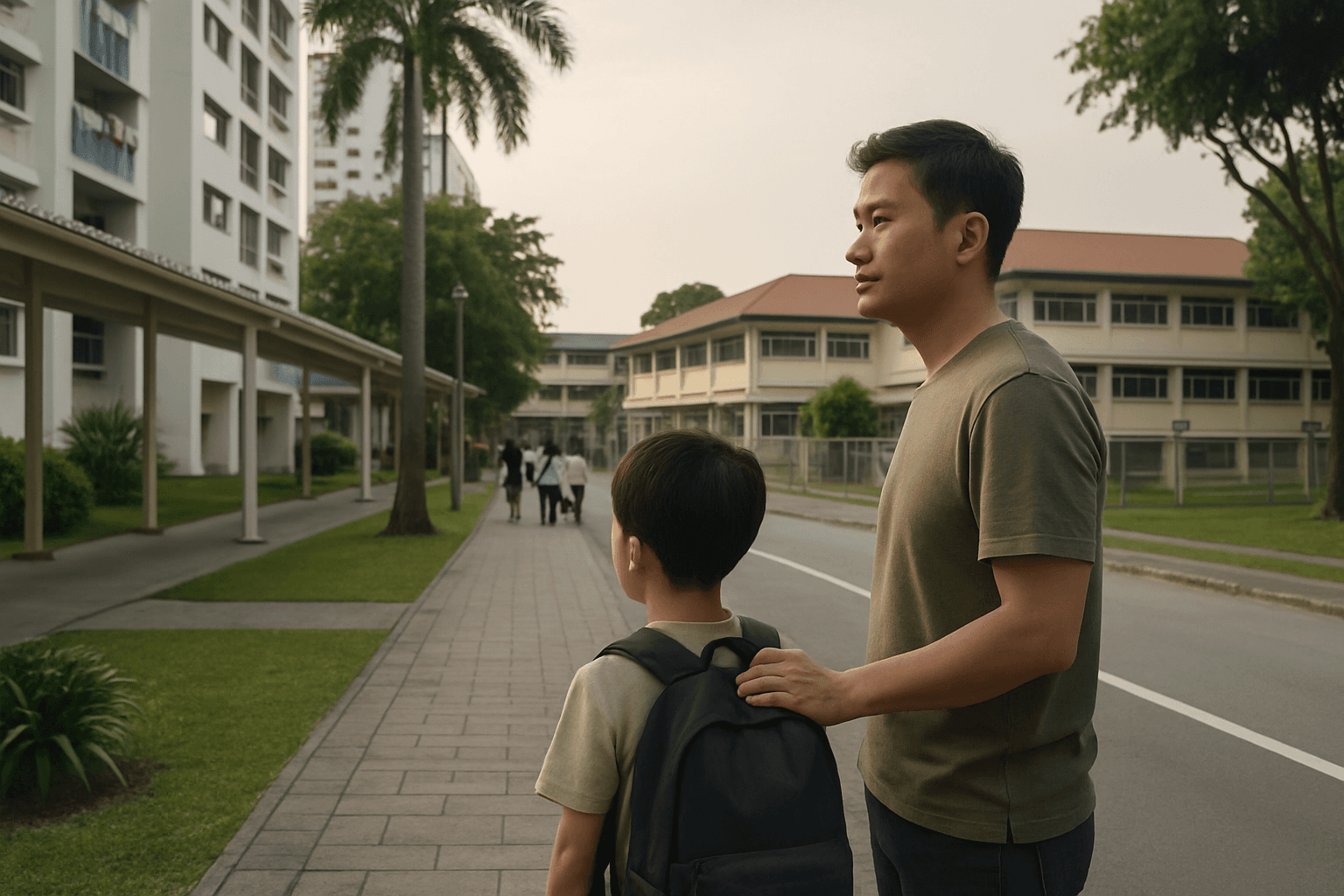
Many parents assume the nearest mainstream primary school is the safest choice. That is understandable, but Primary 1 registration does not work that way in practice. A neighbourhood school can still be oversubscribed when many nearby families apply, earlier priority groups take up places, or the remaining vacancies become tight enough for balloting.
What does it mean when a neighbourhood school is harder to enter than expected?
A neighbourhood school is harder to enter when local demand is strong enough that being nearby is not enough on its own. If applications exceed vacancies, balloting can still happen.
It means the school is close to home, but not automatically easy to secure. A neighbourhood primary school becomes harder to enter when more families apply than there are places available for them at that stage of the Primary 1 registration process.
A common parent scenario is a family in a large HDB estate assuming the nearest school is their low-risk option, only to realise many other nearby families made the same choice. The school may not be seen as a "top school", but it can still be attractive because it is practical, familiar, and manageable for daily routines.
Think of "neighbourhood" as a location label, not a guarantee label. Close by may reduce travel stress, but it does not mean every child living nearby will get in. For a broader overview, see Primary 1 Registration in Singapore: How It Works, Balloting Risk, and How to Choose a Realistic School Plan.
[Central] Primary Schools
Hi Msrajey, Hmm I think it is at the sole discretion of the principal to sieve out the applicants. Basically, we were given a form during registration as PV on the areas that we would like to contribute.. The numbers of PV that the school opens for registration has been dropping... Was 60 during my time then dropped to 30 last year. Seems like the number further dwindled into half this year, judging by Phase 2B's actual no. of applicants? Less PV = more vacancies for Phase 2C... When is your chi
All About Preparing For Primary One
First of all, how far are u from the school? Within 1km or 1 - 2km? If near, don't take school bus, send yourself. Any balloting history for the neighbourhood school under 2C?
Why can a mainstream neighbourhood school still be competitive?
A neighbourhood school can be competitive because many families want the same practical, convenient option. Strong demand often comes from location and daily-life fit, not branding.
Competition often comes from local demand, not just prestige. A school can be mainstream and still draw many applications because it sits near a dense housing catchment, serves several estates, or is simply the most workable daily option for families.
In Singapore, convenience is a major driver. A school near a large HDB cluster, a bus interchange, or a stretch of estates with many young children can become the default first choice for many households. Parents may not see it as a "brand name" school, but they may still want it because the commute is shorter, grandparents can help with pick-up, or the morning routine is easier to manage.
This is what many parents overlook: the "practical" school is often the one most families want. A school does not need a big reputation to be competitive; it only needs to be the most sensible option for enough nearby families. For a broader overview, see Primary 1 Registration Phases in Singapore: What Each Phase Means for Your Chances.
Are All Primary Schools The Same?
A lot of people underestimate the role parents play in the education landscape. In every school, the “parent support group” synergy can be a powerful source of strength for further improvements. A school with a better track record attracts parents who want the same for their children. Higher expectations will also lead to higher demands on the school teachers. In some schools, it is not uncommon for parents to voice their concerns to the school leaders, even to the ministry if teachers or exam p
All About Preparing For Primary One
My son is going primary 1 next year and I am eligible for phase 2b under a good school but it took two hours of time of bus transport to n fro from home. The kid have to be at the bus stop at 6am waiting for bus. That school have proven track record for the past many years because of it’s strict standards. Now, my headache is there Is a relatively new school which is only a few years old n has not proven track records n the highest psle scores is 230plus. This school is just downstairs my home b
Have More Questions?
Get personalized guidance on schools, tuition, enrichment and education pathways with AskVaiser.
Try AskVaiser for Free →How does Primary 1 registration affect your chances at a nearby school?
Your chances depend on vacancies, priority groups, and official distance bands. Living nearby helps only if there are still places left for your group.
Your child is not admitted just because the school looks close on a map. Entry is shaped by the Primary 1 registration guide, the number of vacancies still available at your stage, and how many families in the same priority and distance categories are applying.
That is why two families who both feel "near enough" to the same school can end up with very different outcomes. One family may be applying when there are still places available in their band, while another may find that earlier-priority groups have already taken up much of the intake. If applications exceed vacancies in the relevant phase and distance category, balloting can happen.
Distance still matters, but it has to be read correctly. MOE recommends using the official home-school distance guidance and School Query approach, because a rough map estimate may not match the official measurement. For a clearer explanation, see how home-school distance works.
[Central] Primary Schools
http://www.moe.gov.sg/education/admissions/primary-one-registration/vacancies/#header
[Central] Primary Schools
normally after all dust had settled after P1 registration Phases had ended, if vacancie(s) arise in the event a child withdraw from school before P1 Term 1 commence, transfer may take place. After 2B end, you may fill up the Transfer form, state down your reason(s) for Transfer that you were a PV before - so that P is aware, take notice of your unique application. However, it's up to individual school Principal (P) decision - who she want to take in. It is up to P whether or not she prefer to gi
What do parents often get wrong about neighbourhood schools?
Parents often overestimate what proximity can do and underestimate how competitive a practical local school can become. Near does not mean safe.
The biggest mistake is assuming near means safe. It does not. A shorter distance can improve your position, but it does not create a reserved place for every child who lives nearby.
The second mistake is assuming only famous schools are risky. In reality, a school can be little discussed online and still be hard to enter because it is the preferred choice for many families in that estate. Parents sometimes spend too much time worrying about headline schools and not enough time studying the practical competition around their own block.
The third mistake is treating convenience as the same thing as certainty. They are not the same. If a school looks like the obvious sensible choice for your family, it may also look like the obvious sensible choice for many other families nearby.
A simple way to remember it: close by lowers the travel burden, not the competition. For a broader overview, see How to Read Past Balloting Data Before Chasing a Popular Primary School.
All About Preparing For Primary One
Starting primary school? This is a big milestone. Do enjoy the journey with your child! :rahrah: https://www.straitstimes.com/singapore/education/the-st-guide-to-preparing-your-child-for-primary-1 Parents often confuse being ready for school with being academically capable in skills like reading and counting. Instead of focusing solely on academic progress, it is more important to make learning an enjoyable process, and help your child have a swift and happier adjustment to primary school. Here
Top Primary school?
for me, there is only one school within 1km from my place...it is a good one, but...i don't have any girls. i will need to ballot for a place for one sch within 1-2km from my place (next nearest school). if *touch wood*, balloting is unsuccessful, i will go for the next nearest neighbourhood school. for this, i am wary that this school focus its resources on the 'diamond' class and streaming starts as early as end of P1! getting him into such class will be my next best bet. so neighbourhood scho
Which families usually have more of an edge at a neighbourhood school?
Families with sibling, alumni, staff, or some volunteer-related links may have an edge, but that edge is not a guarantee. These links can also reduce the places left for everyone else.
Families with existing links to a school often start from a stronger position than families choosing the school purely for convenience. In broad terms, sibling, alumni, staff, and some volunteer-related links can matter during Primary 1 registration because they may affect priority before places are fully opened up to other applicants.
This is one reason a neighbourhood school can feel unexpectedly tight. A parent may look at a school and think, "It is just the closest one to us," while missing the fact that a meaningful share of applicants may already have school ties. By the time families without those ties are competing for places, the remaining vacancies can be much narrower.
It is still important not to overread these links. They can improve odds, but they do not remove competition. Even parent volunteering is not a guaranteed path to entry, as explained in this KiasuParents overview on parent volunteering. The practical takeaway is simple: treat school ties as an advantage, not a promise. For a broader overview, see Popular Primary School vs Neighbourhood School in Singapore: Which Is Better for Your Child?.
[Central] Primary Schools
@qms : thanks for the advice didn't knew that Primary School registration will be such a stressful and competitive \"game\" for the parents I have heard from other parents in my son's kindergarten with elder siblings that the parents will each station at different Sch to do registration together on P2C and live update each other on the latest \"battle\" status. Then they will choose and withdraw application of their plan B sch should they get into their first choice sch... Something like that ri
All About Preparing For Primary One
Was surfing around on understanding if I am well prepared on behalf of my DD1 for Primary 1 Chanced upon a few websites, thought to share though it could have been mentioned before Tips For Parents ◦Work on independent reading skills. ◦Set up a study area and regular study times that are not interrupted. ◦Learn to follow a routine with a lot of sleep and early mornings. ◦Practice organisation and planning by packing a daily bag with essentials for the day. ◦Talk about social skills and communica
What local conditions make a neighbourhood school more likely to be oversubscribed?
Neighbourhood schools are more likely to be oversubscribed when they sit in dense housing areas, serve several nearby estates, or offer especially convenient daily travel. Local practicality can drive demand as much as reputation does.
The clearest signal is concentrated demand. A school is more likely to be oversubscribed when it sits near a large housing catchment, serves multiple estates at once, or is especially convenient for families who want to keep weekday travel short and predictable.
In Singapore, common patterns include schools near large HDB clusters, schools surrounded by many young families, and schools that are easy to reach for grandparents, childcare pick-up, or a parent's commute route. Another factor parents sometimes overlook is school size. Some schools simply have larger Primary 1 intakes than others, so two nearby schools in the same district can face very different levels of pressure.
These are not guarantees that a specific school will be difficult. They are demand clues. If a school looks centrally placed, practical for daily routines, and surrounded by many homes, it deserves a closer look before you assume it is your easy backup. For a broader parent perspective, this guide on how to choose the best primary school near you is a useful companion read.
Sengkang/punggol primary school - input from parents of kids in schools in these area?
~ starting to think about primary school registration (applying this year, 2025) and it’s giving me a headache. The schools my kid has a good chance of getting in (2B - 1km) are: 1)Nativity primary 2)Mee Toh 3) Rivervale primary My kid is really quite nerdy and has a hard time finding friends because of her subject-specific interests (usually science-related). Has expressed a preference for co-ed, but I don’t know how seriously to consider her input. Nan Chiau (phase 2b) seems impossible because
All about Transferring to Other Primary Schools
Note that primary schools normally have a class size of maximum 30 for P1 and P2 (I think it’s MOE policy) so for most schools, unless there are parents who give up their confirmed places, it is unlikely there will be any vacancy until P3, where schools are allowed to have 30++ for each class. Or you can approach the schools that still have vacancies after P1 registration (all phases) for P1 and P2 transfers.
How should parents shortlist schools more realistically?
Shortlist schools by balancing preference, convenience, and entry risk. A realistic three-school plan is usually safer than a one-school plan.
- ✓Build your shortlist around at least one preferred option, one realistic option, and one lower-risk backup rather than assuming one nearby school will work out.
- ✓Check your official distance position using MOE's recommended School Query method, and do not rely only on a map app or estimated walking route.
- ✓Compare the daily commute in real life, including morning traffic, caregiver handover, rain, after-school pickup, and whether another adult can manage the trip if plans change.
- ✓Look at whether the school serves a dense housing cluster or several nearby estates, because that often signals stronger demand even for a neighbourhood primary school.
- ✓Factor in any family links such as sibling, alumni, staff, or volunteer-related connections, but treat them as an advantage rather than a certainty.
- ✓Read [past balloting data](/blog/how-to-read-past-balloting-data-before-chasing-a-popular-primary-school) as a pattern, not a forecast of this year's outcome.
- ✓If you are torn between convenience and aspiration, compare the trade-offs in [this guide to popular versus neighbourhood school choices](/blog/popular-primary-school-vs-neighbourhood-school-in-singapore).
- ✓When choosing a fallback, use practical backup thinking rather than prestige thinking; this KiasuParents article on spotting a good safety school can help.
What should you do if your first-choice neighbourhood school looks competitive?
If your first-choice neighbourhood school looks competitive, verify your distance, prepare a workable backup early, and decide in advance how much uncertainty you can accept.
Start with the checks you can control. Confirm your official distance result, review whether your family has any school ties that may matter, and decide early how much risk you are genuinely willing to take. Parents often get stuck because they are emotionally anchored to the most convenient school and leave backup planning too late.
Then build a fallback that you would actually accept. That usually means identifying at least one alternative school within a practical travel range and testing the routine honestly. A backup is not useful if it only works on paper but breaks down once work hours, transport, or caregiving arrangements come into play.
It also helps to prepare mentally for balloting instead of treating it as a remote possibility. If your preferred school sits in a dense estate or shows signs of strong local demand, assume uncertainty and plan around it. You may find it useful to read what each registration phase means for your chances, how to compare a dream school with a safer nearby option, and what happens if you do not get your preferred school. The goal is not to predict the exact outcome. It is to avoid being surprised by a result that was always possible.
All about Transferring to Other Primary Schools
Primary schools normally have a class size of maximum 30 for P1 and P2 (I think it's MOE policy) so unless there are parents who give up their confirmed places, it is unlikely there will be any vacancy until P3, where schools are allowed to have 30++ for each class. I do know of a case where a student did not turn up since first day of P1. Around Term 2, a student from another school was transferred. This student was balloted out from earlier phase (parent volunteer). For normal transfer (P3 and
All about Transferring to Other Primary Schools
Parents, do take note of which primary school, u are attempting to seek Transfer into, for your P2 kid. 1) if is not a popular, just an ordinary neighbourhood school, vacancies may still arise at end of P2, for those seeking Transfer. 2) But, if is a highly popular GEP school like Raffles Girls' Primary (for example), If any vacancies (if any) were to arise during the course of entire P2, the school will rather \"keep\" or reserve these vacancies, wait until ... the end of P3, before start to co
What is the simplest way to think about neighbourhood school risk?
Treat a neighbourhood school as easier to travel to, not automatically easier to secure.
Proximity reduces inconvenience, but it does not remove competition.
A nearby school is easier to commute to, not automatically easier to enter.
All about Transferring to Other Primary Schools
If u transfer in at P2, you have control over which schools u apply to. But if u apply at Phase 3, u have zero control. MOE has a history of assigning foreigners a school far far away from their home. To ensure better spread of racial groups - no congregating of ethnic enclaves into a particular region in Singapore. IMPT NOTE: if u are really intending to apply at Phase 3 this year, do take note of the important dates that u have to Pre-register. There has been a change in the rules from this ye
[Pasir Ris] Primary Schools
Hi, I am a newbie here. I require some advice on the P1 registration for 2014 intake and I hope you guys can assist me I just paid an booking fee for a HDB resale unit, and the OTP is due to be signed in 14 days time. I will be registering my daughter under Phase 2C 1st Question: Will MOE base the proximity of the school I choose on my current residence or the "new"residence which I am buying. I do not expect the lease of agreement to be signed anytime now, but at least in 3rd or 4th quarter 201
Have More Questions?
Get personalized guidance on schools, tuition, enrichment and education pathways with AskVaiser.
Try AskVaiser for Free →