
Working Parents in Singapore: Should You Prioritise Convenience Over School Prestige for Primary 1?
A practical guide to commute, after-school care, school fit, and reputation for Primary 1 decisions.
Usually, yes. For most dual-income families, a convenient Primary 1 school is the more sustainable choice. Prestige only matters when the school is a clear fit for your child and your family can manage drop-off, pick-up, after-school care, and disruptions without chronic stress.
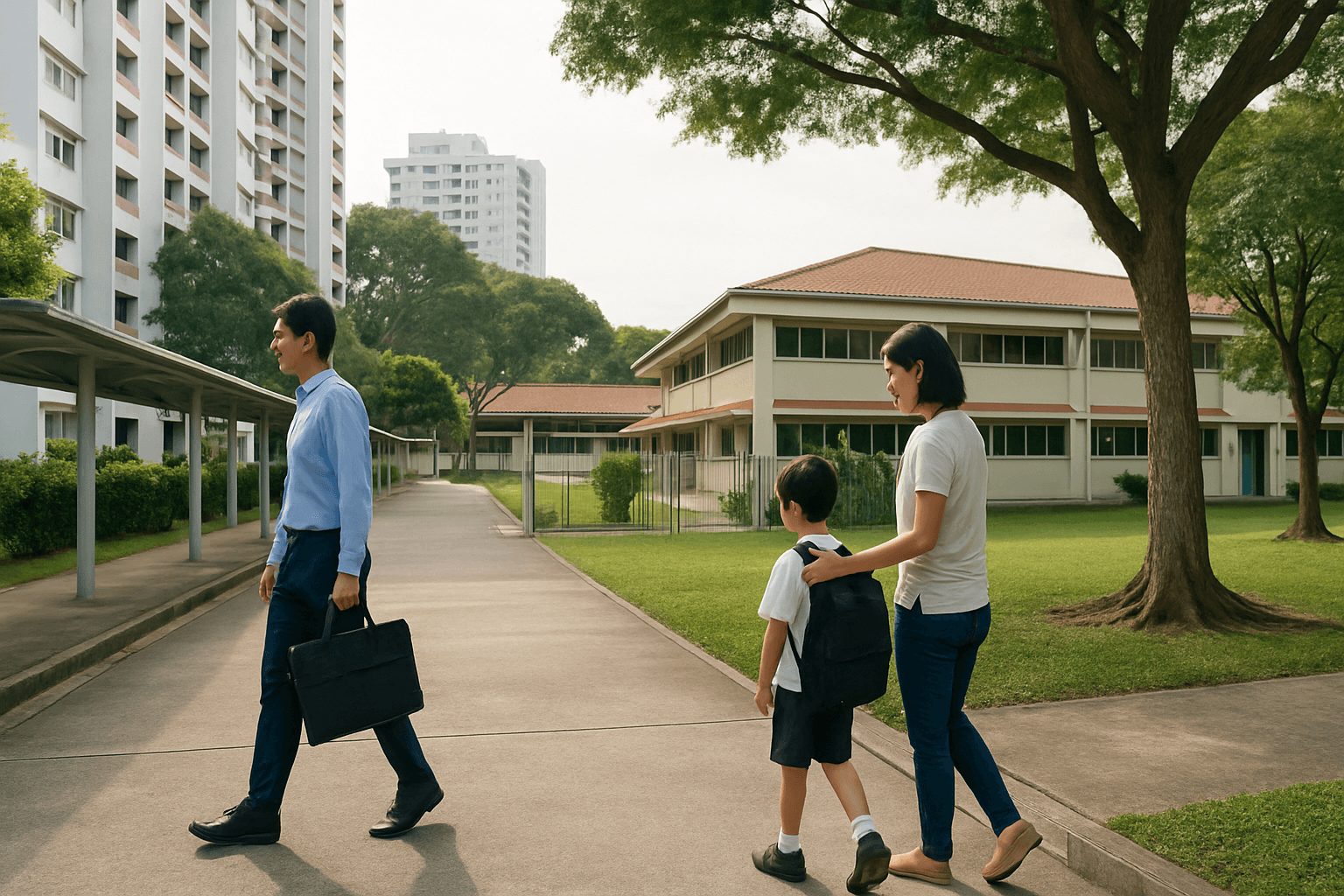
If both parents work full-time, convenience usually deserves more weight than school prestige for Primary 1. A well-known school only becomes a strong choice if your family can handle the daily routine without constant rushing, fragile pick-up plans, or repeated dependence on leave, luck, or one exhausted caregiver.
This does not mean you should always choose the nearest school. It means you should first shortlist schools your household can realistically sustain, then compare fit, culture, programmes, and admission chances. This guide helps you weigh reputation against the things working parents deal with every week: commute time, handoff arrangements, student care, emergency backup, and whether the routine still holds on a difficult day.
Should working parents prioritise convenience over school prestige for Primary 1?
Usually, yes. If the school does not fit your weekday routine, prestige is unlikely to outweigh the daily strain.
For most dual-income families, yes. Convenience should usually be the first filter, not the last one. If a school does not fit your real weekday routine, its reputation rarely makes up for repeated late pick-ups, tiring mornings, and a child starting Primary 1 already worn out.
The more useful way to think about it is this: choose from schools your family can actually sustain. Once a school clears that test, then compare culture, programmes, child fit, and admission realism. If neither parent has flexible hours, grandparent support is limited, and after-school coverage is shaky, a more manageable school is usually the safer long-term choice.
Think of school choice as a sustainability decision, not a status decision. A school is only a good choice if your family can live with it on an ordinary Tuesday. If you are still deciding which schools are realistic overall, start with our Primary 1 Registration in Singapore guide, then compare it with our article on whether to pick a popular dream school or a safer nearby school.
[Geylang] Primary Schools
For primary schools, I recommend going for convenience than popularity. Reason is the kids are still young, and travelling time should not be long enough to tire them out, even for those driving. Have you seen children dozing off in the parents car (some in an awkward position, especially straining their necks) because they have to wait up earlier than their peers to reach these “better” schools to feed their parents “ego”. Please note that the above is just my PERSONAL view as I have gone throu
All About Preparing For Primary One
Starting primary school? This is a big milestone. Do enjoy the journey with your child! :rahrah: https://www.straitstimes.com/singapore/education/the-st-guide-to-preparing-your-child-for-primary-1 Parents often confuse being ready for school with being academically capable in skills like reading and counting. Instead of focusing solely on academic progress, it is more important to make learning an enjoyable process, and help your child have a swift and happier adjustment to primary school. Here
What does convenience really mean for a Primary 1 family in Singapore?
Convenience is more than being nearby. It includes travel time, transport mode, handoff arrangements, backup care, and whether the school day fits both parents’ work schedules.
Convenience is more than distance from home. For working parents, it means the whole weekday system: travel time, transport mode, who drops off, who picks up, how the child gets to student care, and what happens when work runs late or a caregiver is suddenly unavailable.
A school can look close on paper and still be inconvenient in practice. For example, a school near home may be awkward if both parents commute in opposite directions and there is no reliable grandparent or student care handoff. The reverse can also happen: a school slightly farther away may work better because it sits along one parent’s route to work, is near a grandparent, or connects cleanly to after-school care.
Parents also often confuse registration distance with daily convenience. Home-school distance may affect your registration priority, but it does not tell you whether the school run will feel calm and sustainable. Use our guide on how home-school distance works for Primary 1 registration to understand the rule, then test the route during actual school-run hours. If the route only works in ideal conditions, it is not truly convenient. For a broader overview, see Primary 1 Registration: Should You Pick a Popular Dream School or a Safer Nearby School?.
Preschools prepared your kids well for Singapore primary?
For parents who have already been through the pre-school days and with kids now in primary schools (Singapore schools), can you share your comments on your kid's previous preschool and their curriculum - specifically if they have prepared your child properly for the Singapore education system ? (not discussing the international or foreign schools system here) Nowadays, there are so many pre-schools and childcare centres with many learning methods. Parents currently at the pre-school stage will b
All About Preparing For Primary One
the standard of kindergarten and child care centres in SG varies from one another. Some kindy prepare kids well for P1, but other kindy not sufficient. The standard varies. moreover, P1 standard is getting higher and higher, each year. that is why some parents still prefer to send kids for P1 Prep course. if you think you come from a kindy where then standard is reasonable, then ok.
Have More Questions?
Get personalized guidance on schools, tuition, enrichment and education pathways with AskVaiser.
Try AskVaiser for Free →A popular school is not automatically the better school for your child.
A strong reputation does not guarantee better teaching, lower stress, or a better fit for your child.
School brand does not guarantee better teachers, an easier Primary 1 year, or a better classroom experience. Every school has a mix of teachers, and some popular schools also come with a faster peer pace or more visible comparison. That can suit some children, but it can also make the first year feel heavier than parents expected.
If you want a useful reset on why school name should not be treated as destiny, this article on whether a primary school determines future success is worth reading. For a broader overview, see Primary 1 Registration Distance Priority: How Home-School Distance Works.
Top Primary school?
Honestly I am not sure if there is such a thing as a top primary school based on the efforts of the school. All schools have the same mission set by MOE to deliver the same thing. If you hear from them, even teachers they have no control, it's all from MOE. So what then would you consider as top primary school? It definitely cannot be results alone because results are typically parents-driven in today's context in some schools. Every school has the best cream of the crop and the worst performers
[Punggol] Primary Schools
hmm… the most impt thing is your child must be happy. This must come from supportive parents in their learning. My boy enjoys his class and gamely contribute and am glad teachers (Chinese and form teacher) have been responsive in his learning. As he was a transferred student, I was also concern of him blending to his school but such were unfound. Phew! All in all, in a primary school, be it a popular, a top or mediocre school (in others’ opinion) you can still “control” a child’s learning habits
When does school prestige matter more than convenience?
Prestige matters more only when it brings a real benefit for your child and your family can comfortably carry the logistics.
Prestige matters more only when it comes with a concrete benefit your child is likely to feel, and your family can absorb the extra logistics without constant strain. The school name alone is not enough.
A longer commute may be worth it if the school offers a learning environment, culture, or programme that genuinely matches your child. For example, one child may do well in a more structured, academically brisk setting. Another may benefit from a school known for a specific language, arts, or co-curricular strength. In some families, the trade-off is also easier because an older sibling is already there, a grandparent lives nearby, or one parent has enough flexibility to keep the routine stable.
The better question is not "Is this school more prestigious?" It is "What concrete advantage will my child actually experience, and can we support that choice every week?" To assess that, look beyond the label. Use MOE’s SchoolFinder to compare programmes, and pay attention to visible culture signals such as student work, how staff speak during open houses, and the tone of the school’s public communications. For a parent-friendly perspective on reading those signals, this guide to alternative ways to assess a school is helpful. If your interest in a prestigious school is partly tied to admission strategy, remember that routes such as parent volunteering are not guaranteed; this overview of parent volunteering is a useful reality check. You can also compare this with our article on popular primary school vs neighbourhood school in Singapore.
[Geylang] Primary Schools
No problem, June. The decision is difficult because we believe it has significant impact on our children's education, which of course also impacts their future. The presence of a teacher that your child likes and respects in the school can make all the difference in determining how he will view his learning journey. We parents think, perhaps rather shallowly, that the \"elite\" schools have better teachers because they churn out national-level top students, that's why we are so eager to register
[Punggol] Primary Schools
Hi, I am considering between Punggol View and Changkat (Simei) for my daughter P1 in 2014. Appreciate your opinions. Punggol View - brand new school - not sure how the sch is in term of establishment, culture etc - convenience as it near to my place, I can send her in the morning - problem is who to fetch her - new building and up-to-date facilities Changkat (Simei) - my former school - near my parents’ place - slightly inconvenience > I have to drive & send her to school every morning, not sure
How should dual-working families assess drop-off and pick-up logistics?
Assume the school run will happen on your busiest weekday, not your smoothest one.
Test the school run against your hardest normal weekday, not your easiest one. Many parents imagine a smooth morning with no rain, no urgent meeting, and no transport delay. That is not a reliable planning model for Primary 1.
A better test is to run through common failure points. What happens if one parent is travelling? What if both parents have early meetings? Who does pick-up if your main caregiver falls sick? If your plan only works when one specific parent can drive every day, it may be too fragile. If grandparents are part of the solution, ask whether they can do it consistently, not just occasionally. If a helper will accompany the child, think through the route, handoff timing, and what happens on activity days or when work runs late.
Many parents plan carefully for drop-off but not for pick-up, even though pick-up is usually the harder problem. The practical question is simple: who does what on a normal day, and who steps in when that person cannot? If you cannot answer that clearly, the school may not be as workable as it looks. For a broader overview, see How to Read Past Balloting Data Before Chasing a Popular Primary School.
[Punggol] Primary Schools
Published on Jun 19, 2015 Oasis of learning in Punggol, to fill young minds source http://mypaper.sg/top-stories/oasis-lea ... s-20150619 THREE new primary schools will open in Punggol next year to help meet the growing demand in the area. The schools - Oasis Primary in Edgefield Plains, Punggol Cove Primary in Sumang Walk and Waterway Primary in Punggol Drive - will be able to take in 210 pupils each . They are located near a number of housing projects. Waterway Primary, for instance, is locate
[Jurong East] Primary Schools
there are 4 primary schools within 1 Km from my place: Yuhua, Fuhua, Jurong East and Princess Elizabeth. for 2C, we’d like to try Princess Elizabeth, but I’m afraid if we are not lucky enough, we may not have the chance to go into any of the 4 schools. How can we stratigise so that we can try our preferred school? many thanks for the advices from experienced parents.
What after-school care questions should parents ask before choosing a school?
Ask whether there is reliable after-school coverage, how the handoff works, and whether it truly matches your family’s work hours.
For many working parents, after-school coverage is the make-or-break factor. Before settling on a school, find out what care arrangements are realistically available and whether they fit your work hours, not just your preferred plan.
The important checks are practical. Is there student care in or near the school? How does the child get there after dismissal? Does the arrangement still work on days when school ends earlier than your workday, when activities run later, or when a parent is delayed? Some families also need to think ahead about school holidays, ad hoc closure days, and whether grandparents or helpers are only backup support or the main support.
It also helps to picture the child’s day from end to end. A prestigious school with a longer commute and a long after-school block may sound manageable on paper, but it may leave a six- or seven-year-old tired before the family even gets home. There is no single official checklist that covers every real-world care arrangement, so ask the school and provider directly about the handoff. The details often decide whether the routine feels calm or stressful.
[Geylang] Primary Schools
Hi thanks for your message. Ok lah, I will tell you everything. All the schools you mentioned are not too bad, in fact we qualify for phase 2B under Saint Stephen. But because I have a boy and a girl and expecting another girl, I opted this boys' school out. Don't wanna go through P1 registration stress again. I would choose Tao Nan if I have a choice because I had heard good feedbacks from my friends (who have kids in the school) and also due to its chinese culture emphasis (I'm from chinese sc
[Geylang] Primary Schools
School vacancies out ! http://www.moe.gov.sg/education/admissions/primary-one-registration/vacancies/#geylang How to pick the right school ? http://www.straitstimes.com/the-big-story/ask-sandra-p1-registration/story/how-pick-the-right-school-20130620
How much commute is too much for a Primary 1 child?
It is too much when travel consistently causes fatigue, rushing, late arrivals, or no room for backup when something goes wrong.
There is no official cut-off, but the practical threshold is easy to recognise: the commute is too much when it regularly causes fatigue, rushed mornings, late arrivals, or a routine with no backup margin.
You do not need a magic number to spot an unsustainable route. If your child has to wake up very early, make multiple transfers, carry bags through crowded transport, or arrives already tired, that is a warning sign. The same goes for a route that is manageable only because one parent can drive every day, even though that parent sometimes travels or works irregular hours.
Judge the commute by its failure points, not its best-case timing. A route that looks fine at 11am on a quiet weekday may feel very different during morning rush hour or heavy rain. If possible, test it in real conditions before deciding. If the journey keeps eating into sleep, calm mornings, or reliable after-school handoff, it is probably too heavy for Primary 1.
All About Preparing For Primary One
For me, two hours is just too long. Your child will need to wake up at 5:30am meaning that he should be in bed by 7:30pm every evening if he won't nap in the afternoon. Are you able to do that? As he gets older, there will be more after-school activities so he will be coming back very late. You say that the new school is not results-oriented. I think what you mean is that they don't make exam results the be all & end all. Isn't that a good thing? Your child will be able to enjoy school and not b
All About Preparing For Primary One
Was surfing around on understanding if I am well prepared on behalf of my DD1 for Primary 1 Chanced upon a few websites, thought to share though it could have been mentioned before Tips For Parents ◦Work on independent reading skills. ◦Set up a study area and regular study times that are not interrupted. ◦Learn to follow a routine with a lot of sleep and early mornings. ◦Practice organisation and planning by packing a daily bag with essentials for the day. ◦Talk about social skills and communica
What trade-offs do parents usually overlook when chasing a better-known school?
Parents often underestimate the hidden cost of stress, leave-taking, backup care gaps, and a more pressured peer environment.
The biggest blind spot is treating school choice as an academic decision only, when it is also a family systems decision. Parents may focus on reputation and undercount the daily cost in time, energy, leave, transport, and dependence on other caregivers.
A farther school can quietly create repeated strain: one parent keeps leaving meetings for pick-up, grandparents become the default caregivers, or a child spends more time in transit and less time resting. Some parents also underestimate the peer environment. In more sought-after schools, classmates may arrive with more enrichment exposure or stronger preschool preparation, which can shape classroom pace and comparison. That can motivate one child and unsettle another.
A useful mindset is this: convenience is not laziness. It is bandwidth. If the school choice keeps shrinking your family’s buffer for illness, urgent work calls, or ordinary tiredness, that hidden cost matters. For a grounded reminder that less-hyped schools can still serve children very well, this article on why neighbourhood schools are worthy too is a helpful counterweight. You may also want to read our comparison of popular primary school vs neighbourhood school in Singapore.
Is Singapore’s education system too stressful?
I truly believe that the Singapore education system is not only stressful for the kids, but for the parents too. My another half and I are barely struggling with the kids’ enrichment classes now let alone the kids go to primary school. i felt that the stress can also be within ourselves as well, because as working parents, we know the importance of educations and the need to keep ahead and the edge to our kids with the hope that they could excel in life. Maybe, we were poor once, and didn’t want
[Geylang] Primary Schools
From what you've described, it appears that GMPS may be a better overall school than Haig Girls. But could it be that GMPS has more obvious credentials (given its a government-aided school) and therefore more of what it does is known? And Haig Girls, being a much smaller school (in terms of physical size) does not have so much publicity, and less of what it does is actually known to the public (except of course its PSLE results which of course doesn't look that fantastic)? :idea: So would anyone
How can families compare two schools without getting stuck on prestige alone?
Use a weighted comparison that gives more importance to the factors your family actually has to live with every week.
Use a simple weighted comparison and make the family logistics visible. A practical method is for both parents to rate each school on the same factors, then give more weight to the ones that affect daily life most. In most working-parent households, that means commute, pick-up feasibility, after-school care, support network, school culture, and child fit. Prestige can sit on the list, but it should not be the whole list.
This often changes the outcome. School A may have the stronger name, but if it means a longer journey, no smooth student care arrangement, and no reliable emergency pick-up option, its advantage may disappear once you model real life. School B may be less talked about, yet offer a calmer route, easier handoff to care, and a school environment that suits your child just as well. For many families, that is the better choice because it is actually liveable.
If you need a parent-facing resource on how families think through school selection, this FAQ-style guide on choosing a primary school is useful alongside official tools such as MOE’s SchoolFinder. For admission realism, our guides on how to read past balloting data and Primary 1 registration phases can help you separate preference from actual likelihood.
Sengkang Primary School vs Compassvale Primary School
Hello, I’m an Employment Pass (EP) holder living in Sengkang, about 450m from Sengkang Primary School and 900m from Compassvale Primary School. I plan to apply for my daughter’s Primary 1 admission in 2026. She is a Dependant Pass (DP) holder. Could you provide insights into which of these schools has a better reputation? Additionally, based on my circumstances, which school might offer a better chance of admission for my daughter? Thank you!
[Geylang] Primary Schools
Hi Candymum, Those unsuccessful in Tao Nao, Kong Hwa and Geylang Methodist Primary will go for Ngee Ann but this school only left with 4. The next school will be Tanjong Katong Primary School. Tangjong Katong is more popular than Eunos becos it is so called an international school. Alot of foreign students too. They have a lot of variety of sports eg. bowling etc which other schools don't have. I guess Eunos Primary is less popular becos it is in Eunos area which is quite jam in the morning & ev
What should you do if you and your spouse disagree on convenience versus prestige?
Agree on non-negotiables, then test each school against a realistic weekday routine rather than school labels alone.
Start by agreeing on non-negotiables before debating school names. One parent may care more about reputation while the other is more worried about logistics, but the discussion becomes much clearer when both concerns are translated into concrete questions. What does the child gain from this school? What does the family have to carry to make it work? Which burdens are occasional, and which will repeat every weekday?
A useful way to reduce conflict is to test both options against the same mock week. Picture a rainy morning, a late workday, one caregiver being unavailable, and at least one day when pick-up needs backup. If one school option collapses as soon as the week becomes slightly messy, that tells you something important. It is better to learn that before registration than after school starts.
If you are still split after that, give more weight to the option with fewer irreversible daily burdens. A child can still thrive in a less prestigious school that fits the family well. It is much harder to enjoy a highly regarded school if the household around that choice is constantly strained. If this debate is really about balancing aspiration against realism, our article on dream school versus safer nearby school may help you frame the final decision.
[Punggol] Primary Schools
Hihi, I'm also interested in knowing about the punggol schools as will be moving there next year, just in time for P1 registration! - Edgefield Primary - Horizon Primary - Mee Toh Our preference is Mee Toh coz it's a buddhist school but based on the previous stats, it is really popular and always has balloting for 2C (purely luck then!) I was wondering should we risk it or should we go for the other 2 schools instead as it seems mostly SC within 1km should be able to get in (even with balloting,
[Geylang] Primary Schools
both SJI and Anglo Chinese are very popular schools. Chance of getting in via P2C is very competitive. If you fail to get in via P2C, you can only go into whichever schools in the area that still has openings in P2CS. I always believe that if you have a chance to go into a good school via P2A, you should take this chance. Many parents I know actually rent out their places and then rent a place near their school of choice. My place is located near a SAP and currently a family is renting it cuz th
Have More Questions?
Get personalized guidance on schools, tuition, enrichment and education pathways with AskVaiser.
Try AskVaiser for Free →