
How Should Distance Affect Your Primary School Shortlist in Singapore?
Use distance to test registration realism and daily routine, not just to pick the nearest school.
Distance should be an early filter when shortlisting primary schools in Singapore. Keep schools your child can reach comfortably every day, then separate them into safer options, competitive options, and stretch choices based on registration realism and daily feasibility.
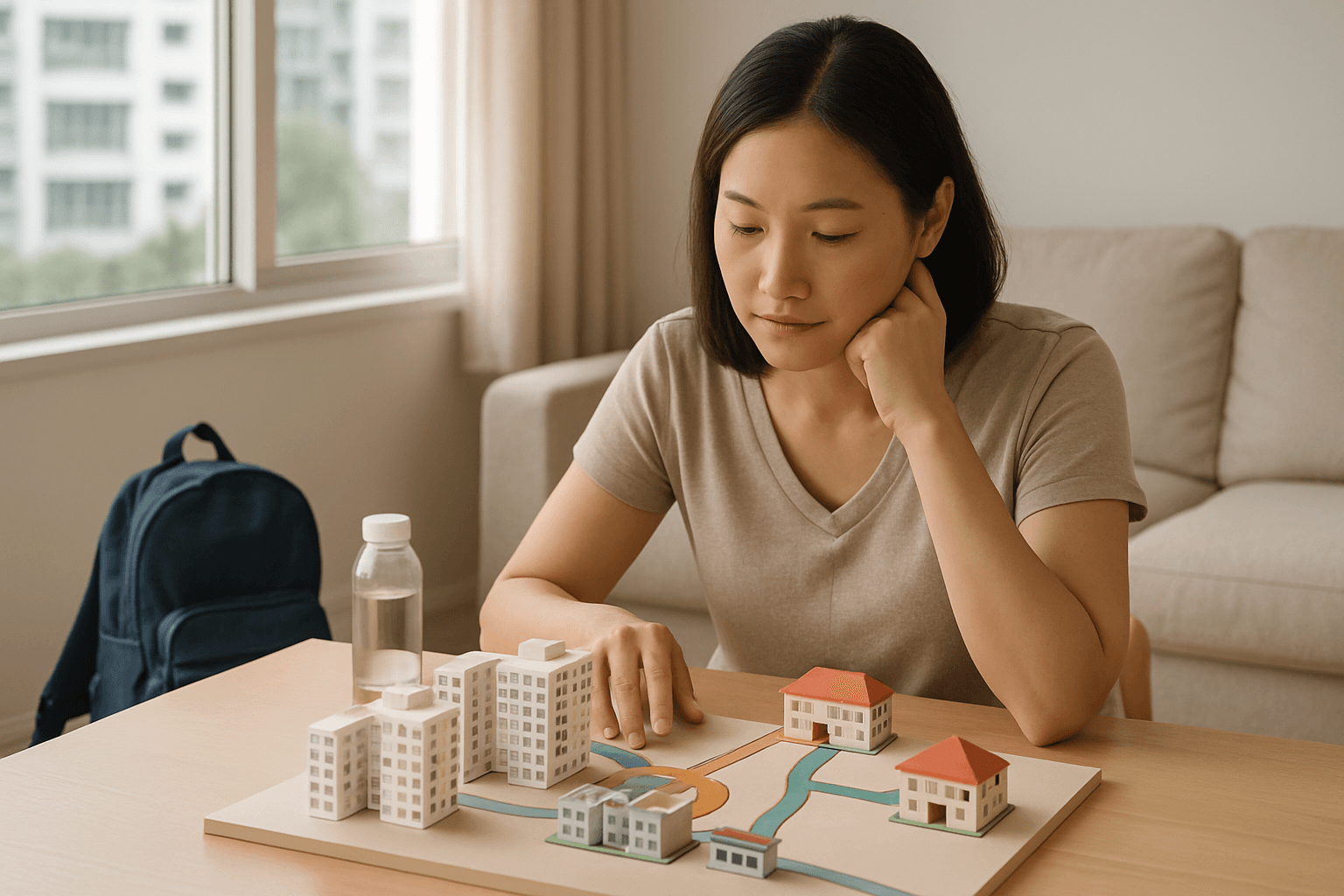
Distance matters, but it should not decide the shortlist on its own. Use it first to rule out schools that are unrealistic for daily travel or too risky for your registration plan, then compare the remaining schools for fit, routine, and long-term practicality.
What role should distance play when shortlisting primary schools in Singapore?
Use distance as an early reality check for both registration and the daily school run.
Distance should be one of your first filters because it affects both registration realism and daily life. It does not mean you must choose the closest school. It means you should be careful about shortlisting schools that look appealing on paper but are weak in practice.
A useful test is simple: can your child reach the school comfortably on ordinary weekdays, and is the school a realistic registration choice from your home address? If the answer is no to either question, that school usually belongs lower on your list.
Parents often make one of two mistakes. Some chase a school mainly for reputation and only think about the commute later. Others focus only on map distance and ignore whether the school is actually a good fit. A better shortlist balances both. For example, a school that is not the nearest but has one direct bus route may be more workable than a school that needs a rushed car trip, heavy morning traffic, and backup pickup plans every time it rains.
Short insight: distance is not the whole decision, but it is often the first reality check. If you want the wider admissions context first, start with our Primary 1 Registration in Singapore guide.
Singapore Secondary School short listing and historical cut off points
This is an online workbook to help you shortlist secondary schools during the S1 posting exercise after PSLE. You may shortlist secondary schools by cut off point, location, CCA and more: https://public.tableau.com/app/profile/sg.parent/viz/SingaporeSecondarySchoolSearch/Search This is another online workbook that lists out all secondary schools’ historical cut off points from 2021, when the AL system started: https://public.tableau.com/app/profile/sg.parent/viz/SingaporeSecondarySchoolHistorica
Singapore Secondary School short listing for DSA
This is an online workbook to help you shortlist secondary schools for DSA. You may shortlist secondary schools by DSA, location and more: https://public.tableau.com/app/profile/sg.parent/viz/SingaporeSecondarySchoolSearchDSA/Search Please view these workbooks from a computer and not mobile device (may not not display in full). Will work towards updating them yearly.
Why does distance matter more in Singapore than in many other countries?
Because home-school distance can affect registration priority when a school is oversubscribed.
In Singapore, distance is not only about convenience. It can also affect priority when a primary school is oversubscribed. That makes home-school distance part of the admissions picture, not just a transport detail.
The key takeaway is simple: living closer can improve your position, but it does not guarantee admission. Popular schools can still be competitive even for nearby families. Parents should treat distance as a way to understand risk, not as a promise of success.
This is where many shortlists go wrong. A family may assume that being near one well-known school makes the choice safe, then realise late in the process that nearby applicants can still face balloting. A stronger approach is to label schools honestly: safer nearby options, realistic but competitive options, and true stretch options.
If you want the mechanics behind this, read Primary 1 Registration Distance Priority: How Home-School Distance Works and Primary 1 Registration Phases in Singapore: What Each Phase Means for Your Chances. It also helps to confirm that you are using an address that actually counts by checking Which Home Address Counts for Primary 1 Registration in Singapore?.
[Bukit Timah] Primary Schools
if i have the powder, i may even ask MOE to have one more criteria on 500m - vertical distance first, then followed by horizontal distance by gazzetted road distance, not straight line distance in the form of radius from the school compound 1. these days there are so many high apartments, surely the one staying on ground floor is nearer than the one staying on the 50th floor 2. some houses on straight line is within 1 km from school, but on driving distance, due to road conditions and traffic ro
[Geylang] Primary Schools
For primary schools, I recommend going for convenience than popularity. Reason is the kids are still young, and travelling time should not be long enough to tire them out, even for those driving. Have you seen children dozing off in the parents car (some in an awkward position, especially straining their necks) because they have to wait up earlier than their peers to reach these “better” schools to feed their parents “ego”. Please note that the above is just my PERSONAL view as I have gone throu
Have More Questions?
Get personalized guidance on schools, tuition, enrichment and education pathways with AskVaiser.
Try AskVaiser for Free →How should parents think about distance in three layers?
Think about distance as three separate issues: daily commute, admission position, and whether the routine will still work years later.
It helps to judge distance in three separate layers: commute, registration position, and long-term routine. Parents often mix these into one vague feeling of whether a school is "near enough", and that usually hides the real trade-offs.
The first layer is the daily journey. Can your child do this trip without starting the day tired, rushed, or overwhelmed? A school may look close on a map but still involve a long walk, a transfer, or a congested drop-off point. The second layer is registration realism. Does your home address give this school a meaningful advantage if demand is high, or are you assuming too much from being "fairly near"? The third layer is durability. Will the routine still work in Primary 3 or Primary 4 when dismissal times, school events, enrichment, or student care become more complicated?
Seeing these as three separate questions improves the shortlist quickly. A school can be easy to reach but still be a stretch in admissions terms. Another can be realistic for registration but hard to sustain every day. Parents tend to underestimate this mismatch.
A common example is the school that feels manageable during one trial trip but becomes exhausting once peak-hour traffic, wet-weather pickup, and work delays enter the picture. Another is the school that is technically MRT-accessible but still requires a long outdoor walk for a six-year-old carrying a full bag. Distance on paper is not the same as an easy school run. For a broader overview, see Which Home Address Counts for Primary 1 Registration in Singapore?.
2024 Secondary 1 posting - short listing of secondary schools with historical cut off point and more
These are 2 secondary schools shortlisting webpages that help in selecting secondary schools for the coming S1 posting exercise. View these webpages on computer. May not display in full when viewed on mobile devices Shorting listing of Sec. Sch. with historical cut off point, location, any JC affiliation, single gender or not, and more: https://public.tableau.com/app/profile/sg.parent/viz/SingaporeSecondarySchoolSearch/Search Listing of secondary schools with 2021-2023 cut off point: https://pub
[Bukit Timah] Primary Schools
2012 Phase 2C Balloting took place within 1 km , for 5 schools :- 1. Nanyang primary Balloting was conducted for SC children residing within 1km of the school. (33 applicants, 25 places) 2. Pei Hwa Presbyterian primary Balloting was conducted for SC children residing within 1km of the school. (42 applicants, 27 places) 3. Henry Park primary Balloting was conducted for SC children residing within 1km of the school. (43 applicants, 15 places) 4. Raffles Girls’ primary Balloting was conducted for S
What is a realistic "close enough" shortlist?
Start with schools you would comfortably accept, add a few manageable alternatives, and keep stretch schools limited.
A realistic shortlist usually starts with a small group of nearby schools you would genuinely accept, then adds a few schools with manageable commutes, and only then includes one or two stretch choices. That structure keeps the list practical instead of turning it into a wish list.
In real life, "close enough" means more than geography. It means the route still works on a rushed Tuesday, a rainy dismissal, or a week when one parent is travelling. A school that is slightly farther away but simple to reach may be a better shortlist choice than a physically nearer school with chaotic traffic, awkward crossings, or unreliable pickup support.
A useful private test is this: if your child were offered this school tomorrow, would you feel relieved, or would you immediately worry about how to survive the routine? If the second reaction is stronger, that school is probably not a solid option no matter how attractive it sounds.
A typical family might keep two nearby schools as steady options, one direct-bus school as a reasonable alternative, and one popular school as a stretch choice. That is usually healthier than building a shortlist around only famous names. Insight line: do not just shortlist schools you can reach. Shortlist schools you can sustain. For a broader overview, see How to Read Past Balloting Data Before Chasing a Popular Primary School.
What goes into choosing a suitable Secondary School
Saw this being shared in the parents groupchats. https://www.thewackyduo.com/2022/11/how-to-choose-secondary-school-guide.html https://i.imgur.com/fDkJSy6.png\"> https://www.thewackyduo.com/2022/11/how-to-choose-secondary-school-guide.html It's time to choose a secondary school. Choosing a secondary school is a completely different process than primary school. One tends to choose a primary school based on distance or affiliation. Picking a secondary school is a different ball game. Grades play a
Beyond AL/PSLE scores - Choosing Secondary School
Hi everyone, I’ve noticed a lot of discussions here about PSLE posting and how tough it can be to shortlist secondary schools — especially when trying to consider more than just the cut-off points. I recently built a free website called School Advisor SG that might be useful for parents going through this process. It helps you explore schools holistically, by combining publicly available data on: PSLE cut-off points (2024) Sports & CCA performance (from national competitions) Primary–secondary a
Close address helps, but it does not secure a place.
Even families who live nearby may still face balloting at popular schools.
This is the mistake to avoid: living near a school is an advantage, not a guarantee. In a very popular school, nearby families can still face balloting.
Treat these schools as possible, not promised. If one is on your shortlist, pair it with safer options and read How to Read Past Balloting Data Before Chasing a Popular Primary School together with Primary 1 Registration Unsuccessful: What Happens If You Do Not Get Your Preferred School. For a broader overview, see Primary 1 Registration: Should You Pick a Popular Dream School or a Safer Nearby School?.
[Bedok] Primary Schools
end of Phase 2C schools enter into balloting :- 1.\tRed Swastika School\t Balloting will be conducted for SC children residing within 1km of the school. 2.\tTemasek Primary School\t Balloting will be conducted for SC children residing within 1km of the school. 3.\tYu Neng Primary School\t Balloting will be conducted for SC children residing within 1km of the school. 4.\tFengshan Primary School\t Balloting will be conducted for SC children residing between 1km and 2km of the school. 5.\tSt. Steph
[Bukit Timah] Primary Schools
3 yrs back, 1 popular school in bukit batok had short fall of 2(or3) vacancies in Phase 2C. no exceptions too; still need to ballot.
When is it sensible to shortlist a farther school?
A farther school is worth shortlisting only when the added fit is meaningful and the commute plan is solid.
A farther school can be sensible when the fit is strong enough to justify the added effort and the commute is genuinely manageable. Distance should raise the standard for inclusion, not automatically rule a school out.
This tends to make sense in a few common situations. One is when the school environment seems materially better for your child, not just more prestigious. For example, the school culture may feel calmer, the support may suit your child better, or the overall environment may fit your child’s temperament more clearly than the nearer choices. Another is when the route is longer in distance but simpler in practice, such as one direct bus, a straightforward car route that fits a parent’s work commute, or reliable student care that removes daily pickup stress.
What is usually less sensible is choosing a farther school mainly for reputation while hoping the logistics will somehow settle later. They often do not. Morning fatigue, late pickups, sibling clashes, and wet-weather disruptions tend to expose weak plans very quickly.
A good rule is this: the farther the school, the stronger the reason should be. If the only advantage is status, it probably does not belong on the final shortlist. If you are weighing aspiration against practicality, our guide on whether to pick a popular dream school or a safer nearby school can help sharpen the trade-off.
What goes into choosing a suitable Secondary School
Hi there, Recently a relative asked me how I choosed my kid’s Secondary School and I kind of got a shock, I had no answer. It was simply just based on the results. My relative came then with a list of important factors that he thought would be helpful to help his kid cope with the stresses of school. I thought that I would help him make this post to help him make a better decision (the kid will be going into the Secondary School in next year). So here goes, considering grades what else should he
Preschools prepared your kids well for Singapore primary?
For parents who have already been through the pre-school days and with kids now in primary schools (Singapore schools), can you share your comments on your kid's previous preschool and their curriculum - specifically if they have prepared your child properly for the Singapore education system ? (not discussing the international or foreign schools system here) Nowadays, there are so many pre-schools and childcare centres with many learning methods. Parents currently at the pre-school stage will b
What practical factors should sit alongside distance when comparing schools?
Compare distance with school fit, transport ease, after-school care, and who can manage the routine every day.
Distance should be compared alongside child fit, transport practicality, and family logistics. A school is not truly convenient if the child starts each day stressed or if the adults cannot manage the routine consistently.
Start with your child. Would your child likely do better in a calmer environment, a more structured one, or a school with support that matters to your family? Then test the daily system around that school. Is there workable student care? Is the route direct or full of transfers? Who handles pickup when work runs late? How will sibling drop-offs work if children attend different schools or care settings?
Parents also often overlook the difference between short distance and low friction. A nearer school can still be the harder option if traffic is chaotic, the final walk is unpleasant, or dismissal timing clashes with work. A slightly farther school may actually create a calmer family routine if the route is simple and the after-school arrangements are dependable.
One practical way to compare schools is to ask three questions side by side: can my child thrive here, can my family repeat this route every day, and is this school a realistic admissions choice from our address? The best shortlist answers all three reasonably well, not just one of them.
[Bukit Timah] Primary Schools
a) Nanyang refer http://www.nyps.moe.edu.sg/index.php?option=com_content&view=article&id=32&Itemid=33 ai) phase 2B 2011: staying more than 2 km. # of applications Received: 11. but # of successful applicants: 0 (> 2km not given chance to ballot). all those 28 who got in - stayed less than 1 km. aii) phase 2B 2010: staying more than 2 km. out of 22 balloted, 7 got in. (better than 2011 batch) means ratio is 1:3 ie. out of every 3 kids, only 1 lucky child able to get into NYPS aiii) under Phase 2C
[Bukit Timah] Primary Schools
Hi Huilink and Nite At this point in time, I dun think you should be overly concerned with which school is more well-rounded. All the schools you are targeting are good branded schools. So, your priority is to measure which school offers you the highest chance of getting in, and whether you are willing to go to a lesser school should you not be successful. First, you guys are all registering at Phase 2C, which is open to all Singaporeans and PRs without connections. This is the most competitive
What should parents check before deciding if a school is too far?
Test the journey in real conditions and stress-test the family routine around it.
- ✓Try the route on a real weekday morning if possible, not just on a quiet weekend.
- ✓Check the full journey, including the walk from home, any transfer points, and the final walk to the school gate.
- ✓Compare the route in different conditions, such as peak-hour traffic, heavy rain, and days when one caregiver is unavailable.
- ✓Decide who will handle drop-off and pickup on ordinary days, and what the backup plan is when work runs late.
- ✓Check whether student care or after-school arrangements make the routine easier or harder.
- ✓Think about the full six-year journey, not just the first few months of Primary 1.
- ✓Consider sibling logistics, especially if another child has a different school, preschool, or care arrangement.
- ✓Watch your child’s likely tolerance for early mornings, long rides, waiting time, and multiple transfers.
- ✓Notice whether the school is close on paper but awkward in reality because of congestion, crossing points, or a long final walk.
- ✓Ask one plain question: would we still choose this school if we had to do this route almost every day for years?
Should I pick the nearest primary school, or a better-fit one that is farther away?
Choose the nearer school if it is a solid fit and the easier routine matters. Choose the farther one only if the stronger fit clearly outweighs the travel load and uncertainty.
Usually, pick the nearer school if it is a good enough fit and the easier routine will noticeably reduce daily stress. A farther school is worth it only when the added fit is clearly meaningful and your family can manage the travel reliably for years.
The nearest school is not automatically the best school. But parents often underestimate how much a difficult commute shapes the child’s actual experience. Earlier mornings, more rushing, longer pickups, and tired afternoons can matter more than a small perceived difference in school reputation. If the nearby school feels broadly suitable, that is often a strong and sensible outcome.
A farther school becomes the better choice when the difference is not cosmetic. For example, the school environment may suit your child much better, or the route may still be stable because it matches a parent’s commute and comes with dependable care support. In that case, the real question is not simply whether the school is farther. It is whether the extra value is large enough to repay the daily cost and the possible registration risk.
Rule of thumb: shortlist for fit and feasibility together. If a school wins only on reputation but weakens daily life, be cautious. If you want a wider comparison, see Popular Primary School vs Neighbourhood School in Singapore: Which Is Better for Your Child?.
[Jurong East] Primary Schools
there are 4 primary schools within 1 Km from my place: Yuhua, Fuhua, Jurong East and Princess Elizabeth. for 2C, we’d like to try Princess Elizabeth, but I’m afraid if we are not lucky enough, we may not have the chance to go into any of the 4 schools. How can we stratigise so that we can try our preferred school? many thanks for the advices from experienced parents.
[Jurong East] Primary Schools
[Moderator's Note: For Balloting History of Jurong East schools, click http://www.kiasuparents.com/kiasu/content/jurong-east .] Im too having problems with my boy for next year P1 intake. I live in the west area. The schools which I aiming for is Princess Elizabeth but is too far from my place at Jurong East. Thought of putting him in Jurong Primary.. but not to sure if its a good school... Nevertherless... even Jurong Primary is more than 1km from my place.. you see... please help.. any suggest
Have More Questions?
Get personalized guidance on schools, tuition, enrichment and education pathways with AskVaiser.
Try AskVaiser for Free →