
How Much Does Distance Help at a Heavily Balloted Primary School?
A practical guide to 1km vs 2km priority, ballot risk, and what living closer can and cannot do at oversubscribed schools.
Distance helps most by moving your child into a stronger priority band. At a popular school, being within 1km usually gives you a better shot than being between 1km and 2km or beyond 2km, but it does not guarantee admission if the school is already oversubscribed within that nearer band.
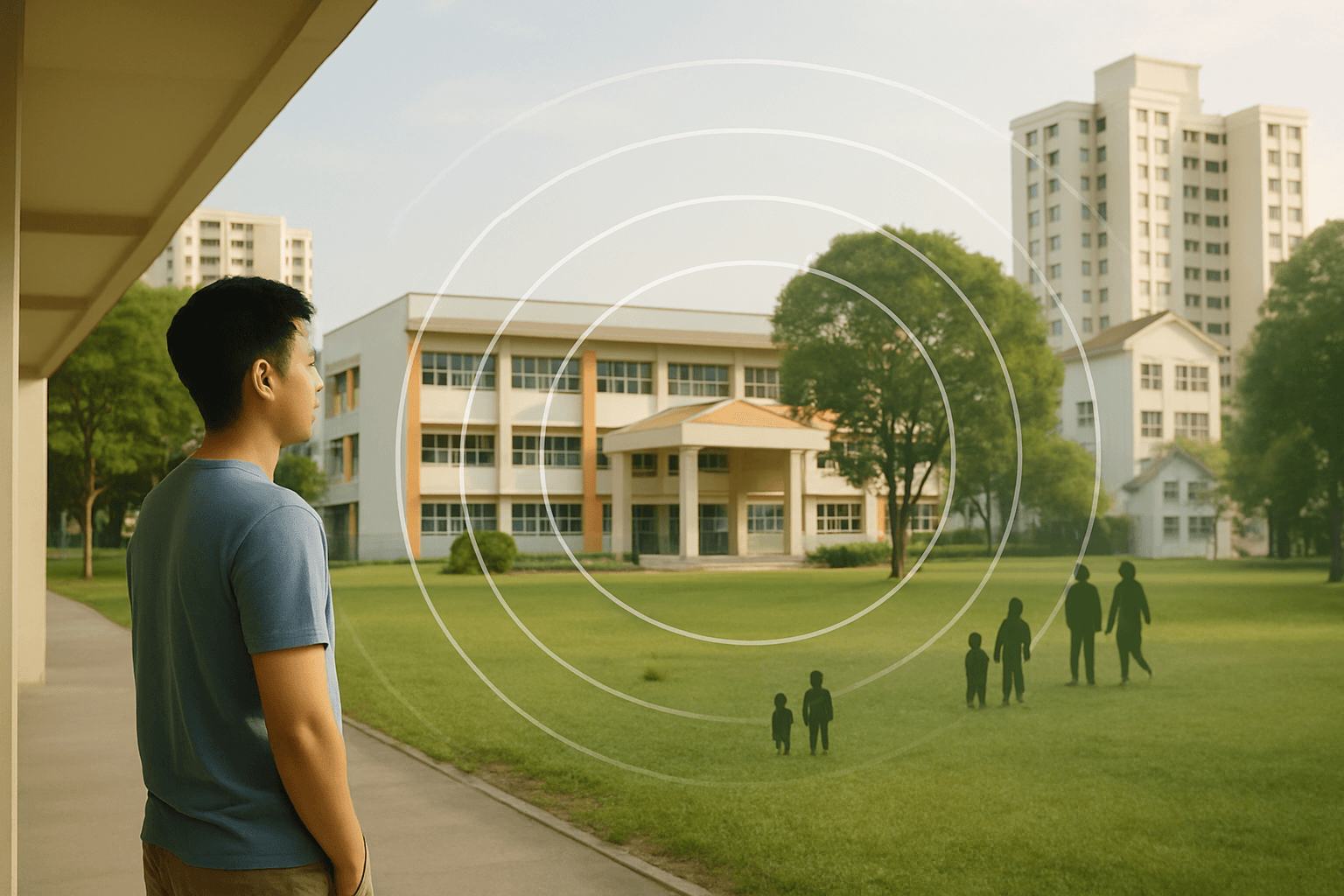
If a school is very popular, many parents ask the same question: is it really worth paying more to live closer?
In Singapore Primary 1 registration, distance matters, but not in the way many families hope. It usually improves your place in the queue rather than securing a place outright. So a home within 1km can be meaningfully better than one within 2km, but it may still leave you facing a ballot if too many nearby families are applying for too few places.
The useful mindset is simple: closer helps, but it does not make a hot school predictable.
Short answer: how much does distance help at heavily balloted primary schools?
Distance improves your priority, but at a heavily balloted school it does not remove risk. Within 1km is usually better than within 2km, yet either band can still face a ballot.
Distance helps, but it helps as a priority advantage, not as a guarantee. If a school is heavily oversubscribed, being within 1km usually puts you in a stronger position than being within 2km, and being within 2km usually puts you ahead of applicants beyond 2km. But if too many families are competing within the same band, a ballot can still happen.
The clearest way to think about it is this: distance changes your place in the queue, not the size of the queue. At a very hot school, even a good place in the queue may still end in a ballot. For a broader overview, see Primary 1 Registration in Singapore: How It Works, Balloting Risk, and How to Choose a Realistic School Plan.
All About Primary Schools' Balloting History
Can someone enlighten me if for example a school has history of balloting for SC >2 KM, if student A live 4 KM from the school vs student B live 6 KM from the school, does student B has higher chance of being ballotted out?
All About Primary Schools' Balloting History
For many \"hot\" schools - P2A > 2 km now prepare standby plan(s). In the event need to ballot & they got balloted out under 2A - they will enrol the child into their nearby neighbourhood school, under P2C < 1 km. Some 2A > 2 km smart : devise strategy. Example Make use of child's grandparents address to enrol under 2A : if grandparents' house happen to be < 2 km, from these popular, \"hot\" schools. This way : they can enrol their child under 2A 1 to 2 km, instead of > 2 km. So if 2A > 2 km bal
How MOE distance bands work in Primary 1 registration
You can apply to any school, but distance affects priority when demand exceeds places. The main bands parents watch are within 1km, between 1km and 2km, and beyond 2km.
In Singapore, parents can apply to any primary school they want. Distance does not decide whether you are allowed to apply. What it affects is priority when a school has more applicants than places. MOE explains that home-school distance matters when vacancies are limited, which is why families focus so much on the 1km and 2km bands.
In practice, parents usually think in three groups: within 1km, between 1km and 2km, and beyond 2km. The nearer group generally has stronger priority than the next one down. If you are checking your address, do not rely on a map app or driving time. Use OneMap SchoolQuery, because small boundary differences can change your band. If you want the full basics before going deeper into this article, our guide on Primary 1 distance priority covers the broader setup.
All About Primary Schools' Balloting History
hey, thanks for your very detailed answer.. Am reading up on MOE and they do publish a list of schs who are doing balloting leh. http://www.moe.gov.sg/education/admissions/primary-one-registration/balloting/ Priority for places is first given to children living within 1km from the school of choice. Should there be vacancies remaining, children living between 1km and 2km of the school will be considered followed by those living outside 2km of the school. So means har, within 1 km will ballot firs
All About Primary Schools' Balloting History
Balloting 18.What are the guidelines to be used for balloting when the number of applications exceed the number of vacancies from Phase 2A1 to Phase 2C(Supplementary)? Balloting will be conducted within the school premises and priority will be given in the following order: a.children living within 1 km of the school of choice. b.children living between 1 km and 2 km of the school of choice. c.children living outside 2 km of the school of choice. If the number of children in category (1) is less
Have More Questions?
Get personalized guidance on schools, tuition, enrichment and education pathways with AskVaiser.
Try AskVaiser for Free →What changes when a school is heavily balloted?
At a heavily balloted school, distance becomes part of a competitive queue. Even families within 1km can still be balloted if too many nearby applicants are in that same band.
Once a school is heavily balloted, distance stops being a simple edge and becomes part of a crowded queue. The common misunderstanding is that living close means being safe. In reality, balloting happens when applications exceed vacancies in a phase and distance band, so a school can still ballot among families who all live quite near it.
This is why some sought-after schools end up balloting even among applicants within 1km. Reporting on oversubscribed schools shows how quickly pressure can build at popular schools. For parents, the practical takeaway is that distance only helps if there are still enough places left when your child is considered. That is also why phase timing matters. If you have not yet looked at that side of the process, our guide to Primary 1 registration phases is the next useful read. For a broader overview, see How to Read Past Balloting Data Before Chasing a Popular Primary School.
All About Primary Schools' Balloting History
BTW, if balloting occurs for those <1km, it is very likely that the number of applicants is equal to the number of people involved in the balloting. People who live more than 1km are likely to be called on to withdraw their applications before the close of the Phase because they can’t even join the balloting. In any case, while applying for the school, you should already know if the school will likely be requiring balloting under one of the 3 distance categories.
All About Primary Schools' Balloting History
It includes all applicants. All are allowed to apply, even if their distance does not stand a chance. However, to be extra cautious in your planning you should always assume the stats is close to 100% <1km for the popular schools.
How much better is 1km than 2km in real terms?
1km is usually better than 2km, but how much better depends on where the school typically starts to ballot. At some schools it is a strong edge; at others it only moves you from higher risk to lower risk.
Being within 1km is usually meaningfully better than being between 1km and 2km, but the size of that advantage depends on where the school usually starts to get squeezed.
If a school often clears all applicants within 1km and only becomes tight in the 1km to 2km band, then moving from 1.4km to 0.8km can be a real planning advantage. But if a school already ballots heavily within 1km, that same move may still leave you in a ballot. In that case, you have improved your position without turning it into a safe outcome.
So the right question is not just, "Is 1km better than 2km?" It is, "At this school, does the pressure usually start before or after 1km?" That is why past patterns matter. Our guide on how to read past balloting data can help you judge whether a school is simply popular or consistently difficult. For a broader overview, see Primary 1 Registration: Should You Pick a Popular Dream School or a Safer Nearby School?.
All About Measuring Home-School Distance
Hi all, We always hear about within 1km and 1-2km criteria. Now I have this question: Canberra primary school is within 1km from my house, but almost at the border of the 1km (around 900m), and Wellington primary school is just next to my block. So, will my kid’s chance of balloting to Canberra be reduced because my house is almost hitting the 1km, and some more there’s already another school nearer? When the school does the balloting, does the actual distance influence the chance of balloting?
All About Primary Schools' Balloting History
I’m looking at the past balloting history. Can I interpret that as long as there is balloting for those staying within 1km, my chance of getting in to the school is almost zero if I stay within 1-2km?
When does distance help most, and when does it barely change anything?
Distance helps most when demand is high but not extreme. It helps least when the school is so oversubscribed that many nearby families are already competing for too few places.
Distance helps most when a school is popular but not extreme. In that situation, being under 1km can move you ahead of enough competing families to make a practical difference. The school may still be attractive and oversubscribed, but not so overloaded that every nearby family is forced into a ballot.
Distance still matters when a school has regular ballot pressure, but parents should read it as a risk reducer rather than a safety zone. A child within 1km may be in the stronger group, yet the outcome can still depend on how many other under-1km families apply that year.
Distance helps least when demand is so intense that the nearer band is already packed. Then moving closer may improve your odds on paper while changing little in lived reality. The memorable rule is this: proximity matters most before the queue becomes crowded. Once the queue is already packed, proximity still helps, but it cannot carry the whole plan.
All About Primary Schools' Balloting History
san20sg: Yes, 2A1 has never been \"spared\" from balloting based on proximity since the beginning of time. It's just that prior to the \"40-seat\" rule, 2A1 & 2A2 had never been subjected to balloting. But proximity as the next important criteria has always been on MOE website under \"Balloting\": http://www.moe.gov.sg/education/admissions/primary-one-registration/allocation/
All About Primary Schools' Balloting History
The school doesn't decide on this. At the beginning of the P1 registration, every school has a finite number of places. So, it depends on the number of places taken up in earlier phases. If balloting is only for SCs staying within 1 km of the school, you will be wasting your P2C chance if you insist on applying with the school even though you stay 1-2 km away from the school. Having said that, statistics are statistics. Registration situation differs every year. So, you need to keep track.
What parents often misunderstand about a popular school within 1km ballot
Being within 1km is not the same as being safe. At some popular schools, under-1km families still face real ballot risk.
A popular school within 1km ballot situation does not mean your child is almost in. It means your child is in the strongest distance group available, but that group may still be larger than the number of places left.
The practical mistake is treating 1km as the finish line. At very popular schools, it is often only the first filter. If your target school has a history of balloting within 1km, prepare backup schools early and do not build an expensive housing decision around one hoped-for outcome.
All About Primary Schools' Balloting History
The most important thing is which school you can realistically get in. No point discussing the merits of each school but can’t get in. Mee Toh will ballot for SC < 1km, with odds close to or exceed 3 to 1. For Waterway, you should get in without needing to ballot < 1km. Horizon is a little unknown this year, probably safe for SC < 1km. Therefore, the real question the kind of stress level you can endure during balloting, and do you realistically have a backup for Phase 2Cs.
Top Primary school?
for me, there is only one school within 1km from my place...it is a good one, but...i don't have any girls. i will need to ballot for a place for one sch within 1-2km from my place (next nearest school). if *touch wood*, balloting is unsuccessful, i will go for the next nearest neighbourhood school. for this, i am wary that this school focus its resources on the 'diamond' class and streaming starts as early as end of P1! getting him into such class will be my next best bet. so neighbourhood scho
Should you move house to improve your chances?
Move closer only if the school matters enough to justify the housing tradeoff even without certainty. At a school that ballots within 1km, the move buys a stronger position, not a sure place.
Moving closer can make sense, but only if the school is a genuine family priority and the move still works even if admission does not happen. If the new home also improves daily commute, gives you access to several acceptable schools, and fits your budget and support arrangements, then the move has value beyond one registration result.
The move is harder to justify if the school is already known to ballot heavily within 1km. Then you may be paying much more for better odds rather than a predictable outcome. That can still be a rational choice for some families, but it should be treated as a risk decision, not a guaranteed route in.
Before acting, make sure you understand which address will count and how timing can affect your plan. These AskVaiser guides are the practical starting points: Which Home Address Counts for Primary 1 Registration in Singapore? and Primary 1 Registration After Moving House. For a broader parent view on how families weigh location and school choice, this KiasuParents FAQ on choosing a primary school is also useful.
All About Primary Schools' Balloting History
First check your second choice school, that can guarantee you a seat, if they are likely to have vacancies left in Phase 2C supp. If no, you may want to seriously consider going for second choice school cos balloting case in Henry Park n Fairfield does not guarantee you a seat - ie if you are risk-adverse. If you are game enough for balloting and willing to take the risk, monitor the stats during the last day of Phase 2C ie call up the school to check the no. of applicants <1km vs the no. of vac
All About Primary Schools' Balloting History
I see the wealth effect playing a larger role for popular schools. If you are alumni, you had better get yourself within 1km if you have the means, unlike now. As alumni ‘dilution’ will occur, this opens the door to new money who can afford the move at 2C.
Practical scenarios: if you are within 1km, within 2km, or beyond 2km
Within 1km is the strongest distance position, within 2km can still be workable at some schools, and beyond 2km is usually the toughest position at a heavily contested school.
If you are within 1km, you have the strongest distance-based position. That is valuable at many schools, but it should change your planning mindset, not switch it off. A sensible approach is to treat this as your best starting point while still checking whether the school has a history of balloting in that same band.
If you are between 1km and 2km, your application may still be realistic, especially at schools that are popular but not extreme. This is the band where old balloting patterns become especially useful. Some schools only get tight after the under-1km group is processed, while others are already effectively full by then. For many families, this is the zone where a well-chosen backup school matters most.
If you are beyond 2km, you are still allowed to apply, but you are in the weakest distance position when the school is crowded. That does not make the application pointless. It simply means you should be more realistic if the school is widely known to be oversubscribed. In practical terms, families in this band usually do best when they pair the dream-school application with stronger alternatives instead of treating one hot school as the whole plan.
All About Primary Schools' Balloting History
RGPS 2C (speaking for SC above 2km), this year SC above 2km no chance. Based on the historical data, RGPS ballot during 2010,2011,2012 (ballot for either SC within 1km) and 2013 SC within 1km to 2km. Some major factors affect the balloting range. Like, birth rate, school vacancy, 2B applicant (determine how many seats left for 2C). Combine all the relevant data into the analysis, SC 1km to 2km very high chance balloting and balloting ratio should be around 3 to 1 or 4 to 1. Small chance for SC w
All About Primary Schools' Balloting History
You are actually right! For any phase where number of applicants exceed number of places, balloting will be conducted. Under this situation, places will first be allocated to those living within 1km. If there are not enough places to satisfy those living within 1km, then there will be balloting for those living within 1km ONLY . Sad to say, those living outside 1km will have to look elsewhere, or try again in the later phase. If there are leftover places after allocating to those within 1km, the
How to plan smartly if your target school is likely to ballot every year
Use distance together with past balloting patterns, phase awareness, and backup schools. The smartest plan assumes proximity helps, but does not rely on it alone.
Start by confirming your actual distance band with OneMap SchoolQuery, then look at whether the school shows repeated ballot pressure rather than reacting to one isolated year. If the school seems consistently hard to enter, treat distance as one input in your planning, not as the whole strategy. Our main Primary 1 registration guide and our article on choosing a popular dream school or a safer nearby school can help you build a more balanced shortlist.
It also helps to compare what you gain by chasing one school against what you may be overlooking. Daily commute, childcare pickup, support from grandparents, and whether there are several acceptable schools in the area often matter more over six years than parents expect. If you want a broader parent perspective on evaluating schools near home, this guide on how to choose the best primary school near you is useful context.
The best planning question is not only, "Will 1km help?" It is also, "If 1km still does not work, is the rest of our plan still sensible?" Families who answer both early usually make calmer decisions and avoid overpaying for a small probability edge.
All About Primary Schools' Balloting History
any where I can check if the schools around my area last year needs balloting? so I can judge on my chances this year for my kid.
All About Primary Schools' Balloting History
Hi, I’m keen to find out the balloting history in 2011. The school of my choice definitely has balloting in Phase 2B last year looking at the respective chart. Just needed to know whether the balloting occured for those living within 1km, 1-2 km or more than 2 km. Please advise where I can find that. Thanks
Have More Questions?
Get personalized guidance on schools, tuition, enrichment and education pathways with AskVaiser.
Try AskVaiser for Free →