
How P1 Balloting Works in Singapore
When balloting happens, how MOE allocates places, and how distance affects your child's chances.
P1 balloting happens only when applications exceed the vacancies left in that phase. MOE first applies citizenship and home-school distance priority, then runs a central computerised ballot if the phase is still oversubscribed. Living nearer can improve your child's position, but it does not guarantee a place.
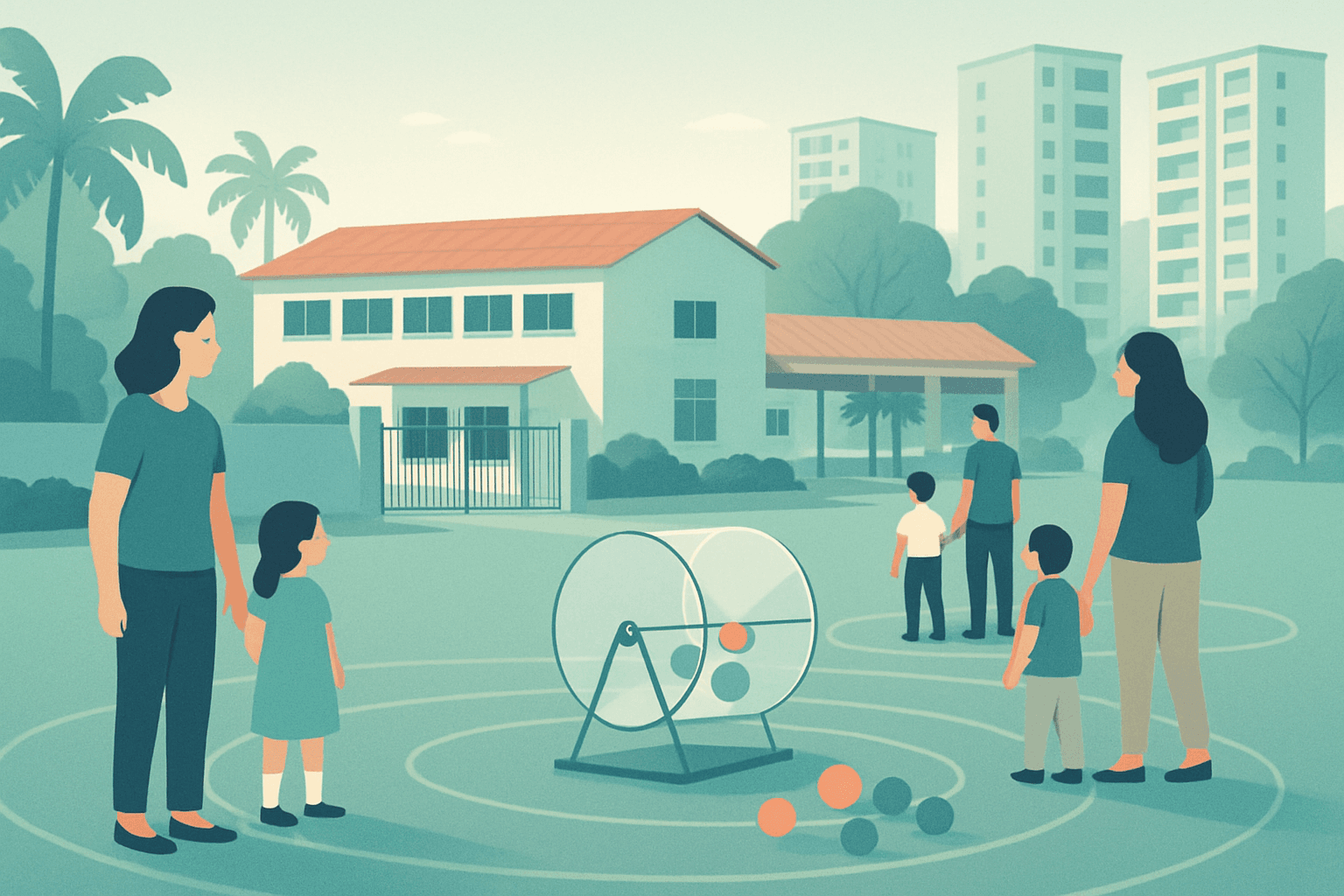
Primary 1 balloting is MOE's tie-breaker when a school gets more applications than places left in a specific registration phase. It is not a separate admission track. It happens inside the normal P1 process, after MOE checks how many vacancies remain and which priority band each child falls into. For parents, the practical question is not just whether a school is popular. It is whether your child is applying in a competitive phase, how many places are still available, and where your child sits in MOE's citizenship and home-school distance order.
What is Primary 1 balloting, in simple terms?
Primary 1 balloting is MOE's tie-breaker when applications in a phase exceed the vacancies left.
Primary 1 balloting is MOE's way of deciding who gets the remaining places when a school receives more applications than vacancies in a particular registration phase. Parents do not apply for balloting separately. It only happens if that phase is oversubscribed.
A simple way to picture it: if a school has 20 places left and 30 children apply, MOE first checks which applicants have priority under its rules. If there are still more children than places within the relevant priority group, MOE then conducts a central computerised ballot.
The important takeaway is that balloting is the final step, not the whole admission process. First comes eligibility and priority. Only then comes chance. For a broader overview, see Primary 1 Registration in Singapore: How It Works, Balloting Risk, and How to Choose a Realistic School Plan.
All About Primary Schools' Balloting History
Vacancies and balloting data: 2023 P1 Registration Exercise is out. https://www.moe.gov.sg/primary/p1-registration/past-vacancies-and-balloting-data
All About Primary Schools' Balloting History
http://www.moe.gov.sg/education/admissions/primary-one-registration/balloting/ If there are no withdrawals, these 24 schools listed below will be conducting balloting at Phase 2B on Wednesday, 28 July 2010. The schools have informed parents concerned of the balloting time. Parents are welcome to witness the conduct of the balloting.
When does balloting happen in the P1 registration process?
Balloting can happen from Phase 2A to Phase 2C Supplementary if applications in that phase exceed the places available.
Balloting can happen from Phase 2A through Phase 2C Supplementary when a school does not have enough places left for that phase. MOE explains this in its balloting overview, and parents can follow phase-by-phase updates on the vacancies and balloting page.
What many parents miss is that balloting is tied to each phase, not to the whole registration exercise. A school may not need a ballot in one phase, then require one later when fewer places remain. MOE also sets aside places for later phases at the start of the exercise, so later phases are not simply a leftovers round. They have their own vacancy pattern and their own level of competition.
If you want the wider process first, see our guide to Primary 1 Registration in Singapore and our explanation of Primary 1 registration phases.
All About Primary Schools' Balloting History
https://www.kiasuparents.com/kiasu/article/singapore-primary-1-registration-school-balloting-history/
All About Primary Schools' Balloting History
end of Phase 2B , as at Wednesday, 24 July 2013 (for 2014 P1 intake - born 2007, year of golden piggy) Balloting at Phase 2B - will be conducted on Friday, 26 July 2013. \t30 schools conducting Balloting (as at 24 July 2013)\t 1.\tAi Tong School \tBalloting will be conducted for SC children residing within 1km of the school. 2.\tAnglo-Chinese School (Junior)\t The school has places for only SC children residing within 1km of the school. No balloting will be conducted. 3.\tAnglo-Chinese School (P
Have More Questions?
Get personalized guidance on schools, tuition, enrichment and education pathways with AskVaiser.
Try AskVaiser for Free →What triggers a ballot in a Primary 1 phase?
A ballot happens when applicants outnumber the places left in that registration phase.
A ballot is triggered when the number of applicants in that phase is greater than the number of vacancies left for that phase.
That is why school reputation by itself is not enough to predict balloting. A well-known school may avoid balloting in a given phase if applications stay within the available places. A quieter school can still ballot if only a few places are left and demand is strong.
For example, if a school has 12 places available in a phase and 18 families apply, MOE has to decide who gets those 12 places using its priority rules and, if needed, balloting. The real trigger is the mismatch between applicants and vacancies in that specific phase, not the school's name alone. For a broader overview, see Primary 1 Registration Distance Priority: How Home-School Distance Works.
2021 P1 Registration Exercise for 2022 In-take
https://www.moe.gov.sg/primary/p1-registration/vacancies-and-balloting It's out!
All About Primary Schools' Balloting History
Hi!can anyone enlighten me on hw the P1 balloting works?e.g i’m in P2C n available vancanies are 50 does that mean the total of applicants who lives < 1km is less than 50 do not need to be balloted?? tks KO NAh
How does MOE decide who gets priority in a ballot?
MOE applies citizenship and home-school distance priority first, then ballots within the oversubscribed group if needed.
MOE does not place every applicant into one random pool. It first applies priority by citizenship and home-school distance, and only then uses balloting if a priority group is still oversubscribed.
The published order is Singapore Citizen within 1km, Singapore Citizen between 1km and 2km, Singapore Citizen beyond 2km, Permanent Resident within 1km, Permanent Resident between 1km and 2km, and Permanent Resident beyond 2km. In practical terms, MOE works through these groups in order. If the places are filled before it reaches a lower-priority group, that group will not get places in that phase.
So balloting is not purely random. It is filtered by the rules first, then decided by ballot within the oversubscribed group. A useful mental model is: rules first, randomness second. For a broader overview, see How to Read Past Balloting Data Before Chasing a Popular Primary School.
Give citizens priority in Primary 1 registration
Not sure if this has been mentioned in KSP forum? From 2010, Singapore Citizens (SCs) will be given an additional ballot slip (i.e. two chances instead of one), while Permanent Residents (PRs) will retain one ballot slip whenever balloting is conducted by any school during the P1 Registration Exercise. SCs will therefore have a higher chance of securing a place for their child in a school of choice when there is balloting. Giving Singaporeans two chances during balloting will retain the underlyi
All About Primary Schools' Balloting History
With all due respect to technology, I still agree with Limlim that Singaporean parents want to see that 2 ballot slips had actually gone into the bowl. Computers can easily be \"controlled\" whereas manual balloting cannot kelong. If u don't get picked, it's just your luck for being at the bottom of the fish bowl. You can still ask the person to stir the bowl. Many parents requested the admin manager to do that at the school we balloted at. Feel free to speak up. Manual balloting for me. (PS. wi
How does home-school distance affect your chances?
Distance improves your priority band, but even being within 1km does not guarantee a place.
Distance matters because it determines your priority band, but it does not secure a place. MOE uses the address declared for registration to determine the home-school distance category. Parents should read MOE's distance rules together with its home address guidance if distance is part of their plan.
In practical terms, being within 1km usually puts you ahead of families in the same citizenship group who live farther away. But it only improves your position relative to others. If many applicants are also within 1km, the school can still ballot inside that band.
A common mistake is to treat 1km as a safe zone. It is better understood as a stronger band, not a guarantee. Closer is better, not certain. If you are relying on distance, make sure the address basis is genuine and supportable before registration. Our guides on how home-school distance works, which home address counts, and moving house before registration can help you pressure-test the plan. For a broader overview, see Primary 1 Registration Unsuccessful: What Happens If You Do Not Get Your Preferred School.
All About Primary Schools' Balloting History
Phase 2C Supplementary , for 2016 P1 intake (born 2009) Schools Conducting Balloting, at P2C (Supp) (as at 14 August 2015) 1) CHIJ (Kellock) Balloting will be conducted for SC children residing outside 2km of the school. 2) Clementi Primary School Balloting will be conducted for SC children residing outside 2km of the school. 3) Concord Primary School Balloting will be conducted for SC children residing between 1km and 2km of the school. 4) Corporation Primary School Balloting will be conducted
All About Primary Schools' Balloting History
With the latest https://www.moe.gov.sg/news/press-releases/20210909-changes-to-the-primary-one-registration-framework-to-ensure-our-schools-remain-open-to-all announcement wef 2022 registration, you may like to know the following: Had the new changes applied to the 2021 registration: 2A would have another 16 schools joined the ballot: Yu Neng Primary School Chongzheng Primary School Fairfield Methodist School Red Swastika School Henry Park Primary School Riverside Primary School Westwood Primary
Key thing parents often misunderstand about balloting
Balloting is not a pure lottery, and living nearby is not a guarantee.
Balloting is filtered randomness. MOE's priority rules decide who is considered first, and only then does the ballot decide between applicants in an oversubscribed group. A good distance band helps, but it should not replace a real backup plan.
All About Primary Schools' Balloting History
Have you check out this http://www.kiasuparents.com/kiasu/content/singapore-primary-1-registration-school-balloting-history ?
All About Primary Schools' Balloting History
You should first read http://www.kiasuparents.com/kiasu/forum/viewtopic.php?t=3311 for a clear overpicture of the P1 registration. For stats, http://www.kiasuparents.com/kiasu/content/singapore-primary-1-registration-school-balloting-history it is - click on your preferred area.
What happens when there are too many applicants in your phase?
If your child misses out, the next step is usually the next eligible phase, or MOE posting after Phase 2C Supplementary.
If there are too many applicants in your phase, some children will not get a place in that phase. If your child is unsuccessful, MOE says you can register in the next eligible phase if there are vacancies. If your child is unsuccessful in Phase 2C Supplementary, MOE will post your child to a school with available vacancy.
Parents can check outcomes through the P1 Registration Portal and will also receive SMS updates. The practical mistake to avoid is waiting too long after an unsuccessful result. Once the outcome is known, the next step is to look immediately at which schools still have vacancies and whether your backup option is still realistic.
All About Primary Schools' Balloting History
I will suggest that you start with MOE website and https://www.moe.gov.sg/primary/p1-registration/registration-phases-key-dates . Based on the info that you have provided, the approach that would maximise your chances would be: Phase 2B - ACSP Phase 2C - ACSP Phase 2CS - Farrer Park Primary School (or another school with vacancies of your choosing)
All About Primary Schools' Balloting History
end of Phase 2C Supplementary , as at Wednesday, 14 August 2013 (for 2014 P1 admission - born 2007, year of golden piggy) Balloting at Phase 2C Supplementary - will be conducted on Tuesday, 20 August 2013. 1.\tBedok Green \tBalloting will be conducted for SC children residing between 1km and 2km of the school. 2.\tCanossa Convent \t The school only has places for all SC children and those PR children residing within 1km of the school. No balloting will be conducted. 3.\tCHIJ (Kellock)\t Ballotin
What are common real-world balloting scenarios parents should expect?
Balloting risk changes by phase, remaining vacancies, distance band, and citizenship group.
One common scenario is that a popular school looks manageable early on, then becomes much tighter later because fewer places remain. The school may still have places reserved for later phases, but the number available to your phase can be small once earlier allocations are done.
Another common scenario is that a parent assumes living within 1km makes the school safe. It does not. If many Singapore Citizen families also live within 1km, balloting may happen entirely inside that band. Two families can both be close to the school and still not both get in.
A third scenario is that the same school feels reasonable in one phase and risky in another. That is why parents should look at phase, distance band, and likely competition together rather than asking only whether a school is popular. Past patterns can help with that judgment, even though they do not guarantee the same result next year. For a deeper read, see how to read past balloting data.
For some PR families, later phases can be tighter still. MOE also notes that some schools have a cap on PR intake in Phases 2C and 2C Supplementary. The practical point is simple: the same school can look very different depending on when you enter the process and which applicant group you are in.
All About Primary Schools' Balloting History
You could try this: http://www.kiasuparents.com/kiasu/content/singapore-primary-1-registration-school-balloting-history It is from this site. Hope it helps.
All About Primary Schools' Balloting History
Yes, we are aware. A quick eyeball shows that if balloting is <1km, then it is most likely that all players involved are <1km, like we have all along suspected. Good luck for this year's P1 registration!
What should you do if your child does not get a place after balloting?
Do not wait passively after an unsuccessful ballot. Move to the next realistic option while vacancies still remain.
Start planning your next move immediately. If there is another eligible phase ahead, look at which schools still have vacancies and choose based on realistic odds, not just hope. The goal is to protect your next decision while better options are still open.
Parents who struggle most are often not the ones who lost the ballot, but the ones who had no backup school in mind before results came out. If you have already shortlisted one ambitious option and one safer option, the next step is far less stressful.
It also helps to keep the practical side tidy. Make sure your registration details are consistent, be clear which address basis you are using, and prepare the usual documents early rather than scrambling after an unsuccessful phase. Our guides on Primary 1 registration phases and common documents parents prepare can help if your plan changes quickly.
Share with us your kid's P1 registration experience
First thing to do after being balloted out, is to put your child's name under the school's wait list. After then, I've wrote in to MOE, called/met the school's Principal for discussion. Telling them all my problems and how the registration system had affected us (because I have only 1 school within 2km and NO school within 1km). With this factual, MOE has verified and consulted the school. My son was then placed on the highest priority in the waiting list .. and fortunately by early Nov, we were
All About Primary Schools' Balloting History
Hi, it's my first time to post question here Please help I am quite anxious of P1 registration of my son which is due this year. He will be P1 by next year. I just want to know the balloting of within 1KM of the school, what if my son was not selected during the Phase 2C? Can I still register him in my second option for school? What if it is full too? Can you pls tell me the steps / tricks on how to go about this... My first option of school is, we definitely wait for the ballot Phase 2C due to
How should parents choose a school with balloting risk in mind?
Choose with both preference and risk in mind: shortlist the dream school, but also prepare a realistic backup.
Choose with both preference and risk in mind. A sensible school list is usually not just one dream school. It is a plan built around the school you want most, the phase you are relying on, and at least one backup school you would genuinely accept.
This is where many parents overfocus on school name and underfocus on admission reality. A school may be attractive, but if your likely phase is competitive and your distance band is weak, the real question is whether you are comfortable with the risk of needing a second choice. In contrast, a nearby school with steadier vacancy patterns may give you a more predictable path and less last-minute stress.
Past data can help you judge that tradeoff more calmly, especially when you compare phase and distance patterns rather than headline popularity. Our articles on dream school versus safer nearby school and how to read past balloting data work well alongside MOE's guide on how to choose a school. Hope for the school you want, plan for the school you can realistically get.
All About Primary Schools' Balloting History
Do read some of the sticky threads posted above. http://www.kiasuparents.com/kiasu/content/singapore-primary-1-registration-school-balloting-history
All About Primary Schools' Balloting History
Schools' balloting history can be found here : http://www.kiasuparents.com/kiasu/content/singapore-primary-1-registration-school-balloting-history?page=8
Have More Questions?
Get personalized guidance on schools, tuition, enrichment and education pathways with AskVaiser.
Try AskVaiser for Free →