
Primary 1 School Choice in Singapore: Siblings, Pick-Up Plans and Family Routine
A practical guide for parents comparing Primary 1 schools while managing sibling schedules, transport, and after-school care.
For families comparing siblings school logistics primary 1 singapore, the key point is simple: one child’s school choice can reshape the whole household routine. If siblings attend different schools, parents often juggle separate dismissal times, different pick-up routes, extra handoffs, and more backup planning. Keeping siblings in the same school can reduce friction, but only if that school is still a good fit for the child and the routine works on ordinary bad days, not just ideal ones.
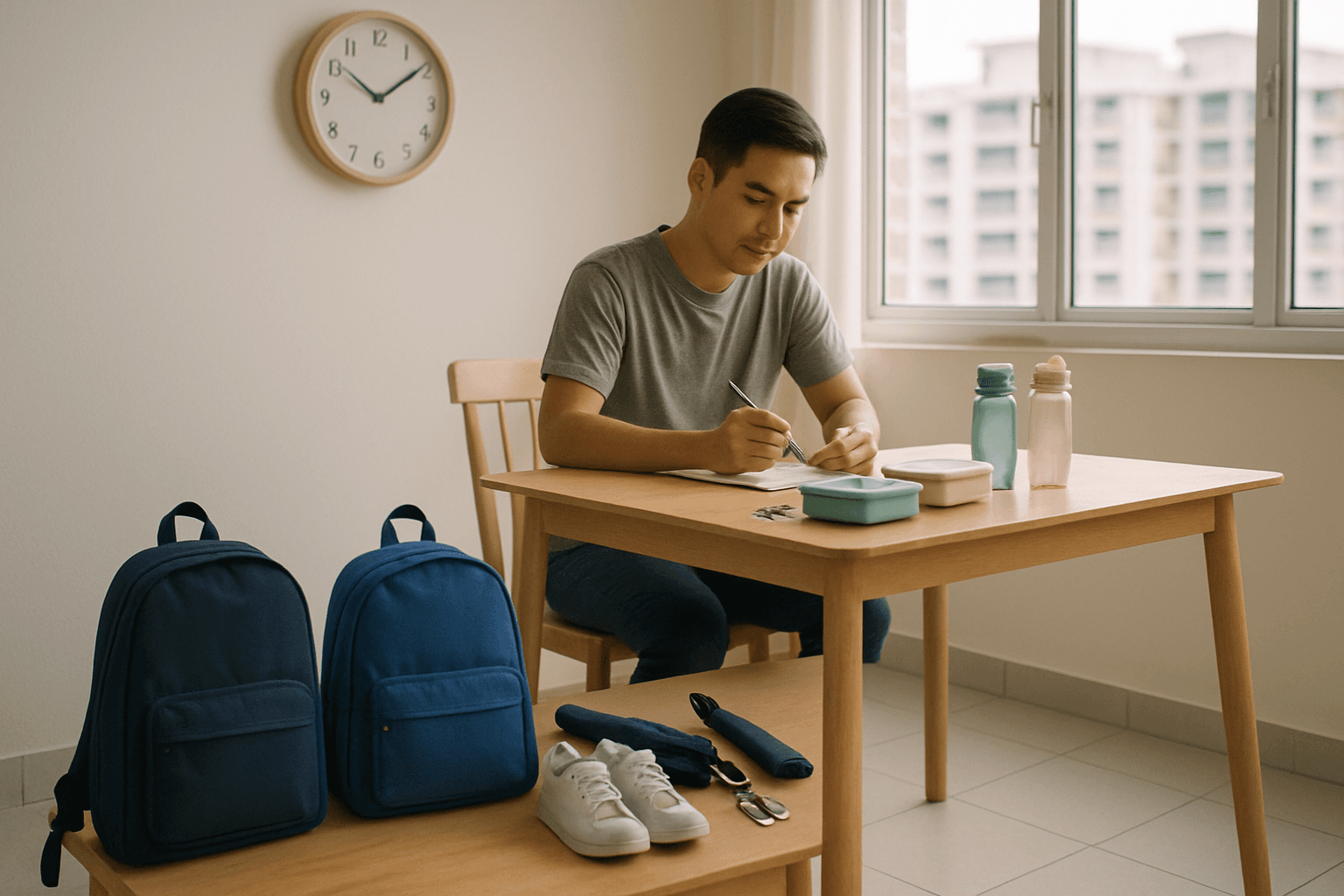
Choosing a Primary 1 school is not only about where one child studies. It also affects how the whole household moves through the day: who drops off, who picks up, whether grandparents can help, whether student care is needed, and how much buffer the family has when something goes wrong.
If you have an older child in another school, a younger sibling with fixed care arrangements, or a caregiver who can only help at one location, one school decision can change daily routes, dismissal handoffs, meal timing, and even work schedules. A school that looks good on paper can still be a poor fit if the logistics are too fragile.
The simplest way to think about it is this: a school choice is also a family timetable choice. The goal is not to pick the most convenient school at all costs. It is to choose a school your child can do well in and your household can realistically support every week. For the broader registration process, keep the Primary 1 registration guide open alongside this article, and use home-school distance guidance to sanity-check the commute.
Why does Primary 1 school choice affect the whole family, not just one child?
Primary 1 school choice affects the whole family because it changes transport, handoffs, care arrangements, and who must be available at different times of day.
Because a school choice changes the household operating plan, not just the classroom for one child. It affects who leaves home first, who can do pick-up, whether grandparents can help, whether student care becomes necessary, and how much buffer the family has if traffic, work, or school timings change.
Many parents start by comparing school reputation or distance. Those matter, but the more useful question is: can our family run this routine five days a week without constant scrambling? A school that seems manageable on a calm day can become difficult once you add an older sibling’s dismissal time, a caregiver who can only cover one location, or a parent whose work hours are not flexible.
A good rule of thumb is to treat the school decision as both an education decision and a family logistics decision. Start with your child’s fit, then test whether the timetable, handoffs, and backup plan are realistic. If you are still narrowing options, the Primary 1 registration guide and home-school distance guide are useful companions. MOE also advises parents to consider a child’s abilities, interests, and the school’s culture and values, not just reputation; SchoolFinder can help you compare schools in a more practical way.
All About Preparing For Primary One
Starting primary school? This is a big milestone. Do enjoy the journey with your child! :rahrah: https://www.straitstimes.com/singapore/education/the-st-guide-to-preparing-your-child-for-primary-1 Parents often confuse being ready for school with being academically capable in skills like reading and counting. Instead of focusing solely on academic progress, it is more important to make learning an enjoyable process, and help your child have a swift and happier adjustment to primary school. Here
All About Preparing For Primary One
Was surfing around on understanding if I am well prepared on behalf of my DD1 for Primary 1 Chanced upon a few websites, thought to share though it could have been mentioned before Tips For Parents ◦Work on independent reading skills. ◦Set up a study area and regular study times that are not interrupted. ◦Learn to follow a routine with a lot of sleep and early mornings. ◦Practice organisation and planning by packing a daily bag with essentials for the day. ◦Talk about social skills and communica
What happens when siblings are in different schools in Singapore?
When siblings are in different schools, the family usually has to manage more moving parts, not just two separate commutes.
Daily life usually becomes more fragmented. Two schools often mean two dismissal patterns, two pick-up locations, different traffic bottlenecks, separate school messages, and more chances for the afternoon plan to break.
A common setup is sequential pick-up. One adult collects one child first, then heads to the second school. This works when the timing gap is comfortable and the route is predictable. It becomes stressful when dismissal windows overlap or one delay creates a chain reaction. Another common arrangement is split coverage, where one parent handles one school while a grandparent, helper, or another parent covers the other. That reduces rushing, but only if the adults involved are reliably available every day.
Some families use a mixed arrangement. One child goes to student care or waits at a caregiver’s home while the other is picked up directly. That can be practical, but it means the family is no longer running one shared routine. It is two separate systems running in parallel.
The hidden cost is usually coordination, not just distance. Parents often think the main problem is how far the school is. In practice, the harder problem is overlap: two individually manageable schedules that become tiring once they collide in real life. For a broader overview, see If Your Older Child Is Already in the School, Does Your Younger Child Automatically Get In?.
All about Transferring to Other Primary Schools
When is the LAST day of primary schools' Term 4, before year-end school holiday start ? Answer : Friday, 18 November 2022 The Transfer school processing itself, will depend on Total number of candidates, who have applied to seek Transfer into the same, identical primary school. The more competitive the primary school is, the longer processing time required, especially if the school has received \"high mountain piled up, highly\" Transfer Application Form requests, from parents all over Singapore
All about Transferring to Other Primary Schools
Hi w0nderlnd I can only share what I did with my ds1. I transferred him to a sch nearer to home in mid pri due to our preference of the sch culture, affiliation it offers, distance (walking distance) and phase 1 priority for ds2. Ds1 was reluctant when I brought up the topic as he was doing very well in p1. Still I submitted a transfer request at end p1 and only got vacancy 1.5 years later. By then he was doing very very well in his previous school - a p3 and already given opportunity to emcee m
Have More Questions?
Get personalized guidance on schools, tuition, enrichment and education pathways with AskVaiser.
Try AskVaiser for Free →Do not build your whole routine around the assumption that both children will end up in the same school
Plan for same-school convenience, but make sure your fallback routine still works if the children do not end up in the same school.
Sibling convenience matters, but parents should not treat same-school placement as guaranteed. Admissions outcomes can differ, so it is safer to prepare both an ideal plan and a workable fallback.
If this affects your shortlist, read If Your Older Child Is Already in the School, Does Your Younger Child Automatically Get In?, the guide to Primary 1 registration phases, and what to expect if you do not get your preferred school. The practical takeaway is simple: plan for convenience, but make sure your family can still function without it. For a broader overview, see Primary 1 Registration Distance Priority: How Home-School Distance Works.
All about Transferring to Other Primary Schools
It is not surprising to hear that the top students in some primary schools are aiming to go to better-name schools. Nothing wrong with transferring school but must bear in mind that there is a 1% risk that the child will not fit into school culture. Usually, those who get the first few positions in class or are in the so called best class for high ability learners will tend to transfer out. With this cycle, the more famous primary schools will have no lack of top potential students to bring glor
[Bedok] Primary Schools
Do consider carefully on the distance to the school and the logistics. Just to share my experience. I am staying in the east and enrolled my dd when she was younger in St Anthony's Canossian Primary though I had priority in a branded school in the west. Never regretted it, the convenience of being near the school especially during her later years when there were cca, extra afterschool lessons and activities, I could ask my maid to assist bringing her back from school. The time saved on distance
When does keeping siblings in the same school actually make life easier?
Keeping siblings in the same school helps most when the family relies on one main caregiver, one vehicle, or a tightly timed weekday routine.
It helps most when your family runs on a tight schedule with limited backup. If one adult does most school runs, if a grandparent can only manage one location, or if you rely on one car, one school can remove a lot of daily friction.
The benefit is not only a shorter commute. It is simpler coordination. You usually get fewer handoffs, fewer competing dismissal windows, fewer separate event calendars, and easier instructions for whichever adult is helping that day. Even if siblings finish at different times, one campus or one route is often easier than two different directions.
This matters most for families with very little slack. If your plan depends on perfect traffic, perfect timing, and two adults being free every day, it is fragile. Same-school coordination helps because it reduces the number of things that must go right.
A useful insight for parents: the best school on paper can be the worst school at 4.30pm. If your household relies heavily on one main caregiver, convenience is not a minor factor. It is part of whether the choice is realistic. For a broader overview, see Primary 1 Registration: Should You Pick a Popular Dream School or a Safer Nearby School?.
School Placement Exercise for returning S'porean children
Yes, doing Sec 1 topics is right if the student is planning to join Sec 2, and P6 topics for joining Sec 1. I don't know of any group - hope someone can help if there is one. What about relatives and family friends? If you can arrange some \"play dates\" (they are old enough not to want to use that term, I guess!) for them in the weekends, that might help. If you go to church or other regular activity, ask for them to join in some activities with similar-aged kids? Do they have old school friend
All about Transferring to Other Primary Schools
I thought the transfer process is not transparent. But, if the child has good results or something to offer the school, the chances are higher. Just highlight these in your application. DD1 transferred to another school during term 2 of P2. If there is a need to transfer, you can always put in the application. I applied directly to the school.
When is it better to choose the right school for one child even if siblings are elsewhere?
Choose a different school when the child’s fit, support needs, or travel burden matters more than keeping siblings together and the family can still run the routine reliably.
Choose a different school when the fit for that child is meaningfully better and the logistics are still manageable. Convenience matters, but it should not automatically outweigh the child’s daily experience, support needs, or ability to cope well in that environment.
A useful starting point is to look beyond school reputation. MOE’s broad guidance for school choice includes considering the child’s abilities and interests, plus the school’s culture and values. In practical terms, sibling convenience is one factor, not the whole decision. If one child would likely do better in a school with a more suitable environment, a stronger programme fit, or better support, a different-school setup can still be the better long-term choice.
This happens more often than parents expect. An older child may be doing fine in a school mainly because it is convenient, while the younger child may need a different pace, a different culture, or a shorter journey. Another family may find that the older sibling’s school is familiar and easy for the adults, but the younger child’s commute there would be harder than attending a closer option.
If you want a broader way to assess schools, not just by name value, this FAQ-style guide on choosing a primary school and this piece on alternative ways to assess a school are useful. You can also compare this trade-off with our guides on popular schools versus safer nearby options and popular primary school versus neighbourhood school. For a broader overview, see Primary 1 Registration Unsuccessful: What Happens If You Do Not Get Your Preferred School.
All about Transferring to Other Primary Schools
There is nothing wrong with local neighborhood schools, they provide an adequate education. I’m not sure how German international schools are like but if German culture is fairly structured & regimental (?) then your girls will do ok in the 3 neighborhood schools that have vacancies. There is not much chance for social interaction in schools now, what with the new classroom rules like sitting apart & masks on whole day except during eating/drinking and PE time (which is usually individual static
All about Transferring to Other Primary Schools
Anyone know if elder sister get posted to a full school (MGS/ SCGS/ Cedar) through PSLE result for Sec 1, the younger sibling currently in P1 get the chance to transfer to the same school’s primary?
What school pick-up routine problems do Singapore parents run into most often?
The most common problems are overlapping dismissal times, traffic, limited caregiver availability, and small last-minute changes that break a tightly timed plan.
The biggest problems are usually caused by overlap, not distance alone. Parents often find that two schedules that look fine separately become difficult once real dismissal times, traffic, and caregiver limits are added.
One common pressure point is waiting gaps. One child finishes much earlier than the other, and there is no practical place for that child to wait without extending care arrangements or creating extra trips. Another is congestion around pick-up time. A route may look short on a map but still be stressful if it regularly collides with another school’s dismissal traffic. Caregiver limits are another major issue. A grandparent may be happy to help, but only for one school, one route, or one child who is easier to supervise.
Last-minute changes are what usually expose a weak plan. A late meeting, a sick child, a school event, or a delayed release can break a routine that seemed manageable in theory. These are logistics problems, not parenting failures.
A practical test is to plan for an ordinary bad day, not an ideal day. If one delay forces three more changes, the routine is probably too tight.
Preschools prepared your kids well for Singapore primary?
For parents who have already been through the pre-school days and with kids now in primary schools (Singapore schools), can you share your comments on your kid's previous preschool and their curriculum - specifically if they have prepared your child properly for the Singapore education system ? (not discussing the international or foreign schools system here) Nowadays, there are so many pre-schools and childcare centres with many learning methods. Parents currently at the pre-school stage will b
[Bukit Timah] Primary Schools
should be the same across all schs Registration at Primary School Registration is conducted at the primary school that you wish your child to be admitted into. The hours of registration are from 8.00 am to 11.00 am and from 2.30 pm to 4.30 pm on each scheduled registration day. Parents or a person authorized by the parents in writing (letter of authorization (72kb .pdf)) is to submit the registration form and required documents at the school of choice. From the 2012 P1 Registration Exercise onwa
How do families usually handle transport and handoffs between two schools?
Families usually make two-school logistics work through sequential pick-ups, split caregiver coverage, or student care that absorbs the timing gap.
Most families use one of a few practical arrangements, and the easiest one is usually the one with the fewest daily handoffs. There is no single correct model, but some setups are more resilient than others.
One common arrangement is for one caregiver to handle both schools in sequence. This works best when the route is straightforward and there is enough time buffer for traffic. Another is split coverage, where one adult handles one school and another adult handles the second. That can work well, but only when responsibilities are stable and not being renegotiated every week.
Some families reduce the timing problem by placing one child in student care near school while the other is picked up directly. Others choose a school near home, near a parent’s workplace, or near a grandparent’s home so that at least one daily leg is easier. These are common real-world examples, not official rules, but they show the main principle: reduce moving parts before you chase the ideal school profile.
If you are comparing feasibility, do not only check the home-to-school distance. Parents often forget to test the second leg as well: school to caregiver, school to home, or school to the next pick-up point. A route that looks acceptable on paper can fail once you add that extra leg.
All about Transferring to Other Primary Schools
I do not think MOE permit students to Transfer school so fast, so quickly within such a short time frame. One minute, transfer to a school in the West. Next minute, next change - Less than 1 year later, transfer to another school in the east. Moe will sure question you : why are you Transfering schools, so shortly ? Where is your final destination? If your permanent house purchased is in the east, then stick to schools in the east. That should be your guide. Those primary schools that often have
All about Transferring to Other Primary Schools
Within 6 years of primary school education, from (P1 to P6), note that u can only Transfer schools from (P1 to end of P4). Reason being, after end of P4, there is streaming, into P5 classes. End of P4 is the last whistle calling (blowing), for Transfer students to board (hop onto) another new train journey. Schools do not allow Transfer once start P5, in Upper primary years (P5 / P6). Schools consider these last 2 years as key PSLE preparatory years, won't allow Transfer. At what level, is your
What should parents think about if one child needs after-school care and the other does not?
If one child needs after-school care and the other does not, the family has to manage two different afternoon systems, which adds coordination, cost, and supervision strain.
This creates a mismatch in timing, cost, and supervision. It can work well, but only if the routine is built around that mismatch instead of treating it as a small detail.
A common example is a new Primary 1 child who needs student care because no adult is free in the afternoon, while an older sibling can go home independently or stay with a grandparent. That can be perfectly workable if the younger child’s care arrangement is close to school and the older child’s routine is genuinely stable. The reverse can also happen: the older child has a more complex schedule with CCA or enrichment, while the younger child needs direct pick-up.
What parents often underestimate is the cumulative effect. Two afternoon modes usually mean two release times, two sets of instructions, two backup plans, and sometimes two different payment structures. None of that sounds dramatic on its own. Together, it can make every weekday feel like a coordination exercise.
The better question is not just whether one child needs care. It is whether one family routine can still cover both children without turning every afternoon into a separate logistics project.
School Placement Exercise for returning S'porean children
One of the things that kids who switch from US-type schools to Sg schools need to be aware of - the awarding of marks is extremely different, especially in sec school (other than Maths). US schools take marks away from 100 for mistakes; Sg schools start from a lower base (around 80+?), marks are taken away for mistakes, and marks have to be earned for good work (not always easy to earn) to push marks higher. Hence an A in US school is 90, but an A in Sg school is about 75-80. My daughters transi
Choosing Secondary school
Hi, Wonder if anyone knows what happens in this Secondary School selection scenario : If there are 10 places left in School A and 20 pupils with EXACTLY the same PSLE score apply, how does MOE decide which 10 to take into the school. Does it matter in this case whether the child had put School A as the first choice? This impacts what schools to put as 1st and 2nd choice - whether the common advise of putting the dream school which is just out of range of the child’s mark is a wise thing to do. P
How do enrichment classes, CCA, and school events complicate sibling logistics?
Enrichment, CCA, and school events complicate sibling logistics because they create repeat clashes that can break an otherwise manageable routine.
They create recurring exceptions to the normal routine. Most parents plan around standard dismissal time first, then realise the harder problem is how often the routine stops being standard.
CCA, enrichment, performances, sports activities, parent-teacher meetings, and school events can all shift pick-up timing or require extra trips. If siblings are in different schools, these exceptions may happen on different days, which means the family has to coordinate more often, not just travel more. One child may need collecting later on a day when the other has enrichment elsewhere. Another may have a school event at the same time a sibling must be fetched.
This is worth checking early because recurring clashes are more tiring than one-off disruptions. When you compare schools, look beyond the normal school day. Ask whether the plan still works when one child has an event, whether you have backup support for those days, and whether one child’s schedule will repeatedly push the other into longer waiting time or extra care hours.
If you are visiting open houses, it helps to observe the everyday rhythm of the school, not just the standout programmes. Some parents use open houses to get that wider sense of school life, as discussed in this piece on primary school open houses.
[Choa Chu Kang] Primary Schools
Extracted (& adapted) from MOE webbie.. Hope this helps provide an even clearer picture. Registration Exercise Children who are Singapore Citizens or Singapore Permanent Residents Phase 1 For a child who has a sibling studying in a school of choice. *All children registered under this phase will be given places in schools.* Phase 2A1 For a child whose parent is a former student of the school and who has joined the alumni association as a member not later than 30 Jun 2009; or whose parent is a me
Sengkang/punggol primary school - input from parents of kids in schools in these area?
~ starting to think about primary school registration (applying this year, 2025) and it’s giving me a headache. The schools my kid has a good chance of getting in (2B - 1km) are: 1)Nativity primary 2)Mee Toh 3) Rivervale primary My kid is really quite nerdy and has a hard time finding friends because of her subject-specific interests (usually science-related). Has expressed a preference for co-ed, but I don’t know how seriously to consider her input. Nan Chiau (phase 2b) seems impossible because
What practical checklist should parents compare before deciding on a Primary 1 school?
Compare schools as a family routine, not just a school ranking. The stronger option is the one your child can handle well and your household can run consistently.
- ✓Can your main pick-up adult reach the school consistently without depending on best-case traffic?
- ✓Which school fits better with home, workplace, or the home of the grandparent or caregiver who is most likely to help?
- ✓If siblings end up in different schools, who will handle each drop-off and each pick-up on an ordinary weekday?
- ✓If one adult is unavailable, what is the real backup plan for both children?
- ✓Can both children share one afternoon routine, or will one need student care while the other goes home or to enrichment?
- ✓Are you choosing a farther school for a clear child-fit reason such as support, culture, or programme fit, or mainly for reputation?
- ✓On days with enrichment, CCA, or school events, does the routine still work without extra trips or long waiting gaps?
- ✓Can the family sustain this plan five days a week for years, not just for the first few months?
- ✓If siblings do not end up in the same school, what fallback routine will you use for the first term?
- ✓Which option feels calmer in real life, not just stronger on paper?
Have More Questions?
Get personalized guidance on schools, tuition, enrichment and education pathways with AskVaiser.
Try AskVaiser for Free →