
How to Build a P1 School Shortlist Around Your Home Address in Singapore
A practical way to turn nearby primary schools into dream, realistic, and backup choices without guessing.
To choose a P1 school based on your address, use the genuine registration address you can support, identify nearby schools, then sort them into dream, realistic, and backup options. MOE uses Home-School Distance when a school is oversubscribed, but parents should also check recent demand, likely phase, travel routine, and whether the school works for everyday family life.
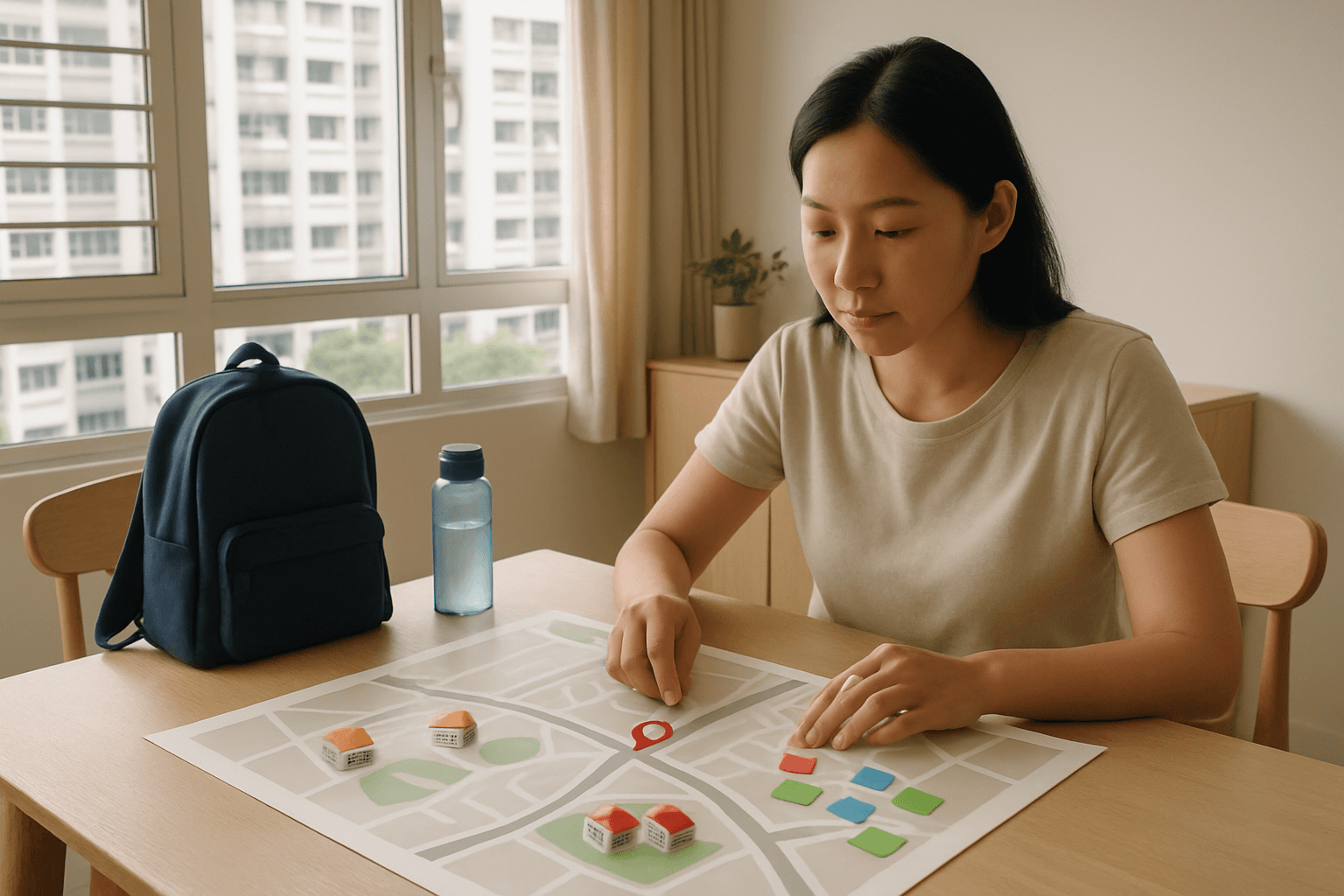
The easiest way to build a Primary 1 shortlist is to start with the genuine home address you can use for registration, find the nearby schools, and then sort them into three bands: dream, realistic, and backup. That gives you a shortlist that reflects both what you want and what is actually workable.
In Singapore, distance matters when a school is oversubscribed, but it is not the only factor. After you identify schools near your address, you still need to check likely balloting pressure, your probable registration phase, and whether the school fits your weekday routine. If you want the wider registration context first, start with our Primary 1 Registration in Singapore guide.
What is the simplest way to build a P1 shortlist from your home address?
Use the address you can genuinely register with, identify nearby schools, then sort them into dream, realistic, and backup choices.
Start with the address you can genuinely use for registration, list the primary schools near that address, and sort them into three bands: dream, realistic, and backup. That approach works better than one flat ranking because P1 choice is not only about preference. It is also about whether the school is realistically accessible from where your family lives.
A simple example shows why this matters. Suppose your home puts five schools within reach. One is very close but regularly draws heavy demand, so it goes into the dream band. Two others are nearby and look less pressured based on recent patterns, so they become realistic options. Another is slightly farther but has a direct bus route and works for grandparents’ pickup, so it becomes the backup. The last school looks close on a map but would require a stressful crossing or a difficult morning route, so it drops off the list.
The key idea is simple: your address narrows the field, but your shortlist should reflect both access and daily life. A good P1 shortlist is a decision tool, not a wish list. For a broader overview, see Primary 1 Registration in Singapore: How It Works, Balloting Risk, and How to Choose a Realistic School Plan.
[Punggol] Primary Schools
similar predicament as mine, i stay at SK, already brought punggol new flat ready only in 2015, but my child is need to enrol in 2014? So can i apply for punggol school within 1km? showing proof of purchased address?
[Punggol] Primary Schools
Published on Jun 19, 2015 Oasis of learning in Punggol, to fill young minds source http://mypaper.sg/top-stories/oasis-lea ... s-20150619 THREE new primary schools will open in Punggol next year to help meet the growing demand in the area. The schools - Oasis Primary in Edgefield Plains, Punggol Cove Primary in Sumang Walk and Waterway Primary in Punggol Drive - will be able to take in 210 pupils each . They are located near a number of housing projects. Waterway Primary, for instance, is locate
Why should your home address be the starting point, not the final answer?
Start with your address because distance affects access, but use daily routine and school fit to decide what is actually workable.
Your home address matters because MOE uses Home-School Distance when a school is oversubscribed, and the address used for registration must be genuine and supportable under MOE's home address rules. Since the 2022 exercise, HSD is calculated from the school land boundary rather than a single reference point, which is one reason parents should not try to infer outcomes from a quick rough map.
But address is only the starting point. Two schools can sit in a similar distance band and still feel very different in practice. One may be technically close but awkward for drop-off, hard for grandparents to reach, or unrealistic if both parents leave early for work. Another may be slightly farther yet easier because there is a direct bus, safer walking access, or a smoother student care arrangement.
A useful way to think about it is this: address tells you what is plausible, while family routine tells you what is sustainable. Build around both. And do not plan around an address arrangement you cannot genuinely support. If your housing situation is changing, our guide on which home address counts for Primary 1 registration helps you think through the practical issues.
[Punggol] Primary Schools
Hi, Would like to seek some opinions/advises here. I will be shifting to Punggol in another year’s time and DS will be starting P1 next year. The only issue now is I’m not sure whether to put him in Punggol View or Punggol Green. Seems to me that PV is a more popular school but it is slightly further away from my place (almost 1km distance). Spoken to a parent of a P1 kid in PV and the feedback was very good. Said her son enjoys school alot and the teachers, VP, and P are really nice ppl. PG is
[Punggol] Primary Schools
hmm… the most impt thing is your child must be happy. This must come from supportive parents in their learning. My boy enjoys his class and gamely contribute and am glad teachers (Chinese and form teacher) have been responsive in his learning. As he was a transferred student, I was also concern of him blending to his school but such were unfound. Phew! All in all, in a primary school, be it a popular, a top or mediocre school (in others’ opinion) you can still “control” a child’s learning habits
Have More Questions?
Get personalized guidance on schools, tuition, enrichment and education pathways with AskVaiser.
Try AskVaiser for Free →How do you map schools near your address without overcomplicating it?
Use MOE's nearby-school information first, then use a map app to check actual travel time and route convenience.
Use MOE information first, then do a simple map check for day-to-day convenience. MOE's guidance on how to choose a school is a good starting point, and during the registration exercise MOE also provides nearby-school information, including schools within 2km and whether they were oversubscribed in certain phases in the previous year. That is usually a much better starting point than relying on hearsay.
After that, use Google Maps or another map app to sanity-check the morning route. This is not for calculating official distance. It is for spotting practical issues parents often miss at first, such as a route that only works if one parent drives, a school that looks close but requires crossing a major road, or a school that is farther in pure distance but easier because there is one direct bus.
For example, a school that takes ten minutes by car but forty minutes by public transport may not be realistic if both parents commute early. On the other hand, a slightly farther school may be easier if it is on the way to work or close to student care. The goal is not a perfect map. The goal is a shortlist your family can actually live with from the first week of school. For a broader overview, see Primary 1 Registration Distance Priority: How Home-School Distance Works.
[Bedok] Primary Schools
please go to this thread. there are a number of url that you can used to check the distance of your home to the desired school http://www.kiasuparents.com/kiasu/forum/viewtopic.php?t=426
[Punggol] Primary Schools
HI, I’m residing in Punggol but have no clue of the primary schools in the area. Can someone please share with me which school is good and reputable? TIA.
How should you group schools into dream, realistic, and backup options?
Put schools into three bands based on both proximity and likely competition, not on reputation alone.
Use distance together with likely admission pressure. Dream schools are the ones you would be happy to get but may be harder to enter because they are very popular, your likely phase is competitive, or recent demand looks consistently strong. Realistic schools are nearby options that still fit your family but do not look so pressured that your plan depends on a favourable ballot. Backup schools are the ones your child can attend comfortably if the first choices do not work out.
These are planning bands, not official MOE categories. Their value is that they force clearer thinking. A well-known school near home may still belong in the dream band if it often attracts intense demand. Another school in the same area, with a manageable route and steadier demand, may be the realistic choice. A third school may not be the most talked-about one in your neighbourhood, but if it has a simple commute and a daily routine your family can manage, it may be the best backup.
A useful test is this: if you ended up with your backup school, would the plan still make sense? If the answer is no, the shortlist is not ready yet. For a broader overview, see How to Read Past Balloting Data Before Chasing a Popular Primary School.
How to select schools during S1 posting?
In order to better determine the 6 schools for the Secondary 1 posting submission, I wanted a tool that will help me filter schools based on cutoff. Further, I wanted to sort based on the last student's cutoff in order to determine the \"best/worst\" school in order to rank the choices. As such, I created a site for my own use and hopefully may help you and your child. You can select and sort group 3/2/1 schools and filter by a cutoff score. Remember to ensure the last cutoff box is checked. Oth
[Punggol] Primary Schools
hi blitze u can check on the open house somewhere from june to july, cos aug will start to P1 reg for phase 2 onwards (if i remember). my colleague’s girls are in Changkat (Simei). Seems not a bad sch. but like you, i stay in punggol. but i chose Horizon due to below reasons (my girl in P2 now): 1) i did not do any PV (parent volunteer) even i stay opp of Meetoh. I don want to stress myself for the ballating. 2) Horizon has student care center (SCC) inside the school. this is more safer than to
What makes a nearby school realistic rather than just close?
A nearby school is realistic when it is both practical to reach and not so oversubscribed that you are relying mainly on luck.
A realistic school is not just near your home. It is near enough to help, and not so heavily oversubscribed that your plan depends mostly on luck. This is the difference many parents miss when they first try to choose a school based on address for P1.
A comparison makes this clearer. One school may be 800 metres away, but if it regularly faces strong demand in the phase you are likely to enter, it is usually safer to treat it as a dream option. Another school may be 1.6 kilometres away, yet still fall within a workable distance band and show less pressure historically. In practical terms, the second school may be more realistic even though it is farther.
Your own circumstances matter too. If a sibling is already in the school, or another legitimate pathway applies, that may make the school more attainable than distance alone suggests. Even so, it is better to think in terms of stronger chances, not guaranteed outcomes. If you want to judge realism more calmly, our guides on distance priority, reading past balloting data, and whether an older child in the school changes things can help. For a broader overview, see Primary 1 Registration: Should You Pick a Popular Dream School or a Safer Nearby School?.
[Punggol] Primary Schools
Location. It’s the only school within 1km for a number of projects, especially those in Sumang /Mathilda.
[Punggol] Primary Schools
Hi all parents, May I know if i am living near punggol mrt which is more than one clique from Meetoh, is it possible for my child to get in? Any ways to let my kids getting in? And may I know Meetoh and edgefield, which one is better? Beside my house, there’s a new school Punggol view which started to open this year. My mum keep telling me to let my kids study there but it’s a new school and I’m afraid that my kids will become white rabbit!! What should I do? Which one should I choose?
What practical factors should you compare after distance?
After distance, compare commute, caregiver logistics, daily routine, and only then the school's programmes and fit.
After distance narrows the field, compare the schools against your real weekday routine. MOE encourages parents to consider travel time, the child's interests, and the school's offerings when deciding how to choose a school. In practice, that means your shortlist should survive the school run, not just look good on paper.
Start with the routine. Who is doing drop-off and pickup? Is there a workable before-school or after-school plan? Can grandparents, a helper, or student care support the route? A school that is close but hard to hand over to another caregiver may be less suitable than a slightly farther one that fits the family schedule cleanly.
Then compare the school's character and programmes. This should come after the logistics check, not before it. A niche programme may sound attractive, but if the journey is tiring for a six- or seven-year-old, the trade-off may not be worth it. Parents often overestimate how much prestige matters in the first year and underestimate how much a smooth daily routine matters by March.
If you are stuck between a high-demand option and a more manageable one, our guide on a popular dream school versus a safer nearby school can help frame that trade-off.
[Punggol] Primary Schools
Need advise from all experience parents here, if u are staying at another district but moving to punggol in 2 years time.will you register your kid into a school at punggol or the district you currently lives. Plus if both parents are working and main care giver are their grandparents staying outside Punggol, what will you choose? School in punggol or current location nearer to grandparents lives?
[Punggol] Primary Schools
so your younger ds should have priority to edgefield since his elder sibling studied there before? just curious, what is the thing that cause you to have second thoughts about edgefield then?
What do most parents misunderstand about proximity-based P1 choices?
Close does not mean safe, and popular does not mean impossible.
The biggest mistake is assuming that close means safe. It does not. A school can be near your home and still be highly competitive. The second mistake is assuming that a popular school should be dropped immediately. That is too simplistic as well. A popular school can still stay in your dream band if it is genuinely near, you understand the risk, and you have a backup you can genuinely accept.
Near helps, but demand decides. Use proximity to narrow the list, not to create false certainty.
[Punggol] Primary Schools
dear parents, my daughter born on 2009 and looking to P1 register few months later. I am staying within 1km to MT, Horizon and PV, history show all school required ballot for SC within 1km in phase 2c. Dun think I will register MT as chance is low, any idea/comment/advise to choose between Horizon and PV?
[Punggol] Primary Schools
We transferred our kid to Greendale primary this year. He is in P4. So glad of the move! Happy and loving school. Finding a school in punggol(any level) is tough not to mention my key criteria is proximity. Check Greendale primary. The principal is very responsive and motivating. Waterway pri is just opposite my place and the school will definitely be my choice when my younger one enter P1 next year. remember primary school is a place for children to grow and learn not compete. New schools may h
How should you think about ballot risk when choosing schools near home?
Use recent ballot pressure to decide whether a nearby school belongs in your dream, realistic, or backup band.
Treat ballot risk as part of the shortlist from the beginning, not as a late surprise. MOE explains that balloting can happen from Phase 2A through Phase 2C Supplementary when applications exceed vacancies. MOE has also built places for later phases into the framework, as outlined in its Primary 1 registration changes press release, but competition still varies sharply from school to school and from year to year.
In practical planning, recent oversubscription patterns are most useful as a warning signal, not a prediction tool. If a nearby school has shown persistent pressure in the phases relevant to your family, it belongs in the dream band unless you have a concrete reason to treat it as safer. If another nearby school has looked steadier, that is often the better realistic or backup choice.
A good mental model is to think in probabilities, not promises. You are not trying to forecast exact odds. You are trying to avoid building your whole plan around the most fragile option. For parent-side pattern spotting, community summaries such as KiasuParents' balloting risk roundup can add context, but treat them as planning aids rather than official forecasts. If you need more detail, our guides on Primary 1 registration phases and what happens if you do not get your preferred school can help you plan calmly.
[Punggol] Primary Schools
If you fail in the ballot, you have to look for a school with vacancies left in P2Cs. Based on the current situation, you will probably have to look at one of the following schools in Punggol in P2Cs: - Greendale - Oasis - Punggol Cove - Punggol Green - Waterway
[Punggol] Primary Schools
end of Phase 2C , as at Thursday, 1 August 2013 (for 2014 P1 intake - born 2007, year of golden piggy) Balloting at Phase 2C - will be conducted on Tuesday, 6 August 2013. school, Vacancy for Phase 2C, No. of children Registered 1.\tHorizon \t143,\t209 Balloting will be conducted for SC children residing within 1km of the school. 2.\tMee Toh \t77,\t114 Balloting will be conducted for SC children residing within 1km of the school. 3.\tPunggol View \t197,\t198 The school only has places for all SC
What should you check before finalising your shortlist?
Before you finalise the list, check address, distance, demand, logistics, and whether your backup is truly acceptable.
- ✓Confirm that the home address you plan to use for registration is genuine, supportable, and stable enough for the school plan you are making.
- ✓Check each shortlisted school against likely distance priority and your actual travel route, not just a quick impression from the map.
- ✓Review recent oversubscription or balloting pressure so you know which schools belong in dream, realistic, or backup bands.
- ✓Think through morning drop-off, pickup, student care or after-school arrangements, and who will handle the routine on ordinary weekdays.
- ✓Factor in any real advantage that applies to your family, such as sibling priority, without treating it as an automatic outcome.
- ✓Make sure your backup school is one you can genuinely say yes to, both for your child and for the family's daily routine.
Have More Questions?
Get personalized guidance on schools, tuition, enrichment and education pathways with AskVaiser.
Try AskVaiser for Free →