
How to Check School Distance Before Primary 1 Registration in Singapore
Use the address you will actually register from, understand the 1km and 2km bands, and shortlist schools more realistically.
To check Primary 1 registration distance in Singapore, start with the child’s actual home address, use map tools only as a rough first screen, and sort schools into three practical bands: likely within 1km, likely within 2km, or beyond 2km. If a school sits near a boundary, treat it as borderline and verify it before you rely on it. Distance helps you shortlist sensibly, but it does not guarantee a place or override phase eligibility.
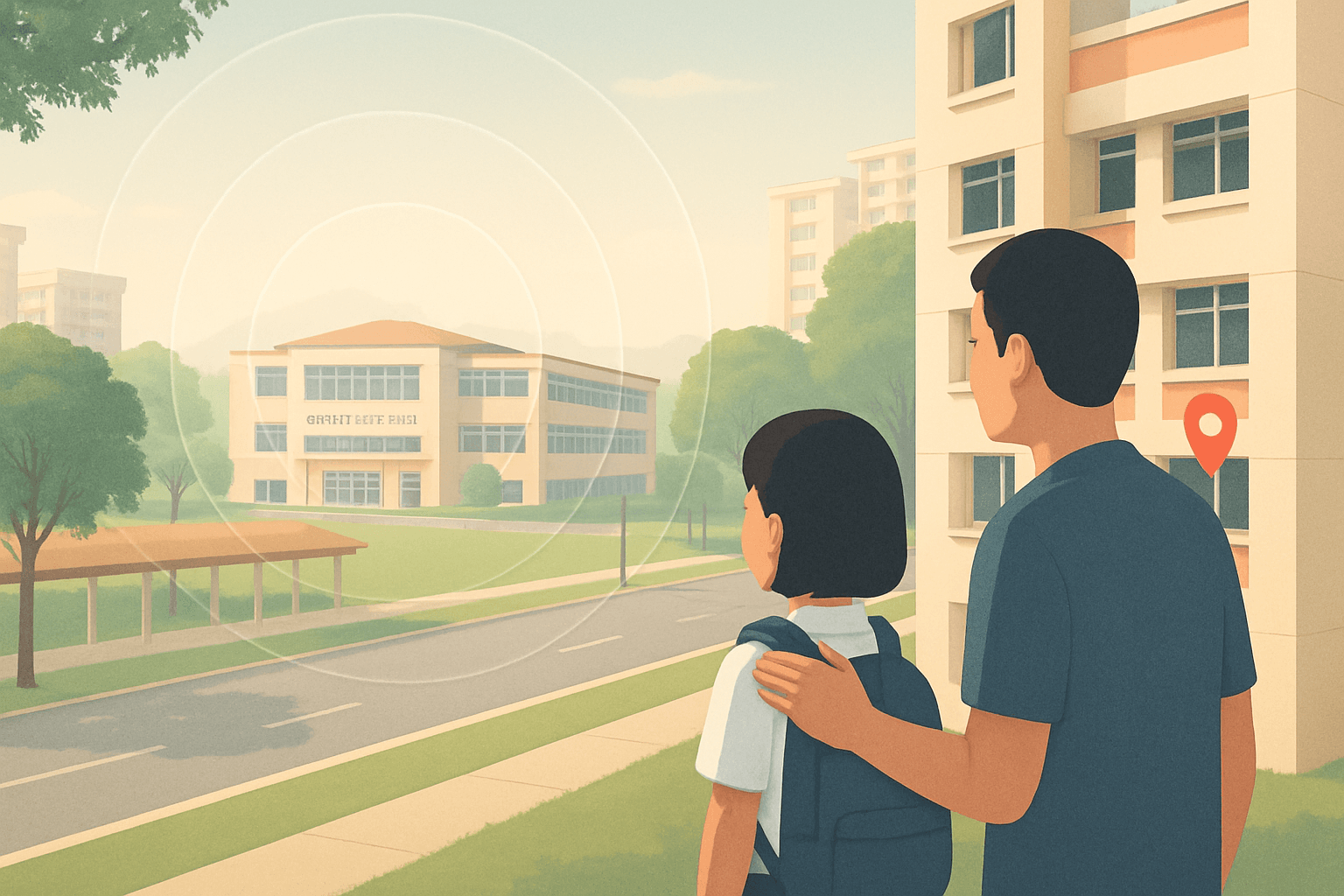
Before you compare school reputation, alumni stories, or hearsay, check distance from the home address you are likely to use. For many families, this is the fastest way to tell which Primary 1 choices are realistic and which ones are better treated as stretch options.
Why does school distance matter before Primary 1 registration starts?
Check distance early because it tells you which schools are realistic from your address and which are mainly wishful thinking.
Distance matters because it quickly tells you which schools are worth serious planning before registration opens. A school may look ideal on reputation, but if your home address does not place it in a useful distance band, it may be a weak choice to build your main plan around.
This is especially useful in a process where not every phase is based on distance. For example, MOE states that Phase 1 is for children with older siblings already studying in the school, so living nearby does not automatically make a child eligible for Phase 1. The practical move is simple: check distance first, then compare the schools that are still realistic from your address.
A useful way to think about it is this: distance does not choose the school for you, but it decides whether the school is even a sensible bet. If you want the bigger picture, start with our Primary 1 registration guide and phase-by-phase explainer.
[Jurong East] Primary Schools
I tried searching on Jurong Primary's website, but there is no info about the registration exercise at all. Just wondering how many of the 100 are within 1km...
[Geylang] Primary Schools
latest update: day 2 (Phase 2B), 9.25 am Kong Hwa yesterday @ end of day 1, 68 registered for 40 vacancies. out of 68 registered: 55 (SC) stay within 1 km. No PR. http://www.moe.gov.sg/education/admissions/primary-one-registration/vacancies/#geylang school request those out of 1 km to withdraw, try other school elsewhere. if out of 1 km, no chance to ballot. balloting (for < 1km) takes place next Wed, 25 July time: 9 am, morning venue: once you enter school compound, signboard will be placed up
What distance categories should parents focus on?
Most parents should focus on whether a school is likely within 1km, within 2km, or beyond 2km. Those bands are the most useful starting point for Primary 1 planning.
For most parents, the useful planning bands are within 1km, within 2km, and beyond 2km. You do not need to memorise every policy detail to use these bands well. What matters is whether a school is clearly inside a band, clearly outside it, or sitting right near the line.
These are planning bands, not admission promises. A school clearly within 1km is usually a stronger option than one that is 2km away. A school within 2km may still be workable, but it often gives you less comfort than a nearer option. Beyond 2km does not automatically rule a school out, but it usually belongs in the stretch category rather than the core of your plan.
A simple parent rule: if School A is clearly within 1km and School B is well beyond 2km, the real question is not which one sounds more prestigious. It is which one your address genuinely supports. Shortlist by address strength first, then compare fit among the schools that remain in play. For a broader overview, see Primary 1 Registration Distance Priority: How Home-School Distance Works.
[Serangoon] Primary Schools
Hi Parents, My elder son going to register for P1 this year. Currently, we are staying in sengkang. We are planning to try phase2B for nan chiau primary school (ncps) Chances of getting in is slim as we are staying between 1-2km. We are planning for the worst. We have shortlisted Northvista Primary for phase 2C. But my son needs to take school bus back to my mother-in-law place everyday bcos both my wife and myself are full time working parents. My mil leave in hougang which is considered 1-2km
[Bedok] Primary Schools
http://www.moe.gov.sg/education/admissions/primary-one-registration/vacancies/#bedok If only they can just list down the % from each group of distance category for those who applied..
Have More Questions?
Get personalized guidance on schools, tuition, enrichment and education pathways with AskVaiser.
Try AskVaiser for Free →What is a practical way to check school distance before shortlisting schools?
Use your real home address, sort schools into likely 1km and 2km bands, and recheck every boundary case before you rely on it.
- ✓Start with the home address you genuinely expect to use for registration, not a future move or a borrowed address.
- ✓Compare the schools you are considering using each school’s official location as the reference point.
- ✓Use map tools only for rough screening at the start, not as your final distance decision.
- ✓Sort each school into one of three planning buckets: likely within 1km, likely within 2km, or likely beyond 2km.
- ✓Mark any school that appears close to a 1km or 2km boundary as borderline and recheck it before treating it as a core option.
- ✓Do not use walking time, driving time, or "it feels nearby" as your main test.
- ✓Keep at least one clearly safer nearby school on your shortlist, even if your preferred school looks close.
- ✓Before finalising your plan, verify any important school using MOE-linked registration guidance rather than a casual map estimate alone.
Which address should you use when checking distance?
Use the child’s real home address, not a borrowed, temporary, or hoped-for one. If you are moving, compare both addresses early but plan around the one you can genuinely rely on.
Use the address that genuinely reflects where your child lives and what you can properly support for registration. Do not build your plan around a future move that has not happened, a grandparent’s flat used only for convenience, or a temporary arrangement that makes a preferred school look nearer.
This is one of the most common ways parents misread the situation. A family waiting for keys may plan too early around a new flat. Another may casually use a caregiver’s address because that school cluster looks better. A third may assume a short-term rental solves the problem. These are risky assumptions because address declarations matter and can be checked. MOE has also addressed address verification under the Primary 1 proximity policy and action taken on fraudulent declarations.
If your family may move, do the comparison early. Check schools from both the current and future homes, note your timeline honestly, and keep your shortlist anchored to the address most likely to matter when registration comes around. If your move is uncertain, plan conservatively from your current home and treat future-home options as provisional. For more detail, read Which Home Address Counts for Primary 1 Registration in Singapore? and Primary 1 Registration After Moving House: Should You Use Your Old or New Address?.
[Serangoon] Primary Schools
I think you are taking a big risk changing address in the middle of registration. If I worked at MOE I would definitely investigate!
[Bedok] Primary Schools
please go to this thread. there are a number of url that you can used to check the distance of your home to the desired school http://www.kiasuparents.com/kiasu/forum/viewtopic.php?t=426
Do not treat a map estimate as the official result
Use map tools for rough screening, not final certainty.
A school that looks "about 1km away" on a map is not automatically within the band you are planning around. Map apps are useful for early screening, but if your whole strategy depends on a school being inside 1km or 2km, verify it before registration opens. For a broader overview, see Primary 1 Registration After Moving House: Should You Use Your Old or New Address?.
[Bedok] Primary Schools
Telok Kurau Primary School has places only for children who have registered in the school and are living within 1km of the school. Therefore, children living outside 1km of the school are unsuccessful in their registration. No balloting will be conducted in Telok Kurau Primary School. Temasek Primary School has places only for children who have registered in the school and are living within 1km of the school. Therefore, children living outside 1km of the school are unsuccessful in their registra
[Pasir Ris] Primary Schools
Schools Conducting Balloting (as at 4 August 2014) Source : http://www.moe.gov.sg/education/admissions/primary-one-registration/balloting/ Elias Park Primary School: \tAll SC children are admitted to the school in this phase. Balloting will be conducted for PR children residing between 1km and 2km of the school. Pasir Ris Primary School: \tBalloting will be conducted for SC children residing within 1km of the school. White Sands Primary School: \tBalloting will be conducted for SC children resid
How should you read a result if a school is just inside or just outside 1km or 2km?
If a school is close to a boundary, treat it as borderline. Boundary cases should trigger backup planning, not confidence.
Treat any near-boundary result as borderline, not safe. If a school appears just inside 1km, that may make it more attractive, but it still should not be treated like a guaranteed advantage. If it appears just outside 1km, do not round it down in your head and assume it is effectively the same thing.
This is where many parents become too optimistic. Seeing a school at roughly 900m on a map is a reason to be encouraged, not to relax. Seeing a preferred school almost exactly on the 1km edge is a sign to prepare a backup, not to build the whole strategy around that line. A popular school that is clearly nearby can still be competitive. A less famous school slightly farther away may end up being the more practical choice.
The simplest rule is this: near the line means stretch, not certainty. If your plan only works when a school falls into one specific band, your plan is probably too fragile. For a broader overview, see Primary 1 Registration Phases in Singapore: What Each Phase Means for Your Chances.
[Ang Mo Kio] Primary Schools
@boyz Do take note that if you are using a caregiver's address to register, you will be considered to be in the 1 - 2 km category, even if the actual distance is within 1km. Taken from http://www.moe.edu.sg/education/admissions/primary-one-registration/statutory-declaration/ : If statutory declaration is used, children who are registered using either the grandparent’s or the parent’s sibling’s address and residing within 1 km or between 1 km and 2 km of the school of choice are balloted together
[Choa Chu Kang] Primary Schools
Hi when you apply, you have to choose one school and go down and apply. use this link to measure the distance of the school from your home: http://www.onemap.sg/index.html SV balloting is needed for <1km.
What mistakes do parents commonly make when checking Primary 1 registration distance?
The usual mistakes are using the wrong address, relying on walking time, and assuming that being near a boundary or inside a band guarantees a strong outcome.
The biggest mistake is checking from the wrong address. Parents sometimes use a future home, a grandparent’s place, or a temporary arrangement because it gives a better-looking result. The second is relying on walking time or driving time as if that were the same thing as registration distance. A school can feel close in daily life and still be a weak planning assumption.
Another mistake is mixing up distance with overall eligibility. Distance can strengthen a school’s place on your shortlist, but it does not override the rest of the registration process. For example, MOE makes clear that Phase 1 is for children with older siblings already studying in the school, so living nearby does not create Phase 1 eligibility. Parents also tend to overread borderline results by telling themselves that "close enough" is the same as clearly within a band.
The planning mistake underneath all of this is shortlisting by reputation first and distance later. That often produces a list full of admired schools but very few strategically sensible ones. If you are weighing that trade-off now, our guide on whether to pick a popular dream school or a safer nearby school is a useful next read.
All About Preparing For Primary One
Starting primary school? This is a big milestone. Do enjoy the journey with your child! :rahrah: https://www.straitstimes.com/singapore/education/the-st-guide-to-preparing-your-child-for-primary-1 Parents often confuse being ready for school with being academically capable in skills like reading and counting. Instead of focusing solely on academic progress, it is more important to make learning an enjoyable process, and help your child have a swift and happier adjustment to primary school. Here
[Bedok] Primary Schools
Hi, My girl is 6yo and we’re planning to register her with Temasek Pri Sch but falls under phase 2c (within 1km). A few questions I have: 1) 2013 P1 registration - was balloting required under phase 2c (within 1km)? 2) Is it better to register online (P1-IS) or do it direct at school? 3) 2014 P1 registration phase 2c - Registration dates are 29-31 Jul (online) and 30 Jul-1 Aug (at school). Results will be known on 6 Aug. If balloting is required, how and when do we know?
How should distance findings change your school shortlist?
Let distance sort your schools into realistic, stretch, and backup options. That is more useful than starting with a dream list and checking distance too late.
Use your distance check to sort schools into three groups: realistic options, stretch options, and backups. Realistic options are schools that fit a useful distance band and still make sense for your family’s daily life. Stretch options are schools near a boundary or farther away that you may still try for if you understand the risk. Backups are the schools that keep your plan stable if competition goes against you.
This works better than building a prestige-first wish list. A common pattern is to name three famous schools, assume one will somehow work out, and only later discover that none of them was a strong address-based fit. A stronger pattern is to start with the schools your address genuinely supports, then compare culture, commute, and fit within that realistic set.
It also helps to stay realistic about last-minute rescue options. Parents do appeal, but MOE has said appeals make up only a small share of total Primary 1 enrolment. That is a reminder, not a scare tactic: appeals are a fallback after a weak outcome, not a substitute for a sound shortlist. If you are balancing distance against popularity, our guides on distance priority, past balloting data, and what happens if you do not get your preferred school can help you plan more calmly.
[Bukit Panjang] Primary Schools
distance does not determine the phase you enter. it is the (phase + distance) combined together that determine your choice of school. go and read up MOE website, what each phase mean:- http://www.moe.gov.sg/education/admissions/primary-one-registration/phases/
[Bukit Panjang] Primary Schools
This is the scenario for ALL schools, not only these three schools. What is the distance of the schools from your house?
Can I still apply to a school if we live beyond 2km?
Yes, but it is usually a weaker strategy than focusing on schools where your address gives you a stronger position. Keep it as a stretch option, not your only serious plan.
Yes, you can still consider it, but you should usually treat it as a stretch option rather than your main plan, especially if the school is popular. Living beyond 2km does not automatically close every door, but it often puts you in a weaker position than families whose addresses are closer.
The practical question is not only "Can we try?" but also "What are we giving up if we make this our main strategy?" If the school is your clear first choice, keep it on the list with open eyes. Then balance it with at least one or two schools that are genuinely nearer and easier to defend as realistic choices. That way, you are not scrambling late if the higher-risk option does not work out.
A good parent rule is this: love the school if you want, but do not let one faraway school become your whole plan. Families usually feel calmer during registration when they separate aspiration from strategy early.
[Bukit Panjang] Primary Schools
Dear Adeqicious, As stated on MOE website,PV registration for 2018 P1 already over.Must register 2 years beforehand. However,if you are Singaporean and if you are staying within 2km from the school then there should not be any problems getting into the school. This year all Singaporeans’ child got in.
[Geylang] Primary Schools
Please double check that your statistics refers to those residing 1-2km from the school. For registration using caregiver's address, MOE will categorise it as registration within 1-2km even if the caregiver stays <1km from the school. If you fail in Phase 2C, you will need to register in Phase 2C supplementary. At that point, you can register in any schools that has vacancies left in Phase 2C (taking into consideration your success rate based on distance too, as that is already the second last r
Have More Questions?
Get personalized guidance on schools, tuition, enrichment and education pathways with AskVaiser.
Try AskVaiser for Free →