
Is It Worth Buying a Home Near a School for Primary 1 Registration?
A practical Singapore guide to school odds, housing cost, commute savings, and why proximity still does not guarantee a place.
Buying a home near a school for Primary 1 registration is usually worth it only if you already like the area, can afford the premium comfortably, and would benefit from the shorter daily commute even without a guaranteed school place. Proximity can improve your position in some registration situations, but popular schools can still be oversubscribed and go to balloting.
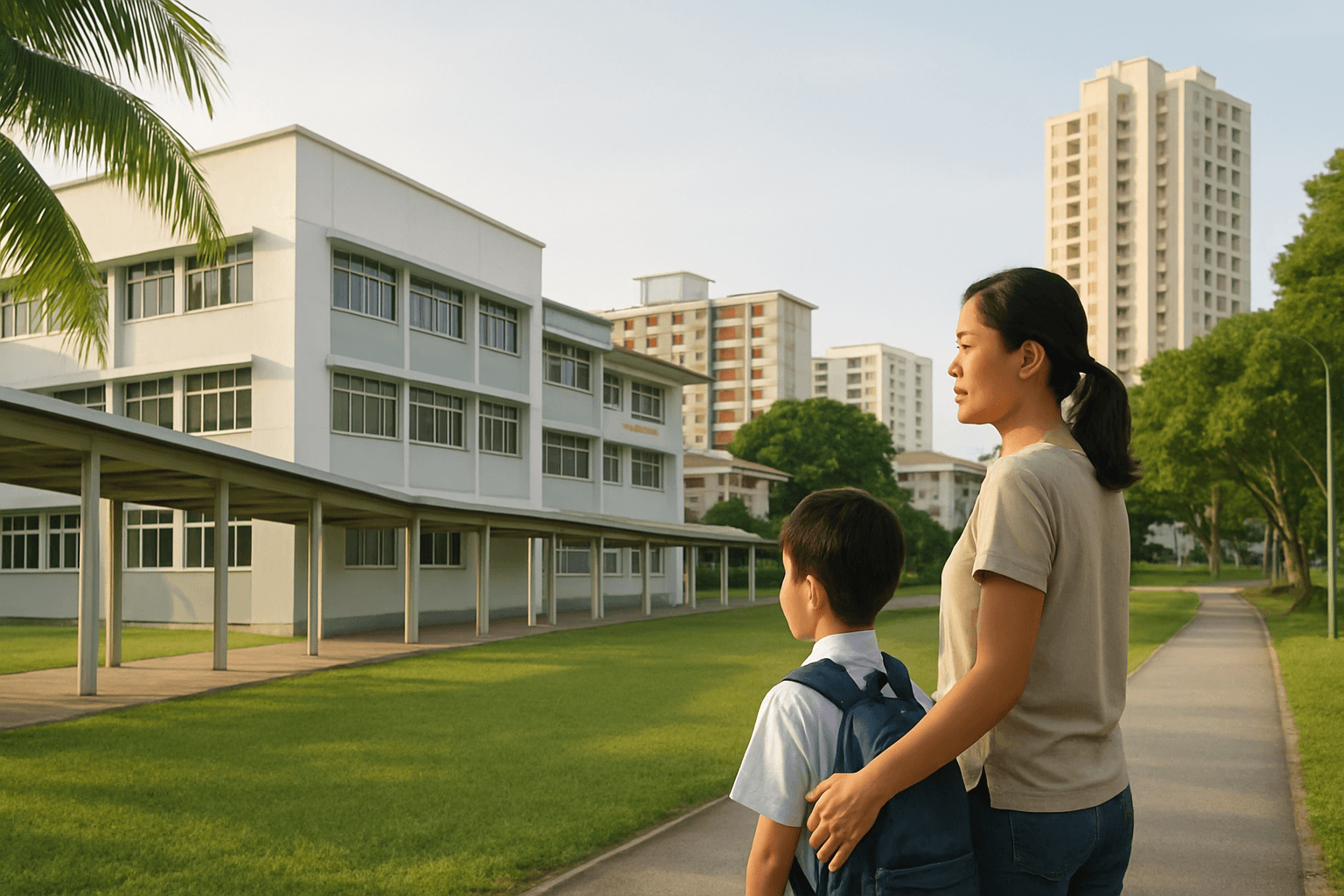
Usually, yes only if you would still want that home even if your child does not get into that school. In Singapore, living near a school can matter for Primary 1 registration, but it is only one part of the process, and popular schools can still end up with balloting.
The better question is not just whether a nearby address helps. It is whether the possible registration advantage, shorter school commute, and easier daily routine are worth the housing premium and reduced flexibility. If you need the wider context first, start with our Primary 1 registration guide.
Short answer: is it worth buying a home near a school for Primary 1 registration?
Usually yes only if the home still works as a long-term housing choice, not just a Primary 1 strategy.
Usually only if the home also makes sense for your family beyond Primary 1. Buying near a school can help in some registration situations and can make daily life much easier, but it is not a strong enough admissions shortcut to justify an overstretched budget on its own.
A practical rule is this: buy the home first, let the school benefit be a bonus. If you already like the neighbourhood, can afford the price comfortably, and would genuinely use the shorter school run for years, the move may be sensible even if the school outcome is uncertain. If you would dislike the area, need to compromise too much on space, or plan to move again soon, the school angle alone is often too weak a reason to commit.
Think of proximity as risk reduction, not certainty. It can improve your position, but it does not turn a competitive school into a safe one. For a broader overview, see Primary 1 Registration in Singapore: How It Works, Balloting Risk, and How to Choose a Realistic School Plan.
All About Preparing For Primary One
First of all, how far are u from the school? Within 1km or 1 - 2km? If near, don't take school bus, send yourself. Any balloting history for the neighbourhood school under 2C?
All About Preparing For Primary One
My son is going primary 1 next year and I am eligible for phase 2b under a good school but it took two hours of time of bus transport to n fro from home. The kid have to be at the bus stop at 6am waiting for bus. That school have proven track record for the past many years because of it’s strict standards. Now, my headache is there Is a relatively new school which is only a few years old n has not proven track records n the highest psle scores is 230plus. This school is just downstairs my home b
How does living near a school affect Primary 1 registration in Singapore?
Proximity matters, but only the official address classification matters for registration, not a rough map estimate.
Home-school distance matters in Singapore's Primary 1 framework, but it is only one part of the picture. MOE's parent FAQ points parents to SchoolFinder to identify nearby schools and to the official distance-check tool for verifying how an address is classified.
That distinction matters more than many parents realise. A property listing may say near a popular school. An agent may say walking distance. A map may look close enough. None of that is the same as the official address classification used for registration. Before making any housing decision, verify the exact address first, then read our guides on how home-school distance works and which home address counts for Primary 1 registration.
The key takeaway is simple: do not buy based on rough proximity. Buy only after checking the official address result and understanding whether distance is likely to matter for your registration situation at all.
[Serangoon] Primary Schools
Hi Parents, My elder son going to register for P1 this year. Currently, we are staying in sengkang. We are planning to try phase2B for nan chiau primary school (ncps) Chances of getting in is slim as we are staying between 1-2km. We are planning for the worst. We have shortlisted Northvista Primary for phase 2C. But my son needs to take school bus back to my mother-in-law place everyday bcos both my wife and myself are full time working parents. My mil leave in hougang which is considered 1-2km
[Serangoon] Primary Schools
I think you are taking a big risk changing address in the middle of registration. If I worked at MOE I would definitely investigate!
Have More Questions?
Get personalized guidance on schools, tuition, enrichment and education pathways with AskVaiser.
Try AskVaiser for Free →When does being nearby actually improve your child’s chances?
Being nearby helps most when the school is not heavily oversubscribed and distance still has room to influence the outcome.
It helps most when the school is not severely oversubscribed and when your registration situation gives weight to home-school distance. In plain terms, proximity works best when there is still real room for it to make a difference.
A useful comparison is this. For a moderately popular neighbourhood school, a nearby address may turn the school from a hopeful option into a realistic one. For a very sought-after school, buying nearby may simply place you in a crowded pool of other nearby families. In that case, you have removed one hurdle but not the competition.
This is why parents should think in terms of demand, not just distance. Check whether the school has a history of heavy competition by reading our guide on how to read past balloting data, and understand where distance fits into the overall process with our overview of Primary 1 registration phases. If you want a parent-oriented secondary read on why families plan so carefully around the framework, KiasuParents' overview is useful, but MOE guidance should remain your anchor. For a broader overview, see Which Home Address Counts for Primary 1 Registration in Singapore?.
Top Primary school?
for me, there is only one school within 1km from my place...it is a good one, but...i don't have any girls. i will need to ballot for a place for one sch within 1-2km from my place (next nearest school). if *touch wood*, balloting is unsuccessful, i will go for the next nearest neighbourhood school. for this, i am wary that this school focus its resources on the 'diamond' class and streaming starts as early as end of P1! getting him into such class will be my next best bet. so neighbourhood scho
[Bedok] Primary Schools
When will you be registering for your child? To go by the grassroot leader way, you need at least 3-4 years. As for PV, you may like to indicate in the PV application form of your intention to move wihin 1 km of the school. This will increase your chance of being selected as a PV.
Why buying near a popular school may still lead to balloting
A nearby address can still end in balloting if many other nearby families apply to the same school.
Because many other families may also live close enough to compete for the same limited places. A nearby address removes one barrier, but it does not remove competition. Think of proximity as a filter, not a fast pass. Before paying a housing premium, assume a very popular school can still ballot among nearby families and decide in advance what your backup school plan would be. Our guide on what happens if you do not get your preferred school can help you pressure-test that scenario. The pressure is real enough that false-address cases have made the news, which is a reminder that school demand and housing demand often move together. For a broader overview, see How to Read Past Balloting Data Before Chasing a Popular Primary School.
All About Primary Schools' Balloting History
Read this KSP article: https://www.kiasuparents.com/kiasu/article/p1-registration-2020-for-2021-phase-2a1-2/ Those are the popular primary schools which go into balloting at phase 2A1. If you are not from those schools, then don’t need to move closer lor.
All About Primary Schools' Balloting History
If you just want to be able to get into any school within 1km, just go for those schools with no color coding in any of the Phases in the Balloting charts.
What are the main financial trade-offs of buying near a school?
You are paying a location premium for convenience and a possible registration edge, not for guaranteed admission.
The main trade-off is paying more for a possibility rather than a certainty. A home near a well-regarded school may cost more to buy, require a larger mortgage, or force you to accept a smaller unit than the same budget would buy elsewhere. That means the school decision is tied to wider trade-offs such as space, savings, retirement planning, and how much room you have if work or caregiving needs change.
For example, one home may give you an easy school walk but cost materially more. Another may be cheaper, larger, or better connected by transport but not as strong on school proximity. The first option may be worth it if you will use the location advantage every weekday for years. It may not be worth it if you are mainly paying for a one-time admissions hope.
Market watchers have noted this pressure before. The Straits Times reported that sale and rental prices near popular schools could rise as parents adjust their housing plans. Treat that as a market signal, not proof that every school-adjacent property is good value. The parent question is simpler: if the school benefit disappears, is the home still worth the price? For a broader overview, see Primary 1 Registration Unsuccessful: What Happens If You Do Not Get Your Preferred School.
[Bedok] Primary Schools
For Temasek Primary, there were some years where P2C <1km no need to ballot. Now that SC have priority over PRs, the odds are quite good if <1km. Blk 46~50 enbloc and many residents left. Now these are mostly rented to PRs and S Pass holders. Plus a big part of the area ard TP is not very populated with few HDBs.. Further up north, these HDBs are within 1km of Red Swastika and yu neng, and these pple may prefer the other 2 primary schools. So, for <1km, chances is pretty good, but Not w/o risk.
[Bedok] Primary Schools
Is this the only school that is less than 1 km from your house? Have you checked the balloting history of other schools near your house? In the absence of other options, other parents who are also within 1 km from the school will thank you for not even applying because you have increased their children's chance of getting into the school.
How much convenience are you really paying for?
In many cases, you are paying for easier mornings and a calmer six-year routine, not just better odds.
Often, more than just admissions odds. You are paying for time, predictability, and less daily friction. A shorter walk or easier drop-off matters every school day, not just during registration season.
This is easiest to see in ordinary family routines. A rainy morning is less stressful when school is nearby. A grandparent or helper may manage one direct route comfortably but struggle with a longer trip involving transfers. If one parent starts work early, even a modest reduction in travel time can make the whole household run more smoothly. Over six primary school years, that daily convenience can be meaningful.
This is why some families remain happy with the location decision even if the school outcome is uncertain. They are not only paying for a registration strategy. They are paying for a calmer routine. If your household would genuinely feel the difference every weekday, that convenience deserves real weight in the decision.
[Bedok] Primary Schools
Do consider carefully on the distance to the school and the logistics. Just to share my experience. I am staying in the east and enrolled my dd when she was younger in St Anthony's Canossian Primary though I had priority in a branded school in the west. Never regretted it, the convenience of being near the school especially during her later years when there were cca, extra afterschool lessons and activities, I could ask my maid to assist bringing her back from school. The time saved on distance
[Bedok] Primary Schools
Distance is really 1 of the most important factor. My kids school is 2 bus stops away and within 1km so they can choose to walk or take bus. Since P2 they can go to school and come home on their own. Just need to go bus stop to fetch them. So convenience and save some $$ as no need school bus which is so exp. Plus even if you engage sch bus, got CCA or anything also must arrange own transport so sch bus is waste of money and not worth.. let alone the fact that you need to pay $$ for > 2 months o
What should parents consider about future resale or rental value?
School proximity may support demand, but the home should still make sense even if your school plan changes.
A home near a popular school may stay attractive to future buyers or tenants, but that should be treated as a support factor, not the main reason to buy. The safer choice is a home that also has broader strengths such as transport convenience, nearby amenities, and a layout your family can actually live in comfortably.
This matters because your own school plan can change. Your child may not get into that school. Your work location may shift. You may later care more about space, eldercare support, or secondary school logistics than one primary school address. If the home's appeal depends too heavily on a single school story, the decision is more fragile than it first appears.
A useful test is this: would this still feel like a sensible home if the school outcome goes against us? If yes, any resale or rental support is a bonus. If no, you may be overpaying for a very narrow thesis. The same Straits Times report on price and rental pressure is relevant here, but it should not be read as a guarantee that every nearby unit will hold a premium equally well.
All About Preparing For Primary One
Starting primary school? This is a big milestone. Do enjoy the journey with your child! :rahrah: https://www.straitstimes.com/singapore/education/the-st-guide-to-preparing-your-child-for-primary-1 Parents often confuse being ready for school with being academically capable in skills like reading and counting. Instead of focusing solely on academic progress, it is more important to make learning an enjoyable process, and help your child have a swift and happier adjustment to primary school. Here
All About Preparing For Primary One
Was surfing around on understanding if I am well prepared on behalf of my DD1 for Primary 1 Chanced upon a few websites, thought to share though it could have been mentioned before Tips For Parents ◦Work on independent reading skills. ◦Set up a study area and regular study times that are not interrupted. ◦Learn to follow a routine with a lot of sleep and early mornings. ◦Practice organisation and planning by packing a daily bag with essentials for the day. ◦Talk about social skills and communica
When is buying near a school a sensible strategy?
It is sensible when you already want to live there and the school benefit improves an already sound housing choice.
It is usually sensible when the move already fits your family's wider housing plan. That includes families who genuinely want to stay in the area for years, parents who already work nearby, households with reliable caregiving support in the neighbourhood, or families with younger siblings who may also benefit later. In those cases, the school advantage strengthens an already sensible move.
It also makes sense when parents are realistic about the risk. A family that likes the area, has checked the official address classification, has looked at past demand, and can still live comfortably if the school result goes the wrong way is making a much stronger decision than a family chasing one outcome.
A simple way to frame it is this: housing first, school second. If the neighbourhood already works for work, childcare, family support, and everyday logistics, then buying near the school can be practical even without certainty.
[Bedok] Primary Schools
I’m also interested in Red Swastika, can some experienced ppl advise whether the school is good, is considering buying house near some good schools. It is really appreciated to give some advise whether this school is worth the effort of moving house, thanks!
[Bedok] Primary Schools
Hi, I have registered as PV for YuNeng Pri School without doing much homework like reading this wonderful site... I live more than 2 km away.... Alternatively i live within 2 km from Gongshang and Pasir ris pri... I hope my son could get into any of these 3 schools. Is there any advice for an ill-informed parent here? Thank you so much!
When is it not worth stretching your budget for school proximity?
It is usually not worth it if the purchase strains your budget or only makes sense if one school outcome happens.
It is usually not worth it when the purchase only works if everything goes right. If the mortgage feels tight, the home is not one you would otherwise choose, or the entire logic depends on getting one specific school, the risk is probably too high. That is especially true for highly competitive schools where many nearby families may still be competing for the same places.
Parents also get into trouble when they overlook practical alternatives. A slightly farther home with better transport links may still support a workable school routine at a much lower cost. Another common mistake is assuming all homes near the school are equally useful without verifying the official address classification. If you are moving around the registration period, our guide on Primary 1 registration after moving house can help you think through that issue.
A good stress test is this: if you mentally remove the school place from the equation, do you still want the home? If not, pause. The safer approach is to assume uncertainty, keep a backup plan, and compare that option against a more realistic school strategy such as choosing between a popular dream school and a safer nearby school.
[Bedok] Primary Schools
Thank you for your valuable comments. However to be realistic, the achievement grades of Bedok Green students are better than East Coast. I'm caught in a fix. Cos based on our registered address, Bedok Green falls between 1 to 2 km, whereas East Coast is within 1 km. Really stressful.
[Bedok] Primary Schools
Telok Kurau Primary School has places only for children who have registered in the school and are living within 1km of the school. Therefore, children living outside 1km of the school are unsuccessful in their registration. No balloting will be conducted in Telok Kurau Primary School. Temasek Primary School has places only for children who have registered in the school and are living within 1km of the school. Therefore, children living outside 1km of the school are unsuccessful in their registra
Have More Questions?
Get personalized guidance on schools, tuition, enrichment and education pathways with AskVaiser.
Try AskVaiser for Free →