
Primary 1 Registration Distance Strategy: How Home-to-School Distance Affects Your Odds in Singapore
How to use the 1km and 2km bands to judge dream schools, shortlist backups, and avoid treating proximity as a guarantee.
Home-to-school distance mainly matters when a school has more applicants than places. Within 1km is usually the strongest distance position, 1km to 2km is the middle band, and beyond 2km is usually weaker for popular schools. But distance never works on its own: phase, citizenship priority, and balloting still shape the outcome.
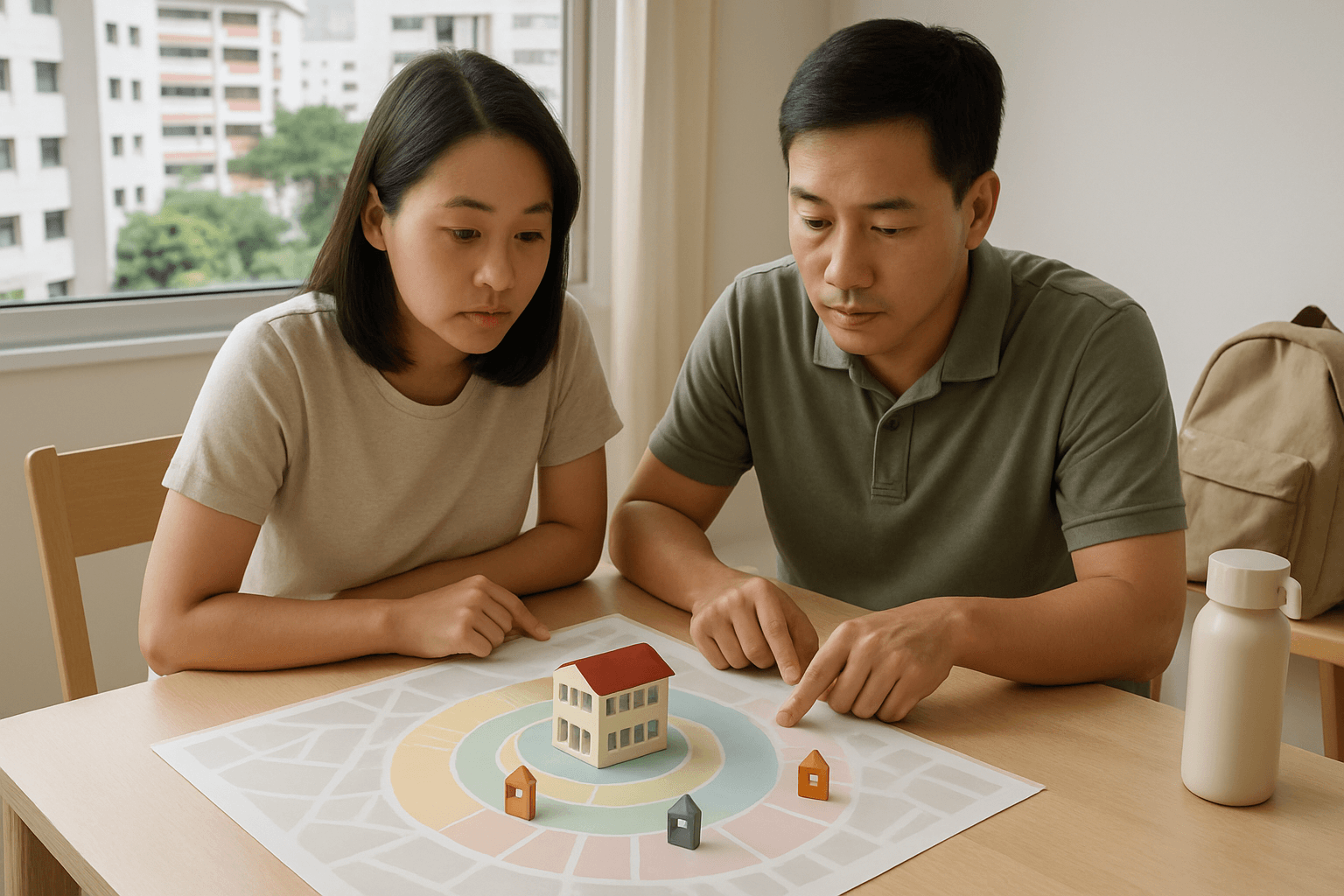
Living closer to a school can improve your child’s Primary 1 registration chances, but mainly when the school is oversubscribed. That makes distance most useful as a planning tool, not a promise. The smart approach is to use your distance band to decide whether a school is a realistic target, a hopeful long shot, or a backup you should take seriously.
How does home-to-school distance affect Primary 1 registration in Singapore?
Living closer usually helps only when a school is oversubscribed, because distance is one part of MOE’s wider priority system rather than a guarantee of entry.
Home-to-school distance affects Primary 1 registration mainly when a school has more applicants than vacancies. MOE uses the registered home address to determine your child’s Home-School Distance, and that distance can improve priority when demand exceeds places, as explained in MOE’s guidance on distance and home address.
The practical takeaway is straightforward: distance improves your odds, but it does not secure a place by itself. If a school has enough vacancies in your phase, distance may never become the deciding factor. If it is oversubscribed, being closer can put your child ahead of another applicant who lives farther away.
Parents often treat distance like a yes-or-no rule. It is not. Distance sits inside the wider Primary 1 registration framework, where phase and citizenship priority also matter. If you want the bigger picture first, start with our Primary 1 registration guide and our explanation of how Primary 1 phases affect your chances.
[Ang Mo Kio] Primary Schools
@boyz Do take note that if you are using a caregiver's address to register, you will be considered to be in the 1 - 2 km category, even if the actual distance is within 1km. Taken from http://www.moe.edu.sg/education/admissions/primary-one-registration/statutory-declaration/ : If statutory declaration is used, children who are registered using either the grandparent’s or the parent’s sibling’s address and residing within 1 km or between 1 km and 2 km of the school of choice are balloted together
[Ang Mo Kio] Primary Schools
My girl will be enrolling in a primary school next year too. I feel where you stay will play a big part in deciding on which pri school your child will study at eventually. Why do we need to compare which primary schools your child will study in ? I think this create an unhealthy system in which most parents will strive to get their child into these perceived good schools. ( If they score well in those schools, it is expected of them but if they do not, these children will enter different second
Why are the 1km and 2km bands so important to parents?
The 1km and 2km bands matter because they are the clearest way distance changes priority, especially at popular schools where parents need to judge risk realistically.
Parents focus on 1km and 2km because these are the bands that most clearly affect how competitive your application looks. In practical terms, within 1km is usually your strongest distance position, 1km to 2km is still helpful but less strong, and beyond 2km is usually the weakest position when a school is popular.
A useful way to think about the bands is this: they are not a guarantee ladder, they are a priority ladder. A school may feel realistic within 1km and much riskier beyond 2km, even if both families love the school equally.
This is why two families can look at the same school and make very different decisions. One family may treat it as a serious first choice because they are close enough to stay competitive. Another may treat it as a stretch option and keep looking for a safer backup. That difference is the real value of the distance bands. For a broader overview, see Primary 1 Registration Distance Priority: How Home-School Distance Works.
All About Measuring Home-School Distance
Does this school distance still played important factor in primary 1 registration ? MOE website did not state this factor in for this primary 1 registration :? Bad new for me : I just moved to SK area near to primary school. So I did not did any PV since I just moved into SK area. I need to know whether this distance (within 1km) still plays important factor . If yes, which phase will it be? Accordingly to new MOE , I only in phase 2C
All About Measuring Home-School Distance
I recall that schools may use this to measure distance. In any case, this is based on a as crow flies distance and not the actual travel distance. From my place, my kid's school is within 1km although actual walking would like 30-45min (driving though is about 5min). I would suggest to use this as a measure to get a list of your target schools - and if you feel unsafe, please call up the schools of interest to verify the information is accurate. Nothing beats knowing on the day of registration t
Have More Questions?
Get personalized guidance on schools, tuition, enrichment and education pathways with AskVaiser.
Try AskVaiser for Free →When does distance matter most, and when does it matter less?
Distance matters most when a school has more applicants than vacancies, and much less when the school has enough places or stronger priorities apply first.
Distance matters most when a school is oversubscribed in your registration phase. In those situations, MOE may need to separate applicants by priority before or during balloting, which is why MOE’s page on understanding balloting matters so much for parents looking at popular schools.
Distance matters less when the school has enough vacancies for all applicants in that phase, or when your child is already in a stronger priority group before distance is considered. This is where many parents go wrong: they hear that 1km matters and apply that logic to every school, even those that do not usually fill up.
A practical comparison helps. A neighbourhood school with room to spare may admit children from several distance bands without much drama. A sought-after school may still be tight even for families within 1km. So the better parent question is not only, "How close are we?" It is also, "How likely is this school to ballot in our phase?" That is why our guide on how to read past balloting data is often more useful than guessing from reputation alone. For a broader overview, see Primary 1 Registration: Should You Pick a Popular Dream School or a Safer Nearby School?.
All about Transferring to Other Primary Schools
Hi hennaoh, Please refer to the FAQ below. Does it address your situation? https://va.ecitizen.gov.sg/cfp/customerPages/moe/ExploreFaq.aspx?Category=3645&Mesid=422335 Q:- I am in the midst of purchasing a new resale property. The transaction will be completed soon and I will be able to move in prior to the commencement of the academic year. Can I make use of this new address to register my child? Answer: The resale Housing & Development Board (HDB) flat's/ private property’s address can be used
[Bedok] Primary Schools
http://www.moe.gov.sg/education/admissions/primary-one-registration/vacancies/#bedok If only they can just list down the % from each group of distance category for those who applied..
How should distance shape your dream-school shortlist?
Distance should act as a realism filter so you can keep dream schools on the list without mistaking a stretch choice for a sensible main plan.
Use distance as a realism filter. A dream school can stay on your list, but your distance band should tell you whether it is a plausible target, a stretch choice, or a school you like but should not build your whole plan around.
A simple method is to sort schools into three buckets: best fit, realistic target, and acceptable backup. If a popular school is within 1km, it may deserve serious consideration, but you should still expect competition. If it is between 1km and 2km, you are in a middle-risk zone where past balloting patterns start to matter more. If it is beyond 2km and known to be popular, it is usually better treated as a hopeful option than the centre of your strategy.
This is where many parents get caught. They shortlist based on aspiration, then only later realise the distance band made the school a long shot from the start. If you are weighing ambition against realism, our guide on dream school versus safer nearby school can help. Some parents also use community round-ups such as KiasuParents’ balloting risk discussions as extra context. Treat those as supplementary, not official. For a broader overview, see How to Read Past Balloting Data Before Chasing a Popular Primary School.
All About Measuring Home-School Distance
So this article shall make all of us on the same page: https://www.straitstimes.com/singapore/parenting-education/new-way-of-calculating-distance-for-p1-registration-means-more And in a simple word: onemap.gov.sg will help to determine.
All About Measuring Home-School Distance
my kid's registration is next year. i checked with the school this morning & they have only home school distance list for registration this year. & i was told it's best to check again next year to be sure... i was puzzled... can the distance change next year? my place is just right outside 1km according to onemap... :stupid: :stupid: has anyone experienced changes in home school distance? thanks.
How should you choose a backup school if your first choice is far away?
Pick a backup that is genuinely more viable and manageable, not just a school you rank lower on paper.
Choose a backup that is safer in both admissions and daily life. A good backup is not simply "the school we like less." It is a school you can register for with more confidence and live with every weekday.
A practical way to test a backup is to ask three questions. Is the commute manageable without exhausting the child or the adults handling drop-off and pickup? Does your distance band put you in a better position than at your dream school? And is the school truly less risky, rather than another popular name that could also balloted? For many families, a sensible backup is a nearer school with workable transport, student-care arrangements, and pickup support from grandparents or helpers if needed.
For example, if your dream school is beyond 2km and known to ballot, a backup within 1km or 2km may be far more than a consolation prize. It may be the school that makes mornings, after-school care, and contingency planning much easier. Our guides on reading past balloting data and what happens if you do not get your preferred school can help you pressure-test that backup early instead of scrambling later. For a broader overview, see Which Home Address Counts for Primary 1 Registration in Singapore?.
All about Transferring to Other Primary Schools
Put your kid on waitlist in all the schools first. There is no limit. make a copy of the waitlist (take pic etc) and email to principal cc school admin to tell them you waitlisted and really really hope to join them because of distance. Anywhere in punggol is still nearer than her current school. Explore neighboring towns too. you may need to register on waitlist yearly. movement may only take place in end p3 when students move on to gep and p4 class size increased then have vacancies. Important
[Bedok] Primary Schools
I also did the same as you. The school staff advise me to have my hubby to stationed at the school that you registered earlier and yourself at the school under p2c. So you weigh your chance, if you think the chance good under p2c, call your hubby to withdraw then afterwhich u can register. Withdrawing no need show original ics, but registering you need originals. You can do this on 1st August, but make sure got sufficient time. For myself, I still thinking which school to choose?
What is the biggest mistake parents make about distance strategy?
Parents often overestimate what a close address can do and underestimate how risky a faraway popular school really is.
The biggest mistake is confusing advantage with safety. A 1km address can improve your position, but it does not secure a place at a competitive school. A beyond-2km popular school can still work out, but it is usually a gamble, not a normal first choice. Plan around probability, not one lucky anecdote.
All About Measuring Home-School Distance
Hi Andaiz! The answer to your question can actually be found in the http://www.moe.gov.sg/education/admissions/primary-one-registration/faqs/#proximity section of the MOE website, Question 24. In short, you should use the address of the permanent location.
All About Measuring Home-School Distance
[Moderator's note: Topics merged.] I have recently encountered an incident regarding home to school distance. As this particular school left a few vacancies. So I have to be very careful to make sure that my house distance falls within 1km for Phase 2 Supp. When I went to the school, the admin girl said my house falls within 1 to 2km. I was disappointed and shocked as my house is just a few blocks away. I managed to find out the statelite distance online and shown that it is still within 1km, ev
What should parents do if they live just inside or just outside 1km?
If you are near the 1km boundary, do not rely on a casual map view and do not plan as though the better band is already yours.
Treat boundary cases as provisional until the official distance band is clear. Since the 2022 exercise, MOE calculates Home-School Distance using the School Land Boundary rather than a single school point, which can shift some homes into or out of the 1km and 2km bands, as noted in this parliamentary reply.
If you appear to be just inside 1km, that may improve your outlook, but it is still wise to keep a serious second option because popular schools can remain competitive even for nearby families. If you appear to be just outside 1km, do not plan as though you have the stronger band. In real parent terms, one block cluster, one road, or one edge of a condo can change how realistic a school is.
The safe approach is to verify your address carefully and plan conservatively until you are sure. This matters most when you are deciding whether a school is a realistic target or only a hopeful reach. If address rules are part of your uncertainty, see our guide on which home address counts and MOE’s page on home address.
[Bukit Timah] Primary Schools
should be the same across all schs Registration at Primary School Registration is conducted at the primary school that you wish your child to be admitted into. The hours of registration are from 8.00 am to 11.00 am and from 2.30 pm to 4.30 pm on each scheduled registration day. Parents or a person authorized by the parents in writing (letter of authorization (72kb .pdf)) is to submit the registration form and required documents at the school of choice. From the 2012 P1 Registration Exercise onwa
[Bukit Timah] Primary Schools
a) Nanyang refer http://www.nyps.moe.edu.sg/index.php?option=com_content&view=article&id=32&Itemid=33 ai) phase 2B 2011: staying more than 2 km. # of applications Received: 11. but # of successful applicants: 0 (> 2km not given chance to ballot). all those 28 who got in - stayed less than 1 km. aii) phase 2B 2010: staying more than 2 km. out of 22 balloted, 7 got in. (better than 2011 batch) means ratio is 1:3 ie. out of every 3 kids, only 1 lucky child able to get into NYPS aiii) under Phase 2C
Should you consider moving house for Primary 1 registration?
Only consider moving if the home choice stands on its own, because a shorter distance improves odds but does not secure the school place.
Consider moving only if the housing decision still makes sense even if the school outcome does not go your way. A better address can improve priority, but it still does not guarantee a place at a popular school.
The lower-risk scenario is a family that is already planning a genuine move and uses school distance as one factor among price, commute, and support from grandparents. The higher-risk scenario is paying rent or reorganising the household mainly for one school outcome. If the school still ballots, the family absorbs the cost and disruption without certainty.
Do not treat a relative’s address or a temporary arrangement as a harmless shortcut. MOE takes improper address use seriously and says it may transfer a child out of the school, and giving false information can also be an offence. Read MOE’s home address guidance before relying on any address arrangement, and see our article on Primary 1 registration after moving house if your family is genuinely relocating.
Useful rule: move for the home first, and let school distance be a bonus.
All about Transferring to Other Primary Schools
https://www.moe.gov.sg/primary/transfers “You can apply to transfer your child to a primary school nearer to your new residential address if your child is: - A Singapore Citizen (SC) or Permanent Resident (PR). - Currently in Primary 1 to 5. We will offer your child a school nearer to your new residential address which has available vacancies. Your child will have to report to the new school by the end of the reporting period to complete the school transfer. Your NRIC must be updated with your n
[Bedok] Primary Schools
For Temasek Primary, there were some years where P2C <1km no need to ballot. Now that SC have priority over PRs, the odds are quite good if <1km. Blk 46~50 enbloc and many residents left. Now these are mostly rented to PRs and S Pass holders. Plus a big part of the area ard TP is not very populated with few HDBs.. Further up north, these HDBs are within 1km of Red Swastika and yu neng, and these pple may prefer the other 2 primary schools. So, for <1km, chances is pretty good, but Not w/o risk.
How can parents use distance strategy without making the plan too rigid?
Use distance to make your shortlist more realistic, but keep enough flexibility that one school outcome does not derail the whole family plan.
Use distance as one planning input, not the whole strategy. The strongest Primary 1 plans usually have one aspirational choice, one realistic target, and one backup the family can genuinely accept.
That balance matters because registration is part strategy and part competition. You can improve your odds by choosing schools that fit your distance band, but you cannot remove uncertainty completely. A good plan is one that still works if the most competitive school does not happen.
MOE also reminds parents to consider travel time and daily commute when choosing a school, because the school journey affects sleep, transport costs, after-school care, and how rushed family life feels. Many parents spend more time estimating registration chances than thinking about who will do pickup on a rainy Tuesday. The better question is not only, "Can we get in?" but also, "Will this school still work well for our child and family every day?"
Keep this line in mind: proximity is a planning tool, not a promise.
All About Preparing For Primary One
Starting primary school? This is a big milestone. Do enjoy the journey with your child! :rahrah: https://www.straitstimes.com/singapore/education/the-st-guide-to-preparing-your-child-for-primary-1 Parents often confuse being ready for school with being academically capable in skills like reading and counting. Instead of focusing solely on academic progress, it is more important to make learning an enjoyable process, and help your child have a swift and happier adjustment to primary school. Here
All About Preparing For Primary One
Was surfing around on understanding if I am well prepared on behalf of my DD1 for Primary 1 Chanced upon a few websites, thought to share though it could have been mentioned before Tips For Parents ◦Work on independent reading skills. ◦Set up a study area and regular study times that are not interrupted. ◦Learn to follow a routine with a lot of sleep and early mornings. ◦Practice organisation and planning by packing a daily bag with essentials for the day. ◦Talk about social skills and communica
Have More Questions?
Get personalized guidance on schools, tuition, enrichment and education pathways with AskVaiser.
Try AskVaiser for Free →