
Should You Move House for a Popular Primary School in Singapore?
How to weigh school access against housing cost, family routine, and the risk that a move still may not secure the school you want.
If you are thinking about moving house for Primary 1 in Singapore, the practical rule is simple: move only when the new address improves your school plan and still makes sense for your family's finances, routine, and longer-term housing needs. A better address can help in oversubscribed situations, but it is not a guaranteed shortcut into a popular primary school.
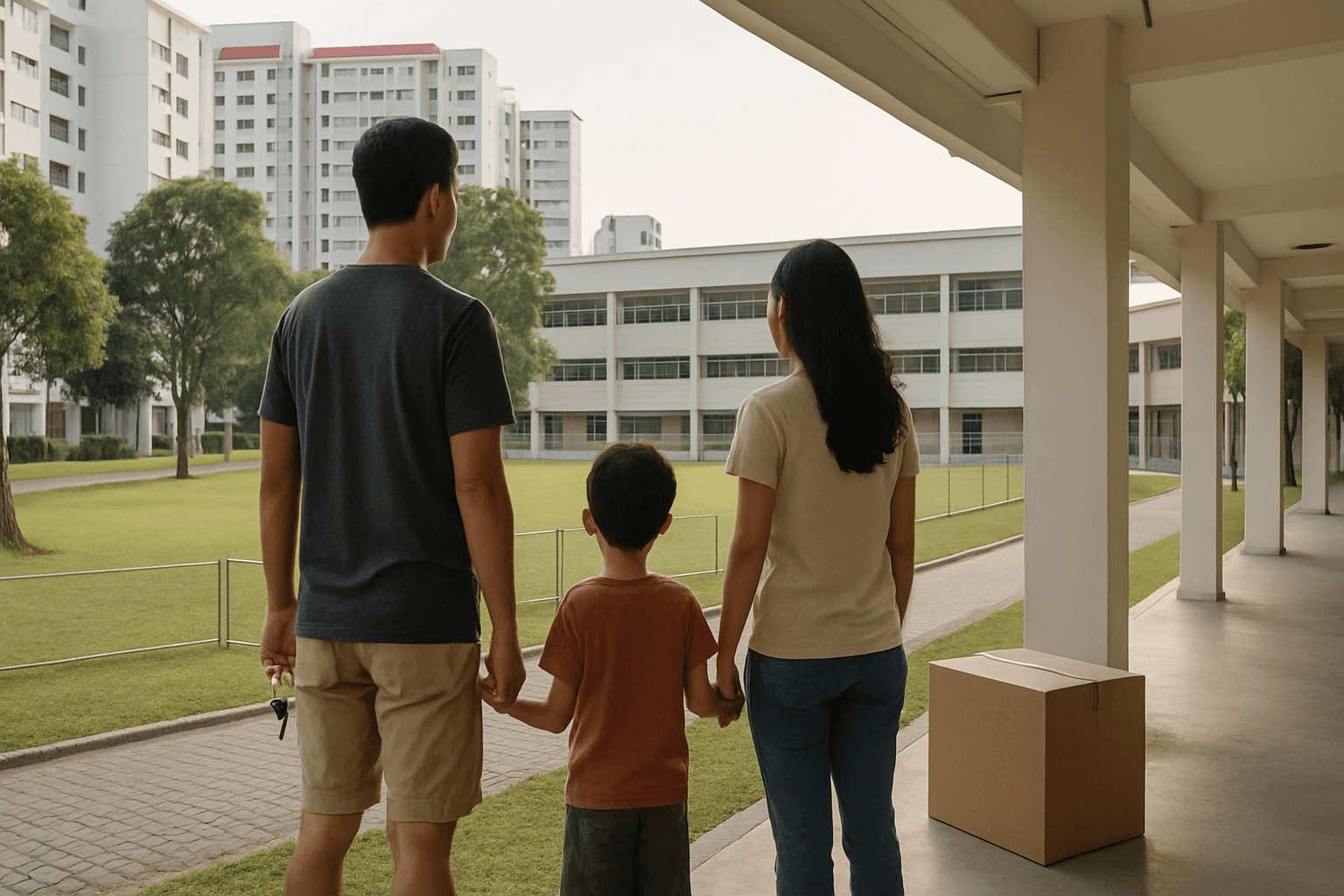
Sometimes, yes, but only if the move still works as a housing decision. In Singapore, a nearer home can improve your position when a primary school is oversubscribed and distance matters, but it does not remove competition or guarantee a place. If moving strains your budget or makes daily family life harder, the school upside is often too uncertain to justify the housing trade-off.
Should you move house for a popular primary school in Singapore?
Yes, sometimes, but only when the move still works for your budget, routine, and longer-term housing plans.
Sometimes yes, but only if the move also makes sense as a family housing decision. A new address can improve your child's position when distance is used to sort oversubscribed applications, but it does not guarantee admission to a popular school.
The strongest cases are usually the least desperate ones. If your family already expects to move, can afford the new area comfortably, and genuinely likes the school for reasons beyond reputation, the move may be sensible. If you are stretching your finances mainly to chase one famous school, the risk is much higher because the housing commitment is certain but the school outcome is not.
A useful way to think about this is: a good move is a housing decision with a school benefit, not a school gamble with a housing bill. If the plan improves only your admission odds on paper but makes cash flow, caregiving, commuting, or family routine worse, it is usually too expensive a strategy.
If you want the full process first, start with our guide to Primary 1 Registration in Singapore.
[Geylang] Primary Schools
For primary schools, I recommend going for convenience than popularity. Reason is the kids are still young, and travelling time should not be long enough to tire them out, even for those driving. Have you seen children dozing off in the parents car (some in an awkward position, especially straining their necks) because they have to wait up earlier than their peers to reach these “better” schools to feed their parents “ego”. Please note that the above is just my PERSONAL view as I have gone throu
All about Transferring to Other Primary Schools
https://www.moe.gov.sg/primary/transfers “You can apply to transfer your child to a primary school nearer to your new residential address if your child is: - A Singapore Citizen (SC) or Permanent Resident (PR). - Currently in Primary 1 to 5. We will offer your child a school nearer to your new residential address which has available vacancies. Your child will have to report to the new school by the end of the reporting period to complete the school transfer. Your NRIC must be updated with your n
How does home address affect primary school admission in Singapore?
A nearer home can improve your priority when a school is oversubscribed, but it does not guarantee admission.
Your home address can matter because distance may affect priority when a school has more applicants than places. In oversubscribed situations, living nearer can improve your position, including in situations such as Phase 2C where distance priority matters for Singapore Citizens. But it does not remove competition. If too many applicants are still in the same priority group, balloting can happen.
The first practical step is to check the actual address, not your assumption. MOE points parents to SchoolFinder and SLA's OneMap SchoolQuery Service in its P1 registration FAQ. This matters because a home that feels "very near" may not fall into the distance band you thought it did.
Parents often misunderstand one point here: being closer is helpful, but it is not the same as being safe. If a family moves from farther away to an address within a better distance band, their priority may improve. But if many other families are also in that same band, they may still face balloting. Nearer helps. It does not secure.
For the mechanics, read our guide to home-school distance priority and our article on how to read past balloting data.
[Ang Mo Kio] Primary Schools
My girl will be enrolling in a primary school next year too. I feel where you stay will play a big part in deciding on which pri school your child will study at eventually. Why do we need to compare which primary schools your child will study in ? I think this create an unhealthy system in which most parents will strive to get their child into these perceived good schools. ( If they score well in those schools, it is expected of them but if they do not, these children will enter different second
All about Transferring to Other Primary Schools
Not sure what nationality your child is, because u didn't tell us. Take note. 1) if your child of \"foreign\" status had sat for the AEIS test conducted by MOE, and if MOE had successfully posted your kid into a primary school, then No, you are NOT allowed to transfer to another primary school. MOE will put a stop, to students who attempt to seek Transfer, out of their AEIS been assigned school. This fact, u must know. If u don't know, now u know. 2) assuming that your kid is currently studying
Have More Questions?
Get personalized guidance on schools, tuition, enrichment and education pathways with AskVaiser.
Try AskVaiser for Free →When does moving house make the most sense?
It makes the most sense when the move already fits your long-term housing plan and not just the school race.
Moving usually makes the most sense when the school plan and the housing plan already point in the same direction. If your family was likely to move anyway, can comfortably afford the new location, and genuinely thinks the school is a good fit, the decision is easier to justify.
The most practical moves usually solve more than one problem at once. One common example is a family choosing a home that can work for siblings, not just one registration year. Another is a family already relocating for work, caregiving support, or space, then choosing an area with several realistic nearby schools instead of betting everything on one very competitive option. That kind of planning is usually more resilient than chasing a single brand-name school.
Real-world parent planning often follows this longer view, such as looking for an address that may support more than one child or give access to more than one school. A community article on school-related property planning shows the kind of trade-offs families commonly think about, though these are planning examples rather than official rules.
A simple test helps: if you would still feel reasonably good about the move even without the dream-school outcome, it may be a sound decision. If the move only feels worthwhile if one school result goes your way, it is a much weaker plan. For a broader overview, see Which Home Address Counts for Primary 1 Registration in Singapore?.
All about Transferring to Other Primary Schools
I do not think MOE permit students to Transfer school so fast, so quickly within such a short time frame. One minute, transfer to a school in the West. Next minute, next change - Less than 1 year later, transfer to another school in the east. Moe will sure question you : why are you Transfering schools, so shortly ? Where is your final destination? If your permanent house purchased is in the east, then stick to schools in the east. That should be your guide. Those primary schools that often have
All about Transferring to Other Primary Schools
It is not surprising to hear that the top students in some primary schools are aiming to go to better-name schools. Nothing wrong with transferring school but must bear in mind that there is a 1% risk that the child will not fit into school culture. Usually, those who get the first few positions in class or are in the so called best class for high ability learners will tend to transfer out. With this cycle, the more famous primary schools will have no lack of top potential students to bring glor
When is it not worth relocating just for a school?
Usually not when the move is about prestige alone, or when the cost and disruption will strain the family.
It is usually not worth it when the move is driven mainly by prestige, or when the family is taking on a housing commitment that already feels tight before the child even starts school. Popular schools can remain highly competitive after you move, so parents can end up paying more without getting the outcome they wanted.
There are a few common danger signs. One is buying in an expensive area and leaving too little room for childcare, emergencies, or normal family spending. Another is renting near a school without thinking through lease timing, transport, or what happens if the result does not go your way. A third is focusing so much on the school's name that no one stops to ask whether the commute, daily routine, and the child's temperament still fit.
A realistic example is a family who pays a premium to live nearer a famous school, only to discover that balloting still happens and the fallback schools near the new home are not actually better for them. Another is a family whose new address helps their school strategy a little but creates a much longer work commute and more dependence on grandparents or paid transport every day.
If the move improves the address but worsens everything else, the trade-off is usually wrong. Parents comparing a dream school with a steadier option may also find our guide on popular versus neighbourhood schools useful. For a broader overview, see Primary 1 Registration After Moving House: Should You Use Your Old or New Address?.
All about Transferring to Other Primary Schools
For primary schools, it can be very difficult to transfer into the popular primary schools. There is a waiting list and transfer will only happen if there is a vacancy. The school has the discretion of who to select. It's like a job application. Different schools will likely have different criteria.
All about Transferring to Other Primary Schools
Within 6 years of primary school education, from (P1 to P6), note that u can only Transfer schools from (P1 to end of P4). Reason being, after end of P4, there is streaming, into P5 classes. End of P4 is the last whistle calling (blowing), for Transfer students to board (hop onto) another new train journey. Schools do not allow Transfer once start P5, in Upper primary years (P5 / P6). Schools consider these last 2 years as key PSLE preparatory years, won't allow Transfer. At what level, is your
Should you buy or rent near a popular primary school?
Buy for long-term fit and stability; rent for flexibility if you are still testing whether the plan is worth the cost.
Buy if the neighbourhood genuinely fits your long-term housing plan. Rent if you want flexibility, need time to test the area, or are not ready to lock in a large mortgage for a school-driven move.
Buying can make sense when your family already wants to stay in that area for years and can afford the property without stretching. It is more defensible when the location may also work for siblings, reduce school-run stress, or suit future transport and caregiving needs. The advantage is stability. The risk is obvious: you are making a large financial commitment for a school outcome that is still uncertain.
Renting is often the more cautious option if you are still testing the plan. It can give you flexibility, but it is not automatically cheap. Areas near sought-after schools can attract stronger demand in both sales and rentals, as noted in The Straits Times. Policy changes can also affect how parents think about school-linked location decisions, a tension discussed in this Channel NewsAsia commentary.
The practical difference is this: buying is a commitment to the area, while renting is a commitment to the strategy for a shorter period. Neither one guarantees a place. If you are deciding between the two, compare them only after you have checked distance and looked at past balloting patterns.
[Bedok] Primary Schools
is temasek primary a good choice? why is it so popular?how do parent actually choose the school?
[Bedok] Primary Schools
Thank you for your valuable comments. However to be realistic, the achievement grades of Bedok Green students are better than East Coast. I'm caught in a fix. Cos based on our registered address, Bedok Green falls between 1 to 2 km, whereas East Coast is within 1 km. Really stressful.
What are the real costs of moving for primary school?
Expect more than housing cost alone. The full bill includes transaction costs, moving expenses, and changes to daily family logistics.
The real cost is much bigger than the purchase price or monthly rent. For buyers, parents usually need to think about the down payment, duties, legal and agent fees, renovation or basic furnishing, and the cost of moving. For renters, there can be deposits, agent fees, overlap between old and new housing, utility setup, and a rental premium if the area is in demand.
The hidden cost is often daily life. A new home can change work commutes, preschool routes, enrichment schedules, after-school arrangements, and how often grandparents can help. Parents sometimes focus so heavily on getting nearer to one school that they overlook the cost of getting everyone else where they need to be.
This is where two families can make the same move and get very different results. One family pays more but also shortens commute time, reduces school-run stress, and likes the area enough to stay. Another family pays more, still needs complicated transport arrangements, and remains unsure about admission. The first may be making a rational housing move. The second may be paying a premium for uncertainty.
A useful takeaway is to budget for the move as a whole life decision, not just as a school tactic. If the numbers only work when everything goes perfectly, the plan is already fragile.
All about Transferring to Other Primary Schools
When is the LAST day of primary schools' Term 4, before year-end school holiday start ? Answer : Friday, 18 November 2022 The Transfer school processing itself, will depend on Total number of candidates, who have applied to seek Transfer into the same, identical primary school. The more competitive the primary school is, the longer processing time required, especially if the school has received \"high mountain piled up, highly\" Transfer Application Form requests, from parents all over Singapore
All about Transferring to Other Primary Schools
whitesand and casuarina. In terms of popularity sequence 1. Pasir ris primary 2. whitesand 3. elias 4. casuarina 5. park view 6. meridian
How early should you move before P1 registration?
Early enough that the home is real, settled, and usable for your school plan without relying on rushed arrangements.
Move early enough that the address is genuine, stable, and not rushed. There is no useful universal shortcut here. Property searches, financing, lease negotiations, renovation, and the actual move often take longer than parents expect, so last-minute planning creates unnecessary risk.
In practice, families who think this move may matter often start considering it during the preschool years rather than treating it as a late K2 problem. That does not mean everyone must move years ahead. It means you should leave enough buffer for delays and enough time to settle into the home properly. If your school strategy depends on an address, that address should be one your family can genuinely live with and support as a real residential arrangement.
It also helps to separate two questions. One is whether a new address supports your initial P1 plan. The other is what happens if you move later. If your move may happen around the registration period, read our guides on which home address counts and whether to use your old or new address after moving. If you move after admission and are considering a school change, MOE notes in its FAQ that parents may apply for a transfer after relocating or if they will be relocating, but that is a separate process and not a plan most parents should treat as their main fallback.
The practical rule is simple: if the move feels rushed, the school plan is probably too late.
All about Transferring to Other Primary Schools
I suppose before august, u will still be living in Punggol? Perhaps you still need some time to renovate, move/pack or settle down. Think it’s easier to transfer to TPY schools when your new premise is ready and settled.. perhaps register your child where your p2 is first and apply for transfer later. Better to start in a fresh year, say p3 and p1. If you have a caregiver for your p1 near TPY, u can try register p1 under that address...
All about Transferring to Other Primary Schools
Hi, i am moving house at early 2021. So will need to relocate my children school to new location. By Jan 2021, my eldest will start her first year of secondary school. Whereby my second daughter will be in P3. Would like to know when should i start to approach/register future school? Or am i being too kiasu in asking this question too early? Can i start to approach the future school to chop a seat? Any idea what is the procedure?
What should parents avoid when using a home address for school planning?
Do not rely on a temporary or questionable address. If the move is for school, it should be real and properly supportable.
Do not treat a temporary, unclear, or manipulated address as a safe shortcut. If you are moving for school, the address should be a genuine residential arrangement that your family can properly support.
This is not a minor technicality. Public reporting, including this The Straits Times report, shows that false-address cases are taken seriously. If your address plan feels like a workaround rather than a real move, do not build your child's school strategy on it.
All about Transferring to Other Primary Schools
Actually, if u only want a specific primary school that is directly behind your hdb block for your own convenience, AFTER shifting to your new house, then u should have just approached or call up the school directly, ask them whether got vacancies or not. If got vacancy, then apply. If No vacancy, then move on to the 2nd next school near your house, to inquire. But all these query, u need to do personally, as homework basic checking first. Because The moment u go through MOE STEPS, then it is up
All about Transferring to Other Primary Schools
Please contact the General Office of nearby primary schools. They should be able to guide you whether they can accept transfer for your case and if so, the process of doing it (filling up transfer/waitlist request form, ...). Also contact the General Office of your son's school to confirm about school transport arrangement. All the best.
How should parents decide whether the school upside is worth the housing trade-off?
Judge the move using school fit, financial sustainability, and everyday family convenience rather than reputation alone.
Use a simple three-part test: school fit, financial sustainability, and daily family convenience. Start by asking whether the school is genuinely a good fit for your child and your family, not just a popular name. Then ask whether the move is affordable without turning the next few years into a strain. Finally, ask whether life becomes easier or harder after the move. If two of those three answers are weak, that is usually a sign to slow down.
A practical way to decide is to compare two full plans, not just two schools. One plan is the popular school near the possible new address. The other is a realistic school plan near your current home or a less costly location. Compare distance category, likely competition, total monthly housing impact, travel time, and fallback options. This is often where parents realise they are not choosing between a good school and a bad school. They are choosing between a high-cost gamble and a steadier family plan.
If you are still torn, it helps to read our articles on dream school versus safer nearby school, what happens if registration is unsuccessful, and how to read past balloting data.
A better school address is useful, but a better family plan is better.
All about Transferring to Other Primary Schools
I'm afraid you have the process mixed up. You should: 1. Apply first, 2. Think / decide later. (And not consider first, apply when you've made up your mind) Not point thinking or considering now when: 1. the school(s) may not have vancancies, or 2. the school(s) have vacancies but you are not high on their priority list. Talks about psyhoing your child or deciding between school a and school b are meaningless until you have something concrete on your hand. And I'll expand the options to waitlist
All about Transferring to Other Primary Schools
Whether you are going via MOE (Assured School Placement for Primary Schools) or directly, there won’t be any entrance tests. However, your chances to popular schools is close to NIL. Schools need to have a vacancy in order to accept you and popular schools will either have no vacancies or have a long waitlist for vacancy (and your priority will be very low down the list). Check MOE website for Assured School Placement for Primary Schools for more details.
Have More Questions?
Get personalized guidance on schools, tuition, enrichment and education pathways with AskVaiser.
Try AskVaiser for Free →