
Should You Move House for an Affiliated or Alumni School for P1 Registration?
A practical Singapore reality check on distance priority, affiliation, alumni status, balloting risk, and the real cost of moving.
Move only if the new home still makes sense even without a guaranteed school result. In Singapore's P1 registration process, a nearer address may improve distance priority, but it does not create affiliation or alumni status, and popular schools can still require balloting.
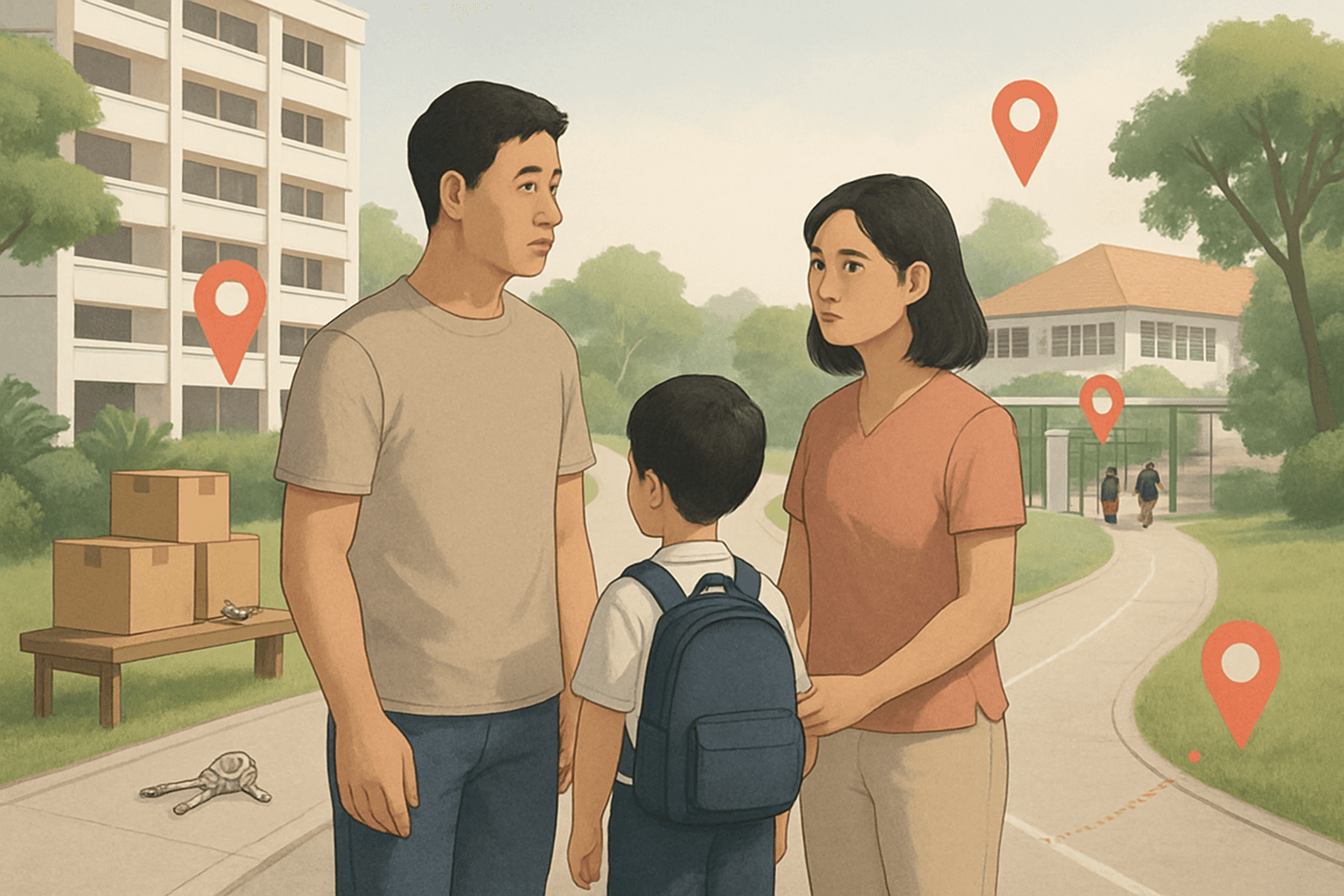
If you are thinking about moving house mainly to improve your child's P1 chances, start with this: a new address can affect distance priority, but it does not give your family affiliation or alumni status, and it does not make admission certain.
The real parent decision is not just "Can moving help?" It is "Does the likely admissions benefit justify the housing cost, routine disruption, and remaining risk?" For many families, that answer is no. For some, especially those who were already planning to move, it can still be a sensible decision.
Short answer: should you move house for an affiliated or alumni school for P1 registration?
Only sometimes. A move can improve distance priority, but it does not create affiliation or alumni status, and it does not make admission certain.
Usually only if the move is still a good family decision without a school guarantee. For most families, moving house is too expensive and disruptive to treat as a pure P1 tactic.
The key point is simple. Moving helps only if the new address improves your distance-based priority for that school. It does not create affiliation. It does not create alumni status. And if the school is heavily oversubscribed, it may not remove balloting risk either.
The most practical way to think about it is this: treat any school advantage as a bonus, not the whole investment case. If the school is a strong fit, your budget can absorb the move comfortably, daily life also improves, and you have a backup plan you can live with, then the move may be reasonable. If the move works only if your child gets that one school, it is usually too risky. For the wider process, start with our Primary 1 Registration in Singapore guide.
*** READ ME FIRST !!! - P1 Registration FAQ ***
Can someone tell me if this rule is new starting from this year or was it around before? Extracted from MOE FAQ under Proximity to School FAQ 4. How long do we need to stay in the address used to register our child during the P1 Registration Exercise? In a small number of cases, there may be situations where the families are unable to remain at the address for the entire duration of the primary school studies. Even so, a child who gains priority admission into a school through his/her distance c
All about Transferring to Other Primary Schools
I suppose before august, u will still be living in Punggol? Perhaps you still need some time to renovate, move/pack or settle down. Think it’s easier to transfer to TPY schools when your new premise is ready and settled.. perhaps register your child where your p2 is first and apply for transfer later. Better to start in a fresh year, say p3 and p1. If you have a caregiver for your p1 near TPY, u can try register p1 under that address...
How does P1 registration priority work for affiliated and alumni schools?
Affiliation, alumni status, and distance are separate advantages. Moving house can only change the distance part.
Parents often mix up three different ideas: school link, home address, and school popularity. They are not the same thing.
Affiliation refers to a formal school link recognised in the P1 process. Alumni priority depends on a recognised alumni connection. Distance priority depends on where your family lives relative to the school. A house move can affect only the third part. It cannot turn your child into an affiliate, and it cannot make a parent an alumnus.
This matters because many relocation decisions are made on the wrong assumption. Some parents move close to an affiliated school and only later realise that living nearby does not give them the same advantage as having the formal link. Others already have an alumni advantage but overpay for a move that changes very little in practice.
A useful order for thinking is: first identify your actual school link, then understand how competitive that school usually is, then ask whether distance is likely to matter enough to justify moving. If you need help mapping that out, read our guides on P1 registration phases and distance priority, then cross-check the current framework against MOE's P1-related FAQs.
*** READ ME FIRST !!! - P1 Registration FAQ ***
Yes, but that presupposes that there are seats left in the school for P2A2. Your NRIC must show the registration address. Otherwise, you must show documentary proof that your property will be ready for occupancy by the time your child starts P1.
Questions on new rules of P1 registration
With the announcement of the new rules of P1 registration - that citizens now have advantage over PRs, I have 2 questions: 1. Does the living distance to the school matter (ie 1 km away)? 2. If the PR has an older child in the school already, is priority given to the child’s younger sibling? Thanks!
Have More Questions?
Get personalized guidance on schools, tuition, enrichment and education pathways with AskVaiser.
Try AskVaiser for Free →What can moving house actually change?
A new address may improve your odds only when distance is likely to matter for that school. It does not guarantee a place.
A move can improve your child's position only if the new address places your family in a more favourable home-school distance category at a school where distance matters in sorting applicants. That is the real upside. The limit is that a popular school can still have more applicants than places even after distance is considered.
Closer is better, but closer is not the same as safe.
Here is the practical test. If a school has often needed distance to separate applicants in the category your child is likely to enter under, moving may be meaningful. If the school usually fills earlier, or if competition remains intense even among nearby families, the same move may change less than you expect.
For example, a family with no alumni or affiliated link may gain the most from moving, because address may be their only practical lever. By contrast, an alumni family may find that the existing school-linked advantage already does most of the work, and distance matters only if that same category becomes crowded. In that case, a costly move may buy only a modest improvement.
Before paying for a new home, study past competition patterns rather than relying on school reputation or chat-group confidence. Our guide on how to read past balloting data is a better starting point than guesswork. For a broader overview, see Primary 1 Registration After Moving House: Should You Use Your Old or New Address?.
All about Transferring to Other Primary Schools
The best reason would be that you are moving house and the school is nearest to the home. You will need to convince the staff that your child is a good student (both academically and socially), and is likely to be a good asset for the school. But your child is still in P1, so, that is tough. Try this https://www.moe.gov.sg/primary/transfers for more information.
All about Transferring to Other Primary Schools
Yes, you are allowed to move to a further location. No min occupation for your current house. The by distance requirement is only applicable for p1 registration.
Important: a new address does not create a school link
A better address can help only with home-school distance. It does not create affiliation or alumni priority.
This is one of the most common P1 misunderstandings. Moving closer may help on distance, but it does not change your family's relationship to the school. Before you spend on a move, make sure you are improving the part of the admissions picture that actually affects your child. For a broader overview, see Which Home Address Counts for Primary 1 Registration in Singapore?.
All about Transferring to Other Primary Schools
Wow, if offer some antiques to the school to display & get the kid into the school is like bribery right? I would like to know when is the best time to apply for the transfer of primary school? After primary 2 school result release or during primary one? My daughter is going to P1 next year but since both of us do not have any alumni with any school - we can only send her to a nearby school within 1 km which require to ballot too. I hope to transfer her to another school which is 1-2km away from
All about Transferring to Other Primary Schools
Transfer is *never* guaranteed, so you should just secure a school that is located near your new home. And your elder gal has to simply deal with the extra travel distance for that 1 year i.e. 2019. That is the most straightforward way to solve this problem. You do not name the schools, so I assume it is easy to get a place in Phase 2C there this year.
When is moving house worth considering?
Consider moving only when the new home improves school odds and still makes sense for your family's budget, routine, and support network.
Moving is most defensible when school is only one of several good reasons. If your family was already planning to relocate for space, work, caregiving, or long-term housing reasons, choosing a home that also improves school options can be sensible.
It can also make sense when the preferred school is a genuine fit and the new home improves daily life even if that school does not work out. A common example is a family upgrading anyway and moving nearer to grandparents who can help with after-school care. Another is a family shifting closer to both parents' workplaces while also improving access to more realistic school choices.
A third sensible case is when the current home is already creating strain: long commutes, weak caregiver support, and limited school options that do not work well for the family. In that situation, a move may solve several problems at once. P1 should then be part of the decision, not the whole decision.
A good rule of thumb is this: move when the home still works even if the school outcome is imperfect. For a broader overview, see How to Read Past Balloting Data Before Chasing a Popular Primary School.
All about Transferring to Other Primary Schools
Hi Jacoco Yes correct. P3 classes become bigger so there will be some vacancies for transfer students. That will be the best time to transfer. You need to ensure good results at P1 and P2 to try for branded schools. If the one you’re looking at is still a neighbourhood school, then there should not be too much trouble getting in. Usu, you will be asked the reasons for transfer and may need to be interviewed by the school mgmt.
All about Transferring to Other Primary Schools
Hi w0nderlnd I can only share what I did with my ds1. I transferred him to a sch nearer to home in mid pri due to our preference of the sch culture, affiliation it offers, distance (walking distance) and phase 1 priority for ds2. Ds1 was reluctant when I brought up the topic as he was doing very well in p1. Still I submitted a transfer request at end p1 and only got vacancy 1.5 years later. By then he was doing very very well in his previous school - a p3 and already given opportunity to emcee m
When is moving house probably not worth it?
Probably not when the move stretches finances, weakens daily support, or gives only a slim improvement in your child's chances.
It is usually not worth moving when you are paying much more for only a small and uncertain admissions edge. This is especially true when the target school is so competitive that even families with some priority still face pressure and possible balloting.
One red flag is financial stretch. If higher rent, a tighter mortgage, renovation costs, or transaction costs would make family life more stressful, the downside is large while the school result is still uncertain. Another red flag is support disruption. Some families move closer to a school but farther from grandparents, childcare arrangements, or workplaces, and only then realise they traded a school chance for a harder week every week.
It is also a weak move if the school is the only thing you like about the new location. If you would regret the home, the commute, or the cost unless your child gets that specific school, the plan is too fragile. The same applies when parents are reacting to a school's name rather than asking whether it is meaningfully better than a solid nearby option. Our guide on a popular dream school versus a safer nearby school can help ground that tradeoff.
If the move only works with a school win, it is usually not a strong plan.
All about Transferring to Other Primary Schools
Hi, my son is going to p1 in 2022. We currently live in Boonlay. We have a HDB in Geylang that was delayed to first half of 2022. During the p1 registration exercise, we didn’t get into any school within 2km in Geylang and is assigned to one 2-3km away. Should we register our child to a school in Boonlay. Then transfer him to Geylang in the middle of his p1 year? Additional info: 1. No car 2. One parent working overseas 3. No grandparents to take care of child
All about Transferring to Other Primary Schools
It is not surprising to hear that the top students in some primary schools are aiming to go to better-name schools. Nothing wrong with transferring school but must bear in mind that there is a 1% risk that the child will not fit into school culture. Usually, those who get the first few positions in class or are in the so called best class for high ability learners will tend to transfer out. With this cycle, the more famous primary schools will have no lack of top potential students to bring glor
What hidden costs do parents often miss?
Parents often undercount the full cost of moving, including commute changes, childcare disruption, transaction costs, and the possibility of paying more without getting the school.
The obvious cost is housing, but the real cost is broader. Parents often focus on rent or purchase price and undercount renovation, agent or transaction costs, movers, temporary overlap between homes, time spent house-hunting, and the mental load of reorganising family routines.
Then come the daily costs. A move that puts you nearer one school may put one parent farther from work. It may reduce help from grandparents, complicate after-school pickup, or disrupt a younger sibling's preschool routine. Over six years of primary school, that daily friction can matter more than the initial admissions advantage.
There is also the cost of paying for a result that may not arrive. Property analysts quoted in this TODAY report on school-related housing demand noted that homes near sought-after schools can attract a premium in some situations. That is useful budgeting context, not evidence that paying more secures access.
A simple stress test helps: would you still accept the full cost of the move if your child ends up in your second-choice school? If the honest answer is no, the move is probably carrying too much admissions risk.
*** READ ME FIRST !!! - P1 Registration FAQ ***
2A need to apply at school , so withdrawal also need to be at school. Then go over to school B for registration. Consider time for travel, withdrawal take 5-10min. Buffer 1.5 hours would be safe if driving. If you can let us know your 2C choice , we can tell you the risk. It might be worth just to go 2C
All about Transferring to Other Primary Schools
You don't get to decide when you can transfer. It depends on whether there's vacancy in the school you want, and whether the school accepts your child. You can start by waitlisting your child in the school you want after P1 registration closes. If you are lucky, transfer can happen before P1 starts, or you can wait indefinitely.
How should different families think about the move decision?
The value of moving depends on what advantage you already have. Alumni, affiliation, and no-link families should not make the same decision by default.
If you already have an alumni connection, do not assume a move is automatically necessary. First ask whether that existing advantage already does most of the work, and whether distance matters only if that category becomes crowded. In some schools, moving may add little. In others, it may help as a tie-breaker. The key is to understand what you already have before paying for more housing.
If you are targeting an affiliated school, be especially careful not to confuse living nearby with having the formal link. If your child has the recognised affiliation, the question is whether a nearer address meaningfully lowers remaining risk. If your child does not have that link, a move changes only the address part of the equation.
If you have no school link at all, moving can matter more because address may be your only real lever. Even then, it is not automatically wise. At a very popular school, a move may simply place you into a stronger but still crowded pool.
These are common scenarios, not guarantees, but they show why the same move can be sensible for one family and unnecessary for another. If you do relocate, the next practical issue is which address can be used and how address rules are applied. We cover that in Primary 1 Registration After Moving House and Which Home Address Counts for P1.
All about Transferring to Other Primary Schools
My son is P1 next year. So registration this year. However he is foreigner status so won’t qualify till phase 3. I will be applying for pr for him as I am Singaporean. Hubby is old boy of acs too, but again we don’t qualify for 2a as not SC or PR. Wondering if we can start off in international sch (P1) and then transfer later (maybe p2).[/quote] Transfer from International schools to local schools happen quite frequently. However, transfer tend to be for less popular local schools since they hav
All about Transferring to Other Primary Schools
just checking for advise on a confusing situation We are moving from old to new location in 2020 Gal1 applying for P1 school start in 2019 (current Registration) Gal2 applying for P1 school start in 2020 (2019 Registration) Situation: Gal1 applying old location school Start school at 2019 at old location school Transferring to new location school at 2020 In this case, Gal2 should be applying at old school and transfer to new sch even before starting at P1? or should Gal2 applying for new school
What do parents usually misunderstand about balloting risk?
Many parents overestimate what a new address can do. Moving closer may help, but demand and vacancies still decide whether balloting remains a live risk.
The biggest mistake is treating distance as if it removes uncertainty. It does not. Balloting is driven by the mix of demand, available places, and where your child sits within the relevant priority category. Distance can improve your position, but it cannot create places that are not there.
A second mistake is assuming that affiliation or alumni status makes a popular school effectively safe. Sometimes it may be enough. Sometimes it is not. If too many families qualify in the same category, competition can still be intense. Parents also tend to anchor too hard on one year's outcome. Past patterns are useful, but they are a guide to pressure, not a promise.
Unofficial parent roundups can help you spot shifting competition, such as this KiasuParents overview of the 2024 P1 exercise. Use that kind of source as context, then return to the real question: does the move change your odds enough to justify the cost, or are you still relying mostly on hope? If you want to plan the downside properly as well, read what happens if you do not get your preferred school.
The best mindset is not "How do we guarantee this school?" It is "How do we make a housing decision that still holds up if the ballot does not go our way?"
*** READ ME FIRST !!! - P1 Registration FAQ ***
Yes. You and your spouse need to be stationed in the two schools - one in the P2A1 school and the other at the P2C school. Once you have decided to register with the P2C school, the one who is at the P2A1 school needs to withdraw your child's application before the one at the P2C school is able to proceed with the registration. Depends. If the school traditionally has balloting in the distance category you are in, you will only know the result of your application on the day of balloting. Please
Share with us your kid's P1 registration experience
First thing to do after being balloted out, is to put your child's name under the school's wait list. After then, I've wrote in to MOE, called/met the school's Principal for discussion. Telling them all my problems and how the registration system had affected us (because I have only 1 school within 2km and NO school within 1km). With this factual, MOE has verified and consulted the school. My son was then placed on the highest priority in the waiting list .. and fortunately by early Nov, we were
A simple decision checklist for families
Use this checklist to judge the whole family decision, not just the hoped-for P1 outcome.
- ✓Is this school still realistically within reach after you account for your actual school link, likely competition, and remaining balloting risk?
- ✓Are you clear about which advantage you really have, instead of assuming that moving creates affiliation or alumni priority?
- ✓Would you still want this move for non-school reasons such as space, commute, caregiver support, or longer-term housing plans?
- ✓Can your family afford the move comfortably without making daily life more stressful?
- ✓If the preferred school does not work out, would the new home still be a good decision?
- ✓Have you looked at past competition patterns instead of relying only on the school's reputation or chat-group stories?
- ✓Do you have a backup school plan that you can genuinely accept?
- ✓Will the new location improve or worsen childcare, work travel, and support from grandparents or other caregivers?
- ✓If you are moving, have you also checked the practical address issue in [Primary 1 Registration After Moving House](/blog/primary-1-registration-after-moving-house-old-or-new-address)?
- ✓Rule of thumb: move for a school only when the move is good on its own, not just because you hope it buys a better registration outcome.
Have More Questions?
Get personalized guidance on schools, tuition, enrichment and education pathways with AskVaiser.
Try AskVaiser for Free →