
Should You Move House for Primary School in Singapore?
A practical way to decide whether relocating really helps with Primary 1 registration, and when the housing tradeoff is too high
Move house for primary school only when three things line up: the school is genuinely worth targeting, the new address is likely to improve your position if the school is oversubscribed, and the move still makes sense for your family even if you do not get that exact school. If you are mainly paying a large housing premium to chase one popular school name, it is usually not worth it.
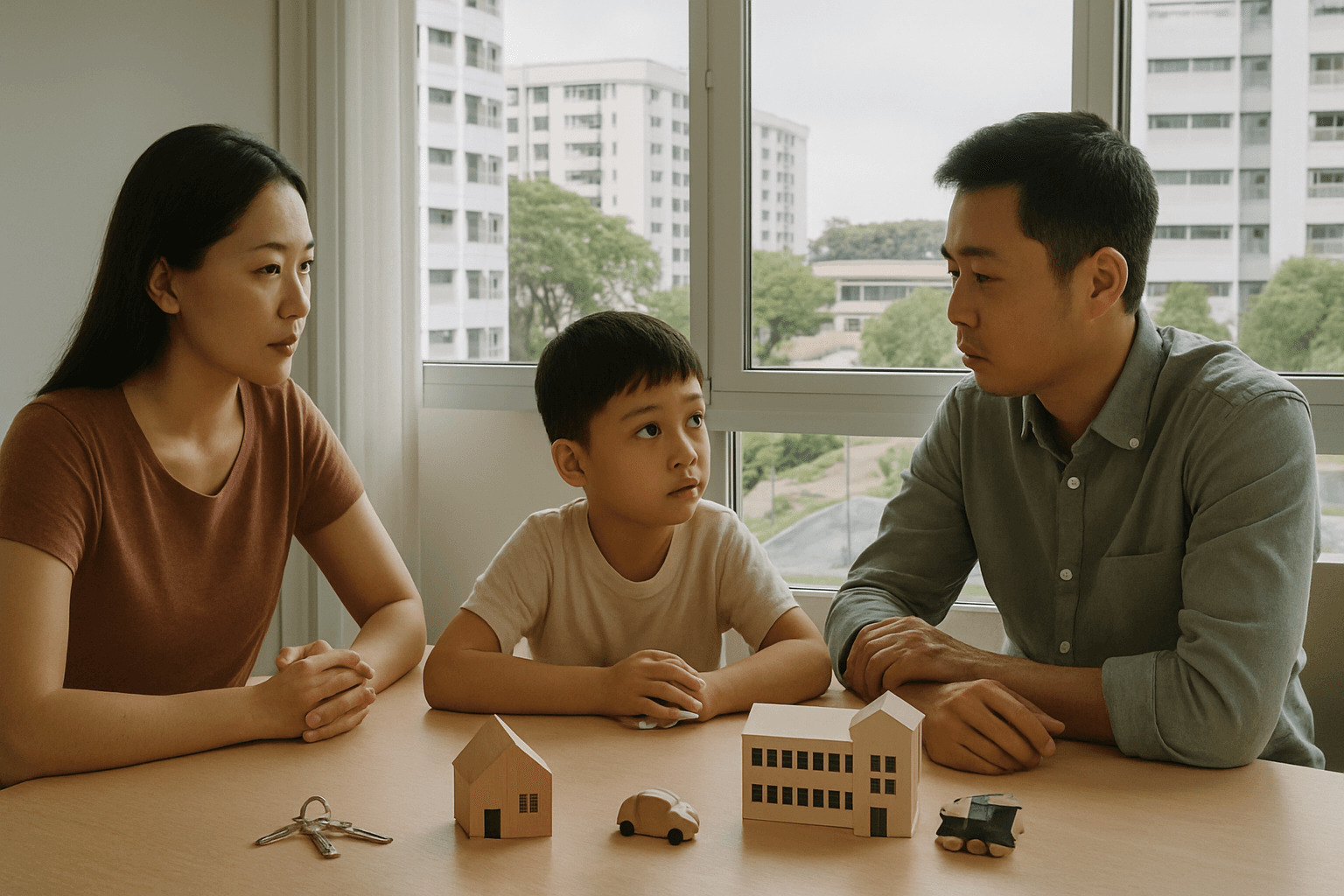
Short answer: sometimes, but only in specific cases. Moving closer to a primary school can improve your position when distance is likely to matter in Primary 1 registration. It does not guarantee admission, and it is rarely a good move if it strains your budget, weakens family support, or is based on the idea that living nearby automatically secures a place. The better question is not just "Will this get us in?" but "Would this still be a good home for our family if the school outcome is only partly better than hoped?"
What does moving house actually change in Primary 1 registration?
Moving house can change your home's verified distance band to a school. That may help in Primary 1 registration only when the school is oversubscribed, and it still does not guarantee admission.
Moving house changes the home address used for registration, and that can change your verified distance band to a school. In practice, that matters only when a school has more applicants than places and distance becomes relevant in sorting applicants or balloting. It can improve your position. It does not secure a place on its own.
Two checks matter before you even think seriously about relocating. First, does the new address materially change your verified distance category for the school? Second, is the school competitive enough for that change to matter? If the school usually has enough places, moving closer may make little difference. If the school is regularly oversubscribed, a nearer address may reduce risk, but you can still face competition.
MOE points parents to official tools in its FAQ, including SchoolFinder and OneMap SchoolQuery, to check nearby schools and home-school distance properly. If you are still mapping out the bigger process, start with our Primary 1 Registration in Singapore guide and then read how home-school distance works.
A simple way to think about it is this: proximity helps most when it changes a real admissions risk, not when it only feels reassuring. A family moving from much farther away into a verified closer band for a frequently oversubscribed school may gain a meaningful advantage. A family already near the school, or targeting a school that is not usually tight on places, may gain very little from paying more to move.
All about Transferring to Other Primary Schools
https://www.moe.gov.sg/primary/transfers “You can apply to transfer your child to a primary school nearer to your new residential address if your child is: - A Singapore Citizen (SC) or Permanent Resident (PR). - Currently in Primary 1 to 5. We will offer your child a school nearer to your new residential address which has available vacancies. Your child will have to report to the new school by the end of the reporting period to complete the school transfer. Your NRIC must be updated with your n
All about Transferring to Other Primary Schools
Hi hennaoh, Please refer to the FAQ below. Does it address your situation? https://va.ecitizen.gov.sg/cfp/customerPages/moe/ExploreFaq.aspx?Category=3645&Mesid=422335 Q:- I am in the midst of purchasing a new resale property. The transaction will be completed soon and I will be able to move in prior to the commencement of the academic year. Can I make use of this new address to register my child? Answer: The resale Housing & Development Board (HDB) flat's/ private property’s address can be used
When does moving house make the most sense?
A move makes the most sense when you already want to live there long term and the school benefit is only part of the reason. It is far easier to justify if the new home also improves commute, care support, or access to several workable schools.
Moving house makes the most sense when you would still want to live there even without a perfect school outcome. The strongest cases are usually families who already plan to move for space, commute, grandparents' support, or long-term lifestyle reasons, and who see school access as one benefit rather than the whole reason.
This is especially sensible when the target school is known to attract strong demand and the new home gives you more than one workable school option nearby. That last point matters. A move built around one single school is a fragile plan. A move into an area with several acceptable schools is usually a more robust one.
Some families do think about school access years in advance, especially around well-known schools. Commentary and reporting have noted how school choice can shape housing decisions, as in this CNA commentary. But the practical lesson for parents is not to plan earlier just to be more kiasu. It is to avoid making a rushed, expensive move later.
A good test is simple: if registration ended tomorrow and your child got a different but still acceptable nearby school, would the move still feel worthwhile? If the answer is yes because the area improves daily life, commute, or care support, the case is much stronger. For a broader overview, see Primary 1 Registration Distance Priority: How Home-School Distance Works.
All about Transferring to Other Primary Schools
I do not think MOE permit students to Transfer school so fast, so quickly within such a short time frame. One minute, transfer to a school in the West. Next minute, next change - Less than 1 year later, transfer to another school in the east. Moe will sure question you : why are you Transfering schools, so shortly ? Where is your final destination? If your permanent house purchased is in the east, then stick to schools in the east. That should be your guide. Those primary schools that often have
[Ang Mo Kio] Primary Schools
My girl will be enrolling in a primary school next year too. I feel where you stay will play a big part in deciding on which pri school your child will study at eventually. Why do we need to compare which primary schools your child will study in ? I think this create an unhealthy system in which most parents will strive to get their child into these perceived good schools. ( If they score well in those schools, it is expected of them but if they do not, these children will enter different second
Have More Questions?
Get personalized guidance on schools, tuition, enrichment and education pathways with AskVaiser.
Try AskVaiser for Free →When is moving house probably not worth it?
Moving is usually not worth it when the housing premium is high, the school outcome is still uncertain, or the move weakens your family's daily support and financial stability.
It is usually not worth moving when the housing cost rises sharply but the admissions gain is still uncertain. That is the regret pattern many parents underestimate. They pay more for a home near a popular school, yet the school remains competitive and the family's monthly stress goes up for years.
This often happens when the move is mainly about one child and one school. A family may stretch for a more expensive rental or mortgage, only to find that the daily routine gets harder in other ways. Grandparents may no longer be nearby. One parent's commute may become much longer. An older sibling may end up with a worse travel arrangement. The registration advantage may be real, but the family burden can still be bigger.
There is also a market reality behind the pressure. Homes near sought-after schools can carry a premium, a point reflected in reporting such as this Straits Times article on sale and rental prices. That does not mean the premium is irrational. It does mean parents should ask whether they are paying for a genuine long-term benefit or just for a thinner layer of uncertainty.
A useful rule is this: do not create a long-term housing problem to solve a short-term school worry. If the move looks good only on registration day and feels bad the rest of the week, it is probably not the right move. For a broader overview, see Primary 1 Registration After Moving House: Should You Use Your Old or New Address?.
All about Transferring to Other Primary Schools
Within 6 years of primary school education, from (P1 to P6), note that u can only Transfer schools from (P1 to end of P4). Reason being, after end of P4, there is streaming, into P5 classes. End of P4 is the last whistle calling (blowing), for Transfer students to board (hop onto) another new train journey. Schools do not allow Transfer once start P5, in Upper primary years (P5 / P6). Schools consider these last 2 years as key PSLE preparatory years, won't allow Transfer. At what level, is your
All about Transferring to Other Primary Schools
It is not surprising to hear that the top students in some primary schools are aiming to go to better-name schools. Nothing wrong with transferring school but must bear in mind that there is a 1% risk that the child will not fit into school culture. Usually, those who get the first few positions in class or are in the so called best class for high ability learners will tend to transfer out. With this cycle, the more famous primary schools will have no lack of top potential students to bring glor
A key mistake parents make: treating proximity as a guarantee
Nearer can help. It never means confirmed admission.
Living nearer can improve your position, but it never means automatic entry. If a school is oversubscribed, demand still matters and balloting may still happen. Before making any housing decision, verify the address properly using the official tools referenced in MOE's FAQ), not rough map estimates, old assumptions, or a property agent's guess. For a broader overview, see Which Home Address Counts for Primary 1 Registration in Singapore?.
All about Transferring to Other Primary Schools
Not sure what nationality your child is, because u didn't tell us. Take note. 1) if your child of \"foreign\" status had sat for the AEIS test conducted by MOE, and if MOE had successfully posted your kid into a primary school, then No, you are NOT allowed to transfer to another primary school. MOE will put a stop, to students who attempt to seek Transfer, out of their AEIS been assigned school. This fact, u must know. If u don't know, now u know. 2) assuming that your kid is currently studying
All about Transferring to Other Primary Schools
If you " die die" only want above 3 named specific schools, nothing else, then just give individual phone call to each of these 3 primary schools’ admin, ask them, if got vacancy. If have vacancy, their admin will ask you to proceed next, by filling up their Wait list form, which u can download yourself from their primary school website, submit, before the dateline is due. Otherwise, if no vacancy, Sorry, move onto some other schools, instead. However, if you are open to other schools’ vacancy a
How should parents think about 1km, 2km, and school proximity?
Treat 1km and 2km as verified planning bands, not guaranteed entry zones. Their value depends on how oversubscribed the school is and whether the move still makes sense for everyday family life.
Think of 1km and 2km as planning bands, not magic lines. If a school is oversubscribed, being in a closer verified band may help. The value is that it can reduce uncertainty. It does not remove uncertainty.
This is where families often oversimplify the decision. A home just inside a band may sound attractive, but if it costs much more and makes family logistics worse, the practical benefit may be smaller than it looks. On the other hand, if your current home is clearly farther away and the new one moves you into a meaningfully closer verified band for a school that is often tight on places, that can be a real reason to consider the move.
Parents should also avoid buying into old map assumptions. Distance calculations and outcomes have changed over time, which is one reason current verification matters. This Straits Times article on distance calculation changes is a useful reminder that a home's status should be checked, not guessed. If you want a fuller explanation of how distance fits into school choice, our guide on Primary 1 registration distance priority breaks it down.
A practical takeaway is this: only pay for proximity after you have checked it officially and asked whether the whole move still works without that exact school. Distance is helpful. It should not be the only thing holding the decision up. For a broader overview, see How to Read Past Balloting Data Before Chasing a Popular Primary School.
All about Transferring to Other Primary Schools
I'm afraid you have the process mixed up. You should: 1. Apply first, 2. Think / decide later. (And not consider first, apply when you've made up your mind) Not point thinking or considering now when: 1. the school(s) may not have vancancies, or 2. the school(s) have vacancies but you are not high on their priority list. Talks about psyhoing your child or deciding between school a and school b are meaningless until you have something concrete on your hand. And I'll expand the options to waitlist
[Serangoon] Primary Schools
ChiefKiasu Wrote [quote]4. And finally, there's the question of practicability. It wouldn't make sense for a child who stay at one end of the country spend hours travelling to a school on the other end of the country. Singapore may be small, but not that small. [/quote]With the sentence above, I believe the system still needs additional tweaking. 2A/2B in my opinion should not be abolished. However, there should be a limit set for 2A. Places after Phase 1 should be apportioned too, accordingly w
What tradeoffs should parents weigh before relocating?
Weigh the whole-family effect, not just the school name. The best move improves school access without creating bigger problems in budget, commute, care support, or sibling routines.
The real question is not only whether the school is better. It is whether the family functions better after the move. Housing cost is the obvious tradeoff, but parents often overlook time, care support, and sibling logistics.
Try to picture an ordinary Tuesday, not just registration day. Who handles drop-off and pickup? What happens when a child is sick? Does one parent gain an easier school run but lose an extra hour each day to commuting? Does the move take you closer to the primary school but farther from grandparents who currently help with meals, emergencies, or after-school care? These details affect family life far more often than the registration exercise does.
Siblings matter too. One child may benefit from a shorter route to a target primary school while an older sibling ends up with a longer daily journey. A move can solve one child's school access problem while creating a multi-year transport problem for the rest of the household.
This is also where school fit matters more than many parents admit. A well-known school may feel worth sacrificing for, but if your child would likely do just as well in a suitable nearby school with a calmer routine, the tradeoff looks very different. If you are still comparing school brand with everyday practicality, our article on popular primary school vs neighbourhood school can help.
A good home decision should make family life easier in more than one way. If the move improves school access but worsens everything else, it is not really a strong move.
All about Transferring to Other Primary Schools
When is the LAST day of primary schools' Term 4, before year-end school holiday start ? Answer : Friday, 18 November 2022 The Transfer school processing itself, will depend on Total number of candidates, who have applied to seek Transfer into the same, identical primary school. The more competitive the primary school is, the longer processing time required, especially if the school has received \"high mountain piled up, highly\" Transfer Application Form requests, from parents all over Singapore
All about Transferring to Other Primary Schools
It's tough and I don't envy you. Is your child capable to taking the bus/mrt by himself? Is the school easily accessible by these means of transport? Maybe get him used to travelling by himself and making use of the travel time to read/study. The top boy in my primary school stayed in Pulau Ubin and takes the sampan to school every day!
What common mistakes do parents make when moving for a primary school?
Common mistakes include assuming proximity equals admission, moving too late, overpaying for a narrow advantage, and planning around only one child instead of the whole family.
The biggest mistake is acting as if school proximity settles the whole problem. It does not. Parents also go wrong when they plan around only one child, rely on outdated distance assumptions, or overpay for a home that does not suit the family beyond the registration period.
Another frequent mistake is moving too late and then expecting certainty from a decision that now has limited room to help. If you are already in that situation, clarity matters more than panic. Work out exactly which address can be used and what it means in practice. Our articles on which home address counts and using your old or new address after moving house are the right next reads.
Parents also sometimes confuse popularity with fit. A crowded school may signal demand, but it does not automatically mean it is the best match for your child or your family's routine. Community discussion pieces like this KiasuParents article on property and school planning can be useful for understanding how people think, but they should never replace current MOE guidance.
Finally, trying to use a false or artificial address is a serious mistake. Apart from the ethical issue, it creates compliance risk and can unravel your entire plan. Cases have drawn public attention, as noted in this Straits Times report on false address cases. The safe strategy is the boring one: use a real home decision you can stand behind.
All about Transferring to Other Primary Schools
Actually, if u only want a specific primary school that is directly behind your hdb block for your own convenience, AFTER shifting to your new house, then u should have just approached or call up the school directly, ask them whether got vacancies or not. If got vacancy, then apply. If No vacancy, then move on to the 2nd next school near your house, to inquire. But all these query, u need to do personally, as homework basic checking first. Because The moment u go through MOE STEPS, then it is up
All about Transferring to Other Primary Schools
Please contact the General Office of nearby primary schools. They should be able to guide you whether they can accept transfer for your case and if so, the process of doing it (filling up transfer/waitlist request form, ...). Also contact the General Office of your son's school to confirm about school transport arrangement. All the best.
How should families decide if the move is worth it financially?
The move is financially worth considering only when the extra housing cost is balanced by real long-term gains such as easier logistics, lower care costs, or a better overall home fit.
A useful way to assess this is to compare the housing premium with the full value the move actually gives you. If the move costs much more each month and mainly buys a slightly better shot at one school, that is usually a weak financial case. If it also improves commute, reduces transport spending, lowers childcare needs, and gives you a home that suits the family for years, the case becomes stronger.
One practical way to test the numbers is to run them under two outcomes. First, imagine you get the target school. Second, imagine you do not. If the move still looks manageable and worthwhile in both cases, it is probably financially safer. If the plan only works emotionally or financially when the school outcome goes exactly your way, that is a warning sign.
Take two common scenarios. In one, a family pays a modest rental top-up to move nearer a cluster of realistic school options, one parent's commute stays similar, and morning transport stress drops enough that after-school care needs are lower. That can be a rational trade. In another, a family takes on a much larger mortgage mainly to target one brand-name school, one parent's commute worsens, and there is no comfortable fallback if admission does not happen. That is much harder to justify.
Do not look only at the headline rent or mortgage. Include moving costs, daily transport, possible childcare savings, and the effect of a tighter monthly budget on family stress. If the move buys broader life improvement, it may be worth the money. If it mainly buys hope, be careful.
[Bedok] Primary Schools
Do consider carefully on the distance to the school and the logistics. Just to share my experience. I am staying in the east and enrolled my dd when she was younger in St Anthony's Canossian Primary though I had priority in a branded school in the west. Never regretted it, the convenience of being near the school especially during her later years when there were cca, extra afterschool lessons and activities, I could ask my maid to assist bringing her back from school. The time saved on distance
All about Transferring to Other Primary Schools
Hi, Can transfer school due to good results? My child is in primary 1, thinking of transferring him to Chong Fu Primary School but we are not staying in Yishun.
What if you miss the chance to move before registration?
If it is already too late to gain a meaningful advantage, do not force the move. Focus on realistic school options, balloting risk, and a routine your family can sustain from your current home.
Do not rush into a bad move late just to feel that you have done something. If the timing no longer gives you a meaningful advantage, the smarter response is usually to work with your current address, shortlist realistic school options, and manage balloting risk properly.
This is the point to switch from rescue mode to planning mode. Build a realistic A, B, and C school plan from where you are now. Look at schools you can actually access, read past demand patterns carefully, and decide where you want to take a measured risk and where you want a safer option. Our guides on how to read past balloting data, popular dream school or safer nearby school, and what happens if you do not get your preferred school can help with that planning.
This is also when family stability matters most. A child starting primary school benefits from a routine that adults can actually sustain. If moving now creates financial pressure or household disruption without much registration upside, keeping the home stable may be the better decision.
Missing one housing window does not mean you have failed the school process. It usually means your best next move is better school selection, not a rushed relocation.
All about Transferring to Other Primary Schools
Hi, i am moving house at early 2021. So will need to relocate my children school to new location. By Jan 2021, my eldest will start her first year of secondary school. Whereby my second daughter will be in P3. Would like to know when should i start to approach/register future school? Or am i being too kiasu in asking this question too early? Can i start to approach the future school to chop a seat? Any idea what is the procedure?
All about Transferring to Other Primary Schools
Check out this link: https://beta.moe.gov.sg/primary/transfers/ (i didnt know there is such a transfer service until you asked and i did a search) See key dates: Key dates for 2020 In light of the COVID-19 situation, the next transfer application period would be in August 2020. Transfer in September 2020 Application period\t- From 9am on Monday, 24 August to 4pm on Friday, 4 September 2020 Application outcome\tMonday, 14 September 2020 Reporting period Tuesday, 15 September to Friday, 18 Septemb
Should we really move house just for Primary 1 registration in Singapore?
Move only if the school is worth targeting, proximity is likely to help, and the new home still makes sense for your family even without a guaranteed place. If the move mainly buys stress, cost, or false certainty, it is probably not worth it.
Usually only if the move still makes sense even without a guaranteed place. Moving house for Primary 1 registration in Singapore can be sensible when the school is a strong fit, the new address is likely to improve your position in a competitive situation, and the home still works well for your family if the school outcome is not perfect.
The most useful test is this: would you still feel okay about the move if your child did not get that exact school? If the answer is yes because the home is affordable, the area suits your family, the commute is workable, and there are several acceptable schools nearby, then the move may be a sound decision. If the answer is no because the move mainly exists to chase one popular school, stretches your finances, or breaks your support system, it is usually not worth it.
Before deciding, verify your current distance position and planning assumptions through the official guidance in MOE's FAQ. Then put that next to a realistic budget, commute check, and family support check. The right move is not the one that sounds strongest in school chat groups. It is the one your family can live with well for years.
All about Transferring to Other Primary Schools
Sorry, but it's getting kinda confusing. You are shifting house? Where to? I assume it's Toa Payoh since you are focusing on that area. If yes, that could legitimately be one of the reasons why you want to transfer. If not, you may want to consider schools nearer your new place. Whatever the case, it's good to register your interest with the schools now. You can call up the schools that you are interested in and ask for their school's procedures. Most will require you to fill up a form of some s
[Pasir Ris] Primary Schools
As long as you have proof that you will be residing in this new address in the form of an OTP, I think there is a declaration that you can sign to certify that you are not making a false claim and that you will indeed be moving into your new place which is close to the school you're interested in. I have friends who have to wait 2 or 3 years for their BTO flats to be ready but managed to secure a place in a school near their future place. So your case is not unheard of and the school will help a
Have More Questions?
Get personalized guidance on schools, tuition, enrichment and education pathways with AskVaiser.
Try AskVaiser for Free →