
What Counts as a Sibling for Primary 1 Registration in Singapore?
How MOE treats sibling priority, which family situations need extra checking, and what parents should verify before relying on it.
For P1 registration, sibling priority only helps when MOE recognises the relationship in its records and the school link is valid for that exercise. Treat it as something to verify early, especially in blended-family or past-school-link situations.
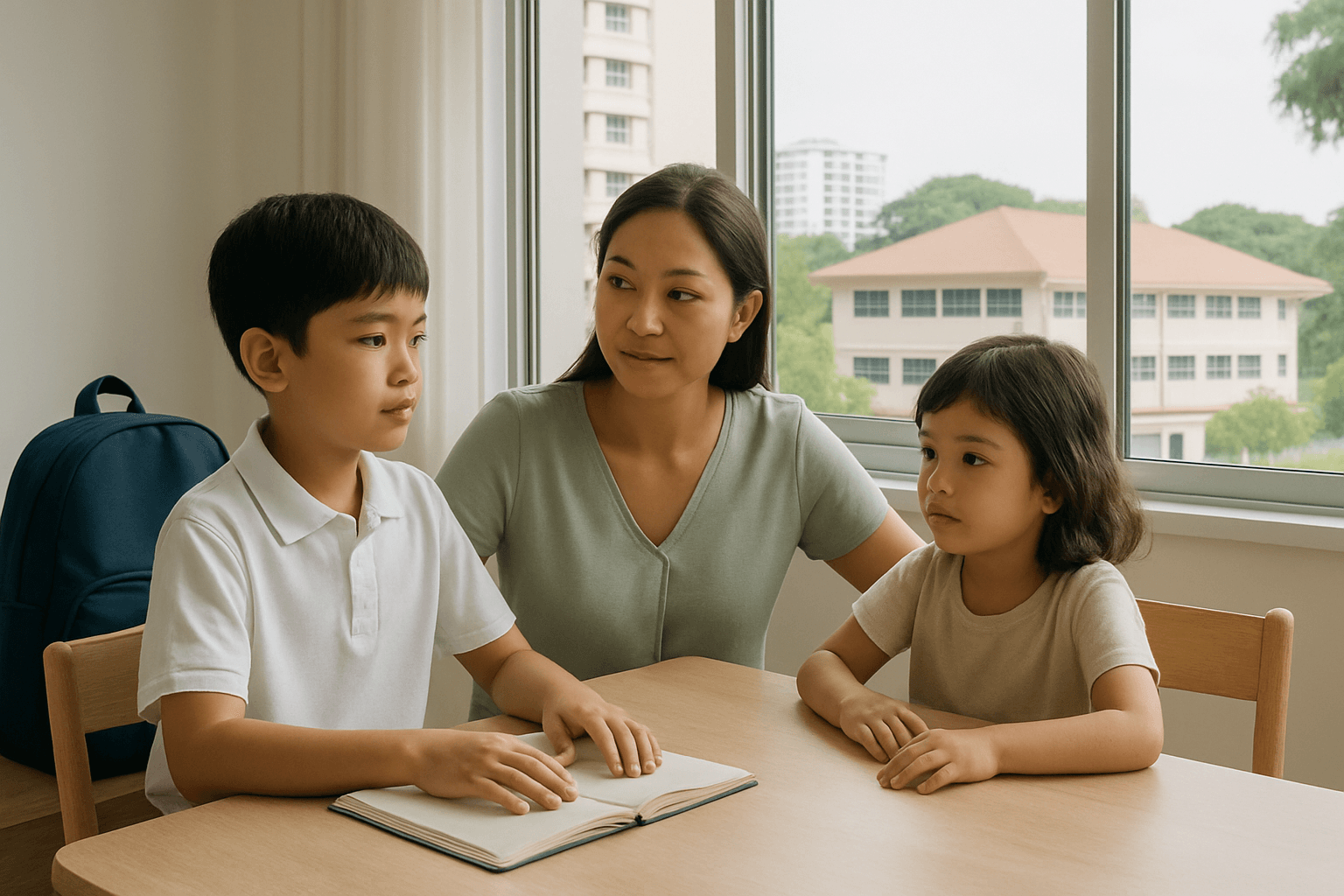
The short answer is: a child counts as a sibling for Primary 1 registration only if MOE recognises the relationship and the school link under the current P1 rules. Do not rely on everyday family language alone. If your plan depends on sibling priority, check early for situations such as half-siblings, step-siblings, adoption, or an older child who has already left the school.
What does sibling priority mean in Primary 1 registration?
Sibling priority can improve your place in the P1 queue, but only if MOE recognises the sibling relationship and the school link under the current rules.
Sibling priority is a registration advantage, not a guaranteed place. In simple terms, it can improve your younger child's chances if MOE recognises both the sibling relationship and the school link under the current P1 rules.
The important thing parents often miss is that Primary 1 registration is centrally managed. Schools do not directly admit a child just because an older sibling is there. MOE has said in its parliamentary reply on P1 registration that schools do not directly admit students outside the exercise.
A good way to think about it is this: sibling priority is a queue advantage, not a private invitation. It may help, but it does not replace the need for a realistic school plan. If you want the wider context on phases, competition, and balloting, start with our Primary 1 registration guide.
Give citizens priority in Primary 1 registration
Ha.ha. maybe next time the P1 registration phase can propose like that, just a suggestion: Phase 1 – Existing siblings in the Primary school except PR siblings. Phase 2A(1) – No Change Phase 2A (2) – No Change Phase 2B – No change Phase 2C – Singapore Citizenship Only. Phase 2C Supplementary - Singapore Citizenship Only Phase 3A – Permanent Residents Phase 3A Supplementary - Permanent Residents Phase 4 – Non Citizen.
Give citizens priority in Primary 1 registration
How about a scheme where advantage points will be given. Such that if both parent are citizen, then awards like 20 points, then if completed NS, some more points, and etc. Scheme can be defined to include like sibling same school, PV, community work, stay near home, and etc and etc. . The more points you get put you higher for prioirty for the school of your choice. . .anymore new ideas, we have to help those civil servants to think I guess. .
Who usually counts as a sibling for P1 registration?
A sibling counts only if MOE recognises the relationship in the records used for the P1 exercise. Do not rely on family terminology alone.
Use MOE's current administrative rule, not just everyday family language. The source material available here does not include MOE's exact sibling wording, so parents should not assume that a relationship that feels obvious at home will automatically be treated the same way in P1 registration.
In practice, the key question is whether the relationship is reflected in the records MOE uses for the exercise. MOE notes in its P1 Registration Portal FAQ that a child's eligibility depends on the information it has about the child and parents. That makes the portal more important than assumptions.
For example, a straightforward biological sibling link is usually the easiest to check. A child who is treated as family in daily life but whose relationship is not clearly reflected in MOE's records should be treated as unconfirmed until you verify it. If you are also checking the broader registration path, see our guide on who is eligible for Primary 1 registration in Singapore. For a broader overview, see If Your Older Child Is Already in the School, Does Your Younger Child Automatically Get In?.
Info on what your child learns in P1 and how you can help
Dear parents, in case you're wondering what your child will be learning when he goes into P1, here's an article which you may find useful. http://sg.theasianparent.com/what-your-child-is-learning-in-primary-1/ The article covers tips which you can do to help your child with literacy and numeracy skills. Hope it helps! Sincerely Junior Wonders Tuition Centre
Questions on new rules of P1 registration
With the announcement of the new rules of P1 registration - that citizens now have advantage over PRs, I have 2 questions: 1. Does the living distance to the school matter (ie 1 km away)? 2. If the PR has an older child in the school already, is priority given to the child’s younger sibling? Thanks!
Have More Questions?
Get personalized guidance on schools, tuition, enrichment and education pathways with AskVaiser.
Try AskVaiser for Free →Do half-siblings, step-siblings, or adopted children count?
Treat half-sibling, step-sibling, and adoption cases as verification cases. Do not assume household relationship alone is enough for P1 priority.
Treat these as cases to verify early, not as automatic yes-or-no answers. The available source set does not confirm a fixed rule for half-siblings, step-siblings, or adopted children, so the safest approach is to check what MOE recognises in your family's records before you build your school plan around it.
This matters because family life and administrative records do not always line up neatly. A half-sibling may clearly be a sibling in real life, but you still need to confirm that the relationship is recorded in the way MOE expects. A step-sibling may live in the same home after remarriage and be treated as part of the family, but that does not automatically mean the relationship will be used for P1 priority. An adopted child may have a strong legal basis for recognition, but parents should still check that the relevant records are updated and visible where needed.
Insight line: living like siblings is not the same as being recorded as siblings for registration. If your family situation involves remarriage, blended families, adoption, or recent changes to family records, verify early rather than finding out during the registration window. For a broader overview, see Primary 1 Registration Phases in Singapore: What Each Phase Means for Your Chances.
Share with us your kid's P1 registration experience
Hi parents, I've gone through 2 rounds of registration for my kids - Phase 2B 5 years ago (2006) and Phase 2A2 (2010). For son's P1 registration at Pei Hwa then, there was just 1 stop - ie to submit documents for verification. No guarantee at Phase 2B, just a high chance of getting in. Today's registration for daughter is slightly longer - 3 'stops'. Station 1 is at ground floor where a lady will make sure we are eligible for Phase 2A2. If so, then we proceed to the hall on 2nd floor. Station 2
Give citizens priority in Primary 1 registration
Not sure if this has been mentioned in KSP forum? From 2010, Singapore Citizens (SCs) will be given an additional ballot slip (i.e. two chances instead of one), while Permanent Residents (PRs) will retain one ballot slip whenever balloting is conducted by any school during the P1 Registration Exercise. SCs will therefore have a higher chance of securing a place for their child in a school of choice when there is balloting. Giving Singaporeans two chances during balloting will retain the underlyi
Does the older sibling need to be studying in the same school now?
Verify the older child's current school status before relying on sibling priority. A past link to the school is not the same as a current recognised link.
Do not assume that a past family link to the school is enough. The practical question is whether the older child's school link is the kind MOE recognises for the current registration exercise, not whether your family once had a child there.
This is where many parents overestimate their position. If the older sibling is still studying in the school, the link is usually easier to understand. If the older child has already graduated, transferred out, moved to secondary school, or withdrawn, pause before relying on sibling priority. A past connection may still matter emotionally, but it is not the same as a current recognised link.
A useful rule of thumb is this: do not ask, "Have we been part of this school before?" Ask, "What school link will MOE recognise when we register?" If this is the issue you are trying to sort out, our guide on if your older child is already in the school, does your younger child automatically get in? helps separate school familiarity from actual priority. For a broader overview, see Primary 1 Registration Distance Priority: How Home-School Distance Works.
All About Preparing For Primary One
the standard of kindergarten and child care centres in SG varies from one another. Some kindy prepare kids well for P1, but other kindy not sufficient. The standard varies. moreover, P1 standard is getting higher and higher, each year. that is why some parents still prefer to send kids for P1 Prep course. if you think you come from a kindy where then standard is reasonable, then ok.
All About Preparing For Primary One
Isn’t pre-school and kindergarten is prep for P1? Or are there still many in SG who donch go to kindy?
What sibling-related situations do parents often misunderstand?
Parents often confuse sibling priority with alumni links, parent alumni status, or distance priority. These are separate parts of the P1 system.
Parents often mix up separate parts of the P1 system. Sibling priority is not the same as alumni status, parent alumni status, home-school distance, or simply having had an older child in the school before. Those are different categories and should be planned for separately.
Another common mistake is assuming the school can make an exception because the family is already known there. P1 registration is centrally administered, so the school itself does not decide priority on a case-by-case basis. If you are comparing how different forms of priority work, read this together with our guides on P1 registration phases and home-school distance priority. For a broader overview, see Primary 1 Registration Unsuccessful: What Happens If You Do Not Get Your Preferred School.
Child's Position in P1 Class
Ranking in P1 does not mean anything. Too young & too early. P2 to P3 is a big jump & P4 to P5 will be another big jump too. My elder boy’s level ranking in P1 was 174/360. He will be taking PSLE this year. His P5 level ranking was 34/360. A lot of them who did much better than him in P1 can’t maintain and he received the MOE Edusave Scholarship last year.
Share with us your kid's P1 registration experience
My P1 registration story.... My dd was due for P1 registration 4 yrs ago and since I also have a ds (2 yrs apart), it makes sense to choose a co-ed school. The best co-ed sch around my neighbourhood (1-2km) is Rulang Pri Sch. Cos dd is the 1st born and having no experience whatsoever with the pre-P1 registration exercise, I was too late in being a PV for the school. Then i started to pull all strings (my great grandfather helped to start the sch during the pre-war, kampung days, my late father h
How should parents check whether their child qualifies in practice?
Start with what the P1 Registration Portal shows, then fix any record gaps before registration opens.
- ✓Log in to the P1 Registration Portal early and check whether your child's details and school-related eligibility appear as expected. MOE says portal eligibility is based on the information it has about the child and parents in its FAQ.
- ✓If something looks missing, ask the other parent to log in too. MOE notes that some child, phase, or school eligibility details may appear only under the other parent's login.
- ✓If your family situation is not straightforward, compare your assumption against the records MOE is likely using. Common examples parents prepare are birth certificates, legal adoption papers, or name-related records; these are examples, not an official checklist.
- ✓Check the older child's current school status before registration if that child has graduated, transferred, withdrawn, or changed schools.
- ✓Resolve mismatched names, parent details, or missing links before the registration window opens, not when you are already choosing a school.
- ✓If you still cannot confirm the status, use the support route in the same MOE FAQ and do not make the assumed sibling link your only school plan.
If sibling priority does not apply, what should parents plan for instead?
Plan as if sibling priority might not apply. Keep at least one realistic backup school you can genuinely live with.
Keep a backup school strategy and make your choice based on realistic odds, not just family history. This matters because parents can select only one school in the P1 Registration Portal, as MOE notes in its FAQ.
In practical terms, shortlist more than one workable option before the portal opens, even though you will submit only one choice. A sensible backup is usually the school your family can actually manage if the first choice does not work out: reasonable travel time, a routine that fits work and caregiving, and a lower chance of becoming a stressful balloting gamble.
Parents often focus so much on whether the sibling link exists that they forget the bigger question: what school plan still makes sense if it does not? MOE reviews place allocation annually, as noted in its parliamentary reply on Primary 1 registrations, but competition still differs from school to school. Insight line: treat sibling priority as a bonus, not the foundation. If you are weighing ambition against certainty, our guides on whether to pick a popular dream school or a safer nearby school and how to read past balloting data before chasing a popular primary school can help.
All About Preparing For Primary One
Dear parents, I hope parents could share your experience regarding the preparation for primary school and time schedule spend with your kids everyday. I have a son of 6 this year going to P1 next year. I would like to find out with parents things that you are doing with your child prior going P1, cos I do not want to react too kan-jiong or too relax in front of my child. I am particularly concerned about the 3 main subjects being taught in P1 and wonder should I expect him to be able to do the a
All About Preparing For Primary One
Starting primary school? This is a big milestone. Do enjoy the journey with your child! :rahrah: https://www.straitstimes.com/singapore/education/the-st-guide-to-preparing-your-child-for-primary-1 Parents often confuse being ready for school with being academically capable in skills like reading and counting. Instead of focusing solely on academic progress, it is more important to make learning an enjoyable process, and help your child have a swift and happier adjustment to primary school. Here
If my older child has already left the school, can my younger child still use sibling priority?
Do not assume sibling priority still applies once the older child has left. Verify the current rule and what the portal shows before relying on it.
Your younger child can still apply to the school, but do not treat past attendance as proof that sibling priority still applies. A former link to the school and a currently recognised sibling-linked advantage are not the same thing.
This catches many families off guard when the older child has already moved on to secondary school or left after a transfer. The school may still feel like "our school," but what matters is what MOE recognises for the current registration exercise. If the portal does not clearly show the eligibility you expect, plan as though you may not have that advantage.
That is also why backup planning matters. Before registration opens, decide what you will do if the sibling-linked assumption does not hold up. Our guide on what happens if you do not get your preferred school is a useful next read, and MOE's broader Primary 1 registration framework reply gives helpful context on how the system is structured.
Share with us your kid's P1 registration experience
Funtastic4, RGPS finally had 117 applicants >2km fighting for 51 places under phase 2C (after 26 applicants <2km admitted). For my case, I had a daughter borned in year 2002. From 2005 onwards, we were closely monitoring the P1 registration stats, keeping all the records ourselvs as MOE dont retain them. Since my mil stayed near HPPS, we decided to enrol our child there. We were prepared to move <1km of the school. However after studying the stats, we discovered that HPPS needs balloting under p
Share with us your kid's P1 registration experience
First thing to do after being balloted out, is to put your child's name under the school's wait list. After then, I've wrote in to MOE, called/met the school's Principal for discussion. Telling them all my problems and how the registration system had affected us (because I have only 1 school within 2km and NO school within 1km). With this factual, MOE has verified and consulted the school. My son was then placed on the highest priority in the waiting list .. and fortunately by early Nov, we were
Have More Questions?
Get personalized guidance on schools, tuition, enrichment and education pathways with AskVaiser.
Try AskVaiser for Free →