
When Is a Dream School Too Risky for Primary 1 Registration?
How Singapore parents can tell when a popular primary school is a reasonable try and when it should stay an aspiration.
A dream school is too risky for Primary 1 registration when you have little or no priority advantage, the school regularly faces ballot pressure in the phase you are likely to enter, and missing out would leave you with no backup you would actually accept. A dream school is worth trying only when the risk is planned, the daily commute still makes sense, and your fallback school is one you can genuinely live with.
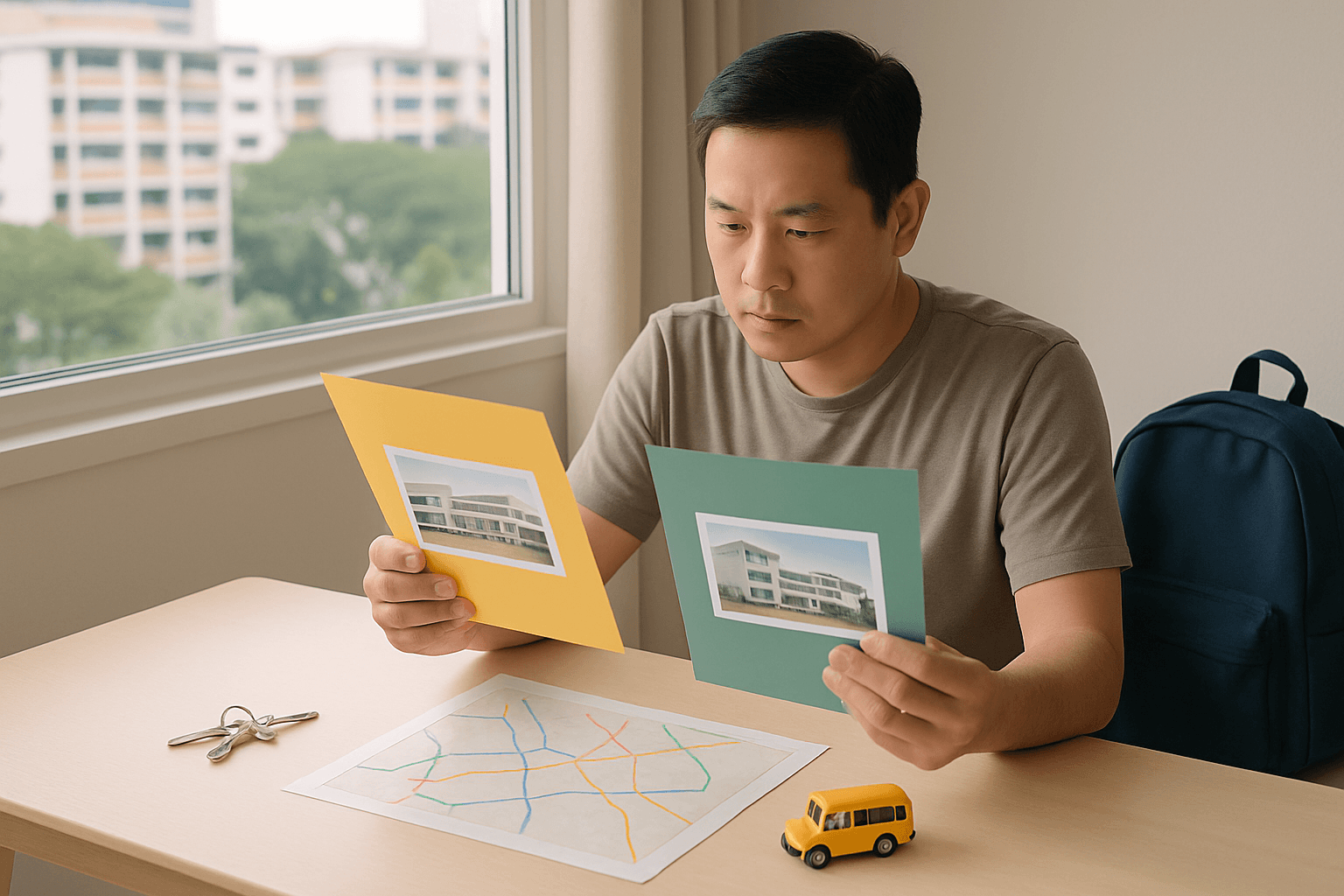
Many Singapore parents have one school that seems perfect on paper. The problem is that in MOE Primary 1 registration, the school you want most is not always the school you should build your plan around.
This guide helps you judge that risk clearly. If your preferred school is popular, oversubscribed, or likely to involve balloting, the real question is not whether it is a good school. It is whether your family can sensibly plan for both outcomes.
What does it mean for a Primary 1 school to be too risky?
It is too risky when the school is uncertain enough that your family should not plan as if admission is likely.
A Primary 1 school is too risky when the chance of getting in is uncertain enough that you should not treat it as your working plan. In practice, that usually means entry may depend on balloting, your family has no strong priority edge, and demand is heavy in the phase you are likely to enter.
The simplest parent test is this: if not getting the school would force a rushed, unhappy, or poorly thought-out fallback, then it is too risky to be your real Plan A. A school can still be worth trying, but it should not be the outcome your family is counting on. A useful way to think about it is this: an aspirational school is one you can try for; a realistic school is one you can plan around. If you want the wider process first, start with our Primary 1 Registration in Singapore guide.
Share with us your kid's P1 registration experience
First thing to do after being balloted out, is to put your child's name under the school's wait list. After then, I've wrote in to MOE, called/met the school's Principal for discussion. Telling them all my problems and how the registration system had affected us (because I have only 1 school within 2km and NO school within 1km). With this factual, MOE has verified and consulted the school. My son was then placed on the highest priority in the waiting list .. and fortunately by early Nov, we were
All About Preparing For Primary One
some primary 1 teachers are still easy-going but not for all schools. those bite-sized tests can be crazy. longer hours in school is a drastic change. so sufficient sleep is important.
What are the main warning signs that a dream school is a long shot?
Look for repeated oversubscription, regular balloting, and no clear priority advantage on your side.
The clearest warning signs are repeated oversubscription, regular ballot pressure, and a weak position in the priority queue. A school is more of a long shot when it is popular year after year, has limited vacancies relative to demand, and your family is relying mainly on hope rather than any meaningful admissions advantage.
Parents often miss the difference between a school that is admired and a school that is realistically reachable. For example, a family may choose a school mainly for reputation, but have no sibling tie, no strong distance advantage, and no backup they actually like. Another family may assume early interest helps, even though places are still allocated by the registration framework, not by enthusiasm. A third may know the school becomes competitive in the phase they are likely to enter, but still treat it like a safe choice. Popularity alone is not enough to judge risk, but repeated ballot pressure is a serious signal. It helps to read our guides on how to read past balloting data before chasing a popular primary school and Primary 1 registration phases in Singapore.
Share with us your kid's P1 registration experience
Sorry, I thought this thread is suppose to discuss on the experience of P1 registration, but I think it had somehow been drifted away by some of the discussions. Anyway, I had gone through the P1 registration last year. Being a P2C applicant, it was extremely stressful and unpleasant. Pre-registration, was worry-some and many sleepless nights After registration, was tough and sleepless due to the balloting wait Post-balloting, for me & spouse … was a total breakdown (balloted OUT) My spouse and
Questions on new rules of P1 registration
With the announcement of the new rules of P1 registration - that citizens now have advantage over PRs, I have 2 questions: 1. Does the living distance to the school matter (ie 1 km away)? 2. If the PR has an older child in the school already, is priority given to the child’s younger sibling? Thanks!
Have More Questions?
Get personalized guidance on schools, tuition, enrichment and education pathways with AskVaiser.
Try AskVaiser for Free →How do MOE priorities affect your real chances in Primary 1 registration?
Priority categories often shape your chances more than the school's reputation when vacancies are tight.
When places are tight, priority factors matter more than school brand. In parent terms, the real contest is often not between families who like a school more or less. It is between families who stand at different points in the priority order.
A child with an older sibling already in the school is commonly in a much stronger position than a family that simply prefers the school. Distance can help, and some school-linked routes such as alumni ties or parent volunteer pathways may improve chances at certain schools, but none of these should be treated as automatic entry. Some schools also narrow or stop volunteer pathways, which is why assumptions made a few years ago may no longer hold. If you are considering that route, read a cautious overview like this parent volunteer guide and pair it with our article on whether an older child in the school means the younger one automatically gets in.
The practical takeaway is simple: compare your priority position before you compare school prestige. Priority improves odds, but it does not remove risk. For a broader overview, see Primary 1 Registration Phases in Singapore: What Each Phase Means for Your Chances.
All About Preparing For Primary One
according to MOE, no need for P1 preparatory class, they stress many times, and they said all kindergarten should be able to prepare the child to primary 1… but parents are too kiasu they prepare them for P1… by the time these kids go to P1, they know most things so those din go to such classes, felt left out and their parents also will send them to classes… never ending… sigh…
All About Preparing For Primary One
hi Celyw, your child is more than ready for P1 at least, he should be fine. a) Speech & drama whether English or Chinese Speech & drama - can help your child in P1 Show & Tell. Nowadays a high percentage of marks are allocated for P1 Show & Tell. i) for K2, some Montessori kindergarten set tests for K2 kids close to K2 Term 4, to assess readiness. Some minor non Montessori kindergarten also do this. However, most or majority of non Montessori kindergarten, church kindergarten do not set tests fo
Does living within 1km make the school safe enough to aim for?
No. Being near the school may help, but it does not make a popular school low-risk on its own.
No. Living close to the school can improve your position, but it does not turn a high-demand school into a safe bet by itself. Distance is one sorting factor in the process, not a promise that you will avoid balloting.
This matters most at popular schools, where many families may also live nearby and may also have stronger priority ahead of you. A parent can live very close to the school and still face serious pressure if the school is heavily oversubscribed. Another common mistake is estimating distance casually by road route, walking time, or postal code. MOE recommends using OneMap School Query because distance is assessed using MOE's method, not rough guesswork. See MOE's P1 registration FAQ and our guide to Primary 1 registration distance priority.
Close is helpful. Close is not the same as safe.
[Punggol] Primary Schools
hi, my girl will be registering for P1 this year. im looking at horizon pri sch but im staying more than 2km away. may I know wat are the chances to get in?
All About Preparing For Primary One
First of all, how far are u from the school? Within 1km or 1 - 2km? If near, don't take school bus, send yourself. Any balloting history for the neighbourhood school under 2C?
When is a balloting school still worth trying?
It can be worth trying when the school is a strong fit and your family can comfortably absorb a no.
A balloting school is still worth trying when the risk is meaningful but manageable. That usually means the school is a strong fit for your child, the daily commute is still workable, and your family either has some real priority advantage or is genuinely prepared to accept a backup if the ballot does not go your way.
For example, trying may make sense if an older sibling is already in the school and the family values having both children in one place. It may also make sense if the school is very near home, the environment suits your child well, and your backup options are schools you would still feel comfortable with. What makes the attempt sensible is not optimism. It is that the plan still works even if the answer is no.
A good rule of thumb is this: a ballot is easier to justify when you are choosing a fit and managing a risk, not chasing a name and hoping for the best. For a broader overview, see Primary 1 Registration: Should You Pick a Popular Dream School or a Safer Nearby School?.
Share with us your kid's P1 registration experience
Pardon me if this question has been answer before. If we registered in P2B and given a place, can we still withdraw at P2C to register at the 1st choice school if chances are very high? :?
Share with us your kid's P1 registration experience
Based on my personal experience, I have to warn that past history is only as good as reference but do not bet on it. It was more than 10 years ago and I still remember vividly. Well we had invested in a property 350m from SCGS after reviewing all the good girls’ school and narrow down that SCGS is easy to secure through the ballot history. We moved in a year before registration and have been telling my daughter that she was going to the school. When the time came for registraton, we took it easy
What signs mean you should stop treating the school as your main plan?
If you have little priority advantage and a miss would leave your family scrambling, it should be an aspiration, not your default plan.
You should stop treating a school as your main plan when you are far down the priority ladder, the school is consistently hot, and a miss would seriously disrupt your family. At that point, the school may still be worth hoping for, but it should no longer be the outcome your planning depends on.
A common tipping-point scenario is a family with no sibling link, no strong distance advantage, and no school-linked priority trying for a school that regularly sees heavy demand. Another is a family that says they are fine with alternatives, but has not actually shortlisted, visited, or mentally accepted any other school. That is not backup planning. That is delayed disappointment.
If losing the ballot would leave you scrambling, the school has already crossed from aspirational into too risky. It helps to work through the fallback now with our guide on what happens if you do not get your preferred school.
All About Preparing For Primary One
Hello parents. I think i am going to go crazy due to anxiety. My child will be attending P1 next year and i felt that he might struggle academically in school. Though he is in kindy, personally i think it may not be enough to pull him through P1. In kindy, they are still learning phonics at P1. To “catch-up” with my perception of the school’s norm, i sent him for supplementary classes since K1. His learning curve is not steep, but he can read (slow though) but can’t spell very well. As for chine
All About Preparing For Primary One
Starting primary school? This is a big milestone. Do enjoy the journey with your child! :rahrah: https://www.straitstimes.com/singapore/education/the-st-guide-to-preparing-your-child-for-primary-1 Parents often confuse being ready for school with being academically capable in skills like reading and counting. Instead of focusing solely on academic progress, it is more important to make learning an enjoyable process, and help your child have a swift and happier adjustment to primary school. Here
What is the safest way to choose a backup school?
Choose a backup that is practical, acceptable, and already vetted, not just the nearest available option.
The safest backup school is not simply the nearest school with a better chance. It is a school you have already checked and can genuinely live with if it becomes the final outcome. That means looking beyond name recognition to travel time, school culture, support options, and how the daily routine would actually work.
In practice, parents usually make better backup choices when they do a few grounded checks early. Read the school website, attend open houses if possible, test the route on a weekday morning, and ask practical questions such as whether drop-off, pickup, student care, and after-school routines are realistic for your family. If your child may need a calmer environment or more support, that should weigh more heavily than whether the school is considered prestigious. This KiasuParents guide to choosing a safety school is useful for thinking through that shortlist.
A good backup is not one you merely tolerate. It is one you can accept without feeling that the whole process has failed.
All About Preparing For Primary One
Was surfing around on understanding if I am well prepared on behalf of my DD1 for Primary 1 Chanced upon a few websites, thought to share though it could have been mentioned before Tips For Parents ◦Work on independent reading skills. ◦Set up a study area and regular study times that are not interrupted. ◦Learn to follow a routine with a lot of sleep and early mornings. ◦Practice organisation and planning by packing a daily bag with essentials for the day. ◦Talk about social skills and communica
Share with us your kid's P1 registration experience
Funtastic4, RGPS finally had 117 applicants >2km fighting for 51 places under phase 2C (after 26 applicants <2km admitted). For my case, I had a daughter borned in year 2002. From 2005 onwards, we were closely monitoring the P1 registration stats, keeping all the records ourselvs as MOE dont retain them. Since my mil stayed near HPPS, we decided to enrol our child there. We were prepared to move <1km of the school. However after studying the stats, we discovered that HPPS needs balloting under p
What is the biggest mistake parents make when chasing a dream school?
Parents often confuse wanting a school badly with having a realistic path into it.
The biggest mistake is treating desire as if it improves admission chances. Wanting a school badly does not change vacancies, priority rules, or ballot pressure. Hope for the dream school, but plan for the ballot.
All About Preparing For Primary One
:goodpost: I totally agree with nms1 - why should we pressurize the kid when he has not even enter the formal P1 education! :scratchhead: MOE is slowly doing away with exams in P1 & P2. Some schools already move away from exams at lower primary, and explore the use of other forms of assessment which place more emphases on learning rather than on grades alone. At P1 it is to place less importance on semestral examinations to facilitate a smooth transition to primary school. A number of schools ha
All About Preparing For Primary One
:goodpost: Thanks so much for your great sharing! It really helps us as P1 parents from 2012! :lovesite:
How should parents balance school prestige against daily practicality?
Treat travel time, fatigue, and family logistics as decision factors that matter as much as reputation.
Use daily practicality as a hard filter, not an afterthought. A well-known school may still be the wrong choice if the commute is long, mornings become exhausting, pickup is stressful, or the family needs to coordinate around work schedules and younger siblings.
This is one of the most common blind spots in P1 planning. Parents imagine the school name, but children live the routine. A school that adds a tiring commute can mean earlier wake-ups, less sleep, more transport dependence, and more friction around student care or enrichment. A slightly less famous school that is nearer home may give your child more rest, more consistency, and less daily stress. MOE has also consistently emphasised looking at fit, interests, distance, and support, not only school status, as seen in this MOE speech on strengthening every school.
If you are weighing reputation against practicality, our comparison of a popular dream school versus a safer nearby school and our broader guide on popular primary school versus neighbourhood school in Singapore can help frame the trade-off.
Does school conduct test before allow the kid to reg Pri 1?
I have not heard of Primary schools giving entrance exams as part of the initial Primary One Registration process. I don't think that will come down well at all, as it implies that parents will be FORCING their pre-schoolers to take up all sorts of academic courses just to ace the entrance tests. However, if you want to transfer your child to another school after Primary One, the new school may require your child's exam results and even conduct assessment tests.
All About Preparing For Primary One
Dear parents, I hope parents could share your experience regarding the preparation for primary school and time schedule spend with your kids everyday. I have a son of 6 this year going to P1 next year. I would like to find out with parents things that you are doing with your child prior going P1, cos I do not want to react too kan-jiong or too relax in front of my child. I am particularly concerned about the 3 main subjects being taught in P1 and wonder should I expect him to be able to do the a
How can parents decide whether to take the risk this year or choose a safer option?
Take the risk only if it is planned, tolerable, and backed by a school you would still be willing to accept.
Use a simple go or no-go test. A dream school is worth trying when it is a strong fit, you have some meaningful priority advantage or a solid practical reason to try, and your family would still be genuinely okay with the backup outcome. A safer option usually makes more sense when you have no clear advantage, the school is regularly oversubscribed, and missing out would leave you stressed, regretful, or forced into a rushed choice.
So do not ask only, "Do we love this school?" Ask, "Can we handle the likely process and live with the possible outcome?" That question usually leads to a better decision. The best dream-school strategy is one your family can manage emotionally and logistically even if the ballot does not go your way. For a fuller planning framework, return to our Primary 1 Registration in Singapore guide or read this practical KiasuParents overview of common P1 questions.
2021 P1 Registration Exercise for 2022 In-take
Hi, does any one know if primary school has open houses and usually when will open houses be held if P1 registration is in the July period?
2021 P1 Registration Exercise for 2022 In-take
Most would have signed up before 30 June 2020. There will be some 'laggards' but the numbers won't be huge since most of the high risk schools are already there or thereabouts for so many years. Names like Rulang, St. Hilda’s, Tao Nan, MGS, Henry Park, Red Swastika and Nan Hua wouldn't surprise anyone that they are at high risk this year, or last year, or any other year. What's probably unpredictable is the number of Phase 1 applicants since that could vary widely every year. Regardless of what
Have More Questions?
Get personalized guidance on schools, tuition, enrichment and education pathways with AskVaiser.
Try AskVaiser for Free →