
Are Good Neighbourhood Primary Schools Easier to Get Into in Singapore?
Often, but not automatically. A quiet school can still be competitive if nearby demand is strong.
Yes, neighbourhood primary schools are often easier to get into in Singapore than the most sought-after schools, but there is no guarantee. A less hyped school can still be oversubscribed if local demand is strong, especially in a competitive phase or distance band. Parents should judge risk by phase, citizenship and priority status where relevant, home-school distance, and past balloting patterns, not by the school label alone.
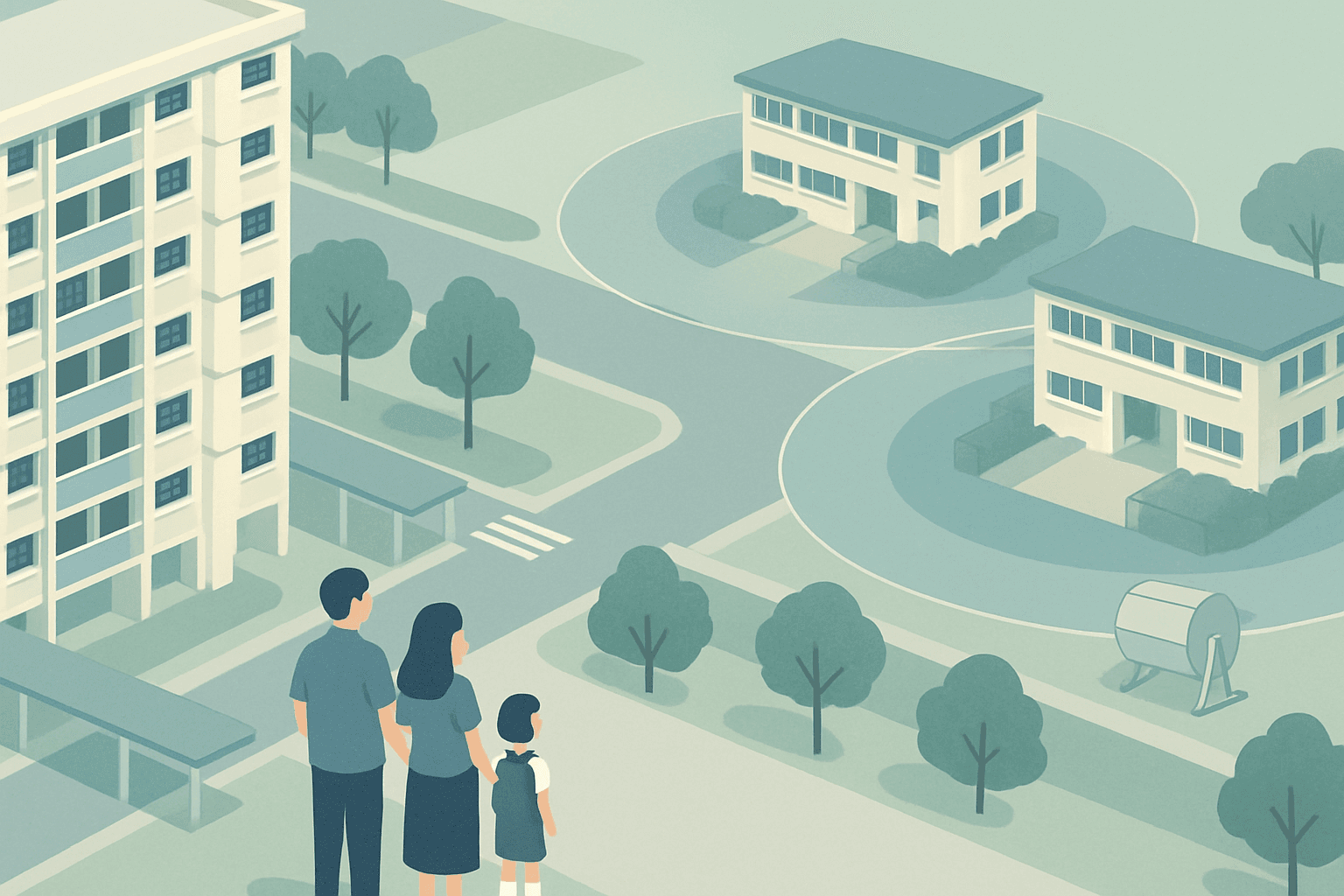
Often, yes, but not automatically. In Singapore, many neighbourhood primary schools face less pressure than the most sought-after schools, yet some still ballot because too many nearby families want the same places. The better question is not whether a school sounds local, but how risky it is for your child in your likely phase and distance band.
Short answer: Are good neighbourhood primary schools easier to get into in Singapore?
Often yes compared with the most popular schools, but not automatically. Some neighbourhood schools still ballot because nearby demand is strong.
Often yes, but only compared with the most oversubscribed schools. Many neighbourhood schools attract less islandwide attention, so the odds can be better. But a school with a low-profile reputation can still be hard to enter if many families living nearby want it in the same phase. For parents, the useful way to read "easier" is "lower risk", not "safe entry". A famous school may be difficult because families from all over Singapore apply, while a quieter school may still ballot because the local catchment is strong. If you are judging a real option, look first at past demand, not the school's reputation label. For a broader overview, see Primary 1 Registration in Singapore: How It Works, Balloting Risk, and How to Choose a Realistic School Plan.
[Ang Mo Kio] Primary Schools
My girl will be enrolling in a primary school next year too. I feel where you stay will play a big part in deciding on which pri school your child will study at eventually. Why do we need to compare which primary schools your child will study in ? I think this create an unhealthy system in which most parents will strive to get their child into these perceived good schools. ( If they score well in those schools, it is expected of them but if they do not, these children will enter different second
[Geylang] Primary Schools
For primary schools, I recommend going for convenience than popularity. Reason is the kids are still young, and travelling time should not be long enough to tire them out, even for those driving. Have you seen children dozing off in the parents car (some in an awkward position, especially straining their necks) because they have to wait up earlier than their peers to reach these “better” schools to feed their parents “ego”. Please note that the above is just my PERSONAL view as I have gone throu
What counts as a neighbourhood primary school in Singapore?
It is mostly a parent shorthand, not a formal MOE label. Parents usually mean a school with less hype, a more local catchment, or a stronger neighbourhood feel.
There is no formal MOE category called a neighbourhood school. It is parent shorthand for a school that feels more local, gets less prestige talk, or draws more families from the surrounding estate than from across Singapore. Some parents use it to mean a practical school choice with a calmer reputation. Others mean a school they believe is easier to enter. The important point is that the label describes perception, not admissions certainty. A school can be "neighbourhood" in reputation and still have a loyal local catchment that makes it surprisingly competitive. In other words, the name tells you how parents talk about the school, not how full it will be this year. For a broader comparison, see Popular Primary School vs Neighbourhood School in Singapore: Which Is Better for Your Child? and this parent-focused perspective on why neighbourhood schools are worthy too. For a broader overview, see Primary 1 Registration Distance Priority: How Home-School Distance Works.
[Toa Payoh] Primary Schools
OIC.... stay in prime neighbourhood is like that one I guess? \"Toa Payoh, Novena or Clementi\"..... your range quite wide leh...
[Geylang] Primary Schools
From what you've described, it appears that GMPS may be a better overall school than Haig Girls. But could it be that GMPS has more obvious credentials (given its a government-aided school) and therefore more of what it does is known? And Haig Girls, being a much smaller school (in terms of physical size) does not have so much publicity, and less of what it does is actually known to the public (except of course its PSLE results which of course doesn't look that fantastic)? :idea: So would anyone
Have More Questions?
Get personalized guidance on schools, tuition, enrichment and education pathways with AskVaiser.
Try AskVaiser for Free →Why a less hyped school is not always easier to enter
Low hype does not equal low demand. Some quieter schools are still oversubscribed because the nearby pool of applicants is large.
The common mistake is assuming low visibility means low demand. In practice, a school can be quiet online and still be oversubscribed for very ordinary reasons. A school in a dense estate may have many young families living within the same distance band. A school in a newer town may have a large cohort of children entering Primary 1 around the same time. A school may also have built a strong local reputation even if it is not widely discussed outside the area. In all three cases, the school can feel like a "safe" option until the registration numbers appear. The better mindset is to separate fame from competition. Fame attracts attention, but nearby demand fills seats. If you want to spot a realistic choice, parent guides such as how to choose the best primary school near you and hidden signs of a good safety school are useful starting points, but the school's actual registration pattern matters more than its online reputation. For a broader overview, see Primary 1 Registration Phases in Singapore: What Each Phase Means for Your Chances.
[Geylang] Primary Schools
Hi Candymum, Those unsuccessful in Tao Nao, Kong Hwa and Geylang Methodist Primary will go for Ngee Ann but this school only left with 4. The next school will be Tanjong Katong Primary School. Tangjong Katong is more popular than Eunos becos it is so called an international school. Alot of foreign students too. They have a lot of variety of sports eg. bowling etc which other schools don't have. I guess Eunos Primary is less popular becos it is in Eunos area which is quite jam in the morning & ev
[Hougang] Primary Schools
Lagi no chance. The less popular the school, the better your chance. Hence, the basic rule of the thumb should be schools with the least familiar name should be the ones at the top of your choices.
What actually affects your child's chances in Primary 1 admission?
The main drivers are phase, priority category where relevant, distance, citizenship order, and whether applicants exceed vacancies.
The main factors are the registration phase, any priority pathway your family may qualify for, your home-school distance, and whether applications exceed vacancies. Balloting happens when there are more applicants than places. That is why the same school can feel manageable for one family and risky for another. For example, a family with a priority route may see a very different picture from a family applying later without one. Distance also matters in a structured way: Singapore Citizen applicants are placed ahead of Permanent Residents, and nearer applicants are placed ahead of those farther away within the same grouping. So a school that looks fine for a family living within 1km may be much less certain for a family outside that band or applying in a later phase. For the mechanics, read Primary 1 Registration in Singapore: How It Works, Balloting Risk, and How to Choose a Realistic School Plan, Primary 1 Registration Phases in Singapore: What Each Phase Means for Your Chances, and Primary 1 Registration Distance Priority: How Home-School Distance Works. For a broader overview, see How to Read Past Balloting Data Before Chasing a Popular Primary School.
[Bukit Timah] Primary Schools
a) Nanyang refer http://www.nyps.moe.edu.sg/index.php?option=com_content&view=article&id=32&Itemid=33 ai) phase 2B 2011: staying more than 2 km. # of applications Received: 11. but # of successful applicants: 0 (> 2km not given chance to ballot). all those 28 who got in - stayed less than 1 km. aii) phase 2B 2010: staying more than 2 km. out of 22 balloted, 7 got in. (better than 2011 batch) means ratio is 1:3 ie. out of every 3 kids, only 1 lucky child able to get into NYPS aiii) under Phase 2C
[Bedok] Primary Schools
2012 end of Phase 2C (for 2013 P1 intake - born 2006, year of doggie) 1)\tRed Swastika primary\t Balloting was conducted for Singapore citizenship children, residing within 1km of the school. 40 registered, 15 places http://www.redswastika.moe.edu.sg/cos/o.x?c=/wbn/pagetree&func=view&rid=1127697 2)\tTemasek primary \t Balloting was conducted for Singapore citizenship children, residing within 1km of the school. 52 registered, 34 places http://www.temasekpri.moe.edu.sg/cos/o.x?c=/wbn/pagetree&fun
How can parents tell if a nearby school is likely to ballot?
Check whether the school has balloted before in your expected phase and distance band. Past patterns are not a guarantee, but they are the most useful risk signal parents usually have.
The best clue is whether the school has balloted before in the same phase and distance band you are likely to fall into. Past patterns do not guarantee this year's outcome, but they are usually more useful than reputation. If a school has repeatedly needed balloting even for families living very near, that is a strong sign that local demand is high. If it tends to fill early in the process, that is more important than whether the school is considered elite or ordinary. Start by confirming your actual distance using the OneMap School Query tool, not a map app or driving route estimate. Many parents overestimate how close they are. Then compare the school's recent outcomes with your likely situation. A school can look calm overall yet still be tight in the exact phase that matters to you. For a deeper read on the numbers, see How to Read Past Balloting Data Before Chasing a Popular Primary School.
[Bedok] Primary Schools
For Temasek Primary, there were some years where P2C <1km no need to ballot. Now that SC have priority over PRs, the odds are quite good if <1km. Blk 46~50 enbloc and many residents left. Now these are mostly rented to PRs and S Pass holders. Plus a big part of the area ard TP is not very populated with few HDBs.. Further up north, these HDBs are within 1km of Red Swastika and yu neng, and these pple may prefer the other 2 primary schools. So, for <1km, chances is pretty good, but Not w/o risk.
[Bukit Timah] Primary Schools
2012 Phase 2C Balloting took place within 1 km , for 5 schools :- 1. Nanyang primary Balloting was conducted for SC children residing within 1km of the school. (33 applicants, 25 places) 2. Pei Hwa Presbyterian primary Balloting was conducted for SC children residing within 1km of the school. (42 applicants, 27 places) 3. Henry Park primary Balloting was conducted for SC children residing within 1km of the school. (43 applicants, 15 places) 4. Raffles Girls’ primary Balloting was conducted for S
Is it easier to get into a nearby primary school in Singapore?
Usually yes, being nearer helps. But it only improves your position if the school is not already heavily oversubscribed in that band.
Usually, being nearer helps. It improves your position if the school becomes oversubscribed, especially for Singapore Citizen applicants. But nearer does not mean automatic. If many families in the same distance band choose that school, balloting can still happen. This is where parents often get caught out. They assume a school 800 metres away must be safer than one slightly farther away, when the reverse can sometimes be true. The nearer school may be heavily contested by neighbours, while the slightly farther school may have lighter demand and therefore a cleaner outcome. Think of distance as an advantage, not a promise. It strengthens your place in the queue, but it cannot create vacancies if too many similar-priority applicants show up. If your address is not straightforward, these related guides can help: Which Home Address Counts for Primary 1 Registration in Singapore? and Primary 1 Registration After Moving House: Should You Use Your Old or New Address?.
[Bedok] Primary Schools
Thank you for your valuable comments. However to be realistic, the achievement grades of Bedok Green students are better than East Coast. I'm caught in a fix. Cos based on our registered address, Bedok Green falls between 1 to 2 km, whereas East Coast is within 1 km. Really stressful.
Sengkang/punggol primary school - input from parents of kids in schools in these area?
~ starting to think about primary school registration (applying this year, 2025) and it’s giving me a headache. The schools my kid has a good chance of getting in (2B - 1km) are: 1)Nativity primary 2)Mee Toh 3) Rivervale primary My kid is really quite nerdy and has a hard time finding friends because of her subject-specific interests (usually science-related). Has expressed a preference for co-ed, but I don’t know how seriously to consider her input. Nan Chiau (phase 2b) seems impossible because
What parents often misunderstand about balloting at neighbourhood schools
Neighbourhood schools can ballot too, especially in dense family areas or newer estates.
Balloting is not only a famous-school problem. A school can look ordinary and still be competitive if many nearby families want it. Choose by admission risk, not by reputation alone.
[Bukit Timah] Primary Schools
a) 11 schools most highly sought after by parents (click on picture inside, one by one):- http://www.edvantage.com.sg/edvantage/photos/1226116/P1_registration_heads_to_ballot_boxes.html b) Parents rent condo, to enhance P1 balloting chance :- source http://www.edvantage.com.sg/edvantage/photos/1243954/Parents_rent_condos_for_better_P1_balloting_chance.html Schools that the paper spoke to said that parents risk having their child expelled if they are caught using a false address. Nanyang Primary
[Bukit Timah] Primary Schools
end of Phase 2C Day 3 5 schools enter balloting :- 1.\tHenry Park Primary School\t Balloting will be conducted for SC children residing within 1km of the school. 2. Nanyang Primary School\t Balloting will be conducted for SC children residing within 1km of the school. 3. Pei Hwa Presbyterian Primary School \tBalloting will be conducted for SC children residing within 1km of the school. 4. \tRaffles Girls’ Primary School\t Balloting will be conducted for SC children residing within 1km of the sch
How should parents judge relative risk before applying?
Compare schools by distance, likely phase, past oversubscription and fallback options. The goal is not just to pick a preferred school, but to build a realistic plan.
A practical way to judge risk is to compare schools through the same lens, not by labels. First, confirm the actual distance with OneMap. Next, look at whether the school has a history of oversubscription in your likely phase. Then check whether your family has any priority pathway that meaningfully changes the picture. After that, decide what kind of choice this is for you. Some parents are comfortable with a must-try school plus a backup. Others want a higher-certainty plan from the start. Both approaches are reasonable. The mistake is treating a school as "safe" without checking the evidence. A sensible shortlist usually includes one school you strongly prefer and one school you would genuinely accept if the first choice gets tight. Your backup should be a real plan, not a last-minute name. If you are weighing ambition against certainty, Primary 1 Registration: Should You Pick a Popular Dream School or a Safer Nearby School? and Primary 1 Registration Unsuccessful: What Happens If You Do Not Get Your Preferred School are useful next reads.
[Geylang] Primary Schools
both SJI and Anglo Chinese are very popular schools. Chance of getting in via P2C is very competitive. If you fail to get in via P2C, you can only go into whichever schools in the area that still has openings in P2CS. I always believe that if you have a chance to go into a good school via P2A, you should take this chance. Many parents I know actually rent out their places and then rent a place near their school of choice. My place is located near a SAP and currently a family is renting it cuz th
Top sch vs Good neighbourhood sch
My child went to one of the IP schools in Singapore following his PSLE. I think access to resources (e.g. facilities, materials, quality teachers, etc.) is one factor, but more importantly is the type of learning environment that he/she will be subject to. In such schools that may be deemed “better”, students are generally motivated to study harder and are more focused on their academics. This will play a huge part in what your child prioritises during these early / impressionable years. Even if
Practical examples: when a neighbourhood school feels easier, and when it does not
A neighbourhood school feels easier only when demand is actually lower for your phase and distance band. Low hype by itself is not enough.
Here is the simplest way to think about it. A school feels easier only when demand is actually lower for your phase and distance band. Imagine one school with modest online chatter but a dense estate full of young families nearby. Even without prestige buzz, it may still be hard to secure because local demand is strong. Another school may be less talked about and also show lighter recent pressure, which makes it a more realistic option. A third school may be manageable for families living very close, but much less certain for those outside that band. Parents often miss this because they only hear that a school is "not popular". The better question is whether the school is less competed-for in your exact situation. For broader context, some parents also read lists such as the most difficult primary schools to get into or news coverage like The Straits Times report on schools that needed early balloting, but those should be used as context, not as a substitute for school-specific checking.
[Ang Mo Kio] Primary Schools
It's also balloting within 1km. My thoughts are that all Neighbourhood schools are ultimately Neighbourhood schools and they don't have much difference. The key thing that affects the direction is the school principal. A good principal will introduce good Programmes and a lousy one will dismantle everything and reduce it to bits. The sad thing is the schools change principals every few years so although the school may be good now, but if you suay suay went in when a new untested principal steps
[Bukit Timah] Primary Schools
Hi Huilink and Nite At this point in time, I dun think you should be overly concerned with which school is more well-rounded. All the schools you are targeting are good branded schools. So, your priority is to measure which school offers you the highest chance of getting in, and whether you are willing to go to a lesser school should you not be successful. First, you guys are all registering at Phase 2C, which is open to all Singaporeans and PRs without connections. This is the most competitive
If a school is not very popular, will my child definitely get in?
No. Lower hype may reduce risk, but it does not guarantee a place.
No. "Not very popular" often just means fewer people talk about the school, not that vacancies will definitely exceed applicants. A school can still be oversubscribed if many nearby families apply or if pressure builds in your phase. The safer way to judge your chances is to compare actual balloting patterns, your distance band, and any priority advantage your family may have. If you are deciding between two local schools, ask which one has shown tighter demand for families in a situation like yours, rather than which one sounds more famous.
[Bedok] Primary Schools
Neighbourhood schools the best option! If get into a poppular school - it is not just torturous process now (with ballotting and all) but also for the next 6years for a child’s life and of course the poor mummy and daddy too! Popular school…nah for me…
[Bukit Timah] Primary Schools
So I guess if my dd can't get into NYPS, sure can get in Bukit Timah Primary or New Town Primary? My friend staying in Duchess is already giving uo NYPS, gping for NTP for her dd as she doesn't want her dd to get too stress out.. Most of her classmates are not going to NYPS. Her sch is near NYPS..
Have More Questions?
Get personalized guidance on schools, tuition, enrichment and education pathways with AskVaiser.
Try AskVaiser for Free →