
Can You Still Face Balloting With Sibling Priority in P1 Registration?
Sibling priority helps, but it does not remove the risk of oversubscription and balloting.
Yes. Sibling priority can improve your child's chances in P1 registration, but balloting can still happen if the school is oversubscribed in that phase.
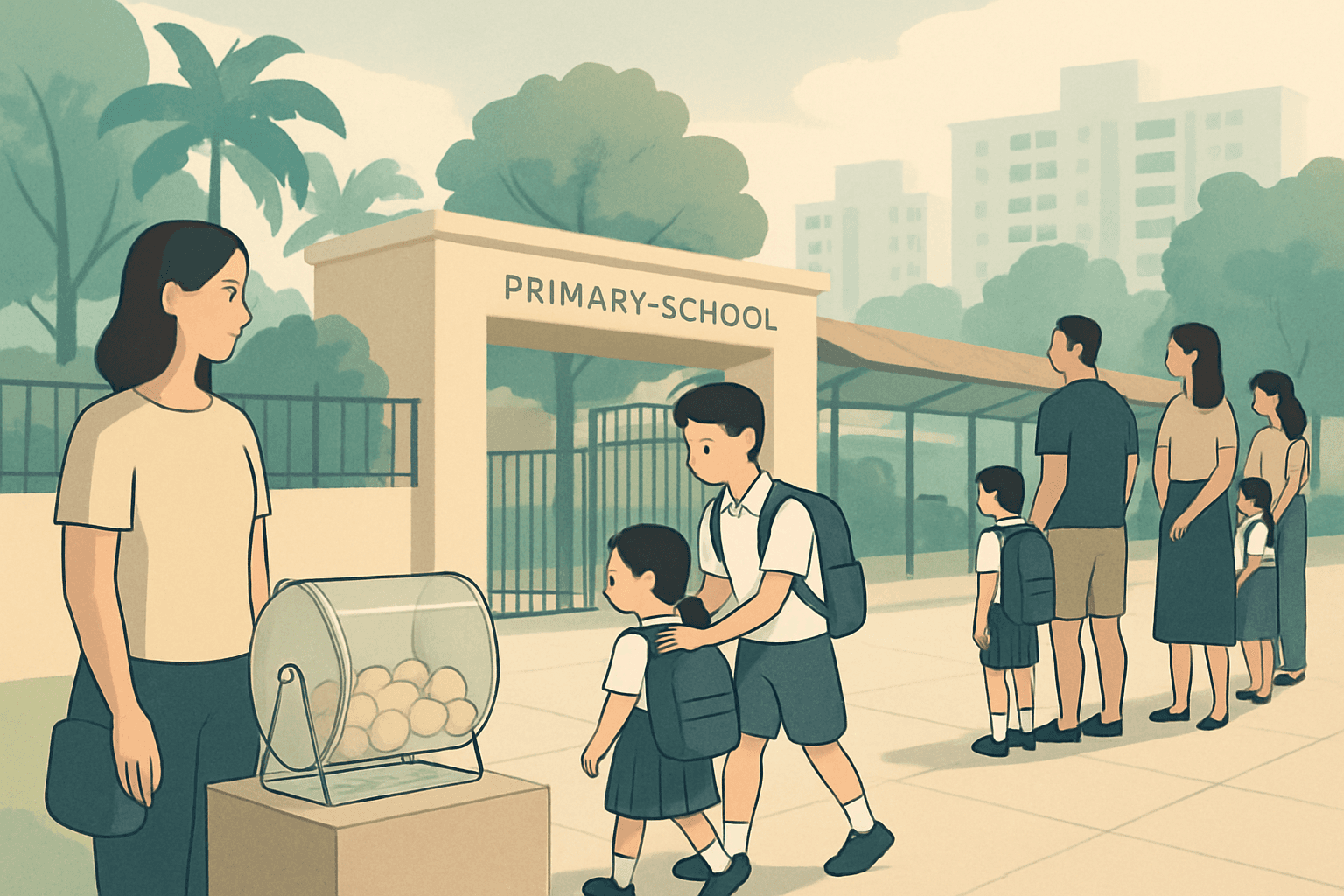
Yes, your child can still face balloting even with sibling priority. The key idea is simple: sibling priority improves your child's position in the queue, but it does not create a guaranteed seat.
That is why some parents are surprised when a preferred school still ballots. They assume having an older child already enrolled means the younger one is safe. In reality, sibling priority is an advantage, not a promise. If you want the bigger picture of how the process works, start with our Primary 1 Registration in Singapore guide. If you are applying because an older child is already in the school, plan as if your odds are better, not certain.
What does sibling priority actually mean in Primary 1 registration?
Sibling priority can improve your child's chances, but it is not the same as a guaranteed place.
Sibling priority means your child may be considered ahead of some other applicants when there is an older sibling already enrolled in the school, if your registration falls under MOE's relevant phase rules. It does not mean the school must admit your child.
That difference matters because parents often blend together three separate ideas: whether you can apply, whether you get priority, and whether you ultimately get a place. Eligibility decides if you are in the right phase. Priority affects your position among applicants. Admission still depends on whether there are enough places left after MOE applies the rules.
A useful way to think about it is this: sibling priority can move your child higher in the queue, but it does not remove the queue. If the school still has plenty of vacancies, that advantage can feel very strong. If the school is already tight on places, it may only improve the odds rather than settle the outcome. If you want the related misconception answered directly, our guide on whether a younger child automatically gets in when an older sibling is already in the school explains why many families overestimate what sibling status guarantees. For a broader overview, see Primary 1 Registration in Singapore: How It Works, Balloting Risk, and How to Choose a Realistic School Plan.
All About Primary Schools' Balloting History
No. The school will NOT make any exception to the number of vacancies it offers, during the P1 registration exercise. Even if the vacancies exceed by 1 place, it will still conduct balloting for all those in the affected distance bucket. This is an extremely strict and procedural process. The only exception that can be made is if multiple children such as twins are included. For example, if during balloting in Phase 2C, the last name drawn are the twins, then both children will be admitted even
Questions on new rules of P1 registration
With the announcement of the new rules of P1 registration - that citizens now have advantage over PRs, I have 2 questions: 1. Does the living distance to the school matter (ie 1 km away)? 2. If the PR has an older child in the school already, is priority given to the child’s younger sibling? Thanks!
Can you still face balloting even if your child has sibling priority?
Yes. If sibling-priority applicants still outnumber the vacancies, MOE may ballot.
Yes. Balloting is triggered by oversubscription, not by whether a child has some form of priority.
MOE uses balloting when a school has more applicants than vacancies. Sibling priority may help your child within the admission order, but if too many children in that priority pool are competing for too few places, balloting can still happen. MOE explains the process on its page about how balloting works in P1 registration.
A practical example makes this easier to see. If a school reaches your child's phase with only a handful of seats left, and several sibling-priority applicants apply, some of those families may still be balloted. The real takeaway is this: sibling priority lowers risk, but it does not cancel oversubscription. For a broader overview, see If Your Older Child Is Already in the School, Does Your Younger Child Automatically Get In?.
Share with us your kid's P1 registration experience
First thing to do after being balloted out, is to put your child's name under the school's wait list. After then, I've wrote in to MOE, called/met the school's Principal for discussion. Telling them all my problems and how the registration system had affected us (because I have only 1 school within 2km and NO school within 1km). With this factual, MOE has verified and consulted the school. My son was then placed on the highest priority in the waiting list .. and fortunately by early Nov, we were
All About Primary Schools' Balloting History
P3 is 1st come 1st serve, remember my colleague bunking outside the school @ 3am in order to get one of the 5 slots available
Have More Questions?
Get personalized guidance on schools, tuition, enrichment and education pathways with AskVaiser.
Try AskVaiser for Free →When does balloting happen for sibling priority applicants?
Balloting happens when applicants exceed vacancies in the relevant phase, including phases where sibling-priority children apply.
Balloting happens after MOE counts the applicants and compares them with the vacancies in the relevant phase. The order is straightforward: parents register, vacancies are counted, priority rules are applied, and if demand still exceeds supply, balloting is used.
MOE says balloting can happen during Phases 2A to 2C Supplementary on its balloting page. That means children applying in phases where sibling-related priority may matter can still face ballot risk if the school is oversubscribed.
Parents also often miss that priority is layered. When places are limited, MOE still sorts applicants by the relevant rules, and categories such as citizenship and home-school distance can matter too. If you want the parent version of that rule, our distance priority guide explains how home-school distance affects the outcome without drowning you in policy language. The practical lesson is simple: sibling priority helps most when the school still has room. Once the intake is tight, expect the process to become layered and competitive. For a broader overview, see Primary 1 Registration Phases in Singapore: What Each Phase Means for Your Chances.
All About Getting Priority Registration
Yes. Don't quite understand your question. Priority only applies for balloting within the phase. So, if all the vacancies in your backup school are taken up in P2C (regardless by SC or PR), there will be no P2CS for this school. Hence, there will not even be balloting, let alone talk about whether you will have priority over PRs.
All About Getting Priority Registration
Karl If u failing ballot in dream sch u will be in later phase later on but in your backup sch as dream sch no more vacancy for later phase aka p2cs. U will have priority over PR in registration in backup sch in p2cs but bear in mind that u may need to ballot it out with other citizens if your back up sch vacancy is limited in p2cs as a result of their popularity increase in the PR community as PR turn to these sch to secure a place at p2c to avoid balloting . Do note that there may only be a ha
What are the most common situations where sibling priority still does not secure a place?
The biggest risk cases are popular schools, small remaining vacancies, and years when many sibling-priority applicants apply together.
The most common situation is a school that is regularly oversubscribed. In those schools, sibling priority is still useful, but it may not be enough if many families are competing for a small pool of places.
Another common situation is a year with a larger-than-usual sibling cohort. Parents sometimes assume that because an older child got in smoothly, the younger one will too. But if many eligible siblings apply in the same year, the competition inside that group can become much tighter than expected.
A third situation is when the number of vacancies at your phase is smaller than parents imagine. What matters is not the school's full intake, but how many places are left when your child's phase opens. Schools do not release every seat at once across the entire exercise, so the number available in your phase can be much smaller than the headline intake suggests.
A fourth situation is when several risk factors stack together. For example, the school is popular, your phase is crowded, and your family is not in the strongest distance band if distance becomes relevant. That does not mean your application is hopeless. It means sibling priority should be treated as a real advantage with limits, not as a safety net.
If you want a sense of how repeated demand patterns show up in practice, parent-focused round-ups such as KiasuParents' P1 balloting risk coverage can be useful background reading. Use them for context, not prediction. For a broader overview, see How to Read Past Balloting Data Before Chasing a Popular Primary School.
All About Getting Priority Registration
As for PV vs Grassroots, both equal opportunity at Phase 2B BUT if both fail at the ballots, PVs stand a higher chance in the the waiting list (appeal) than grassroots or clan members coz they directly served the school.
All About Getting Priority Registration
Does anyone know if there's any priority for grassroots over PV parents in P2B? Or both have same priority? (assuming both are citizens and stay with 1km of the school) Thanks! :please:
How should parents read school demand before registration?
Look at recent oversubscription patterns, the likely demand in your phase, and the school's overall popularity as your main risk check.
Start with a better question: not just, "Do we have priority?" but "How likely is this school to be tight in our phase?" That shift usually leads to better decisions.
The first practical check is pattern. If a school has needed balloting repeatedly, especially in the phase you are targeting, treat that as a real warning sign. One reassuring story from another parent is much weaker than several years of recurring oversubscription. Our guide on how to read past balloting data before chasing a popular primary school can help you interpret those patterns calmly.
The second check is demand profile. Schools that draw applicants from many estates, have strong word-of-mouth appeal, or often appear in oversubscription news are more likely to surprise parents who assume priority will be enough. Reporting such as this Straits Times article on oversubscribed schools is useful because it shows that pressure can stay high even after earlier phases.
The third check is fit, not just reputation. MOE's guidance on choosing a school is worth reading because it encourages parents to think beyond name value. A school that fits your child and offers a more realistic path may be the better choice than a dream school with a much tighter ballot risk. The short version is this: repeated oversubscription is a stronger signal than hopeful assumptions.
All About Primary Schools' Balloting History
Once the entire P1 Registration exercise is officially over, completed, finished, it is up to the individual sole discretion / authority of the Principal(s) of primary schools, how she (he) intend to manage their Wait-list, names submitted by K2 kindergarteners balloted out of Phases (2A1, 2A2, 2B, 2C, 2C Supp) Principal(s) are Not obliged to disclose to public who to give the vacancy to, should there be any withdrawal by any pupil, from within their school. So the answer is, you won't be able t
All About Primary Schools' Balloting History
Hi, it's my first time to post question here Please help I am quite anxious of P1 registration of my son which is due this year. He will be P1 by next year. I just want to know the balloting of within 1KM of the school, what if my son was not selected during the Phase 2C? Can I still register him in my second option for school? What if it is full too? Can you pls tell me the steps / tricks on how to go about this... My first option of school is, we definitely wait for the ballot Phase 2C due to
What most parents misunderstand about priority versus admission certainty?
Priority improves your odds. It does not confirm a place.
The biggest mistake is treating priority as a promise. It is not. Priority improves your position, but admission still depends on whether enough places remain after MOE applies the rules.
Remember it this way: sibling priority is a better place in the queue, not a reserved seat.
Share with us your kid's P1 registration experience
Pardon me if this question has been answer before. If we registered in P2B and given a place, can we still withdraw at P2C to register at the 1st choice school if chances are very high? :?
Share with us your kid's P1 registration experience
Sorry, I thought this thread is suppose to discuss on the experience of P1 registration, but I think it had somehow been drifted away by some of the discussions. Anyway, I had gone through the P1 registration last year. Being a P2C applicant, it was extremely stressful and unpleasant. Pre-registration, was worry-some and many sleepless nights After registration, was tough and sleepless due to the balloting wait Post-balloting, for me & spouse … was a total breakdown (balloted OUT) My spouse and
What should you do if your child may still face balloting?
Have a backup plan early and know what the next eligible phase or fallback path looks like.
Prepare your backup before the registration window gets emotional. If you are aiming for a school where sibling priority still comes with real ballot risk, shortlist one or two realistic alternatives early. That way, you are not making a high-stakes decision under pressure.
It also helps to understand the fallback path. MOE's FAQ explains that if a child is unsuccessful in a registration phase, parents can register in the next eligible phase. If a child is unsuccessful in Phase 2C Supplementary, MOE will post the child to a school with available vacancy. So while an unsuccessful result is disappointing, it is not the end of the process.
The parents who cope best are usually the ones who separate hope from planning. They may still try for the preferred school, but they already know what they will do next if the ballot does not go their way. If you want to think through that trade-off, our guides on what happens if you do not get your preferred school and whether to pick a dream school or a safer nearby school are the next useful reads.
All About Getting Priority Registration
Yes, you can register your son under Phase 2A2 first. The tricky part is when you want to register him in Phase 2B because often there are many late registrations and your prediction might be wrong and you might have to ballot at the last minute. By that time, you would have withdrawn him from Phase 2A2 but might not get the place in Phase 2B. If this is your plan, it would be better to prepare for the worst scenario and choose a backup school that you can register to in Phase 2C.
Give citizens priority in Primary 1 registration
Ha.ha. maybe next time the P1 registration phase can propose like that, just a suggestion: Phase 1 – Existing siblings in the Primary school except PR siblings. Phase 2A(1) – No Change Phase 2A (2) – No Change Phase 2B – No change Phase 2C – Singapore Citizenship Only. Phase 2C Supplementary - Singapore Citizenship Only Phase 3A – Permanent Residents Phase 3A Supplementary - Permanent Residents Phase 4 – Non Citizen.
Does sibling priority apply in every P1 registration phase?
Not necessarily. Confirm the phase-specific rules first, then judge the ballot risk.
Do not assume sibling priority works the same way in every phase. P1 registration is phase-based, and any sibling-related advantage only matters in the phase or category where MOE says it applies.
The official material clearly confirms that balloting can happen from Phases 2A to 2C Supplementary, but parents should still read the current phase rules before building a plan around sibling status. Our Primary 1 registration phases guide is a good starting point because it shows where each phase fits into the bigger process.
The practical lesson is simple: first confirm that your child qualifies for the relevant phase or category, then assess the ballot risk at that school. Many parents do this in the wrong order and end up planning around an advantage they have not properly verified.
*** READ ME FIRST !!! - P1 Registration FAQ ***
Can someone kindly advise me on this scenario? If in the event of oversubscription and balloting is unsuccessful under phase 2B, I believe one will have to register in the next phase 2C. Does that mean the parent who has done PV under phase 2B would have wasted the time and effort as there is no priority for her under phase 2C?
*** READ ME FIRST !!! - P1 Registration FAQ ***
Yes. You and your spouse need to be stationed in the two schools - one in the P2A1 school and the other at the P2C school. Once you have decided to register with the P2C school, the one who is at the P2A1 school needs to withdraw your child's application before the one at the P2C school is able to proceed with the registration. Depends. If the school traditionally has balloting in the distance category you are in, you will only know the result of your application on the day of balloting. Please
What documents or proof do parents usually prepare for sibling priority cases?
Parents usually prepare proof of family relationship, identity, and school linkage, but the exact documents should be checked against MOE's current instructions.
Use MOE's current instructions as your main reference, but in practice most parents prepare documents that show family relationship, identity, and the school link they are relying on. Common examples include the child's birth certificate, the parents' identification details, and information showing that the older sibling is already enrolled in the school if proof is requested.
If your case may also involve distance, it is sensible to prepare address records early too. This is especially helpful for families who have moved recently or are unsure which address will count. Parents often assume they can sort that out later, but address questions tend to become stressful only when the school is already tight on places.
The best approach is to prepare early, then match what you have against the current instructions rather than relying on parent chat groups. Our P1 registration documents checklist, which home address counts guide, and moving house guide can help you review the documents parents commonly check before submission.
For Reference for P1 registration: MOE Official Letters
Question If I have 2 children born in 2008, but different months (eg. Feb and Dec), they will both register for P1 in the year 2014. If the school I registered with needs to ballot for places, will my 2 children be treated like twins (ie. one balloting ball to represent both, so either both get in, or both don't), or they will be treated as separate, each getting a balloting ball? MOE's reply Dear Mr xXx, Thank you for your email dated 16 August 2012. We would like to share that your children wi
1 more ballot chance during 2010 P1 registration for citizen
You can register in ONLY one school even if you can do PV in more than 2. As for the 2 balloting slips for Singaporeans, there are some lucky ones who got chosen not once but twice. My friend's daughter was the first one to be picked...along the way, her name was picked again...TWICE.
Have More Questions?
Get personalized guidance on schools, tuition, enrichment and education pathways with AskVaiser.
Try AskVaiser for Free →